In a Banking-as-a-Service (BaaS) arrangement, the sponsor bank usually retains regulatory accountability for the banking products offered through its charter. The fintech typically manages the customer experience and performs assigned compliance operations, while technology and service vendors execute defined tasks.
A contract can delegate work, but it does not eliminate the sponsor bank’s responsibility to maintain an effective compliance program and oversee third parties. Likewise, fintechs and vendors remain responsible for their own conduct, contractual obligations, accurate representations, data security, and any laws that apply directly to them.
The operating model should answer three questions for every control:
- Who makes the policy or risk decision?
- Who performs the work?
- Who reviews the evidence and resolves exceptions?
This article provides a practical RACI framework for allocating Customer Identification Program (CIP), anti-money laundering (AML), marketing, complaint-management, and vendor-oversight duties in a U.S. BaaS program.
Important: This is a general operational framework, not legal advice. Actual duties depend on the product, customer type, transaction flow, contracts, bank charter, applicable law, and each party’s regulatory status.
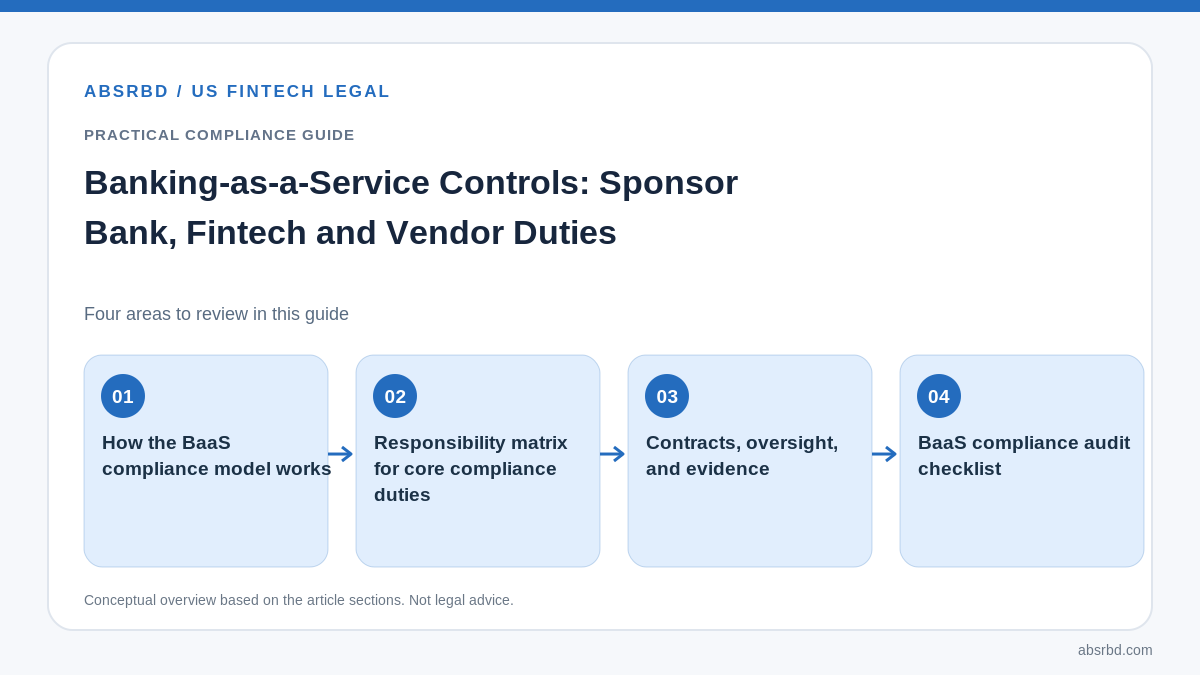
How the BaaS compliance model works
A typical BaaS program has three principal participants.
Sponsor bank
The sponsor bank provides regulated banking capabilities, which may include deposit accounts, payment access, card issuance, or lending. It establishes the risk appetite and compliance requirements for products offered through its charter.
The bank’s core duties generally include:
- Approving products, customer types, markets, and material program changes
- Establishing applicable compliance policies and control standards
- Maintaining an effective Bank Secrecy Act and AML program
- Overseeing consumer compliance for bank products
- Monitoring fintech and vendor performance
- Reviewing material complaints, exceptions, and control failures
- Escalating and reporting matters when required
- Maintaining records sufficient to demonstrate effective oversight
Outsourcing an activity does not convert it into an activity outside the bank’s risk-management responsibilities.
Fintech program manager
The fintech commonly controls the customer-facing application, onboarding workflow, product presentation, customer communications, and first-line customer support. It may also conduct compliance operations under bank-approved procedures.
Typical fintech duties include:
- Implementing bank-approved onboarding and verification workflows
- Collecting accurate customer information and required consents
- Operating transaction-monitoring or case-management processes
- Submitting escalations to the sponsor bank
- Following approved marketing and disclosure standards
- Receiving, categorizing, and resolving customer complaints
- Managing its subcontractors
- Producing complete and timely compliance evidence
A fintech should not treat the sponsor bank as its outsourced compliance department. It needs personnel, controls, training, and governance appropriate to the activities it performs.
Technology or service vendor
Vendors may provide identity verification, sanctions screening, transaction monitoring, card processing, customer support, cloud infrastructure, complaint management, or other operational services.
Their responsibilities normally arise from contracts and service requirements, including:
- Performing assigned services according to approved rules
- Maintaining specified security, availability, and control standards
- Keeping complete and accurate records
- Reporting incidents, control failures, and exceptions promptly
- Supporting audits, testing, and regulatory requests
- Controlling subcontractors and changes to material services
A vendor may perform a control, but the fintech and sponsor bank still need to determine whether that control is properly designed and operating effectively.
Responsibility matrix for core compliance duties
The following matrix is a starting point rather than a universal legal allocation.
RACI definitions
| Code | Role | Meaning |
|---|---|---|
| R | Responsible | Performs or coordinates the work |
| A | Accountable | Owns the decision and confirms that the requirement is met |
| C | Consulted | Provides input before the decision or activity |
| I | Informed | Receives results, incidents, or status updates |
For activities involving a bank product, the sponsor bank will often be the accountable party even when the fintech or a vendor performs most of the operational work. This does not protect another party from liability for its own misconduct or independently applicable obligations.
BaaS compliance RACI matrix
| Compliance activity | Sponsor bank | Fintech | Vendor | Required evidence |
|---|---|---|---|---|
| Set product risk appetite and customer eligibility | A/R | C | I | Approval record, risk assessment, eligibility rules |
| Approve CIP procedures | A/R | C | C | Current policy, procedures, approval history |
| Collect customer identification information | A | R | R/C | Application data, timestamps, consent records |
| Verify customer identity | A | R | R | Verification results, exception records, audit trail |
| Resolve onboarding exceptions | A | R | C | Case notes, supporting documents, approval record |
| Maintain CIP records | A | R | R/C | Retention schedule, accessible customer records |
| Establish AML monitoring standards | A/R | C | C | Risk assessment, scenarios, thresholds, governance minutes |
| Generate transaction-monitoring alerts | A | R | R | Alert logs, model or rule versions, processing records |
| Investigate alerts and escalate suspicious activity | A | R | C/R | Case files, escalation records, quality reviews |
| Make bank SAR decisions and file bank SARs | A/R | C | I | Decision documentation and restricted filing records |
| Conduct sanctions screening for program activity | A | R | R | Screening results, list updates, disposition records |
| Approve product marketing and disclosures | A | R | C | Approved copy, disclosure versions, approval log |
| Publish approved marketing content | A | R | R/C | Final content, channel records, publication dates |
| Receive and categorize complaints | A | R | R/C | Complaint log, category, product and issue data |
| Investigate and resolve routine complaints | A | R | C/R | Investigation notes, response and remediation record |
| Escalate material or systemic complaints | A | R | I/C | Escalation ticket, root-cause analysis, action plan |
| Monitor complaint trends | A | R | C | Trend reports, thresholds, management review |
| Conduct fintech oversight | A/R | C | I | Due diligence, monitoring reports, issue tracking |
| Conduct vendor due diligence | A | R | C | Risk assessment, control reports, financial and security review |
| Approve material subcontractors | A | R | C | Approval, due diligence, contract inventory |
| Monitor service levels and control performance | A | R | R | Metrics, service-level reports, test results |
| Report incidents and material control failures | A | R | R | Incident notice, impact analysis, remediation plan |
| Validate corrective actions | A | R | C | Test results, closure approval, residual-risk decision |
The matrix should be adjusted for the actual product. For example, lending, deposit, card, and payment programs do not have identical disclosure, servicing, monitoring, or complaint requirements.
CIP and customer onboarding duties
A bank’s Customer Identification Program must be incorporated into its broader BSA/AML compliance framework. In a BaaS model, the fintech or an identity vendor may operate the onboarding interface, but the sponsor bank should define and approve the control requirements.
Sponsor bank responsibilities
The sponsor bank should define:
- Required identifying information
- Acceptable documentary and non-documentary verification methods
- Conditions for opening, restricting, or closing an account
- Exception and manual-review criteria
- Recordkeeping and retention requirements
- Customer notice requirements
- Testing, reporting, and escalation standards
The bank should also understand how the onboarding system works in practice. Reviewing a policy without testing the customer journey, system rules, and exception handling is not sufficient operational oversight.
Fintech responsibilities
The fintech should ensure that its application:
- Collects required information before or within the permitted account-opening workflow
- Presents bank-approved notices and disclosures
- Transmits data accurately to verification systems
- Prevents unauthorized overrides
- Routes exceptions to trained personnel
- Retains evidence of verification and decision-making
- Applies account restrictions required by the approved procedure
Product-growth goals should not override bank-approved identification or verification requirements.
Vendor responsibilities
An identity vendor should provide enough information for the bank and fintech to evaluate outcomes, not merely a pass-or-fail response. Relevant evidence may include:
- Data sources used
- Verification result codes
- Confidence or risk indicators
- Reasons for failed or inconclusive verification
- Fraud indicators
- Rule and model versions
- Service outages and processing errors
- Changes to data sources or matching logic
The contract should require advance notice of material changes that could affect onboarding decisions.
AML monitoring and suspicious-activity escalation
The sponsor bank owns the BSA/AML program applicable to activity conducted through the bank. Fintechs and vendors may support monitoring and investigations, but the bank needs effective control over program standards, escalation, decision-making, and evidence.
Divide monitoring duties by decision point
A workable allocation separates the process into distinct stages:
- Risk assessment: The sponsor bank approves the program’s inherent and residual risk analysis.
- Monitoring design: The bank establishes or approves scenarios, thresholds, segmentation, and escalation criteria.
- Alert generation: The fintech or vendor runs the approved monitoring logic.
- Initial review: Trained fintech staff may investigate alerts under bank-approved procedures.
- Escalation: Potentially suspicious activity is sent to designated bank personnel within contractual deadlines.
- Decision and filing: The bank makes and documents decisions concerning suspicious activity reports filed by the bank.
- Quality assurance: The parties test alert handling, escalation quality, timeliness, and record completeness.
- Tuning and change control: Material changes require documented analysis, testing, and approval.
Access to information is critical. The bank should be able to obtain transaction data, customer records, device or access information where relevant, case notes, and supporting documents without avoidable delay.
Because suspicious-activity information is subject to strict confidentiality requirements, contracts and workflows should limit access according to applicable law and bank policy.
Marketing and consumer communications
Marketing risk extends beyond formal advertisements. It includes websites, app screens, social media, emails, help-center articles, comparison pages, scripts, and statements made by customer-support personnel.
The sponsor bank should approve material representations concerning its products, particularly statements about:
- The identity and role of the bank
- Product eligibility and availability
- Fees, rates, rewards, and limitations
- Account or credit terms
- Deposit-insurance representations, when applicable
- Transaction timing and access to funds
- Error-resolution or dispute rights
- Cancellation, closure, and refund practices
The fintech should maintain a controlled content process rather than relying on informal review.
Recommended marketing approval workflow
- The fintech drafts content using current product terms.
- Legal and compliance reviewers identify applicable requirements.
- The sponsor bank reviews and approves bank-product representations.
- The approved version receives a unique identifier and effective date.
- Publishing controls prevent unauthorized changes.
- The fintech monitors live content across all channels.
- Material changes go through renewed approval.
- Outdated content is removed and archived.
Vendor-created content should follow the same approval process. A marketing agency’s involvement does not reduce the need for accurate, non-misleading communications.
Consumer complaint responsibilities
Complaints are both customer-service matters and compliance signals. A BaaS program should capture complaints across every channel, including the fintech, sponsor bank, app store, social media, call center, processor, and other service providers.
Minimum complaint-data fields
A consolidated complaint record should include:
- Date received
- Intake channel
- Customer and account identifier
- Product involved
- Issue and sub-issue category
- Allegation summary
- Assigned owner
- Applicable response deadline
- Investigation steps
- Resolution and customer response
- Financial remediation, if any
- Root cause
- Related control or vendor
- Escalation status
- Closure and quality-review dates
Escalation criteria
The contract and operating procedures should define when the fintech or vendor must notify the bank. Examples of escalation categories include:
- Allegations of discrimination or unfair treatment
- Unauthorized or disputed transactions
- Misleading advertising or disclosures
- Incorrect fees, rates, or product terms
- Privacy or information-security incidents
- Repeated failures affecting multiple customers
- Complaints involving regulators, attorneys, or litigation
- Issues indicating a potentially systemic control breakdown
The bank should receive more than aggregate complaint counts. Effective oversight requires issue categories, aging, resolution quality, repeat complaints, root causes, and remediation status.
Vendor and subcontractor oversight
BaaS programs often depend on multiple layers of service providers. The fintech may contract with an identity platform, processor, customer-support provider, monitoring system, cloud provider, or other subcontractor. This can make accountability unclear unless the contractual chain is mapped.
For each vendor, document:
- The service performed
- Data accessed or processed
- Compliance controls supported
- Contract owner
- Operational owner
- Risk classification
- Approved subcontractors
- Service-level requirements
- Incident-notification deadlines
- Audit and access rights
- Business-continuity obligations
- Data return and deletion requirements
- Exit and transition arrangements
The sponsor bank should have visibility into vendors that materially support its products, even when the fintech is the direct contracting party. The fintech should not add or materially change a critical subcontractor without following the agreed approval and notification process.
Contracts, oversight, and evidence
A strong RACI chart is useful only if the contract, procedures, systems, and actual behavior match it.
Contract provisions that operationalize compliance duties
A BaaS agreement should address the following subjects with specific, testable language.
Scope and ownership
- Define each product and service.
- Identify the legal provider and customer-facing program manager.
- Assign policy, execution, approval, testing, and escalation duties.
- State which party owns each customer relationship, record, and decision.
- Address conflicts between bank policy and fintech procedures.
Information and access
- Identify required reports and their delivery frequency.
- Give the bank timely access to relevant records and systems.
- Establish data-quality and reconciliation standards.
- Define record formats, retention periods, and retrieval deadlines.
- Require support for examinations, audits, investigations, and legal requests.
Change management
- Identify changes requiring prior approval.
- Establish testing and implementation requirements.
- Require notice of vendor, model, data-source, and system changes.
- Define emergency-change procedures and post-implementation review.
Incidents and compliance failures
- Define reportable events and severity levels.
- Set notification and update deadlines.
- Require impact analysis, containment, remediation, and root-cause review.
- Establish customer-remediation and regulatory-escalation responsibilities.
- Preserve relevant evidence.
Audit and remediation
- Provide risk-based audit and testing rights.
- Require access to relevant independent assessments.
- Define issue severity and remediation deadlines.
- Permit validation before an issue is closed.
- Establish remedies for persistent or material failures.
Evidence the parties should retain
A bank-fintech compliance program should be able to demonstrate both control design and operating effectiveness.
| Evidence category | Examples |
|---|---|
| Governance | Committee minutes, approvals, risk acceptances, escalation records |
| Policies and procedures | Current versions, owners, effective dates, revision history |
| Training | Assigned courses, completion records, role-based materials |
| Customer onboarding | Input data, verification results, notices, overrides, case decisions |
| AML operations | Alert records, investigations, escalations, quality reviews |
| Marketing | Approved copy, disclosures, version history, channel inventory |
| Complaints | Intake records, investigation files, responses, trend reports |
| Vendor oversight | Due diligence, contracts, control reports, performance reviews |
| Testing | Test plans, samples, findings, corrective actions, validation results |
| Change control | Requests, approvals, testing evidence, release records |
| Incidents | Notices, timelines, impact assessments, remediation documentation |
Reports alone are not always enough. Oversight should include sampling underlying cases, reconciling data, testing system behavior, and confirming that corrective actions work.
BaaS compliance audit checklist
Use this checklist to review whether the contract and operating model assign responsibilities clearly and produce evidence that can withstand internal audit or regulatory scrutiny.
Governance and responsibility allocation
- [ ] Every material compliance activity has an accountable owner.
- [ ] Policy ownership is separated from routine execution where appropriate.
- [ ] The RACI matrix matches the contract and current procedures.
- [ ] Named committees or executives receive defined compliance reporting.
- [ ] Escalation paths include backups and after-hours contacts.
- [ ] The parties have documented how conflicts and unresolved issues are decided.
- [ ] Material program changes require documented approval.
CIP and onboarding
- [ ] The bank has approved the customer identification procedures.
- [ ] Required data, notices, verification methods, and exception rules are documented.
- [ ] Manual overrides are restricted, logged, and reviewed.
- [ ] Failed or inconclusive verification receives consistent treatment.
- [ ] Records can be retrieved within the contractually required period.
- [ ] Vendor logic and material data-source changes are subject to change control.
- [ ] Testing covers the live customer journey, not only written procedures.
AML and sanctions controls
- [ ] The product and customer risk assessment is current.
- [ ] Monitoring scenarios and thresholds have documented approval.
- [ ] Alert ownership and investigation deadlines are clear.
- [ ] Escalation packages contain the information the bank needs.
- [ ] The bank retains control over its suspicious-activity decisions and filings.
- [ ] Confidential information has role-based access restrictions.
- [ ] Backlogs, aging, false-positive rates, and quality findings are monitored.
- [ ] Material monitoring changes are tested before deployment.
- [ ] Sanctions-screening results and dispositions are retained.
Marketing and disclosures
- [ ] All customer-facing channels are included in the content inventory.
- [ ] Bank-product claims require bank approval.
- [ ] Approved content has version control and an effective date.
- [ ] Product terms in advertisements match operative disclosures and systems.
- [ ] Unauthorized content changes can be detected.
- [ ] Outdated pages, scripts, and app screens are removed promptly.
- [ ] Vendors cannot publish unapproved product claims.
Complaints and customer remediation
- [ ] Complaints from all parties and channels feed into a consolidated process.
- [ ] Categories and escalation thresholds are defined consistently.
- [ ] Response and escalation deadlines are tracked.
- [ ] Material complaints reach sponsor-bank personnel promptly.
- [ ] Trend reporting identifies repeat and systemic issues.
- [ ] Root causes connect to corrective-action plans.
- [ ] Customer remediation is documented and reconciled.
- [ ] Closed complaints receive risk-based quality review.
Vendor management
- [ ] All material vendors and subcontractors are inventoried.
- [ ] Each vendor has a risk classification and business owner.
- [ ] Due diligence covers the actual service and data involved.
- [ ] Contracts include audit, access, incident, and record-retention rights.
- [ ] Service-level metrics include compliance performance where relevant.
- [ ] Material subcontractors require approval or advance notice.
- [ ] Control reports and certifications are reviewed rather than merely collected.
- [ ] Termination plans address data, records, customer service, and operational continuity.
Testing, reporting, and issue management
- [ ] Management reports use reconciled and defined data.
- [ ] The bank can access underlying cases and source records.
- [ ] Independent testing covers both design and operating effectiveness.
- [ ] Findings have owners, severity ratings, and due dates.
- [ ] Overdue issues receive formal escalation.
- [ ] Corrective actions are validated before closure.
- [ ] Repeat findings are analyzed for broader governance failures.
- [ ] Records are available for audits, examinations, and investigations.
Practical standard for a defensible BaaS program
A defensible BaaS compliance model does not merely state that the fintech “handles compliance” or that the bank “provides oversight.” It allocates each decision and task at control level.
The sponsor bank should set requirements, retain appropriate decision authority, and verify performance. The fintech should operate the program according to those requirements and maintain its own effective controls. Vendors should perform clearly defined services, preserve evidence, and report failures promptly.
Most importantly, the parties should test whether the documented model reflects reality. If the contract, RACI matrix, system permissions, staff practices, and management reports point to different owners, the program has an accountability gap.
For broader industry context, review these Banking-as-a-Service statistics. Programs involving international transaction flows may also use cross-border payment statistics when assessing operational scale and monitoring needs.
Official U.S. regulatory reference
The Federal Deposit Insurance Corporation publishes supervisory materials, enforcement information, financial-institution guidance, and other resources relevant to bank oversight and third-party risk management. Because regulatory expectations and official guidance can change, BaaS contracts and control frameworks should be reviewed regularly against current requirements.