PCI DSS compliance applies to payment startups that store, process, or transmit payment card account data—or operate systems that could affect the security of the cardholder data environment. The required validation path depends on the company’s role, payment architecture, transaction volume, contracts, and card-brand or acquiring-bank requirements.
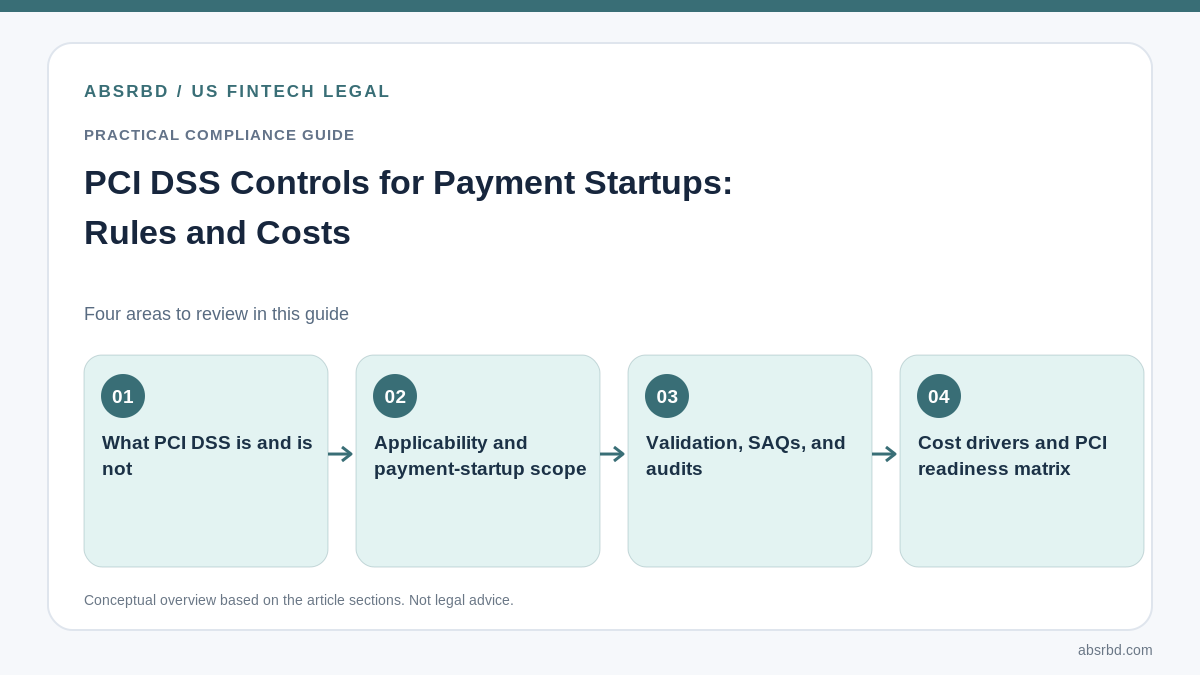
PCI DSS is an industry security standard, not a U.S. federal law. However, compliance is commonly required through agreements with acquiring banks, payment brands, processors, platforms, and other payment partners.
For most startups, the practical priorities are to:
- Map every payment and account-data flow.
- Minimize the systems that handle card data.
- Confirm whether the company is a merchant, service provider, or both.
- Identify the correct Self-Assessment Questionnaire or audit path.
- Collect evidence continuously rather than immediately before validation.
- Verify each vendor’s PCI DSS status and exact scope of responsibility.
PCI DSS readiness checklist
Use this checklist before selecting an assessment or estimating costs:
- [ ] Identify all channels that accept card payments.
- [ ] Diagram where the primary account number, or PAN, enters, moves, and leaves the environment.
- [ ] Locate every system that stores account data, including logs, backups, support tools, and analytics platforms.
- [ ] Confirm that sensitive authentication data is not retained after authorization.
- [ ] Classify the startup as a merchant, service provider, or both.
- [ ] List third-party processors, gateways, hosted payment providers, tokenization vendors, and cloud providers.
- [ ] Obtain current PCI DSS compliance documentation from relevant vendors.
- [ ] Define the cardholder data environment and all connected or security-impacting systems.
- [ ] Evaluate segmentation and test whether it effectively limits scope.
- [ ] Ask the acquiring bank or payment brand which validation method applies.
- [ ] Determine whether an SAQ, external scan, penetration test, or formal assessment is required.
- [ ] Assign owners for technical controls, policies, evidence, and annual validation.
- [ ] Budget for remediation as well as assessment fees.
What PCI DSS is—and what it is not
The Payment Card Industry Data Security Standard is maintained by the PCI Security Standards Council. It establishes baseline technical and organizational controls for protecting payment account data.
At the time of publication, PCI DSS v4.0.1 is the current version. Requirements that PCI DSS v4.0 initially classified as future-dated became effective on March 31, 2025. Organizations should use the latest standard, reporting templates, and guidance in the PCI Security Standards Council’s official document library.
PCI DSS is an industry standard
PCI DSS is not a federal statute or a government-issued license. Its obligations usually reach a startup through the contractual payment ecosystem:
- Payment-brand operating rules
- Acquiring-bank agreements
- Processor or payment-facilitator contracts
- Merchant agreements
- Platform and service-provider agreements
Contractual consequences of noncompliance can include additional oversight, mandatory remediation, increased operating restrictions, contractual assessments or fees, and loss of card-acceptance capabilities.
This guide addresses the PCI DSS standard only. It does not determine whether a startup needs a financial-services license or satisfies other legal and regulatory obligations.
Compliance is not the same as validation
These terms are related but distinct:
- Compliance means meeting the applicable PCI DSS requirements on an ongoing basis.
- Validation means providing specified evidence—such as a Self-Assessment Questionnaire, Attestation of Compliance, or Report on Compliance—to the party requesting it.
- Assessment is the process used to evaluate whether controls are designed and operating as required.
Completing a questionnaire does not make PCI compliance a once-a-year activity. Controls such as access reviews, logging, vulnerability management, patching, testing, and vendor oversight must operate according to their required frequencies.
PCI SSC generally does not “certify” individual merchants. Be cautious when vendors use broad phrases such as “PCI certified” without identifying the assessed entity, applicable PCI standard, assessment date, and scope.
Who must comply with PCI DSS?
PCI DSS applies to entities involved in payment card account-data processing, including merchants, processors, acquirers, issuers, and service providers. It can also apply to entities that do not directly receive card data but can affect the security of the cardholder data environment.
Merchant, service provider, or both?
A payment startup’s role affects its scope and validation obligations.
| Role | Typical activity | Primary scope question |
|---|---|---|
| Merchant | Accepts payment cards for its own goods or services | Which systems support the startup’s own card acceptance? |
| Service provider | Stores, processes, transmits, or can affect account data on behalf of another entity | Which services and system components affect customers’ PCI DSS compliance? |
| Platform or marketplace | Provides payment functionality to sellers or sub-merchants | Does the platform act as a merchant, service provider, payment facilitator, or a combination? |
| Processor or infrastructure provider | Supports authorization, routing, settlement, tokenization, fraud controls, hosting, or security | Which account-data functions and security responsibilities are included in the service? |
A startup may have more than one role. For example, it may be a merchant for its own subscription fees and a service provider for customers using its payment infrastructure.
The acquiring bank, payment partner, and relevant payment brands determine reporting expectations. Do not assume that a merchant validation method covers service-provider operations.
Account data covered by PCI DSS
PCI DSS distinguishes between cardholder data and sensitive authentication data.
Cardholder data may include:
- Primary account number
- Cardholder name
- Expiration date
- Service code
Sensitive authentication data may include:
- Full track data or equivalent chip data
- Card verification codes or values
- PINs and PIN blocks
The PAN is the defining element of cardholder data. Sensitive authentication data generally must not be stored after authorization, even when encrypted.
Systems that can enter scope
PCI DSS scope is broader than the database where card numbers are stored. It can include:
- Checkout pages and mobile applications
- Payment APIs and backend services
- Databases, logs, queues, and backups
- Administrative workstations and jump hosts
- Identity and access-management systems
- Security tools protecting the cardholder data environment
- Network devices and cloud configurations
- Software deployment pipelines
- Customer-support systems
- Third-party scripts that can affect payment-page security
- Connected systems without effective segmentation
A system may be in scope even if it does not store a PAN. The key question is whether it stores, processes, or transmits account data, connects to the cardholder data environment, or can affect its security.
How to determine a payment startup’s PCI scope
Scope decisions should be based on documented data flows and system dependencies, not assumptions about a payment provider’s marketing claims.
1. Map every payment flow
Document each way a card payment can enter the business, including:
- Web checkout
- Mobile application
- Recurring billing
- Telephone or mail orders
- In-person terminals
- Customer-support payment collection
- Payment links
- Partner or embedded-payment integrations
- Refund and dispute workflows
For each channel, identify where account data is entered, transmitted, processed, displayed, logged, and stored.
2. Inventory all account-data storage
Search beyond the primary payment database. Card data can appear in:
- Application and web-server logs
- Error reports
- Customer-service tickets
- Call recordings
- Email and chat transcripts
- Data warehouses
- Analytics tools
- Screenshots
- Backups and snapshots
- Developer test environments
If storage is unnecessary, eliminate it. Reducing retained card data lowers risk and can reduce assessment complexity.
3. Identify security-impacting systems
List systems that provide authentication, administration, logging, monitoring, deployment, networking, or security for the payment environment. Compromise of these systems may allow an attacker to affect account-data security.
4. Classify third parties
For every payment vendor, record:
- Services provided
- Data handled
- Systems connected
- Merchant or service-provider role
- PCI DSS validation status
- Services included in the assessed scope
- Contractual security responsibilities
- Expiration or renewal date of compliance documentation
A vendor’s compliance does not automatically make the startup compliant.
5. Define and test segmentation
Network segmentation can isolate the cardholder data environment from other systems and reduce scope. It must be technically effective and tested; a diagram or firewall rule alone is not sufficient evidence.
6. Confirm scope with the requesting party
Before finalizing a validation plan, ask the acquiring bank, processor, payment facilitator, or payment brand to confirm:
- The startup’s reporting classification
- The applicable merchant or service-provider level
- The required validation documents
- Submission deadlines
- Scanning or assessment requirements
- Whether a Qualified Security Assessor must be involved
Transaction levels and reporting rules can vary by payment brand and agreement.
The 12 PCI DSS requirement groups
PCI DSS organizes its controls into 12 principal requirement groups.
| Requirement | Control objective |
|---|---|
| 1 | Install and maintain network security controls |
| 2 | Apply secure configurations to all system components |
| 3 | Protect stored account data |
| 4 | Protect cardholder data with strong cryptography during transmission over open, public networks |
| 5 | Protect all systems and networks from malicious software |
| 6 | Develop and maintain secure systems and software |
| 7 | Restrict access to system components and cardholder data by business need to know |
| 8 | Identify users and authenticate access to system components |
| 9 | Restrict physical access to cardholder data |
| 10 | Log and monitor all access to system components and cardholder data |
| 11 | Test the security of systems and networks regularly |
| 12 | Support information security with organizational policies and programs |
The applicability of individual controls depends on the environment and validated scope. A hosted checkout may significantly reduce direct card-data handling, but the merchant can still retain responsibilities for its website, access controls, scripts, vendor management, policies, and incident-response preparation.
Validation methods: SAQs, scans, and audits
The appropriate validation path is determined by the startup’s role, payment architecture, eligibility criteria, transaction volume, and reporting instructions from payment partners.
Self-Assessment Questionnaires
SAQs are structured reporting tools for organizations eligible to self-assess. Each SAQ covers a specific payment environment.
| SAQ type | General environment |
|---|---|
| SAQ A | Card-not-present merchants that fully outsource account-data functions and meet all eligibility criteria |
| SAQ A-EP | E-commerce merchants that outsource payment processing but operate a website that can affect payment security |
| SAQ B | Merchants using qualifying imprint machines or standalone dial-out terminals, without electronic account-data storage |
| SAQ B-IP | Merchants using qualifying standalone IP-connected payment terminals, without electronic account-data storage |
| SAQ C-VT | Merchants manually entering transactions into an isolated, browser-based virtual terminal |
| SAQ C | Merchants using payment applications connected to the internet, without electronic account-data storage |
| SAQ P2PE | Merchants using an eligible PCI-listed point-to-point encryption solution |
| SAQ D for Merchants | Merchants that do not qualify for another SAQ or are instructed to use SAQ D |
| SAQ D for Service Providers | Eligible service providers using the self-assessment route |
These descriptions are only starting points. Every SAQ has detailed eligibility criteria, and architecture details can change the correct selection.
Attestation of Compliance
An Attestation of Compliance, or AOC, accompanies the relevant SAQ or formal assessment report. It formally records the assessment result and identifies the environment covered.
An AOC should be reviewed for:
- Assessed legal entity
- Merchant or service-provider designation
- Assessment date
- PCI DSS version
- Covered services and locations
- Exclusions and exceptions
- Assessor information, when applicable
Report on Compliance
A Report on Compliance, or ROC, is a detailed assessment report. It is generally used when required by a payment brand, acquiring bank, customer, or contractual reporting program.
A formal assessment may involve a PCI SSC-listed Qualified Security Assessor. Startups should confirm assessor requirements with the organization requesting validation before signing an engagement.
External vulnerability scans
Approved Scanning Vendors perform external vulnerability scans where required. These scans are commonly conducted quarterly and after certain significant changes, subject to the applicable PCI DSS requirements and validation instructions.
An ASV scan is not a substitute for:
- Internal vulnerability scanning
- Penetration testing
- Secure software development
- Patch management
- Continuous monitoring
- A complete PCI DSS assessment
Penetration testing and segmentation testing
Penetration testing evaluates whether exploitable weaknesses can compromise the environment. If segmentation is used to reduce scope, testing must also verify that out-of-scope networks cannot reach the cardholder data environment in unauthorized ways.
Testing frequency and assessor independence must follow the applicable PCI DSS requirements and the organization’s validation obligations.
PCI DSS cost drivers for payment startups
There is no universal PCI compliance price. Costs depend primarily on architecture, scope, validation path, existing control maturity, and remediation needs.
Main cost categories
| Cost driver | Why it affects the budget |
|---|---|
| Number of in-scope systems | More assets require more configuration, evidence, scanning, monitoring, and testing |
| Direct card-data handling | Storage, processing, or transmission creates additional controls and technical complexity |
| Merchant versus service-provider scope | Service providers often face broader reporting and customer-assurance demands |
| Validation method | A limited SAQ generally requires fewer assessment resources than a formal ROC |
| Cloud and network complexity | Multiple accounts, regions, environments, and connectivity paths increase review effort |
| Software development | Custom payment code requires secure development, change control, testing, and vulnerability management |
| Segmentation | Effective segmentation can reduce scope but requires implementation, documentation, and testing |
| Logging and monitoring | Centralized logs, alerting, retention, and review processes can require new tools and staff |
| Identity and access management | Unique identities, multifactor authentication, privileged-access controls, and access reviews may require upgrades |
| Vulnerability management | Scans, penetration tests, patching, retesting, and remediation create recurring costs |
| Third-party oversight | Vendor reviews, contract changes, evidence collection, and annual monitoring require operational capacity |
| Evidence maturity | Weak documentation can increase assessor time even when technical controls exist |
| Remediation backlog | Unsupported software, flat networks, excessive privileges, and stored card data can dominate the first-year budget |
Initial versus recurring costs
Initial readiness costs may include:
- Data-flow mapping
- Scope assessment
- Gap analysis
- Architecture changes
- Removal of unnecessary card-data storage
- Network segmentation
- Security tooling
- Policy development
- Remediation work
- Initial assessment and testing
Recurring costs may include:
- Annual validation
- Vulnerability scanning
- Penetration and segmentation testing
- Access reviews
- Security awareness training
- Log review and monitoring
- Vendor oversight
- Policy updates
- Evidence collection
- Remediation and retesting
A low assessment quote does not necessarily mean a low total compliance cost. For early-stage companies, engineering time and remediation frequently matter more than the price of the questionnaire or audit itself.
PCI readiness matrix
This matrix provides a planning baseline. It does not replace the eligibility criteria in the official PCI DSS reporting documents.
| Payment model | Likely exposure | Validation starting point | Main readiness priorities |
|---|---|---|---|
| Fully hosted checkout or redirect | Startup systems may not directly receive card data, but the website and vendor relationship can remain relevant | Evaluate SAQ A eligibility | Confirm integration design, secure the merchant website, review vendor AOC, document responsibilities |
| Embedded hosted fields or iframe | Card data may go directly to the provider, while the startup page can still affect transaction security | Evaluate SAQ A or A-EP criteria with the acquirer | Control scripts, access, deployment, website security, and vendor evidence |
| Direct payment API | Startup servers may receive or transmit account data | Usually a broader SAQ or formal assessment | Encrypt transmission, prevent logging, secure APIs, segment systems, monitor access |
| Stored-card or recurring billing using provider tokens | Tokenization may reduce exposure, but implementation and token systems still require review | Determine whether systems can access PAN or detokenize | Verify token properties, permissions, data flows, logs, and provider responsibilities |
| In-person terminal deployment | Scope depends on terminal type, connectivity, and storage | Evaluate terminal-specific SAQ eligibility | Maintain terminal inventory, inspect devices, secure networks, prevent electronic storage |
| Validated P2PE solution | Eligible encryption can substantially reduce merchant scope | Evaluate SAQ P2PE eligibility | Use the listed solution as designed, follow its instruction manual, manage devices |
| Payment platform or processor | Service-provider systems can affect multiple customers | Assess service-provider reporting requirements | Formal scope definition, customer responsibility matrix, strong evidence, independent assessment planning |
| Hybrid merchant and service provider | Separate business functions may have different reporting paths | Confirm each role with payment partners | Separate scopes where feasible, maintain role-specific evidence and attestations |
How to reduce PCI scope without creating blind spots
Scope reduction should remove account data and security dependencies—not merely relabel them.
Prefer architectures that avoid direct card-data handling
Where appropriate, consider:
- Provider-hosted checkout pages
- Redirected payment flows
- Hosted payment fields
- Validated point-to-point encryption
- Provider-issued tokens
- Strict separation between payment and nonpayment systems
These approaches can reduce scope only when implemented according to their eligibility conditions.
Never log raw card data unnecessarily
Review:
- Request and response logging
- Application performance monitoring
- Error tracking
- Session replay
- Customer-support tools
- Data exports
- Debug modes
Masking data in the user interface does not prove that the underlying systems are not storing it.
Restrict detokenization
A token is valuable for scope reduction only when systems cannot readily exchange it for a PAN. Limit detokenization permissions, monitor access, and document which vendor or internal service controls the process.
Separate production and development
Developers should not use live card data in test environments. Keep test systems separate and use synthetic or appropriately provided test data.
Treat segmentation as a security control
Document allowed connections, deny unnecessary traffic, monitor changes, and test segmentation. A flat cloud network with descriptive tags is not equivalent to enforced segmentation.
Questions to ask payment and security vendors
Vendor due diligence should establish what the vendor has validated and what the startup must still do.
PCI DSS status
- What legal entity appears on the vendor’s current Attestation of Compliance?
- Is the vendor assessed as a service provider?
- Which PCI DSS version was used?
- When was the assessment completed?
- Which products, locations, platforms, and services are included?
- Are any services excluded from the assessed scope?
- Is the vendor listed by a payment brand or relevant PCI SSC program where applicable?
Data handling
- Does the vendor store, process, or transmit PAN?
- Can the startup’s systems receive card data before tokenization?
- Can startup personnel view or retrieve full PANs?
- Who can detokenize payment tokens?
- Could account data appear in logs, dashboards, support tools, or exports?
- How is data deleted when it is no longer required?
- How does the integration prevent storage of sensitive authentication data?
Responsibility allocation
- Which PCI DSS controls are fully handled by the vendor?
- Which controls remain the startup’s responsibility?
- Are any controls shared?
- Does the vendor provide a responsibility matrix?
- What evidence will the vendor provide during an assessment?
- How will the vendor notify customers when its compliance status or service scope changes?
- Does the contract support required security reviews and evidence requests?
Integration security
- Does the integration use redirects, hosted fields, an iframe, a direct API, or another method?
- Can scripts on the startup’s page alter the payment flow?
- What domains, API endpoints, and network connections are required?
- How are administrative users authenticated?
- What logs and security alerts are available?
- How are vulnerabilities and security updates communicated?
- What configuration guidance must the startup follow to preserve the vendor’s validated model?
A practical PCI DSS implementation process
1. Assign accountable owners
Designate responsibility for:
- Executive oversight
- PCI scope
- Engineering controls
- Infrastructure and cloud security
- Policies and training
- Vendor management
- Evidence collection
- Validation submissions
2. Confirm the reporting obligation
Contact the acquiring bank or relevant payment partner. Obtain written confirmation of the required SAQ, assessment, scanning, and submission process.
3. Document the card-data environment
Create current data-flow and network diagrams. Include third parties, administrative access, security services, and connected systems.
4. Compare the environment with applicable requirements
Use the current PCI DSS standard and the correct reporting template. Record each requirement as:
- In place
- Partially in place
- Not in place
- Not applicable, with justification
- Vendor-managed, with supporting evidence
5. Prioritize scope reduction and high-risk gaps
Remove unnecessary account-data storage first. Then address weaknesses such as unsupported systems, shared accounts, weak authentication, exposed services, missing logs, and untested segmentation.
6. Implement repeatable evidence collection
For each control, define:
- Control owner
- Required evidence
- Collection frequency
- Storage location
- Reviewer
- Escalation process
Evidence should show that a control operated throughout the assessment period, not merely on the day it was reviewed.
7. Conduct testing and remediate findings
Complete applicable scans, penetration tests, segmentation tests, access reviews, and configuration reviews early enough to allow remediation and retesting.
8. Complete and submit validation documents
Use the current SAQ, AOC, ROC, or other requested materials. Check that entity names, service descriptions, dates, locations, and scope statements are consistent.
9. Maintain compliance after submission
Track significant changes such as:
- New payment channels
- Processor migrations
- Cloud-account changes
- Acquisitions
- New customer-facing scripts
- Network redesigns
- Tokenization changes
- New storage or analytics platforms
- Changes in vendor compliance status
Each change should trigger a PCI scope and control-impact review.
Final planning guidance
Payment startups should treat PCI DSS as an architecture and operating-model requirement, not a form completed at launch. The most effective cost-control strategy is usually to minimize direct card-data handling, isolate necessary payment systems, and assign responsibilities clearly between the startup and its vendors.
Before budgeting, establish four facts:
- Whether the startup is a merchant, service provider, or both.
- Exactly where account data enters, travels, and persists.
- Which validation path the acquiring bank or payment partner requires.
- Which controls remain the startup’s responsibility after outsourcing.
Companies designing modern card experiences should also consider how security architecture affects products such as numberless card programs. For broader market context, see the latest overview of digital banking statistics.
Because PCI DSS documentation and reporting expectations change, confirm decisions against the current PCI Security Standards Council materials and the instructions of the organization receiving the compliance submission.