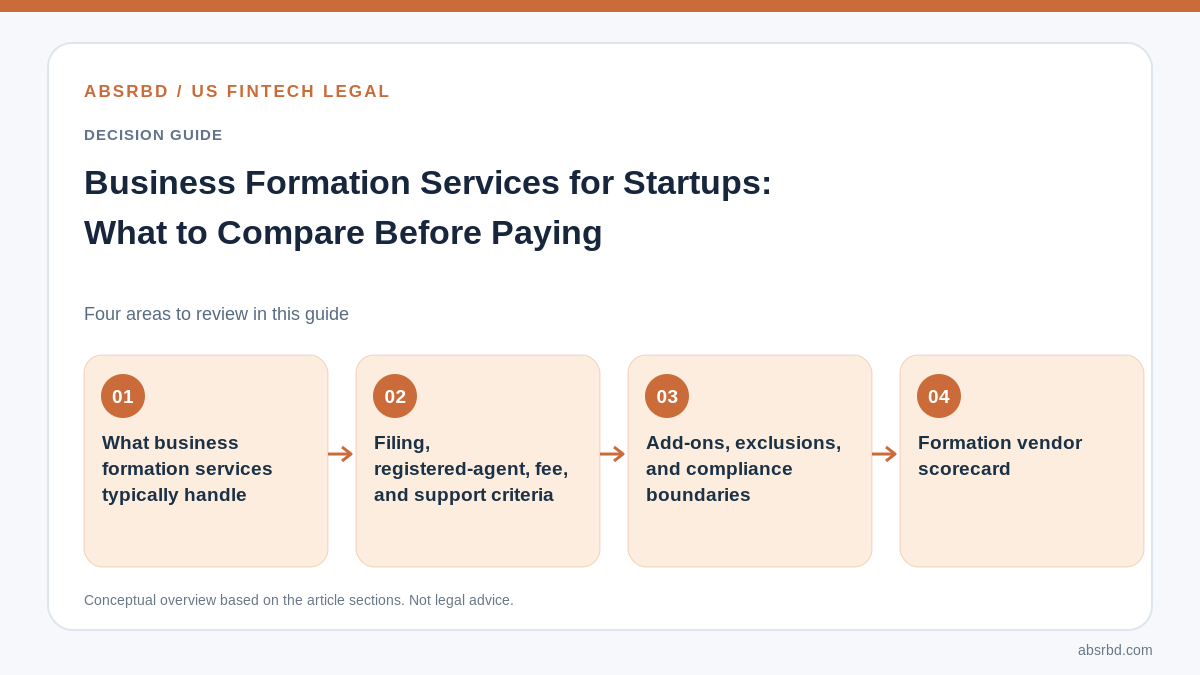
Business formation services can prepare and submit formation documents, monitor filing status, and offer related services such as registered-agent coverage or compliance reminders. The right provider is not necessarily the one advertising the lowest starting price. Compare the complete first-year cost, renewal charges, filing scope, support access, cancellation rules, and clear boundaries around legal and compliance work.
Before purchasing, obtain an itemized quote that separates:
- The provider’s service fee
- Mandatory state filing fees
- State expedited-processing charges, if requested
- Registered-agent fees and renewal pricing
- Document, compliance, or advisory add-ons
- Shipping, certification, or payment-processing charges
- Recurring subscriptions and automatic renewals
What Business Formation Services Typically Handle
A formation provider acts primarily as a filing and administrative intermediary. Exact services vary by plan, so buyers should verify every included task in writing.
Common formation-service tasks
A standard package may include:
- Reviewing an order form for missing information
- Preparing formation documents from customer-provided details
- Submitting documents to the appropriate state filing office
- Tracking the state’s response
- Delivering approved formation documents electronically
- Providing a digital document dashboard
- Offering status notifications or basic customer support
Some packages also include registered-agent service, document templates, federal tax identification assistance, or compliance reminders. These features should not be assumed merely because a package is described as “complete” or “premium.”
What the provider does not control
The state—not the formation service—decides whether to accept a filing and how quickly it will be processed. A provider may transmit documents promptly, but it generally cannot control:
- State processing backlogs
- Rejection caused by unavailable or restricted names
- Requests for corrections from the filing office
- Delays in mail delivery or third-party processing
- Requirements imposed by other federal, state, county, or city agencies
Treat promised turnaround times carefully. Determine whether the quoted period refers to the provider’s document preparation time, the state’s processing time, or both.
Provider categories at a glance
| Provider category | Typical focus | Potential advantage | Point to verify |
|---|---|---|---|
| Online formation platform | Standardized filing packages | Convenient ordering and document access | Upsells, recurring charges, and support limitations |
| Registered-agent company with formation services | Formation plus ongoing receipt of official notices | Continuity between filing and registered-agent coverage | Renewal price and cancellation procedure |
| State- or industry-focused filing service | Filings in a limited jurisdiction or niche | Familiarity with local filing practices | Geographic coverage and broader compliance support |
| Accounting or business-services firm | Formation bundled with tax, bookkeeping, or administrative services | Consolidated business support | Which work is performed in-house and which is referred out |
| Law firm offering formation assistance | Formation within a broader legal engagement | Potential access to tailored legal analysis | Engagement scope and which services are included |
These categories are not quality rankings. A specialized provider may be suitable for a narrow filing, while a broader provider may be more useful when a startup needs continuing administrative support.
Filing, Registered-Agent, Fee, and Support Criteria
A useful business formation service comparison evaluates the entire customer relationship, not just the initial filing.
1. Filing scope
Ask the provider to identify the exact documents and actions included in the package.
Confirm whether the service covers:
- Preparation of the state formation document
- Electronic or mail filing
- Name-availability screening
- Filing-status tracking
- Correction of provider-caused clerical errors
- Delivery of state-approved documents
- Access to documents after cancellation
- Certified copies or certificates, if needed
- Additional state-specific initial filings, if applicable
A preliminary state name search is not the same as trademark clearance or a guarantee that a name can be used without conflict. Startups still developing a brand can review these fintech business name ideas and naming considerations before committing to a filing-service order.
2. Registered-agent service
A registered agent receives official legal and government communications for the business in the relevant state. Formation packages frequently include this service for an introductory period, followed by a recurring renewal charge.
Compare registered-agent offerings using these questions:
| Comparison point | What to ask |
|---|---|
| Initial term | Is service included, discounted, or billed separately during the first year? |
| Renewal price | What will the service cost after the introductory period? |
| Renewal method | Does the service renew automatically? |
| Document delivery | How are notices scanned, uploaded, or forwarded? |
| Notification speed | How will the company alert designated contacts? |
| Account access | Can multiple founders or employees receive notifications? |
| Physical coverage | Does the provider have coverage in every state where the startup expects to register? |
| Address privacy | Which address appears in public records, and which customer addresses may still be required? |
| Cancellation | What must the customer do before ending service? |
| Transition | Will the provider assist with changing the registered agent of record? |
Do not cancel registered-agent service without arranging compliant replacement coverage when it is still required. Canceling a subscription does not necessarily update the state’s official records.
3. Total first-year and recurring cost
Advertised starting prices rarely tell the whole story. Compare vendors using the same assumptions and request a line-item breakdown.
A complete cost review should distinguish among:
- Provider fee: The amount charged for preparing and submitting the filing.
- State filing fee: A government charge that is generally separate from the provider’s fee.
- Expedited service: This may include both a state fee and a provider handling fee.
- Registered-agent fee: Determine when the first charge occurs and how much renewal costs.
- Add-on fees: Templates, reports, certificates, tax registration assistance, or advisory services may cost extra.
- Recurring subscriptions: Compliance tools or business-support packages may renew monthly or annually.
- Cancellation costs: Check whether refunds, prorated credits, or nonrefundable charges apply.
Use the following comparison table for each quote:
| Cost category | Vendor A | Vendor B | Vendor C |
|---|---|---|---|
| Provider formation fee | |||
| Mandatory state fee | |||
| State expedited fee | |||
| Provider expedited fee | |||
| Registered-agent first-year cost | |||
| Registered-agent renewal cost | |||
| Selected add-ons | |||
| Other disclosed charges | |||
| Total due now | |||
| Estimated recurring annual total |
Do not penalize one provider for accurately displaying a state fee while rewarding another that omits the same fee until checkout. Normalize the quotes before comparing them.
4. Customer support
Support quality matters most when a filing is delayed, rejected, or delivered with incorrect information. Evaluate access and responsibility rather than relying only on a promise of “premium support.”
Look for:
- Published support hours and time zone
- Phone, email, chat, or ticket availability
- Expected response windows
- Access to a human representative
- Escalation procedures for rejected filings
- Clear responsibility for provider-caused errors
- Availability after the formation order is completed
- Support for account cancellation and data retrieval
Ask whether support representatives provide only order-status assistance or can answer substantive filing questions. General customer support should not be mistaken for legal, tax, or accounting advice.
5. Policies, privacy, and account control
Formation orders require sensitive business and personal information. Review how the provider handles account access and ongoing customer data.
Check for:
- Multi-factor authentication or other account-security controls
- A clear privacy policy
- Rules for sharing data with affiliates or marketing partners
- Document-retention and deletion options
- Download access to completed documents
- Procedures for changing account administrators
- Automatic-renewal disclosures
- A practical cancellation process
- Refund and service-guarantee terms
A strong cancellation policy should explain both the commercial subscription and any separate steps needed to update government records or transfer ongoing services.
Add-Ons, Exclusions, and Compliance Boundaries
Add-ons can be useful when they reduce administrative work, but buyers should understand what each product actually delivers.
Common add-ons to evaluate
| Add-on | Potential use | What to verify before buying |
|---|---|---|
| Employer Identification Number assistance | Administrative help preparing an EIN application | Whether the service is only form preparation and whether the customer can apply directly |
| Operating agreement or bylaws template | Provides a starting document for internal governance | Whether it is generic, state-specific, customizable, or reviewed by a qualified professional |
| Annual report service | Helps prepare or submit recurring state reports | States covered, filing fees, deadlines, and whether submission is included |
| Compliance reminders | Alerts the business to selected deadlines | Which deadlines are tracked and whether reminders continue after cancellation |
| Business-license research | Identifies possible permits or registrations | Whether the result is a general report or a verified list for the company’s location and activity |
| Certified copies or certificates | Supplies official records requested by banks or counterparties | Whether the government fee and shipping are included |
| Foreign qualification service | Supports registration in another state | Whether registered-agent service and recurring reports are separate |
| Mail or virtual-address service | Receives selected business correspondence | Usage restrictions and whether the address is acceptable for the intended purpose |
| Tax, bookkeeping, or payroll bundle | Consolidates administrative functions | Provider credentials, service scope, separate contracts, and renewal terms |
The Internal Revenue Service does not charge a fee to issue an Employer Identification Number. A commercial provider may charge for preparing or submitting information as a convenience, so compare that service with the official IRS EIN application information.
Services that should not be assumed
Unless the agreement expressly says otherwise, do not assume a formation package includes:
- Trademark searches or trademark registration
- Tailored legal documents
- Legal review of founder relationships
- Tax planning or tax-return preparation
- Industry-specific licensing approval
- Local permits
- Employment-law compliance
- Securities-law analysis
- Ongoing monitoring of every federal, state, and local requirement
- Strategic advice tailored to the startup’s circumstances
A provider may offer some of these through a separate product, professional network, or referral. Verify who performs the work, what qualifications apply, and whether a separate engagement is required.
Template documents versus tailored advice
A template can help a startup organize standard provisions, but it may not address unusual ownership rights, intellectual property arrangements, investor requirements, or founder disputes. Determine whether an add-on is:
- A blank template
- A questionnaire-generated document
- A document reviewed for completeness
- A document reviewed by a licensed professional
- A tailored advisory engagement
The label “customized” is not sufficient by itself. Ask what customization occurs and who reviews the result.
Compliance reminders versus compliance responsibility
Reminder services can be helpful, but they usually track only specified obligations. The startup remains responsible for understanding which filings, taxes, licenses, and reports apply.
For broader launch support, the U.S. Small Business Administration provides access to business counseling and startup resources. Building a reliable compliance process also helps address operational gaps that can contribute to the common reasons startups fail.
Formation Vendor Scorecard
Use this scorecard to compare incorporation service providers under the same requirements. Score each category from 1 to 5:
- 1 — Poor: Unclear, missing, or materially unfavorable
- 2 — Below average: Limited coverage or significant concerns
- 3 — Acceptable: Meets basic requirements
- 4 — Strong: Clear terms and useful coverage
- 5 — Excellent: Comprehensive, transparent, and well aligned with the startup’s needs
Weighted comparison template
| Category | Weight | Vendor A score | Vendor B score | Vendor C score |
|---|---|---|---|---|
| Filing scope and document delivery | 25% | |||
| Total cost and renewal transparency | 20% | |||
| Registered-agent service | 20% | |||
| Customer support and issue resolution | 15% | |||
| Add-ons and compliance boundaries | 10% | |||
| Privacy, account control, and cancellation | 10% | |||
| Weighted total | 100% |
To calculate a weighted total, multiply each 1–5 score by the category weight and add the results. For example, a score of 4 in a category weighted at 20% contributes 0.8 points to the final score.
Adjust the weights before reviewing vendors. A startup expanding into several states may place more weight on registered-agent coverage, while a company seeking only a straightforward filing may prioritize transparent cost and reliable document delivery.
Evidence checklist for each score
Retain documentation supporting each rating:
- [ ] Itemized written quote
- [ ] Current terms of service
- [ ] Refund and cancellation policy
- [ ] Registered-agent renewal terms
- [ ] List of included filing tasks
- [ ] List of excluded services
- [ ] Support hours and contact methods
- [ ] Estimated provider and state processing times
- [ ] Automatic-renewal disclosure
- [ ] Data-access and document-download rules
- [ ] Add-on descriptions and recurring charges
- [ ] Procedure for correcting provider-caused errors
Questions to ask before checkout
- What is the total amount due today, including state fees?
- Which services will renew automatically?
- What will the expected annual recurring cost be after introductory offers end?
- Is registered-agent service included, and when does it renew?
- Which exact documents will the provider prepare and submit?
- Does the quoted turnaround include state processing time?
- What happens if the state rejects the filing?
- Who pays for corrections when the provider made the error?
- Which add-ons are optional, and can they be removed at checkout?
- Can all completed documents be downloaded before cancellation?
- What obligations remain the startup’s responsibility?
- Does any advertised advisory service include professional review, or is it limited to templates and general information?
Final Buying Checklist
A startup is ready to select a formation service when it can answer “yes” to the following:
- [ ] The filing scope is stated in writing.
- [ ] State fees and provider fees are separately identified.
- [ ] The total first-year cost has been calculated.
- [ ] Registered-agent renewal pricing is known.
- [ ] Automatic renewals and cancellation rules are understood.
- [ ] Support channels and escalation procedures have been verified.
- [ ] Optional add-ons have been separated from necessary services.
- [ ] Template products are not being treated as tailored advice.
- [ ] Compliance reminders have a clearly defined scope.
- [ ] Completed documents can be downloaded and retained.
- [ ] The selected provider matches the startup’s actual administrative needs.
The most useful business formation service is the one whose scope, costs, responsibilities, and limitations are clear before payment. Compare vendors with a standardized scorecard, evaluate recurring obligations as carefully as the initial filing, and choose based on documented fit rather than promotional labels.