To start an LLC in the United States, choose a formation state, confirm an available business name, appoint a registered agent, file formation documents, obtain an Employer Identification Number (EIN), and prepare an operating agreement. You must then complete any state-specific initial reports, tax registrations, and ongoing compliance requirements.
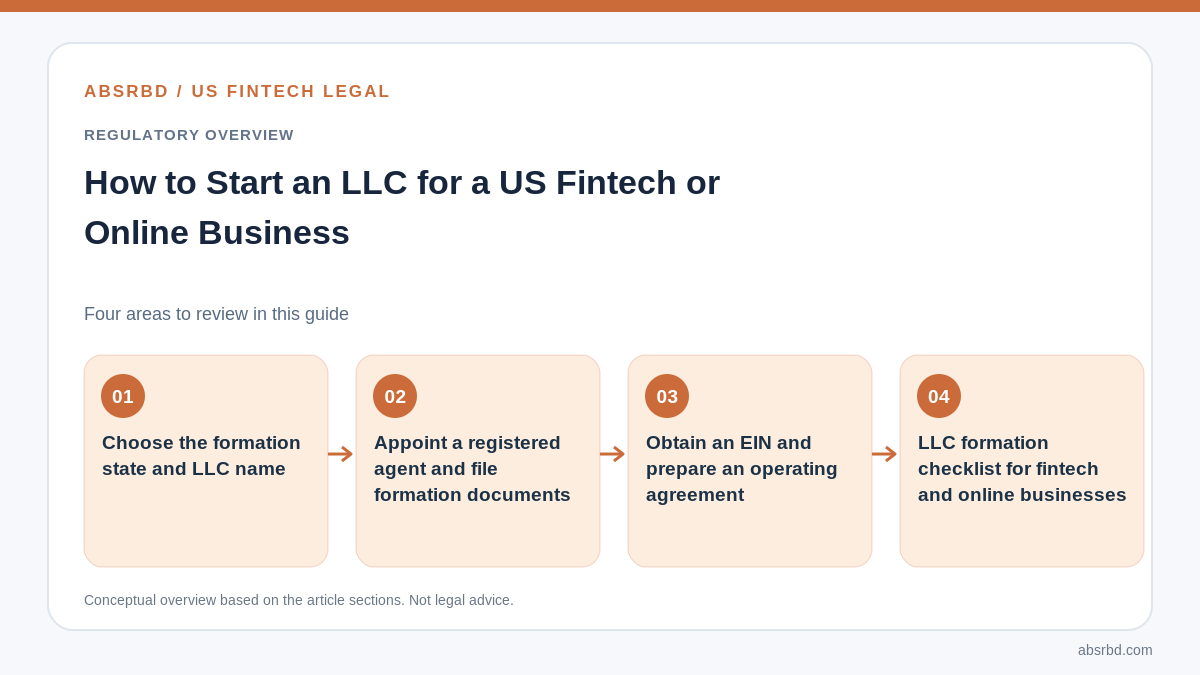
For a fintech or online business, forming an LLC creates the legal entity but does not automatically authorize regulated financial activities. Licenses, registrations, banking relationships, and payment-platform approvals are separate from LLC formation.
LLC formation steps at a glance
- Choose the state where you will form the LLC.
- Select a compliant and available LLC name.
- Appoint a registered agent in the formation state.
- File the state’s LLC formation document.
- Complete any publication or initial-report requirements.
- Obtain an EIN from the Internal Revenue Service.
- Prepare and approve an operating agreement.
- Open a business bank account and separate company finances.
- Register for applicable state and local taxes.
- Create a calendar for annual reports, fees, and other compliance obligations.
Requirements, filing fees, document names, and processing procedures vary by state. Confirm current rules with the relevant Secretary of State or equivalent business filing agency before submitting an application.
1. Choose the formation state
Most small online businesses should first consider forming an LLC in the state where the owner lives and operates the company.
Forming in another state does not necessarily allow a business to avoid registration at home. If the LLC conducts business in a different state, it may need to register there as a foreign LLC, appoint another registered agent, and pay fees in both states.
Questions to ask before selecting a state
- Where will the founders and employees work?
- Does the business have an office or other physical location?
- In which state will the company primarily conduct business?
- Will the LLC need to register as a foreign entity elsewhere?
- What formation fee, annual report, and recurring state charges apply?
- Does the state impose a publication requirement?
- Are there restrictions on business names associated with banking, lending, insurance, trusts, or other regulated activities?
An online customer base does not, by itself, answer where an LLC should be formed. The company’s owners, employees, offices, and operations are generally more relevant than the locations of website visitors.
Home-state formation versus another state
| Decision factor | Forming in the operating state | Forming in another state |
|---|---|---|
| State filings | Usually one primary formation filing | May require formation plus foreign qualification |
| Registered agent | Required in the formation state | May be required in multiple states |
| Recurring compliance | Generally concentrated in one state | Potential reports and fees in multiple states |
| Administrative complexity | Usually lower | Often higher |
| Best fit | Businesses primarily operating in one state | Businesses with a specific legal or operational reason for another state |
Before choosing an out-of-state formation, calculate the total obligations in both the formation state and every state where the company may need to qualify.
2. Choose an available LLC name
An LLC name must satisfy the rules of the formation state. It generally must be distinguishable from names already registered there and include an approved entity designator, such as “Limited Liability Company,” “LLC,” or “L.L.C.”
Complete these name checks
- Search the state business-entity database.
- Review the state’s naming restrictions.
- Check whether regulated or restricted words require approval.
- Search the United States Patent and Trademark Office database for potentially conflicting trademarks.
- Check domain-name and relevant social-media availability.
- Confirm that the name will be acceptable to banks, payment processors, and other essential partners.
- Reserve the name if necessary and if the state offers name reservations.
State name availability is not the same as trademark clearance. A state may accept a formation filing even when another party has trademark rights that create a separate legal risk.
For brainstorming help before conducting availability checks, see these fintech business name ideas.
Legal name and assumed business name
The name shown in the LLC’s formation document is its legal entity name. If the company will operate under another name, it may need an assumed-name, fictitious-name, or “doing business as” registration.
A DBA does not create a separate legal entity. It simply allows an existing company to conduct business under another approved name, subject to state and local rules.
3. Appoint a registered agent
A registered agent is the person or organization designated to receive legal process and official state notices for the LLC.
The agent generally must:
- Have a physical street address in the formation state.
- Be available at that address during normal business hours.
- Consent to the appointment when required.
- Forward official documents to the LLC promptly.
A post office box normally does not replace the required physical registered office.
An owner may be allowed to serve as the registered agent if the owner meets state requirements. Before doing so, consider that the registered address may appear in public records and that someone must reliably be available to receive documents.
Keep the registered-agent information current. Missing a lawsuit, annual-report notice, or state correspondence can have serious consequences for the company.
4. File the LLC formation document
File the required formation document with the state business filing agency, typically the Secretary of State. Depending on the state, the document may be called:
- Articles of Organization
- Certificate of Organization
- Certificate of Formation
Online filing is available in many states, although filing methods differ.
Information commonly requested in an LLC filing
| Filing field | Information to prepare |
|---|---|
| LLC name | Exact legal name, including the entity designator |
| Principal address | Main business or mailing address |
| Registered agent | Agent’s legal name and in-state street address |
| Management structure | Whether the LLC will be member-managed or manager-managed |
| Organizer | Person or entity submitting the formation filing |
| Business purpose | General or specific description, depending on state rules |
| Duration | Perpetual or a stated term, if the state asks |
| Effective date | Filing date or an allowed delayed effective date |
Use consistent spelling and addresses across the formation filing, EIN application, bank records, contracts, and platform applications. Inconsistencies can delay account reviews and create avoidable compliance questions.
Member-managed and manager-managed LLCs
A member-managed LLC is managed directly by its owners, who are called members.
A manager-managed LLC appoints one or more managers to handle company management. A manager may be a member, but does not always have to be one.
The appropriate structure depends on who will have authority to sign contracts, access accounts, hire personnel, and make operational decisions. The operating agreement should match the management structure selected in the state filing.
After submitting the filing
Save the state-approved formation document and any accompanying certificate. Do not rely solely on a confirmation email or public database entry.
The company may need these records to:
- Apply for an EIN.
- Open a bank account.
- Establish a payment-processing relationship.
- Lease property.
- Complete vendor onboarding.
- Demonstrate who is authorized to act for the LLC.
5. Complete state-specific post-filing requirements
Approval of the formation document may not complete the state registration process.
Depending on the state, additional requirements can include:
- Publishing a formation notice in approved newspapers.
- Filing an initial report or statement of information.
- Paying an initial franchise tax or similar state charge.
- Registering with a state tax agency.
- Obtaining local business registrations.
- Filing an assumed-name registration.
- Securing approvals for restricted words in the company name.
Check the formation approval packet and the official state website immediately after filing. Some post-formation obligations have deadlines tied to the LLC’s approval date.
6. Obtain an EIN from the IRS
An Employer Identification Number is a federal tax identification number issued by the Internal Revenue Service. It is commonly needed to open business accounts, hire employees, submit tax filings, and complete financial onboarding.
Form the LLC with the state before applying for its EIN. The legal name entered on the EIN application should match the approved state record.
Information to prepare for the EIN application
- The LLC’s exact legal name.
- Any trade name used by the business.
- The company’s mailing and physical addresses.
- The formation state and date.
- The number of LLC members.
- The responsible party’s information.
- The principal business activity.
- Whether the company expects to hire employees.
- The reason for applying.
The IRS issues EINs directly. Use the official IRS Employer Identification Number application and review eligibility requirements for the available application methods.
Store the EIN confirmation notice with the LLC’s permanent records. Banks and other institutions may request it during onboarding.
7. Prepare an operating agreement
An operating agreement is the LLC’s internal governance document. It explains ownership, management authority, voting procedures, financial rights, and what happens when the membership changes.
Even when a state does not require the agreement to be filed—or does not require a written agreement—a clear operating agreement can help establish how the company is supposed to function.
Provisions commonly addressed
- Legal name and principal office.
- Business purpose.
- Names of the members.
- Ownership percentages or membership interests.
- Initial contributions.
- Allocation of profits and losses.
- Distribution rules.
- Voting rights and approval thresholds.
- Member-managed or manager-managed status.
- Authority to sign contracts and access financial accounts.
- Procedures for admitting new members.
- Restrictions on transferring ownership.
- Treatment of a member’s withdrawal, death, or incapacity.
- Recordkeeping responsibilities.
- Amendment procedures.
- Dissolution procedures.
Single-member LLC operating agreement
A single-member LLC can still benefit from an operating agreement. The document can record that the owner authorized the formation, identify who may act for the company, and establish procedures for company records and finances.
Multi-member LLC operating agreement
A multi-member agreement should clearly address decision-making and economic rights. Ambiguity about voting, contributions, distributions, or departure rights can become especially damaging when the business is under stress. Founders should resolve these issues before operations or fundraising make changes more difficult.
8. Understand the LLC’s federal tax classification
An LLC is a legal entity created under state law, but the IRS applies federal tax-classification rules separately.
According to the IRS overview of limited liability companies:
- A domestic single-member LLC is generally treated as disregarded from its owner for federal income tax purposes unless an election is made.
- A domestic LLC with at least two members is generally treated as a partnership for federal income tax purposes unless an election is made.
- An LLC may be eligible to elect another federal tax classification.
Tax treatment affects filings, payroll, estimated payments, and how company income is reported. State tax treatment may differ from federal treatment. Consult a qualified tax professional if the ownership structure, expected revenue, non-US ownership, or planned tax election creates uncertainty.
9. Separate company and personal finances
After receiving the approved formation document and EIN, establish financial controls for the LLC.
Basic financial-separation checklist
- Open a bank account in the LLC’s legal name.
- Deposit business revenue into company accounts.
- Pay company expenses from company accounts.
- Avoid using business funds for personal purchases.
- Record owner contributions and distributions accurately.
- Use contracts, invoices, and receipts bearing the LLC’s name.
- Maintain accounting records and supporting documents.
- Establish approval rules for transfers and payments.
Banks commonly request the approved formation document, EIN confirmation, operating agreement, ownership information, personal identification, and a business address. Requirements differ by institution and may be more extensive for financial or payments-related businesses.
10. Address fintech and online-business formation details
A fintech or online business should organize its entity records for the compliance reviews commonly performed by banks, processors, marketplaces, vendors, and other counterparties.
Keep these details consistent
| Business detail | Where consistency matters |
|---|---|
| Legal entity name | State filing, EIN record, bank application, contracts |
| Business address | State records, tax records, website, account applications |
| Ownership | Operating agreement, bank records, compliance questionnaires |
| Authorized signers | Operating agreement, resolutions, financial accounts |
| Business description | Formation records, website, processor and bank applications |
| Trade names | DBA registrations, customer-facing terms, billing descriptors |
Do not treat LLC formation as regulatory approval
An approved LLC filing generally establishes the entity; it does not determine whether the company may legally offer a financial product or service.
Before using terms or launching activities involving money transmission, lending, banking, investment services, insurance, custody, virtual currency, or similar regulated areas, determine whether additional federal, state, or local authorization is required. Restricted words in a proposed company name may also require approval.
Keep the LLC filing accurate without making the business-purpose description broader or more specific than necessary. If a filing asks for a specific purpose and the planned activity is regulated, obtain appropriate legal guidance before submitting it.
11. Create an ongoing compliance calendar
An LLC must remain compliant after formation. The specific obligations depend on the formation state, operating locations, tax status, workforce, and business activities.
Track at least the following:
- Annual or biennial state reports.
- State franchise taxes or recurring fees.
- Registered-agent renewals and address changes.
- Federal, state, and local tax filings.
- Payroll registrations and filings, if applicable.
- Business-license renewals.
- Assumed-name renewals.
- Foreign LLC registrations in other states.
- Updates to company ownership and management records.
- Changes to operating agreements and internal resolutions.
- Current federal beneficial-ownership reporting rules, if applicable.
Because reporting rules and court decisions can change, verify current beneficial-ownership requirements directly with the Financial Crimes Enforcement Network rather than relying on an old checklist or filing-service notice.
Failure to maintain state compliance can result in penalties or loss of good standing. A company that loses good standing may face difficulties with banking, contracts, financing, and authority to conduct business.
LLC formation checklist for fintech and online businesses
Before filing
- [ ] Identify the state where the company will primarily operate.
- [ ] Check whether formation elsewhere would require foreign qualification.
- [ ] Search the state database for name availability.
- [ ] Review trademark and domain-name availability.
- [ ] Check restrictions on financial or regulated terms.
- [ ] Select a member-managed or manager-managed structure.
- [ ] Appoint an eligible registered agent.
- [ ] Gather member, manager, organizer, and address information.
State formation
- [ ] File the Articles of Organization or equivalent document.
- [ ] Pay the required state filing fee.
- [ ] Save the approved document and state confirmation.
- [ ] Complete any publication requirement.
- [ ] File any required initial report or statement.
- [ ] Register an assumed name if the business will use one.
Federal and internal setup
- [ ] Apply for an EIN through the IRS.
- [ ] Save the EIN confirmation notice.
- [ ] Prepare and approve the operating agreement.
- [ ] Document ownership interests and initial contributions.
- [ ] Identify authorized signers and account administrators.
- [ ] Confirm the LLC’s federal and state tax treatment.
Financial and operational setup
- [ ] Open a bank account in the LLC’s name.
- [ ] Separate business and personal transactions.
- [ ] Set up accounting and document-retention procedures.
- [ ] Use the LLC’s legal name on contracts and invoices.
- [ ] Confirm that website terms and privacy notices identify the correct entity.
- [ ] Ensure bank, processor, and vendor applications use consistent company information.
- [ ] Determine whether planned financial activities require separate authorization.
Ongoing compliance
- [ ] Record annual-report and tax deadlines.
- [ ] Keep the registered-agent information current.
- [ ] Renew licenses and assumed names when required.
- [ ] Review foreign-qualification obligations as operations expand.
- [ ] Update the operating agreement after material ownership or management changes.
- [ ] Check current federal beneficial-ownership reporting requirements.
- [ ] Maintain state good standing.
Forming the LLC is only the first administrative foundation. Clear records, consistent company information, financial separation, and a reliable compliance calendar help prevent avoidable problems that can contribute to the failure of an early-stage business.