Fintech compliance support generally comes in four forms: an in-house hire, a fractional compliance leader, a law firm, or a compliance consulting firm. The right choice depends on whether the company needs ongoing program ownership, specialized execution, legal advice, additional capacity, or a combination of these services.
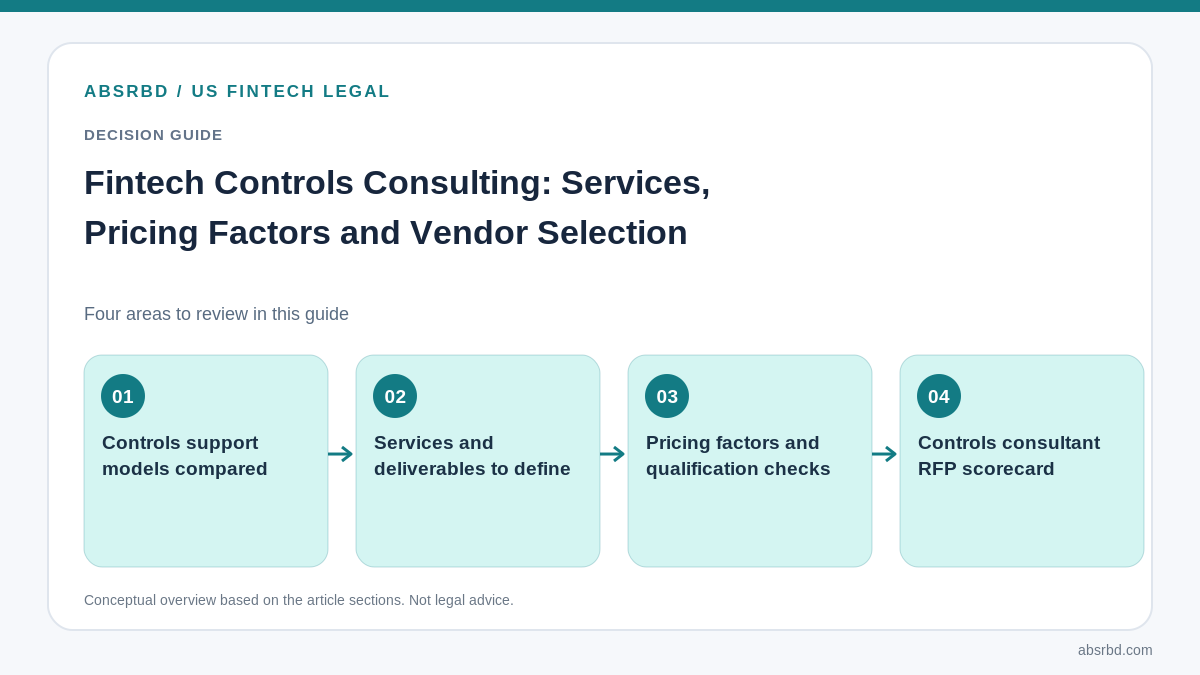
For many U.S. fintech companies, the most practical structure is hybrid: an internal owner remains accountable while outside consultants handle defined projects and qualified counsel addresses legal interpretation. Before requesting proposals, define the required deliverables, decision rights, timeline, and acceptance criteria. This makes vendor qualifications and pricing easier to compare.
Compliance Support Models Compared
No single delivery model is best for every fintech. The comparison should begin with the work that must be performed—not with vendor size or hourly rates.
| Support model | Best suited for | Primary strengths | Common limitations | Typical role |
|---|---|---|---|---|
| In-house compliance | Companies needing continuous oversight and close operational integration | Institutional knowledge, direct access to teams, sustained ownership | Recruiting time, fixed employment cost, possible gaps in specialized expertise | Owns the compliance program and coordinates stakeholders |
| Fractional compliance leader | Early-stage or scaling companies needing recurring leadership without a full-time executive | Flexible capacity, leadership access, faster deployment | Limited weekly availability, dependence on one person, potential continuity risk | Provides part-time leadership, prioritization, and governance |
| Law firm | Matters requiring legal interpretation, privileged advice, contract analysis, or regulatory representation | Legal analysis, attorney-client relationship where applicable, support for high-risk decisions | May not be structured for routine operational implementation | Advises on legal obligations and material regulatory questions |
| Compliance consulting firm | Defined projects, implementation work, independent testing, remediation, or additional capacity | Broader delivery team, repeatable project methods, access to specialists | Quality may vary by assigned team; scope changes can increase cost | Designs, implements, tests, or remediates compliance processes |
| Independent compliance consultant | Narrow projects or hands-on support requiring a specific specialist | Direct expert access, lower organizational overhead, flexible engagement | Limited backup capacity, key-person dependency, narrower service coverage | Executes specialized or time-limited work |
When an in-house model fits
An in-house compliance professional is usually the strongest option when compliance decisions are frequent, cross-functional, and embedded in daily operations. This model can work well when the person needs continuous access to product, engineering, operations, risk, customer support, and executive leadership.
An internal role should have:
- A documented mandate and reporting line
- Authority to escalate material concerns
- Access to relevant operational data
- A defined relationship with legal counsel
- Adequate budget and staffing
- Clear ownership of policies, monitoring, testing, training, and reporting
A single hire may not cover every specialty. Companies should avoid treating one compliance employee as a substitute for legal counsel, independent testing, or specialized project support.
When fractional compliance is appropriate
A fractional compliance leader provides recurring support on a part-time or limited-capacity basis. This format may suit companies that need experienced oversight but do not yet require—or cannot efficiently use—a full-time senior leader.
A fractional engagement should specify:
- Hours or capacity reserved each month
- Expected response times
- Meeting and reporting cadence
- Authority to approve or recommend changes
- Escalation responsibilities
- Coverage during absences
- Ownership of records and work product
- Conditions that would trigger a move to full-time leadership
Fractional support works best when internal employees can execute assigned tasks. It is less effective when the company expects one outside person to own strategy, implementation, testing, documentation, and daily operations within a limited schedule.
When to use a law firm
A law firm is appropriate when the company needs legal advice rather than operational guidance alone. Examples include interpreting an uncertain requirement, evaluating a material legal position, addressing an enforcement-related matter, or structuring communications where legal privilege may be relevant.
The engagement letter should make clear:
- Who the client is
- Which questions require legal advice
- Who may instruct counsel
- How advice will be documented
- Whether consultants or other third parties will participate
- How legal and operational workstreams will be separated
Do not assume that communications with a non-lawyer fintech compliance consultant are legally privileged. Privilege depends on the circumstances and should be addressed with qualified counsel.
When a compliance consulting firm fits
A consulting firm can be useful when the work requires multiple specialists, project management, substantial documentation, independent review, or accelerated execution.
Common use cases include:
- Building or updating a compliance program
- Preparing policies and procedures
- Conducting a gap assessment
- Supporting remediation
- Designing monitoring and reporting workflows
- Performing an independent review
- Providing temporary staff augmentation
- Supporting partner or investor due diligence
Buyers should evaluate the proposed delivery team, not only the firm’s brand or sales representatives. The people named in the proposal should be the people expected to perform and review the work.
How to Choose the Right Support Model
Use the following decision sequence before contacting vendors:
-
Identify the business decision or operational problem.
State what must change, be created, tested, or approved. -
Separate legal questions from implementation work.
Route legal interpretation to qualified counsel while scoping operational work for internal staff or consultants. -
Determine whether the need is continuous or project-based.
Continuous ownership may support an in-house or fractional model. Defined work with an end date may favor consulting. -
Estimate the skills and capacity required.
Identify whether the engagement needs leadership, specialized subject-matter knowledge, documentation, testing, project management, or execution support. -
Assign an internal owner.
Even fully outsourced fintech compliance work needs a company representative who can provide information, resolve conflicts, and accept deliverables. -
Define success before requesting prices.
Establish deliverables, deadlines, review standards, dependencies, and approval authority. -
Select a primary model and fill specific gaps.
A hybrid structure is often more practical than expecting one provider to cover every legal, strategic, and operational need.
Fintech Compliance Services and Deliverables to Define
A request for “compliance help” is too broad to price or manage effectively. Break the engagement into specific workstreams with measurable outputs.
Program assessment
A program assessment evaluates the company’s existing framework against an agreed set of requirements, contractual obligations, or internal standards.
Possible deliverables include:
- Current-state inventory
- Document request list
- Stakeholder interview plan
- Gap register
- Risk-ranked findings
- Remediation recommendations
- Executive summary
- Proposed implementation roadmap
The statement of work should define the assessment criteria. Avoid accepting a vague promise to review the program against “best practices” without identifying the framework or evaluation method.
Policies and procedures
Policy work can range from light editing to full operational design. Specify whether the consultant will create high-level policy statements, step-by-step procedures, job aids, or all three.
Define:
- Documents included in scope
- Required reviewers and approvers
- Number of revision rounds
- Formatting and version-control standards
- Connections to actual systems and workflows
- Employee roles responsible for each procedure
- Training or rollout support
- Update and maintenance responsibilities
A polished document is not necessarily an operational program. Procedures should reflect how the company’s teams, partners, and systems actually work.
Registration and licensing support
Some business models may require federal registration, state licenses, or other authorizations. The exact analysis should be handled by appropriately qualified professionals.
For example, businesses evaluating potential money services business obligations can consult the official FinCEN Money Services Business registration resources. A consultant may support data gathering, project management, documentation, and filings, but the engagement must clearly identify who determines applicability and who provides legal advice.
For this type of project, define whether the provider will:
- Assess information supplied by the company
- Coordinate with legal counsel
- Prepare an application or registration package
- Manage information requests
- Track deadlines and renewals
- Maintain supporting records
- Support post-filing obligations
Monitoring, testing, and quality assurance
These services should not be treated as interchangeable.
- Monitoring is an ongoing process intended to identify exceptions or indicators requiring attention.
- Testing evaluates whether controls are designed appropriately and operating as intended.
- Quality assurance checks the accuracy and consistency of completed work.
- Independent review provides a separate assessment conducted with sufficient objectivity from the activity being reviewed.
The proposal should state the population, sampling method, review period, testing procedures, evidence standards, reporting format, and process for resolving disputed findings.
Remediation support
A remediation engagement should convert findings into completed, verifiable actions.
Useful deliverables include:
- Remediation plan
- Named action owners
- Target completion dates
- Evidence requirements
- Status reporting
- Issue escalation rules
- Validation testing
- Closure memorandum or record
Ask whether the same provider that identified a problem will also validate its resolution. If so, evaluate whether that arrangement provides sufficient independence for the intended purpose.
Training and implementation
Training should be tailored to employee responsibilities rather than delivered as generic content.
Define:
- Target audiences
- Learning objectives
- Delivery format
- Required attendance
- Knowledge checks
- Completion records
- Manager responsibilities
- Refresh schedule
- Update process following material program changes
Implementation support may also include workshops, workflow design, responsibility matrices, communication plans, and launch checklists.
Partner and due-diligence support
Fintech companies may need to respond to requests from banks, investors, enterprise customers, auditors, or other partners. Outside support can help organize evidence and prepare clear responses, but the company should retain control over representations made to third parties.
Potential deliverables include:
- Evidence inventory
- Document repository structure
- Questionnaire response support
- Issue log
- Management briefing materials
- Follow-up request tracking
Companies using embedded finance or sponsored banking relationships may also want broader market context from current banking-as-a-service statistics. Market data can inform planning, but it does not determine a company’s compliance obligations.
Scope Checklist Before Requesting Proposals
Provide each prospective vendor with the same baseline information.
- [ ] Company legal entities and operating locations
- [ ] Products and customer types
- [ ] Current and planned launch states
- [ ] Relevant bank, payment, or platform relationships
- [ ] Existing compliance team and reporting structure
- [ ] Current policies, procedures, and risk assessments
- [ ] Known findings, deadlines, or remediation commitments
- [ ] Required workstreams and excluded work
- [ ] Legal questions reserved for counsel
- [ ] Required deliverables and file formats
- [ ] Project milestones and final deadline
- [ ] Internal stakeholders and decision-makers
- [ ] Data-access and security requirements
- [ ] Required independence or conflict restrictions
- [ ] Budget parameters, if available
- [ ] Proposal submission instructions
A consistent scope allows buyers to compare providers on equivalent assumptions rather than comparing fundamentally different offers.
Fintech Compliance Consulting Pricing Factors
There is no universal price for fintech compliance services. Cost depends on the company’s business model, project scope, maturity, urgency, required expertise, available documentation, and the provider’s responsibilities.
Common commercial structures
| Pricing structure | Appropriate use | Buyer considerations |
|---|---|---|
| Fixed fee | Clearly defined project with stable deliverables | Confirm assumptions, revision limits, dependencies, and change-order rules |
| Hourly or time-and-materials | Uncertain scope, advisory support, or evolving work | Request role-based rates, budget alerts, estimates, and invoice detail |
| Monthly retainer | Recurring access, fractional leadership, or continuing support | Define included capacity, response times, rollover rules, and out-of-scope work |
| Milestone-based fee | Multi-stage implementation or remediation | Tie payments to objective deliverables and acceptance criteria |
| Dedicated capacity | Staff augmentation or sustained execution | Clarify hours, supervision, replacement procedures, and minimum term |
Factors that can increase the engagement cost
- Multiple products, entities, or customer segments
- Operations across numerous states
- Complex partner arrangements
- Incomplete or outdated documentation
- Short deadlines
- Large data populations
- Extensive stakeholder interviews
- Significant remediation work
- On-site requirements
- Specialized expertise
- Additional revision rounds
- Frequent scope changes
- Third-party dependencies
- Required legal coordination
- Senior-level involvement throughout the project
Questions to ask about pricing
- What assumptions support the estimate?
- Which deliverables are included?
- Which activities are explicitly excluded?
- Who will perform each workstream?
- Are meetings, project management, and revisions included?
- What travel or third-party expenses may be charged?
- When is a change order required?
- How will the vendor notify the company before exceeding the budget?
- Are unused retainer hours carried forward?
- What happens if the company delays access to information?
- Is post-delivery support included?
- Who owns templates and final work product?
Compare total expected cost, not merely the lowest rate. A lower-cost proposal may become more expensive if it excludes project management, revision cycles, implementation support, or senior review.
Qualification Checks for a Fintech Compliance Consultant
Vendor qualification should focus on relevant experience, delivery capability, independence, security, and fit with the defined scope.
Relevant experience
Ask candidates to describe engagements involving comparable:
- Products and services
- Customer types
- Distribution models
- Partner structures
- Company stages
- Project sizes
- Deliverables
- Deadlines
General financial-services experience may not translate directly to the company’s operating model. Request concrete examples without asking the vendor to disclose another client’s confidential information.
Reviewing a fintech startups watchlist may help internal teams identify business-model terminology and potential peers before drafting an RFP. However, vendor selection should be based on the company’s own activities and requirements.
Proposed team
Obtain the following information for every material team member:
- Role in the engagement
- Relevant professional background
- Expected responsibilities
- Estimated allocation
- Location and working hours
- Named backup
- Review and escalation authority
Ask whether the vendor can replace personnel without approval. If substitutions are allowed, require replacements to have comparable qualifications.
Delivery method
A credible proposal should explain:
- Project phases
- Information required from the company
- Interview and workshop process
- Analysis method
- Quality-control process
- Status-reporting cadence
- Finding validation process
- Deliverable review and acceptance
- Escalation procedure
Be cautious when a provider promises a complete program without first understanding the product, workflows, partners, and existing controls.
Independence and conflicts
Ask the provider to disclose:
- Current relationships that could create a conflict
- Prior work affecting independence
- Referral or reseller arrangements
- Financial interests connected to recommendations
- Whether the provider will test its own implementation work
- Whether subcontractors will be used
The required level of independence depends on the purpose of the work. A consultant helping build a process may be suitable for implementation, while a separate reviewer may be preferable for an independent assessment.
Data handling and confidentiality
Compliance projects can involve sensitive business and customer information. Evaluate:
- Data requested
- Access method
- Storage location
- Retention period
- Encryption and transfer controls
- Subcontractor access
- Incident-notification process
- Data deletion procedures
- Confidentiality commitments
- Restrictions on using company data for other purposes
Involve the company’s security, privacy, and legal stakeholders when appropriate.
References and work samples
Request references for comparable engagements and ask focused questions:
- Did the provider meet deadlines?
- Were deliverables practical and accurate?
- Did the assigned team match the proposed team?
- Were budget changes communicated early?
- How did the provider handle disagreements?
- Did the work require substantial correction?
- Would the reference hire the provider again for the same scope?
If confidentiality prevents sharing a full work sample, ask for a redacted example, sample table of contents, or demonstration of the proposed deliverable structure.
Compliance Consultant RFP Questions
A concise request for proposal should make responses comparable. Include the following questions.
Company and experience
- Describe your organization and relevant fintech compliance services.
- Identify comparable engagements completed by the proposed team.
- Explain your experience with our product type and operating model.
- Disclose actual or potential conflicts of interest.
- Identify any subcontractors and their responsibilities.
Scope and approach
- Restate your understanding of the requested scope.
- Describe your project approach and major phases.
- List required company documents, data, interviews, and system access.
- Identify assumptions, dependencies, and exclusions.
- Explain how findings or recommendations will be validated with management.
- Describe your quality-review process.
- Explain how you distinguish operational guidance from legal advice.
Team and availability
- Name the personnel assigned to each workstream.
- State each person’s expected allocation and responsibilities.
- Identify the executive sponsor and day-to-day project manager.
- Explain your replacement and backup procedures.
- Confirm availability for the requested timeline.
Deliverables and timing
- Provide a complete deliverables list.
- Include a milestone schedule.
- Define the format and level of detail for each deliverable.
- State the number of review and revision cycles included.
- Describe post-delivery support.
Fees and contract terms
- Provide fees by phase, deliverable, and team role where applicable.
- Identify expenses and potential additional charges.
- Explain change-order and budget-notification procedures.
- State payment milestones.
- Describe work-product ownership and reuse restrictions.
- Confirm confidentiality, data-handling, and subcontracting terms.
Vendor Evaluation Scorecard Template
Score each vendor from 1 to 5 for every criterion:
- 1 — Poor: Does not meet the requirement
- 2 — Weak: Partially meets it with material concerns
- 3 — Acceptable: Meets the basic requirement
- 4 — Strong: Exceeds the requirement in useful ways
- 5 — Excellent: Clearly differentiated and well supported
Multiply the score by the criterion’s weight. Keep evaluator comments and evidence alongside each rating.
| Evaluation criterion | Weight | What to assess |
|---|---|---|
| Relevant fintech experience | 15% | Comparable products, operating models, and project types |
| Understanding of scope | 10% | Accuracy of assumptions, risks, dependencies, and exclusions |
| Proposed team | 15% | Qualifications, availability, senior oversight, and backup coverage |
| Delivery methodology | 10% | Practical phases, project controls, validation, and quality review |
| Deliverable quality | 10% | Clarity, usability, specificity, and implementation value |
| Legal and operational boundaries | 5% | Appropriate separation of consulting work and legal advice |
| Independence and conflicts | 5% | Conflict disclosures and suitability for the intended review |
| Data security and confidentiality | 10% | Access controls, retention, incident handling, and subcontractor management |
| Timeline and capacity | 5% | Ability to meet milestones without unrealistic assumptions |
| Commercial value | 10% | Total expected cost relative to scope and team quality |
| References | 5% | Performance on comparable engagements |
| Total | 100% |
Do not allow the weighted total to make the final decision automatically. Record any non-negotiable requirements separately, such as conflicts, data-security conditions, legal qualifications, independence, or deadline constraints.
Final Selection and Contracting Checklist
Before signing an engagement:
- [ ] Confirm the final scope and exclusions
- [ ] Name the assigned team
- [ ] Document the project schedule
- [ ] Define company dependencies
- [ ] Set objective acceptance criteria
- [ ] Establish status and escalation procedures
- [ ] Confirm fee assumptions and budget controls
- [ ] Review confidentiality and data-security terms
- [ ] Address subcontractor use
- [ ] Clarify work-product ownership
- [ ] Separate legal advice from consulting deliverables
- [ ] Resolve actual or potential conflicts
- [ ] Define termination and transition support
- [ ] Assign an internal executive sponsor
- [ ] Schedule a formal kickoff
The strongest fintech compliance consulting engagement is not necessarily the broadest or least expensive. It is the one with a precise scope, appropriately qualified people, transparent commercial terms, usable deliverables, and clear accountability between the company, consultant, and legal counsel.