A startup lawyer’s cost depends on the work involved, the billing model, the company’s complexity, and the stage of the engagement. Instead of relying on a generic price estimate, founders should request a written scope that separates:
- Attorney fees
- Government filing fees
- Registered-agent or other third-party charges
- Taxes or franchise fees, when applicable
- Expenses such as document retrieval, couriers, or specialized local counsel
- Work excluded from the initial engagement
Straightforward, repeatable matters may qualify for a fixed fee. Negotiations, financing rounds, regulatory analysis, and other unpredictable projects are more commonly billed hourly or through a hybrid arrangement.
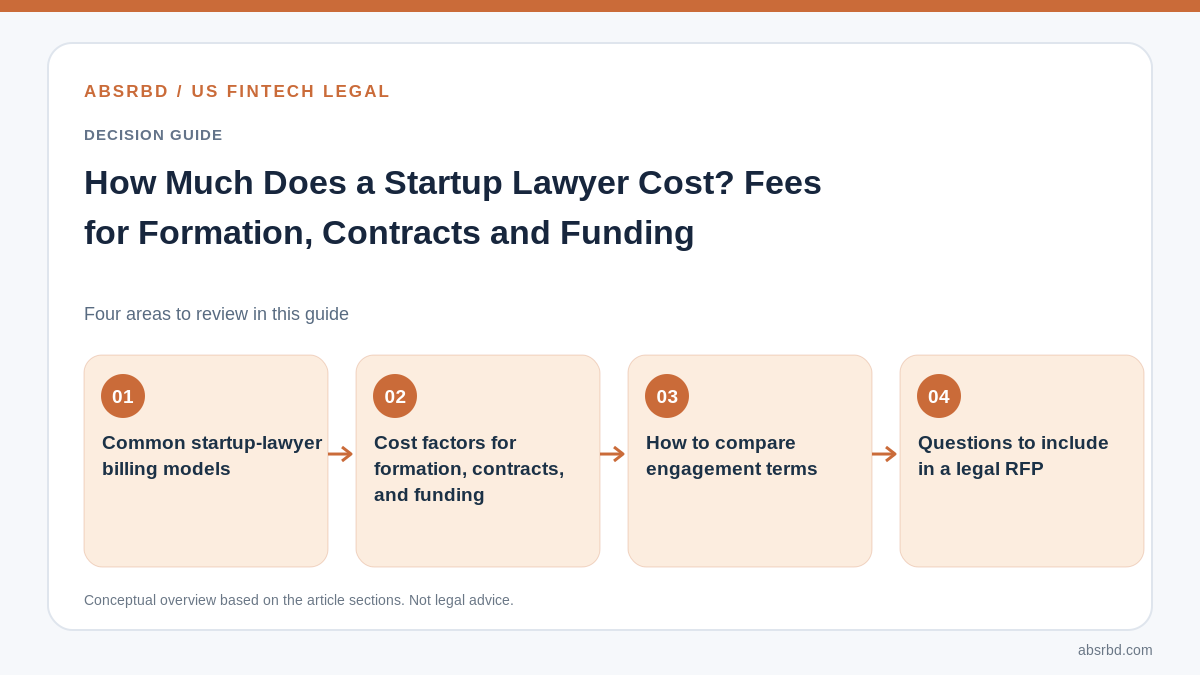
Common Startup-Lawyer Billing Models
Startup attorney fees can be structured in several ways. The right model depends on how predictable the assignment is and how likely the scope is to change.
| Billing model | How it works | Often suited to | Questions to ask |
|---|---|---|---|
| Hourly billing | The firm charges for time spent by attorneys and other professionals | Negotiations, unusual formation issues, complex contracts, financing transactions | Who will work on the matter, what are their billing rates, and how is time recorded? |
| Fixed fee | One defined fee covers a specified scope | Standard formation packages, document reviews, or clearly defined contract work | What deliverables, revisions, meetings, and filings are included? |
| Retainer deposit | The client deposits funds that the firm applies against future invoices, subject to the engagement terms | Ongoing or initially uncertain matters | Is the retainer refundable, replenishing, or treated differently under applicable rules? |
| Monthly subscription | A recurring payment covers specified services or access | Startups with regular but relatively predictable legal needs | Are unused hours carried forward, and what work falls outside the subscription? |
| Capped fee | Work is billed under an agreed method up to a stated limit, subject to assumptions | Projects that are mostly predictable but may require some flexibility | What events allow the cap to change? |
| Blended or hybrid fee | The engagement combines models, such as a fixed fee for drafting and hourly fees for negotiations | Contracts or funding matters with predictable and unpredictable phases | Which phase uses each billing method? |
| Deferred fee arrangement | Payment timing is postponed under written terms | Limited situations in which counsel agrees to delayed payment | When does payment become due, and what happens if the company cannot pay? |
| Equity-related arrangement | Counsel may accept an equity component under carefully documented terms | Select startup engagements, subject to professional and conflict rules | How is the equity valued, and how are conflicts, dilution, vesting, and termination handled? |
A billing model does not reveal the total cost by itself. A low fixed fee can become expensive if essential work is excluded, while hourly billing may be reasonable when the team, budget controls, and decision points are clearly defined.
What Determines Startup Lawyer Cost?
The most important cost drivers are scope, complexity, urgency, negotiation intensity, and the people assigned to the work.
Company and Engagement Factors
Startup lawyer pricing may be affected by:
- Entity and ownership complexity: Multiple founders, existing intellectual property, foreign owners, subsidiaries, or unusual ownership rights can require additional analysis.
- Company stage: A pre-formation team generally has different needs from a company hiring employees, signing enterprise customers, or raising institutional capital.
- Document condition: Reviewing organized, current records is usually more efficient than reconstructing incomplete ownership or contract histories.
- Number of stakeholders: More founders, investors, counterparties, and advisers can mean more communication and revision cycles.
- Industry regulation: A startup operating in a regulated field may need specialized legal analysis beyond general corporate work.
- Geographic reach: Operations, employees, customers, or investors in multiple states or countries can expand the scope.
- Urgency: Accelerated timelines can require reprioritization, additional staffing, or after-hours work.
- Law firm structure: Partner involvement, specialist input, staffing practices, and geographic market can influence fees.
- Founder responsiveness: Delayed decisions and fragmented feedback can create repeated work.
- Risk allocation: High-value liabilities, broad indemnities, or complex representations often require more negotiation.
The U.S. Small Business Administration notes that a business’s legal structure affects matters such as registration, taxes, and personal liability. Its business launch guidance can help founders identify decisions to discuss with qualified counsel.
Cost Factors for Startup Formation
Formation work is not limited to submitting an organizational filing. The scope may also involve documenting ownership, governance, founder obligations, and initial company approvals.
Formation Tasks That May Affect Fees
A formation engagement may include some combination of:
- Entity and jurisdiction analysis
- Review of founder objectives and ownership expectations
- Organizational filings
- Governing documents
- Initial board or member approvals
- Founder stock or equity issuance documents
- Vesting provisions
- Intellectual property assignment documents
- Capitalization records
- Securities-law-related documentation for initial issuances
- Coordination with tax advisers
- Foreign qualification analysis
- State and local registration guidance
The company’s choice of entity can have long-term implications. Counsel may need to coordinate with a certified public accountant or tax attorney when tax treatment is central to the decision.
Questions That Change the Formation Scope
Before providing a useful estimate, counsel may ask:
- How many founders and initial equity holders are involved?
- Has anyone already created intellectual property for the business?
- Has money, equipment, code, data, or another asset been contributed?
- Are founder vesting terms needed?
- Will the startup issue options or other equity awards?
- Are any founders, employees, or operations outside the formation state?
- Is outside funding expected soon?
- Are there existing agreements or commitments that the new company will assume?
A quote based only on “forming a company” may not cover these issues. Ask the attorney to identify which formation deliverables are included and which will require separate authorization.
Cost Factors for Startup Contracts
Contract costs depend less on page count than on commercial risk, customization, and negotiation.
Contract Variables That Influence Fees
| Cost driver | Why it matters |
|---|---|
| Drafting versus review | Creating an agreement from the company’s requirements may involve more discovery than reviewing a suitable existing draft |
| Contract type | Founder, employment, vendor, customer, licensing, and partnership agreements address different risks |
| Counterparty leverage | A large customer or strategic partner may insist on its own paper and extensive changes |
| Negotiation rounds | Multiple redlines, calls, and internal approvals increase attorney time |
| Deal value and liability | High-value obligations may require closer analysis of warranties, indemnities, limits of liability, and insurance |
| Intellectual property terms | Ownership, licensing, open-source use, and work-product provisions can require specialist review |
| Data obligations | Access to personal, confidential, financial, or health-related information may expand the legal analysis |
| Cross-border elements | Foreign counterparties, governing law, tax issues, and localization can add complexity |
| Operational readiness | Counsel may need input from product, security, finance, or sales teams before finalizing terms |
For a fixed-fee contract engagement, confirm whether the quote includes initial drafting, internal revisions, counterparty negotiations, signature support, and post-signing amendments. These are distinct phases and may not all be included.
Cost Factors for Startup Funding
Funding work often combines corporate housekeeping, due diligence, document preparation, negotiation, and closing coordination. Costs can increase when earlier company records are incomplete or inconsistent.
Factors That Affect Funding-Related Legal Fees
- Financing instrument: Equity rounds, convertible instruments, and other structures involve different documents and risks.
- Number of investors: Multiple participants can create additional signatures, questions, side arrangements, and closing logistics.
- Lead investor requirements: Institutional investors may request extensive diligence, governance rights, or changes to standard documents.
- Capitalization-table accuracy: Missing grants, undocumented promises, or conflicting records may need to be resolved before closing.
- Corporate housekeeping: Incomplete approvals or prior issuances can create remediation work.
- Negotiation intensity: Valuation is only one issue; control rights, information rights, protective provisions, and founder obligations may also require attention.
- Due diligence: Investors may review corporate, intellectual property, employment, commercial, privacy, litigation, and financial records.
- Closing conditions: Third-party consents, signatures, filings, and other requirements can extend the process.
- Specialist advice: Tax, regulatory, intellectual property, employment, or securities specialists may be needed.
Ask whether a financing estimate assumes clean corporate records, standard documents, one lead investor, limited negotiation rounds, or other conditions. Those assumptions can materially affect the final invoice.
What Affects Fintech Lawyer Cost?
A fintech startup may require both general corporate counsel and lawyers with relevant financial-services experience. Legal cost is influenced by the product, transaction flow, customer type, jurisdictions, counterparties, and regulatory questions involved.
Potential cost drivers include:
- Whether the company handles or controls customer funds
- The roles of banks, payment processors, platform partners, or other regulated entities
- Consumer versus business customers
- Lending, payments, money transmission, brokerage, digital assets, or other financial functionality
- State-by-state legal analysis
- Required customer agreements and disclosures
- Data security and privacy obligations
- Vendor and bank-partner negotiations
- Regulatory inquiries or examination support
When comparing fintech attorney fees, ask the firm to separate ordinary formation, commercial contracting, fundraising, and specialized regulatory work. This makes proposals easier to compare and helps prevent a narrow estimate from being mistaken for an all-inclusive legal budget.
How to Compare Startup Attorney Engagement Terms
Do not compare proposals solely by the stated fee. Normalize each proposal by scope, staffing, assumptions, exclusions, and budget controls.
Proposal Comparison Checklist
| Comparison area | Information to request |
|---|---|
| Deliverables | Exact documents, filings, meetings, and advice included |
| Work phases | Discovery, drafting, revision, negotiation, filing, and closing support |
| Staffing | Responsible partner, day-to-day contact, associates, paralegals, and specialists |
| Rates and fee model | Applicable rates, fixed fees, caps, subscriptions, or hybrid terms |
| Assumptions | Facts and conditions on which the estimate relies |
| Exclusions | Work that requires a new scope or separate authorization |
| Revisions | Number and type of included revision rounds |
| Negotiations | Whether counterparty calls and redlines are included |
| Third-party charges | Filing fees, searches, local counsel, vendors, and other expenses |
| Budget reporting | Invoice frequency, budget updates, and threshold notifications |
| Scope changes | Who approves additional work and how it will be priced |
| Timeline | Target dates, dependencies, and consequences of delay |
| File ownership and access | How the startup will receive final and editable documents |
| Termination | Payment, file-transfer, and transition terms if the relationship ends |
Calculate the Full Engagement Cost
Use a consistent framework for every proposal:
Expected legal spend = professional fees + filing fees + third-party expenses + out-of-scope work + future maintenance
“Future maintenance” may include periodic governance actions, contract updates, equity documentation, additional registrations, or support for later transactions. It should not be assumed to be part of an initial project unless the engagement letter says so.
How to Control Legal Costs Without Sacrificing Important Work
Cost control should focus on reducing uncertainty and avoidable work rather than choosing counsel solely on price.
- Define the business objective. Explain what needs to be accomplished, by when, and why.
- Organize relevant records. Provide a complete, labeled set of formation documents, contracts, ownership records, and prior legal advice.
- Use one internal point of contact. Consolidated instructions reduce conflicting feedback and duplicate communication.
- Prioritize decisions. Identify issues that could block formation, revenue, hiring, or funding.
- Request phase-based estimates. Separate initial analysis, drafting, negotiation, and closing.
- Set approval thresholds. Require notice before work exceeds a budget, cap, or defined scope.
- Clarify revision assumptions. Ask how internal revisions and counterparty redlines are treated.
- Schedule concise decision calls. Focus meetings on unresolved questions rather than document walkthroughs that could be handled asynchronously.
- Ask for reusable work product. When appropriate, determine whether approved templates or playbooks can support recurring transactions.
- Review invoices promptly. Raise questions while the work and decisions are still current.
Cutting essential legal work can create larger costs later. Weak ownership records, missing intellectual property assignments, and inconsistent contracts can complicate diligence, financing, and acquisitions. Legal planning is one part of managing the broader risks discussed in common reasons startups fail.
Questions to Include in a Startup Legal RFP
A legal request for proposal should give each firm the same information and ask for comparable answers.
About the Firm and Team
- Who will be responsible for the relationship?
- Who will handle routine work?
- Which specialists may become involved?
- What relevant startup-stage and industry experience does the proposed team have?
- How does the firm manage conflicts of interest?
- Who serves as the backup contact when the primary attorney is unavailable?
About Scope and Deliverables
- What specific deliverables are included?
- What information or records do you need before work begins?
- Which issues require analysis before you can provide a firm estimate?
- How many meetings and revision rounds are assumed?
- Does the scope include negotiations with third parties?
- Does it include filing, closing, and post-closing support?
- What work is expressly excluded?
About Fees and Expenses
- Which billing model do you recommend for each phase, and why?
- Who will bill time, and at what rates?
- Are fixed fees subject to assumptions or limits?
- Is a retainer required, and how will it be handled?
- Which government and third-party charges are separate?
- Are travel, research platforms, document services, or administrative expenses billed separately?
- How often are rates reviewed or changed?
- Are payment timing or alternative arrangements available?
About Budget Management
- Can you provide a phase-by-phase estimate?
- What circumstances are most likely to change the estimate?
- When will you notify us that the scope or budget may be exceeded?
- Who must approve additional work?
- How often will we receive invoices and budget updates?
- Can invoices be organized by matter, phase, and professional?
- Will you provide an estimate before involving a specialist?
About Process and Communication
- What is the expected timeline?
- Which dependencies could delay completion?
- What response times should the startup expect?
- How should urgent requests be submitted?
- How will documents, comments, and approvals be managed?
- Will the company receive final signed documents and editable versions where appropriate?
- How will open issues and decisions be tracked?
Startup Legal RFP Template
Founders can use the following outline to request comparable proposals:
1. Company Overview
- Company name and current entity status
- Headquarters and operating locations
- Product or service
- Customer type
- Founders, employees, and contractors
- Current funding stage
- Relevant regulatory or cross-border considerations
2. Requested Work
List each matter separately, such as:
- Formation and founder documentation
- Commercial agreement drafting or review
- Employment or contractor documentation
- Intellectual property assignments
- Equity-related documentation
- Financing preparation, negotiation, and closing
- Specialized legal analysis
3. Desired Deliverables
For each matter, state:
- Documents or advice requested
- Relevant counterparties
- Target completion date
- Known risks or open questions
- Expected negotiation support
- Required filings or closing assistance
4. Proposal Requirements
Ask the firm to provide:
- Proposed scope
- Team and responsibilities
- Billing structure
- Phase-based estimate
- Assumptions and exclusions
- Third-party expenses
- Timeline and dependencies
- Budget-control process
- Engagement-letter terms
5. Evaluation Criteria
Choose and weight criteria before reviewing proposals:
- Relevant experience
- Understanding of the requested work
- Scope completeness
- Team availability
- Communication approach
- Fee predictability
- Budget controls
- Ability to support future stages
Bottom Line
There is no single reliable startup lawyer cost because formation, contracts, and funding involve different scopes and levels of uncertainty. The most useful proposal is not necessarily the one with the lowest stated fee; it is the one that clearly defines deliverables, staffing, assumptions, exclusions, expenses, and change controls.
Send the same legal RFP to each firm, compare proposals line by line, and confirm the final terms in a written engagement letter. For more startup planning and risk-management resources, visit the posts1 blog.
This article provides general information for U.S. startups and is not legal or tax advice. Engagement terms and professional obligations may vary by attorney, jurisdiction, and matter.