The Equal Credit Opportunity Act (ECOA) and Regulation B prohibit discrimination in any aspect of a credit transaction. The rules generally apply to both consumer and business credit, including decisions made through automated underwriting, alternative data, or third-party fintech platforms.
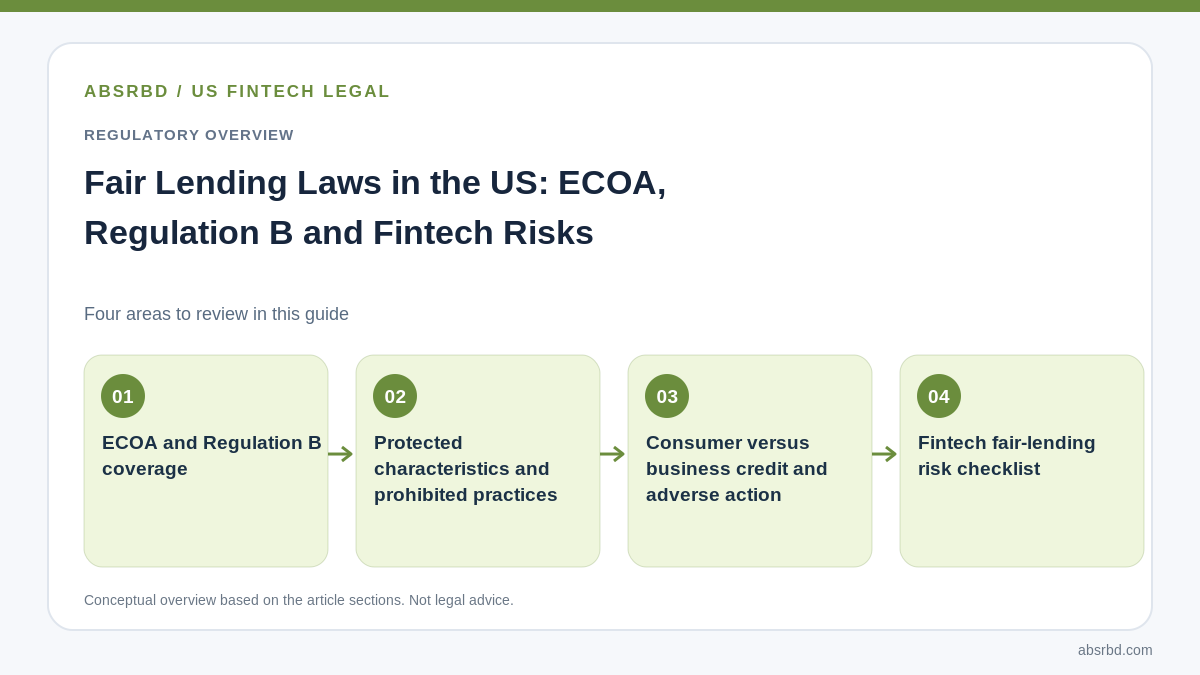
For lenders, compliance requires more than removing protected characteristics from an application. Marketing, eligibility rules, pricing, credit limits, model inputs, manual overrides, servicing, and adverse action notices can all create fair-lending risk.
Scope: This guide focuses on ECOA, Regulation B, adverse action under Regulation B, and fintech controls. Other federal requirements may apply separately to particular products or data sources.
ECOA and Regulation B: What They Cover
ECOA is the federal statute establishing equal credit opportunity protections. Regulation B, codified at 12 CFR Part 1002, implements ECOA and provides operational rules for creditors.
Who must comply?
Regulation B applies broadly to creditors. Depending on the activity and relationship, covered organizations may include:
- Banks and credit unions
- Consumer finance companies
- Mortgage and auto lenders
- Credit card issuers
- Commercial and small-business lenders
- Online lenders and peer-to-peer platforms
- Fintech companies participating in credit decisions
- Companies that set credit terms or regularly participate in credit decisions
Using a bank partner, scoring vendor, or third-party underwriting platform does not eliminate the need to identify and control fair-lending risk.
Which stages of a credit transaction are covered?
ECOA applies to more than application approval or denial. Regulation B governs discrimination in any aspect of a credit transaction, which can include:
- Advertising and applicant outreach
- Prequalification and application access
- Information requested from applicants
- Underwriting and fraud screening
- Approval and denial decisions
- Interest rates, fees, limits, and other terms
- Counteroffers
- Account management and line changes
- Servicing and collections
- Renewal, termination, and revocation of credit
Regulation B also prohibits statements or practices that would discourage a reasonable prospective applicant from applying on a prohibited basis.
Protected Characteristics and Prohibited Practices
A creditor may not discriminate against an applicant on the basis of:
- Race
- Color
- Religion
- National origin
- Sex
- Marital status
- Age, provided the applicant has the capacity to contract
- Receipt of income from a public assistance program
- Good-faith exercise of a right under the Consumer Credit Protection Act
The Consumer Financial Protection Bureau has interpreted ECOA’s prohibition on sex discrimination to include discrimination based on sexual orientation and gender identity. Compliance teams should confirm the current regulatory and judicial position when updating policies.
What does credit discrimination look like?
Credit discrimination is not limited to an explicit policy excluding a protected group. Risk can arise through several patterns.
| Pattern | Description | Example of a control concern |
|---|---|---|
| Overt discrimination | A policy or decision explicitly uses a prohibited basis | A credit policy applies different eligibility rules based on marital status |
| Disparate treatment | Similarly situated applicants receive different treatment because of a protected characteristic | Manual exceptions are granted more often to one group |
| Discriminatory effects | A neutral policy produces a disproportionate adverse effect and requires further legal analysis | A geographic restriction disproportionately excludes a protected group |
| Discouragement | Marketing, application design, or employee conduct deters prospective applicants on a prohibited basis | Ads imply that applicants of a particular age are unlikely to qualify |
| Steering | Applicants are directed toward different products or terms on a prohibited basis | Comparable applicants are routed to products with different pricing |
A statistical difference does not, by itself, establish the cause of a compliance problem. It should trigger a documented investigation into data quality, applicant comparability, business necessity, model behavior, discretion, and possible alternatives.
Common high-risk practices
Organizations should review whether their policies or systems:
- Apply different underwriting standards to similarly situated applicants
- Consider protected characteristics directly or through unjustified proxies
- Discount or exclude qualifying income because it comes from public assistance
- Use assumptions about whether an applicant will have children or take parental leave
- Request information about a spouse when Regulation B does not permit it
- Require a spouse’s signature when an applicant qualifies independently
- Offer different prices, limits, or counteroffers without a documented credit-related basis
- Give employees uncontrolled discretion to override model results
- Exclude audiences from marketing in ways correlated with protected groups
- Use fraud or identity controls that create unexplained disparities
- Treat applicants differently based on the channel through which they apply
Not every variable correlated with a protected characteristic is automatically prohibited. However, correlation can create risk when a variable lacks a sound business rationale, produces material disparities, or has a less discriminatory alternative that would meet the same legitimate objective.
Consumer Versus Business Credit Under Regulation B
A common misconception is that ECOA applies only to individual consumer loans. In fact, Regulation B also covers business credit.
The commercial purpose of the loan does not permit a creditor to discriminate against the applicant. However, some application, notification, and recordkeeping procedures differ by applicant or transaction type.
| Compliance issue | Consumer credit | Business credit |
|---|---|---|
| ECOA protection | Applies | Applies |
| Prohibited-basis discrimination | Prohibited | Prohibited |
| Discouragement of applicants | Prohibited | Prohibited |
| Regulation B adverse action rules | Standard timing and content rules generally apply | Rules apply, with modified procedures for certain business applicants and transactions |
| Automated decision risk | Must be monitored | Must be monitored |
| Notice detail | Specific reasons or a right to request reasons, as permitted by the rule | Requirements depend partly on business revenue and transaction type |
| Record retention | Regulation B requirements apply | Separate business-credit retention provisions may apply |
These distinctions matter for products such as working-capital loans, marketplace loans, and revenue-based financing. Organizations evaluating these markets may also consult data on peer-to-peer lending trends and revenue-based finance trends, while separately determining whether each product constitutes credit and how Regulation B applies.
Business credit is not a fair-lending exemption
A business lender should not assume that commercial underwriting removes protected-class risk. Relevant questions include:
- Is the applicant an individual business owner?
- Are personal guarantees required?
- Does manual review reveal personal characteristics?
- Do relationship managers have discretion over terms or approvals?
- Are businesses in certain neighborhoods excluded?
- Do minimum revenue, industry, or time-in-business rules create unexplained disparities?
- Are applicants routed differently based on names, language, location, or perceived background?
Commercial lenders should test both formal policy and actual outcomes. A neutral written policy is not sufficient if employees, models, or vendors implement it inconsistently.
Adverse Action Under Regulation B
An adverse action is generally a creditor’s unfavorable decision concerning a credit application or existing account, as defined by Regulation B. It can include:
- Refusing to grant credit in substantially the amount or on substantially the terms requested
- Terminating an account
- Making an unfavorable change to account terms that does not apply broadly to a substantial class of accounts
- Refusing to increase a credit limit after an application for an increase
A counteroffer is generally not adverse action if the applicant accepts it. If the applicant does not accept the counteroffer, the creditor may have an adverse action notification obligation.
Certain actions are excluded from the regulatory definition, including some actions taken because an account is currently delinquent or in default. The precise classification should be based on the facts and the definitions in 12 CFR 1002.2.
Regulation B notification timeline
For consumer credit, a creditor generally must notify an applicant within 30 days after receiving a completed application of its approval, counteroffer, or adverse action.
Other timing rules include the following:
| Event | General Regulation B timing |
|---|---|
| Completed consumer application | Within 30 days after receipt |
| Adverse action on an existing account | Within 30 days after taking the action |
| Incomplete application | Follow the rule’s notice-of-action or notice-of-incompleteness procedure |
| Unaccepted counteroffer | Within 90 days after making the counteroffer, unless an adverse action notice was provided when the counteroffer was made |
| Certain larger-business or specified commercial transactions | Notification within a reasonable time, subject to the applicable business-credit provisions |
An application is complete when the creditor has received all information it regularly obtains and considers in evaluating that type of application. A creditor should not use repeated or unnecessary information requests to delay the notification period.
What an adverse action notice must communicate
Subject to the applicable consumer or business-credit provisions, a Regulation B adverse action notice generally addresses:
- The action taken
- The creditor’s name and address
- The required ECOA notice
- The appropriate federal enforcement agency
- The specific principal reasons for the action, or notice of the applicant’s right to request those reasons
- The method and deadline for requesting reasons when that option is used
When an applicant has the right to request reasons, Regulation B generally provides a 60-day request period, followed by a creditor response within 30 days after receiving a timely request.
Reasons must be specific and accurate
A creditor cannot rely on vague language that does not reveal the actual basis for the decision. Examples of potentially inadequate descriptions include:
- “Did not meet internal standards”
- “Failed scoring requirements”
- “Model result”
- “Insufficient qualifications”
The stated reasons should correspond to the principal factors that actually drove the decision. If an automated model uses numerous variables, the system must still support an accurate and understandable explanation.
Model complexity is not an exception to Regulation B. A lender should be able to trace a decision from the final outcome to the data, rules, and principal reasons that produced it.
Business-credit notice differences
Regulation B modifies certain procedures for business applicants:
- Businesses with gross revenue of $1 million or less in the preceding fiscal year generally receive protections based on the standard notification framework, with specified procedural modifications.
- For larger businesses and certain types of commercial credit, the creditor may provide notice within a reasonable time and may provide written reasons after a timely written request.
- Some communications may be oral, but the exact options depend on the applicant and transaction type.
- A creditor using an application-time disclosure about the right to request reasons must ensure that the disclosure satisfies Regulation B.
Because the business-credit provisions contain important exceptions, lenders should map each product to the relevant requirements in 12 CFR 1002.9(a)(3) rather than using one notice process for every commercial applicant.
Fintech Fair-Lending Risks
Technology can make credit decisions faster and more consistent, but it can also scale an unidentified problem across thousands of applications.
Alternative data and proxy risk
Fintech underwriting may use cash-flow information, device data, transaction history, education, occupation, online behavior, or geographic variables. Each input should be evaluated for:
- Its relationship to creditworthiness or another legitimate objective
- Data accuracy and completeness
- Potential correlation with protected characteristics
- Differential availability or quality across applicant groups
- Interaction with other model variables
- Availability of less discriminatory alternatives
- Whether the variable can be translated into an accurate adverse action reason
Removing protected-class fields does not establish compliance. Models may infer similar information from combinations of names, locations, language, employment patterns, or behavioral variables.
Automated underwriting and explainability
An automated system should produce more than a score. The creditor needs to understand:
- Which data entered the decision
- How the data were transformed
- Which rules or model features affected the outcome
- Whether manual steps changed the result
- Which principal reasons support an adverse action notice
- Whether outcomes differ materially among applicant groups
- Whether the model continues to perform as intended after deployment
A vendor’s assurance that a model is “fair” or “explainable” is not a substitute for the creditor’s own review.
Marketing and application design
Fair-lending risk can begin before an application is submitted. Review:
- Audience-selection criteria
- Suppressed or excluded audiences
- Lookalike modeling
- Geographic targeting
- Images and language used in advertisements
- Eligibility messages shown before application
- Application abandonment by channel or group
- Customer-service scripts
- Prequalification and invitation logic
A technically available product may still present discouragement risk if its marketing or interface signals that certain applicants are unwelcome.
Manual overrides and discretionary pricing
Human judgment can correct model limitations, but uncontrolled discretion may create disparate treatment.
Controls should address:
- Who can approve an exception
- Which reasons permit an exception
- Required supporting documentation
- Approval limits for each employee role
- Whether exceptions may improve and worsen applicant outcomes
- How override rates are compared across employees, channels, and groups
- How unexplained patterns are escalated
The same principles apply to discretionary fees, interest-rate adjustments, limits, collateral requirements, and counteroffers.
Fair Lending Controls Checklist
Use this checklist to assess an ECOA and Regulation B compliance program. The appropriate scope will depend on the organization’s products, size, role, and risk profile.
Governance and accountability
- [ ] Assign responsibility for ECOA and Regulation B compliance.
- [ ] Maintain an inventory of consumer and business credit products.
- [ ] Identify every entity involved in marketing, application intake, underwriting, pricing, servicing, and collections.
- [ ] Define who can approve policies, model changes, and exceptions.
- [ ] Establish escalation procedures for unexplained disparities.
- [ ] Require periodic independent review of high-risk controls.
- [ ] Track regulatory updates and revise policies when requirements change.
Policies and application procedures
- [ ] Document eligibility, underwriting, pricing, and limit-setting standards.
- [ ] Review application questions for prohibited or unnecessary information.
- [ ] Apply rules governing spousal information and signatures.
- [ ] Use consistent standards across branches, platforms, and application channels.
- [ ] Document how incomplete applications are handled.
- [ ] Test whether customer communications could discourage applicants.
- [ ] Retain applications, notices, and supporting records for the applicable period.
Data and model controls
- [ ] Inventory model inputs, derived variables, rules, and data sources.
- [ ] Document the business rationale for each material variable.
- [ ] Assess direct and proxy relationships to protected characteristics.
- [ ] Evaluate data availability, accuracy, and missing-value treatment.
- [ ] Test approval, denial, pricing, limit, and counteroffer outcomes.
- [ ] Review interactions between fraud models and credit models.
- [ ] Validate that principal decision factors can be converted into specific notice reasons.
- [ ] Monitor model drift and outcome changes after deployment.
- [ ] Require compliance review before implementing material model changes.
- [ ] Avoid collecting protected-class information unless collection is permitted or required for the relevant purpose.
Adverse action controls
- [ ] Classify adverse action consistently under Regulation B.
- [ ] Identify when an application becomes complete.
- [ ] Track notification deadlines automatically.
- [ ] Use notice templates appropriate to consumer and business applicants.
- [ ] Ensure notices identify the creditor correctly.
- [ ] Verify that the named enforcement agency is correct.
- [ ] Provide specific principal reasons or the applicable right-to-request disclosure.
- [ ] Confirm that reasons reflect the actual decision, not generic model labels.
- [ ] Test counteroffer and incomplete-application workflows.
- [ ] Monitor returned, undelivered, or failed electronic notices.
Marketing and distribution
- [ ] Review targeting and exclusion criteria before campaigns launch.
- [ ] Test geographic restrictions for unjustified disparities.
- [ ] Review images, wording, and eligibility claims for discouragement risk.
- [ ] Monitor differences among branch, broker, mobile, and online channels.
- [ ] Evaluate lead generators and affiliate partners.
- [ ] Confirm that prequalification criteria align with final underwriting policies.
- [ ] Review application abandonment and customer-support outcomes.
Vendors and bank-fintech partnerships
- [ ] Define fair-lending responsibilities in contracts.
- [ ] Obtain sufficient documentation to understand vendor models and rules.
- [ ] Preserve audit and testing rights.
- [ ] Review vendor changes before they affect applicants.
- [ ] Monitor vendor performance rather than relying solely on certifications.
- [ ] Establish procedures for correcting affected decisions and notices.
- [ ] Confirm that third-party systems preserve required records.
Monitoring and corrective action
- [ ] Compare similarly situated applicants using a documented methodology.
- [ ] Analyze approval, pricing, limits, counteroffers, overrides, and servicing outcomes.
- [ ] Investigate statistically or operationally significant differences.
- [ ] Distinguish data-quality problems from policy or model problems.
- [ ] Consider whether a less discriminatory alternative meets the business objective.
- [ ] Document findings, decisions, owners, and remediation deadlines.
- [ ] Retest after corrective action.
- [ ] Review complaints for allegations of discrimination, discouragement, or inconsistent treatment.
A Practical Review Process for New Credit Models
Before deploying a new model or decision rule, a creditor should:
- Define the decision. Specify whether the system affects marketing, eligibility, approval, pricing, limits, fraud review, or account management.
- Map the data. Identify each source, variable, transformation, missing-value rule, and derived feature.
- Document the rationale. Explain how each material input supports a legitimate credit or operational objective.
- Test outcomes. Review model performance and applicant results using a legally appropriate methodology.
- Validate notices. Confirm that adverse decisions generate specific, accurate, and understandable reasons.
- Control discretion. Establish rules for overrides, escalations, and exception approvals.
- Approve and document. Record compliance findings, unresolved limitations, and accountable owners.
- Monitor after launch. Track drift, disparities, complaints, overrides, and notice accuracy.
- Remediate promptly. Correct the model, policy, data, or process when monitoring identifies a substantiated problem.
Key Takeaways
- ECOA and Regulation B apply to both consumer and business credit.
- Fair-lending obligations extend across the entire credit transaction, not just approval decisions.
- Protected characteristics cannot be used to discourage applicants or provide unequal access, terms, or treatment.
- Business applicants are protected, although some notification procedures differ by revenue and transaction type.
- Regulation B adverse action reasons must reflect the actual principal reasons for the decision.
- Complex algorithms and third-party vendors do not excuse inaccurate or vague notices.
- Effective compliance combines policy review, outcome testing, model governance, marketing controls, vendor oversight, and documented remediation.
Official Regulatory Resources
- Consumer Financial Protection Bureau: Equal Credit Opportunity Act compliance resources
- Electronic Code of Federal Regulations: Regulation B, 12 CFR Part 1002
- CFPB Circular 2022-03: Adverse action notification requirements and complex algorithms
Fair-lending requirements and regulatory interpretations can change. Organizations should verify current rules and obtain legal advice for their specific products, applicants, and decision processes.