GLBA compliance for a fintech starts with four questions:
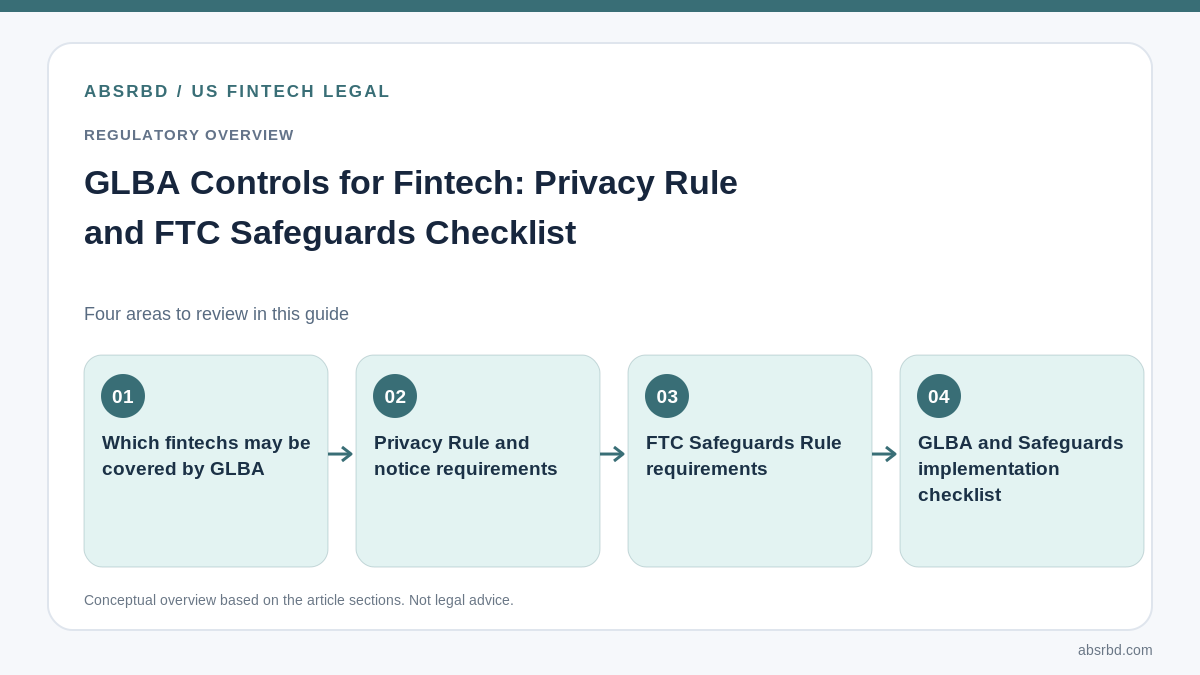
- Is the company a “financial institution” under the Gramm-Leach-Bliley Act?
- Does the GLBA Privacy Rule require notices or an opportunity to opt out of certain information sharing?
- Is the company subject to the Federal Trade Commission’s Safeguards Rule or another regulator’s security requirements?
- Can the company document a risk-based information security program covering customer information, personnel, systems, vendors, testing, and oversight?
A fintech should answer applicability first. The Gramm-Leach-Bliley Act is a federal law, but different regulators administer and enforce its requirements for different categories of financial institutions. A bank partnership, technology label, or lack of a physical branch does not by itself determine whether a company is covered.
Scope note: This guide explains GLBA applicability, the Privacy Rule, and the FTC Safeguards Rule. It does not address general privacy-policy drafting, detailed security-event notification procedures, or payment-card security standards. It is general information, not legal advice.
GLBA requirements at a glance
| Requirement | What it addresses | Core fintech task |
|---|---|---|
| Gramm-Leach-Bliley Act | Federal privacy and security obligations for financial institutions | Determine which entities, products, data, and regulators are in scope |
| GLBA Privacy Rule | Collection and disclosure of nonpublic personal information about consumers | Deliver required privacy notices and manage applicable opt-out rights |
| FTC Safeguards Rule | Protection of customer information by financial institutions under FTC jurisdiction | Maintain a written, risk-based information security program |
| Voluntary frameworks and industry standards | Methods for organizing or assessing controls | Use them as implementation tools, not as substitutes for applicable law |
Frameworks such as the NIST Cybersecurity Framework, ISO standards, and assurance programs may help organize controls or evidence. They are not the GLBA statute or the FTC’s rules, and completing one does not automatically establish GLBA compliance.
The principal regulatory references are the FTC’s Gramm-Leach-Bliley Act guidance, Privacy of Consumer Financial Information Rule, and Standards for Safeguarding Customer Information.
Which fintechs may be covered by GLBA?
A company may be a financial institution for GLBA purposes if it is significantly engaged in activities that are “financial in nature” or incidental to financial activities. Coverage is based on what the business does—not whether it calls itself a fintech, software company, marketplace, or platform.
Potentially covered activities can include:
- Lending or arranging credit
- Servicing loans
- Transmitting or exchanging money
- Providing certain financial advice
- Credit counseling
- Collecting debts
- Preparing individual tax returns
- Providing real estate settlement services
- Brokering or servicing mortgages
- Check-cashing and related financial services
This is not an exhaustive list. A product-by-product and entity-by-entity analysis is usually necessary, especially when a platform combines regulated financial services with software, data, or marketing functions.
GLBA applicability questions
| Question | Why it matters |
|---|---|
| What financial activity does each legal entity perform? | Coverage attaches to activities and entities, not merely to a brand |
| Is the entity significantly engaged in that activity? | Incidental involvement may not create the same obligations as operating a financial service |
| Are products offered for personal, family, or household purposes? | The Privacy Rule focuses on individual consumers obtaining financial products or services for these purposes |
| Does the fintech have a continuing customer relationship? | Customers and one-time consumers can have different notice rights |
| Does the company handle information for another financial institution? | Contractual safeguards may apply even when the vendor is not independently covered for that service |
| Which regulator has jurisdiction? | Banks, securities firms, insurers, and FTC-regulated nonbank institutions can be subject to different implementing rules |
| Does the company operate through a bank or other regulated partner? | The fintech may have contractual obligations and may also have independent regulatory duties |
A bank partnership does not automatically settle coverage
Many fintech products divide responsibilities among a bank, program manager, technology provider, lender, servicer, and other vendors. The regulated bank’s involvement does not automatically make every other party exempt.
Each participant should determine:
- Which entity establishes the customer relationship
- Which entity provides or services the financial product
- Which entity collects or controls consumer information
- Which party sends required notices
- Which systems store or process customer information
- Which regulator and contractual requirements apply to each entity
These conclusions should be documented rather than inferred from contract labels alone.
Service provider status is different from financial-institution status
A software or infrastructure provider does not necessarily become a financial institution solely because it supplies services to a covered company. However, it may still be required by contract to implement safeguards for customer information.
A provider may also be independently covered if it performs its own regulated financial activities. Fintechs should therefore conduct two separate analyses:
- Independent coverage: Is the company itself a financial institution?
- Downstream obligations: What security, privacy, audit, and oversight duties arise from customer or partner contracts?
GLBA Privacy Rule and notice requirements
The GLBA Privacy Rule governs how covered financial institutions disclose nonpublic personal information about individual consumers. It requires certain privacy notices and, in some circumstances, an opportunity to opt out before information is shared with nonaffiliated third parties.
Consumer, customer, and customer relationship
These terms have distinct meanings under the rule.
- Consumer: An individual who obtains, or has obtained, a financial product or service primarily for personal, family, or household purposes.
- Customer: A consumer who has a continuing relationship with the financial institution.
- Customer relationship: A continuing relationship in which the institution provides one or more financial products or services to the consumer.
A person who only submits an inquiry may not be a customer. A borrower with an ongoing loan or an account holder generally has a continuing relationship. The distinction affects when and to whom notices must be delivered.
Business customers are generally outside the Privacy Rule’s consumer-notice framework, although their data may be subject to other contractual or legal protections.
What is nonpublic personal information?
Nonpublic personal information generally includes personally identifiable financial information that:
- A consumer provides to obtain a financial product or service
- Results from a transaction involving the consumer
- The institution otherwise obtains in connection with providing a financial product or service
Examples may include application details, account information, transaction history, balances, payment activity, and information used to service a financial product.
Information is not automatically public simply because part of it appears in a public record. The institution must apply the rule’s requirements for determining whether information is publicly available. Lists, profiles, or inferences derived from customer relationships may also require careful analysis.
When a privacy notice may be required
| Notice type | General trigger |
|---|---|
| Initial customer notice | When establishing a customer relationship, subject to limited timing exceptions |
| Consumer notice before certain disclosures | Before sharing nonpublic personal information with a nonaffiliated third party outside the rule’s exceptions |
| Annual customer notice | During the customer relationship unless the institution qualifies for the statutory exception |
| Revised notice | Before making certain disclosures that are materially different from those described in the current notice |
An institution may qualify for the annual-notice exception when it shares information only under specified exceptions that do not require an opt-out and has not changed the relevant disclosure policies and practices since its most recent notice. The exception does not eliminate the need to maintain accurate practices or provide a revised notice when required.
What the notice should explain
Depending on the institution’s activities, the notice generally addresses:
- Categories of nonpublic personal information collected
- Categories of information disclosed
- Categories of affiliates and nonaffiliated third parties receiving information
- Information-sharing practices involving former customers
- Applicable consumer opt-out rights
- How consumers can exercise those rights
- General policies for protecting confidentiality and security
- Other disclosures required by the rule
The FTC rule includes model privacy forms. Correct use of an applicable model form can provide a safe harbor for the form’s notice content, but the statements must still accurately reflect the institution’s practices.
Delivery must be clear and effective
A required notice should be clear, conspicuous, and delivered in a manner reasonably expected to result in actual notice. Merely placing a privacy link on a public website may not satisfy a requirement to deliver a notice to a particular customer.
Fintechs should align notice delivery with the customer journey, including:
- Account or product enrollment
- Loan origination
- Mobile and web onboarding
- Material changes to sharing practices
- Annual-notice workflows when the exception does not apply
- Account closure and former-customer treatment
The compliance team should retain evidence of the notice version, delivery date, delivery method, and customer population covered.
When an opt-out may be necessary
A financial institution generally must provide an appropriate notice and a reasonable opportunity to opt out before disclosing nonpublic personal information to a nonaffiliated third party, unless an exception applies.
Exceptions can cover disclosures needed to process transactions, service accounts, prevent fraud, comply with legal requirements, or support specified service-provider and joint-marketing arrangements. These exceptions have conditions and should not be treated as a broad authorization for all vendor sharing.
For every external disclosure, document:
- The information being disclosed
- The recipient and its role
- The purpose of the disclosure
- The legal exception or opt-out basis
- Contractual restrictions on use and redisclosure
- How consumer preferences are recorded and enforced
FTC Safeguards Rule requirements
The FTC Safeguards Rule requires covered financial institutions under FTC jurisdiction to develop, implement, and maintain a comprehensive information security program. The program must contain administrative, technical, and physical safeguards appropriate to the institution’s size, complexity, activities, and sensitivity of the customer information involved.
What is customer information?
For Safeguards Rule purposes, customer information generally means records containing nonpublic personal information about a customer of a financial institution, whether in paper, electronic, or another form, that are handled or maintained by or on behalf of the institution.
The scope can therefore extend beyond the fintech’s primary production database. Relevant locations may include:
- Cloud infrastructure
- Employee devices
- Customer-support platforms
- Analytics environments
- File-sharing tools
- Paper records
- Backups and archives
- Vendor systems
- Development and testing environments containing customer information
Core Safeguards Rule elements
| Program element | Required compliance outcome |
|---|---|
| Qualified Individual | Designate a person responsible for overseeing and enforcing the information security program |
| Risk assessment | Identify reasonably foreseeable internal and external risks and evaluate whether existing safeguards control them |
| Access controls | Limit access to customer information to authorized users and necessary functions |
| Data and system inventory | Identify relevant data, personnel, devices, systems, and facilities |
| Encryption | Protect customer information in transit over external networks and at rest, or use an approved effective alternative where encryption is infeasible |
| Secure application practices | Evaluate and secure internally developed and externally sourced applications used with customer information |
| Multifactor authentication | Require MFA for access to information systems unless an equivalent control is approved in writing by the Qualified Individual |
| Data disposal | Securely dispose of customer information within the rule’s timeframe unless a legitimate business, legal, or feasibility exception applies |
| Change management | Evaluate security risks when systems, operations, or business processes change |
| Monitoring and testing | Regularly test safeguards through continuous monitoring or prescribed penetration testing and vulnerability assessments |
| Security awareness | Train personnel and keep security staff informed about relevant threats and defenses |
| Service provider oversight | Select capable providers, require safeguards by contract, and periodically assess providers based on risk |
| Incident response | Maintain an appropriate response plan where required and integrate the Rule’s current regulatory obligations |
| Program review | Adjust safeguards when risks, operations, technology, or testing results change |
| Governance reporting | Provide required written reporting to the board or equivalent governing body |
The Qualified Individual
The Qualified Individual oversees and enforces the information security program. The person does not need a particular job title and may work for an affiliate or service provider, but the covered financial institution remains responsible for compliance.
The role should have sufficient authority, access, and resources to:
- Coordinate risk assessments
- Approve safeguards and documented alternatives
- Monitor remediation
- Oversee testing
- Review service provider risks
- Escalate unresolved issues
- Report to the governing body
Written risk assessment
For institutions subject to the full requirement, the risk assessment must be written and include:
- Criteria for evaluating identified risks
- Criteria for assessing the confidentiality, integrity, and availability of information systems and customer information
- A description of how identified risks will be mitigated or accepted
- An explanation of how the information security program addresses those risks
A generic annual questionnaire is unlikely to be useful if it does not reflect the fintech’s actual systems, data flows, products, vendors, and threats.
Testing and continuous monitoring
The rule expects safeguards to be tested. Depending on the institution’s monitoring model, this can involve continuous monitoring or a combination of penetration testing and vulnerability assessments at the intervals required by the rule and after relevant changes or newly identified risks.
Testing should produce evidence, including:
- Defined scope
- Methodology
- Findings and severity
- Assigned owners
- Remediation deadlines
- Retest results
- Documented risk acceptance
For broader context on changing financial-sector threats, see banking cybersecurity statistics and trends.
Smaller-institution exception is limited
A financial institution that maintains customer information concerning fewer than 5,000 consumers may be exempt from certain specific provisions of the Safeguards Rule. It is not exempt from the entire rule.
Smaller institutions still need appropriate safeguards and should document:
- How the consumer count was calculated
- Which provisions remain applicable
- Why selected controls are appropriate
- When the count will be reassessed
Rapid growth, acquisitions, new products, and imported partner records can change the analysis.
GLBA and FTC Safeguards implementation checklist
Use this checklist as an internal review tool. Add an owner, due date, evidence link, and status for every applicable item.
1. Confirm scope and regulatory ownership
- [ ] List every legal entity, product, and financial activity.
- [ ] Identify which entities may be financial institutions under GLBA.
- [ ] Separate consumer-purpose products from business-purpose products.
- [ ] Identify the regulator responsible for each entity and activity.
- [ ] Document whether the FTC Safeguards Rule applies.
- [ ] Evaluate independent obligations and bank-partner contractual duties separately.
- [ ] Record the reasoning behind exclusions and exemptions.
- [ ] Schedule reassessment after product, entity, or partnership changes.
2. Map consumers, customers, and information
- [ ] Distinguish one-time consumers from customers with continuing relationships.
- [ ] Inventory nonpublic personal information and customer information.
- [ ] Map collection, use, disclosure, storage, transmission, and disposal.
- [ ] Include cloud, mobile, support, analytics, backup, test, and paper environments.
- [ ] Identify systems and vendors that receive customer information.
- [ ] Assign owners for major datasets and processing activities.
- [ ] Define retention requirements and approved disposal methods.
3. Review Privacy Rule notices
- [ ] Identify when an initial notice is required.
- [ ] Determine whether any consumer disclosures require notice and opt-out.
- [ ] Verify that notice statements match actual collection and sharing practices.
- [ ] Confirm that notices describe relevant categories of information and recipients.
- [ ] Establish a clear and conspicuous delivery process.
- [ ] Retain evidence of notice versions and delivery.
- [ ] Determine whether the annual-notice exception applies.
- [ ] Monitor changes that could require a revised notice.
- [ ] Test whether consumer opt-out choices are enforced across systems and vendors.
4. Establish security governance
- [ ] Designate a Qualified Individual.
- [ ] Define the Qualified Individual’s authority, resources, and escalation path.
- [ ] Maintain a written information security program.
- [ ] Assign control owners across security, engineering, operations, legal, and compliance.
- [ ] Establish written reporting to the board or equivalent governing body where required.
- [ ] Track material findings, remediation, exceptions, and risk acceptance.
5. Complete and maintain the risk assessment
- [ ] Identify reasonably foreseeable internal and external risks.
- [ ] Define risk-evaluation criteria.
- [ ] Assess confidentiality, integrity, and availability risks.
- [ ] Evaluate existing safeguards.
- [ ] Create treatment plans for unacceptable risks.
- [ ] Document any accepted risks and approving authority.
- [ ] Update the assessment after material operational or technical changes.
6. Implement technical and operational safeguards
- [ ] Restrict access according to role and business need.
- [ ] Review access periodically and remove access promptly when no longer required.
- [ ] Require multifactor authentication or document an approved equivalent control.
- [ ] Encrypt customer information in transit over external networks and at rest.
- [ ] Document approved alternatives where encryption is infeasible.
- [ ] Maintain secure development and application-review practices.
- [ ] Protect customer information used in development and testing.
- [ ] Maintain secure configuration and change-management processes.
- [ ] Monitor authorized-user activity for unauthorized access or misuse.
- [ ] Dispose of customer information securely when retention is no longer permitted or necessary.
7. Test safeguards and remediate findings
- [ ] Select continuous monitoring or the required testing approach.
- [ ] Define penetration-testing and vulnerability-assessment scope.
- [ ] Test after material changes and relevant new risks.
- [ ] Rank findings consistently by risk.
- [ ] Assign remediation owners and deadlines.
- [ ] Retest corrected issues.
- [ ] Escalate overdue high-risk findings.
- [ ] Preserve reports and remediation evidence.
8. Manage personnel and service providers
- [ ] Provide role-appropriate security awareness training.
- [ ] Train personnel who handle customer information or administer relevant systems.
- [ ] Evaluate whether service providers can maintain appropriate safeguards.
- [ ] Include security requirements in provider contracts.
- [ ] Define permitted use, access, retention, and disposal of customer information.
- [ ] Periodically reassess providers based on risk.
- [ ] Track provider findings and corrective actions.
- [ ] Confirm secure termination or transition procedures when a provider relationship ends.
9. Prepare for incidents and regulatory change
- [ ] Maintain the incident-response documentation required for the institution.
- [ ] Define internal escalation among security, legal, compliance, and leadership.
- [ ] Ensure counsel evaluates current FTC Safeguards Rule notification obligations when relevant.
- [ ] Incorporate lessons from incidents and testing into the security program.
- [ ] Monitor FTC rule changes and official guidance.
- [ ] Review the compliance program after mergers, launches, migrations, and major vendor changes.
Recommended implementation sequence
A fintech building or repairing its GLBA program should proceed in this order:
- Resolve applicability. Identify covered entities, products, regulators, and contractual duties.
- Map customer information. Determine where it enters, moves, resides, and leaves the organization.
- Validate privacy notices. Compare disclosures and opt-out processes with actual data practices.
- Designate accountable leadership. Give the Qualified Individual authority and access to governance bodies.
- Conduct the risk assessment. Base the security program on documented risks rather than a generic control list.
- Close priority control gaps. Address access, MFA, encryption, secure development, monitoring, and disposal.
- Strengthen vendor oversight. Connect due diligence, contracts, reassessments, and remediation.
- Test and report. Validate safeguards, track findings, and provide required governance reporting.
- Reassess continuously. Update the program as products, data, technology, threats, and regulatory expectations change.
Digital finance products can scale faster than their original compliance assumptions. Teams evaluating that growth can also review current digital banking statistics for broader market context.
Final GLBA compliance review
A defensible program should allow the fintech to answer “yes” to five questions:
- Can it explain why each entity and product is inside or outside GLBA’s scope?
- Do its privacy notices accurately describe its real information-sharing practices?
- Can consumer opt-out choices be applied wherever required?
- Does its written security program reflect actual customer information, systems, risks, and vendors?
- Can it produce evidence that safeguards are governed, tested, remediated, and reviewed?
The checklist above should be treated as a living GLBA and FTC Safeguards checklist, not a one-time certification. Revisit it whenever the fintech launches a product, changes a data use, adds a partner, migrates systems, or enters a new financial activity.