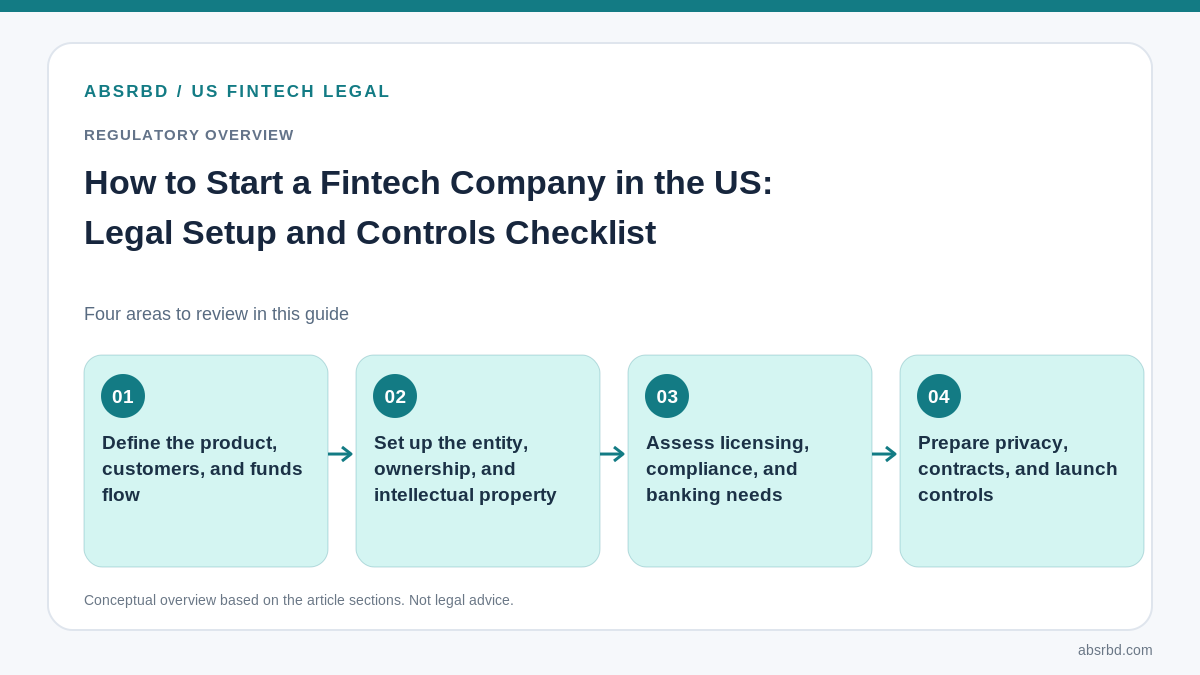
Starting a fintech company in the United States requires more than forming an entity and building an app. The correct launch sequence begins with the product, customers, and movement of money because those details determine which licenses, compliance controls, contracts, and financial partners the company may need.
A practical launch process follows eight steps:
- Define the product and target customers.
- Document how funds and financial data move.
- Form the company and establish ownership.
- Assign intellectual property to the company.
- Analyze licensing and regulatory obligations.
- Select banks, processors, and other regulated partners.
- Prepare privacy notices, contracts, and compliance controls.
- Complete a controlled launch-readiness review.
This guide provides a high-level legal and operational checklist, not a complete map of US financial regulation. Requirements vary by product, customer, transaction flow, and state. Engage qualified legal, tax, and compliance professionals before launch.
Fintech launch sequence at a glance
| Launch phase | Primary task | Required output | Launch gate |
|---|---|---|---|
| Product definition | Identify the product, users, and transaction flow | Written product and funds-flow map | The team can explain who provides each financial service |
| Company setup | Establish the entity, ownership, governance, and tax accounts | Formation records, cap table, founder documents | The company owns its assets and can enter contracts |
| Regulatory assessment | Identify potentially regulated activities | Written licensing and compliance analysis | Each regulated function has an owner and legal basis |
| Partner selection | Evaluate banks, processors, and vendors | Due-diligence file and negotiated agreements | Partners approve the program and responsibilities are documented |
| Privacy and contracting | Create customer, employee, and vendor documents | Notices, terms, policies, and contracts | Documents match actual product behavior |
| Launch readiness | Test controls, disclosures, support, and reporting | Approval checklist with accountable owners | No unresolved critical compliance or operational gaps |
1. Define the product, customers, and funds flow
Do not begin the legal analysis with a company type or a list of regulations. Begin with a precise description of what the product does.
Write a one-paragraph product definition
The definition should answer:
- What financial problem does the product solve?
- Who will use it: consumers, businesses, financial institutions, or another group?
- What financial activity occurs?
- Who holds, receives, transfers, lends, invests, or safeguards money?
- Does the company make decisions or only provide technology?
- Which bank, lender, broker, insurer, or payment provider supplies the regulated service?
- How does the company earn revenue?
Avoid broad descriptions such as “a payments platform” or “an AI lending product.” Legal and partner reviews require operational detail.
A more useful description would identify:
- The payer and recipient
- The payment method
- Where funds are held
- Which party initiates the transfer
- Which party can stop or reverse it
- The company’s fee
- The underlying regulated institution, if any
Identify the customer and user separately
The person paying for the product may not be the person whose money or data is processed. Document all relevant parties, including:
- Contracting customers
- End users
- Account holders
- Payment recipients
- Borrowers or applicants
- Business administrators
- Bank or platform partners
- Third-party data providers
This distinction affects disclosures, consent, identity verification, customer support, data rights, and contract structure.
Create a funds-flow diagram
A funds-flow diagram should show every stage of a transaction from initiation through settlement. For each step, record:
| Funds-flow question | What to document |
|---|---|
| Where does the money begin? | Customer account, card, wallet, business account, or other source |
| Who initiates the transaction? | Consumer, merchant, platform, employer, or automated system |
| Who receives the funds first? | The fintech, a bank, a processor, or another intermediary |
| Does the fintech control the funds? | Whether it can direct, delay, return, or redirect a transaction |
| Where are funds held? | Bank account, custodial account, pooled account, or other arrangement |
| Who maintains the ledger? | The fintech, bank, processor, or multiple parties |
| Who performs settlement? | The institution responsible for final movement of funds |
| What happens when a transaction fails? | Return, reversal, refund, dispute, or exception process |
| How is the company paid? | Subscription, transaction fee, interchange-related revenue, interest-related revenue, or another model |
Create a separate data-flow map showing what personal and financial information is collected, where it is stored, who receives it, and when it is deleted.
Test the business model before legal scoping
Confirm the following before asking counsel or partners to evaluate the product:
- [ ] Target customers and states are identified.
- [ ] Every transaction participant is named.
- [ ] Funds and data flows are documented.
- [ ] Revenue sources are defined.
- [ ] The company’s role is separated from each partner’s role.
- [ ] Refunds, disputes, losses, and failed transactions are addressed.
- [ ] Planned marketing claims match the actual product.
A licensing analysis based on an incomplete transaction flow will often need to be repeated after the product changes.
2. Set up the entity, ownership, and intellectual property
The appropriate entity and jurisdiction depend on financing plans, tax treatment, governance, founder circumstances, and expected operations. There is no single entity structure that is best for every fintech startup.
The US Small Business Administration provides general guidance on launching a business, choosing a structure, registering the company, and obtaining required tax accounts. Fintech founders should combine those formation steps with industry-specific legal and compliance planning.
Establish the company
Work through these foundational tasks:
-
Choose the entity structure and formation state.
Evaluate liability, taxes, fundraising, governance, and administrative obligations with legal and tax advisers. -
File the formation documents.
Complete the required filing with the relevant state authority. -
Adopt governance documents.
Prepare bylaws or an operating agreement, board or manager approvals, and authority rules for contracts and bank accounts. -
Obtain tax registrations.
Apply for an Employer Identification Number and determine whether state or local tax registrations are required. -
Qualify in additional states when necessary.
A company may need authority to conduct business outside its formation state based on its activities and presence. -
Open company financial accounts.
Keep company funds separate from founder funds and establish documented approval controls. -
Maintain a compliance calendar.
Track annual reports, taxes, registered-agent obligations, license renewals, insurance renewals, and contractual reporting dates.
Document founder ownership
Unclear ownership can delay fundraising, banking relationships, and acquisitions. The company’s records should show:
- Founder equity allocations
- Vesting terms, if used
- Voting and approval rights
- Capital contributions
- Restrictions on transferring equity
- Treatment of a founder’s departure
- A current capitalization table
- Board and stockholder approvals
- Tax elections or filings recommended by the company’s advisers
Do not rely on emails or informal promises to establish ownership.
Transfer intellectual property to the company
The company—not an individual founder or outside developer—should own the intellectual property necessary to operate the product.
Review ownership of:
- Source code
- Algorithms and models
- Product designs
- Brand names and logos
- Domains and social accounts
- Documentation
- Customer lists
- Inventions
- Data compilations
- Training materials
- Proprietary processes
Founders, employees, and contractors should sign appropriate confidentiality and intellectual-property assignment agreements. Contractor status alone does not guarantee that all work product belongs to the company.
Also review third-party components, including:
- Open-source software licenses
- Commercial software terms
- APIs and developer platforms
- Data-provider restrictions
- Model and training-data rights
- White-label technology
- Code produced before the company was formed
Protect the brand before investing in it
Before committing to a company or product name:
- Search for conflicting business names and trademarks.
- Confirm that appropriate domains and social handles are available.
- Review whether the name could mislead users about banking, government, insurance, or licensed status.
- Decide whether trademark registration is appropriate.
- Record which company entity owns the brand.
3. Assess licensing, compliance, and banking needs
A fintech company’s regulatory position depends on what it actually does—not what it calls itself. Describing the business as a software platform does not resolve whether its activities require a license or must be performed through a regulated partner.
Screen the product for regulated activities
Use the following table as an issue-spotting tool rather than a legal conclusion:
| Product activity | Questions to investigate | Possible launch response |
|---|---|---|
| Moving or receiving money | Does the company accept, hold, control, or transmit customer funds? In which states? | Evaluate money-transmission and related requirements; consider an appropriate licensed or bank partner |
| Consumer or business lending | Who is the lender? Who sets terms, approves applicants, funds loans, and services accounts? | Determine licensing, disclosure, servicing, fair-lending, and partner requirements |
| Deposit or account features | Which insured depository institution holds the funds and provides the account? | Establish a bank-partnership structure with accurate customer disclosures |
| Cards | Who issues the card, processes transactions, handles disputes, and bears losses? | Contract with the relevant bank and payment providers; define operational responsibilities |
| Investment features | Does the product recommend, arrange, execute, or hold securities transactions? | Obtain specialist securities analysis before launch |
| Insurance features | Does the company sell, solicit, quote, or administer insurance products? | Review state licensing and carrier relationships |
| Credit or identity data | Is consumer-report information obtained, used, or furnished? | Assess permissible use, notices, disputes, accuracy, and vendor controls |
| Digital assets | Does the company exchange, transfer, safeguard, or facilitate transactions involving digital assets? | Obtain activity-specific federal and state analysis |
| Financial data aggregation | What data is accessed, under whose authorization, and for what purpose? | Document consent, security, contractual rights, and data-use limits |
If a product touches several categories, analyze each function separately. One partner may not cover every activity.
Decide whether to obtain licenses or use regulated partners
A startup generally needs to determine whether it will:
- Obtain and maintain required licenses itself
- Operate as an authorized agent or service provider
- Offer services through a bank or another regulated institution
- Limit or redesign the product to avoid performing a regulated function
- Use different structures in different states
The decision should account for:
- Target launch states
- Time and cost of licensing
- Net-worth, bonding, reporting, and examination obligations
- Partner availability
- Product control
- Economics and revenue-sharing
- Geographic expansion plans
- Compliance staffing
- Exit and migration rights
A bank or licensed partner does not automatically eliminate the fintech’s obligations. The contracts and operating model must clearly allocate responsibilities, while the fintech must still perform the controls assigned to it.
Build a proportionate compliance program
After identifying applicable requirements, convert them into operational responsibilities. Depending on the product, the program may need controls for:
- Customer identification and verification
- Anti-money-laundering procedures
- Sanctions screening
- Fraud prevention
- Consumer disclosures
- Marketing review
- Complaints and disputes
- Fair-lending or fair-access risks
- Transaction monitoring
- Record retention
- Regulatory reporting
- Employee training
- Vendor oversight
- Testing and remediation
For each control, document:
- The requirement or risk being addressed
- The person accountable for it
- The systems and vendors involved
- The frequency of review
- The records retained as evidence
- The escalation procedure when the control fails
Select and evaluate financial partners
Fintech startups may depend on banks, lenders, payment processors, card networks, identity providers, data vendors, or compliance platforms. Conduct due diligence before making product promises based on a potential relationship.
A partner review should cover:
- Regulatory status and relevant capabilities
- Product and customer restrictions
- Geographic coverage
- Required compliance controls
- Integration and testing requirements
- Implementation timeline
- Fees and reserves
- Fraud and loss allocation
- Service levels
- Data access and ownership
- Audit and reporting rights
- Subcontractors
- Business continuity
- Termination rights
- Customer migration and data return
- Approval rights over product changes and marketing
Expect regulated partners to review the startup’s ownership, finances, policies, product design, vendors, security, compliance leadership, and marketing materials.
4. Prepare privacy, contracts, and launch controls
Privacy policies and customer terms should describe the product that will actually launch. Copying documents from another fintech can create conflicts between the company’s public promises, internal practices, and partner agreements.
Build privacy from the data map
Start with an inventory of personal and financial information:
- What data is collected?
- Is it collected directly or obtained from another party?
- Why is each data element needed?
- Where is it stored?
- Which employees and vendors can access it?
- Is it sold, shared, or used for advertising?
- How long is it retained?
- How can it be corrected or deleted?
- What happens when the relationship ends?
Then determine which federal and state privacy, financial privacy, security, and breach-notification requirements apply. Applicability can depend on the company’s role, size, customers, location, and relationship with regulated institutions.
At minimum, align the following:
- Public privacy notice
- In-product consent language
- Cookie and tracking practices
- Vendor data-processing terms
- Information-security program
- Access controls
- Retention and deletion schedule
- Incident-response plan
- Consumer request process
- Employee privacy and security procedures
Do not state that data is never shared if banks, processors, cloud providers, analytics services, or other vendors receive it.
Prepare the core contracts
The required agreements will depend on the business model, but most fintech startups should consider the following categories:
| Contract or document | Primary purpose |
|---|---|
| Customer terms of service | Define product use, fees, restrictions, liability, disputes, and account termination |
| Product-specific disclosures | Explain financial terms, transaction timing, risks, and customer rights |
| Privacy notice | Describe collection, use, disclosure, and protection of personal information |
| Bank or regulated-partner agreement | Allocate program responsibilities, oversight, economics, reporting, and termination rights |
| Vendor agreement | Set service levels, data rights, security requirements, audit rights, and exit obligations |
| Data-processing terms | Control the handling, retention, transfer, and deletion of personal information |
| Employment and contractor agreements | Address confidentiality, intellectual property, duties, and compensation |
| Referral or marketing agreement | Define approved claims, lead handling, compensation, and compliance responsibilities |
| Enterprise customer agreement | Set implementation, support, security, data, and commercial terms |
All customer-facing documents should use consistent definitions for the company, its partners, the product, fees, and account relationships.
Review marketing claims
Marketing review should cover websites, app-store descriptions, sales decks, social posts, influencer materials, onboarding screens, and support scripts.
Check whether the company can substantiate claims involving:
- Costs or savings
- Speed of transfers
- Approval likelihood
- Credit improvement
- Returns or performance
- Security
- Insurance or protection
- “Free” services
- Availability in every state
- Bank status
- Government affiliation
- Artificial intelligence or automation
Disclosures should be clear where customers make decisions, not placed only in a separate legal document.
Establish operational launch controls
Before accepting real customers or moving real money, test the full customer journey. Include normal transactions and exceptions.
The launch review should test:
- Account opening
- Identity-verification failures
- Funding and settlement
- Fees
- Refunds and reversals
- Unauthorized transactions
- Customer disputes
- Account restrictions and closure
- Complaint intake
- Suspicious or unusual activity escalation
- Privacy requests
- Data deletion
- System outages
- Security incidents
- Partner reporting
- Ledger and bank-account reconciliation
Assign an owner and deadline to every unresolved issue. Critical legal, security, funds-flow, and customer-harm risks should be resolved before launch.
Fintech startup legal checklist
Product and business model
- [ ] Define the product in operational terms.
- [ ] Identify customers, end users, and transaction participants.
- [ ] Document funds flow from initiation through settlement.
- [ ] Document personal and financial data flows.
- [ ] Identify who holds funds and maintains each ledger.
- [ ] Define revenue sources and fees.
- [ ] Plan for returns, disputes, losses, and failed transactions.
- [ ] Confirm that product descriptions match actual operations.
Entity and ownership
- [ ] Select the entity structure and formation state with professional advice.
- [ ] File formation documents.
- [ ] Adopt governance documents and approval rules.
- [ ] Obtain required federal, state, and local tax registrations.
- [ ] Open company financial accounts.
- [ ] Document founder equity and vesting.
- [ ] Maintain an accurate capitalization table.
- [ ] Create an annual filing and compliance calendar.
Intellectual property
- [ ] Assign founder-created intellectual property to the company.
- [ ] Use confidentiality and invention-assignment agreements.
- [ ] Confirm ownership of contractor work.
- [ ] Review open-source and third-party software terms.
- [ ] Verify rights to data, APIs, models, and content.
- [ ] Search for conflicting company and product names.
- [ ] Register or protect key trademarks when appropriate.
- [ ] Place domains and essential accounts under company control.
Licensing and compliance
- [ ] Identify every potentially regulated product function.
- [ ] Analyze requirements in each target state.
- [ ] Decide whether to obtain licenses, use partners, or change the product.
- [ ] Document the legal basis for the launch structure.
- [ ] Assign an owner to every compliance obligation.
- [ ] Create written policies and operating procedures.
- [ ] Establish training, monitoring, reporting, and recordkeeping.
- [ ] Schedule periodic legal and compliance reviews.
Banks and vendors
- [ ] Determine which regulated partners are required.
- [ ] Complete partner and vendor due diligence.
- [ ] Confirm geographic and product coverage.
- [ ] Define fraud, dispute, and loss responsibilities.
- [ ] Negotiate security, audit, reporting, and data rights.
- [ ] Review subcontractors and critical dependencies.
- [ ] Establish business-continuity arrangements.
- [ ] Plan for termination, migration, and data return.
Privacy, security, and contracts
- [ ] Complete a personal-data inventory.
- [ ] Identify applicable privacy and security requirements.
- [ ] Prepare an accurate privacy notice.
- [ ] Establish retention and deletion rules.
- [ ] Implement role-based access controls.
- [ ] Prepare an incident-response plan.
- [ ] Finalize customer terms and product disclosures.
- [ ] Finalize employee, contractor, partner, and vendor agreements.
- [ ] Review all marketing claims for accuracy and support.
Launch readiness
- [ ] Test onboarding and identity-verification exceptions.
- [ ] Test transactions, settlement, reconciliation, and refunds.
- [ ] Test disputes, complaints, restrictions, and account closure.
- [ ] Confirm customer-support escalation paths.
- [ ] Verify required reports and partner notifications.
- [ ] Confirm that production systems match approved documentation.
- [ ] Record approval from legal, compliance, security, product, and operations owners.
- [ ] Resolve all critical launch issues.
- [ ] Schedule a post-launch control review.
What to monitor after launch
Legal readiness is not a one-time exercise. Product features, state coverage, vendors, marketing claims, and transaction flows can change the company’s obligations.
Establish a change-review process for:
- New products or financial features
- Entry into additional states
- New customer types
- Changes to fees or revenue
- New banks, processors, or data vendors
- Material changes to funds flow
- New uses of customer data
- Acquisitions or fundraising
- Customer complaints and dispute trends
- Security incidents
- Partner audit findings
- Regulatory developments
For broader market context, review the fintech startups watchlist and visit the posts1 resource library for additional startup guidance.
Fintech startup legal checklist (PDF): Save or print the checklist in this guide as a PDF for founder, legal, compliance, product, and operations reviews. Update it whenever the product, transaction flow, partner structure, or launch geography changes.