For most U.S. startups, the practical choice is straightforward:
- Choose an LLC when the founders want flexible ownership, relatively simple governance and pass-through taxation—especially if the company will remain closely held.
- Choose a C corporation when the startup expects to raise institutional venture capital, issue multiple classes of equity, grant conventional stock options or pursue a potential public offering.
Both structures can protect owners from many business liabilities. The bigger differences involve taxation, governance, equity design and investor compatibility.
Important: Entity selection has legal and tax consequences that vary by state, founder residency, industry and financing plan. This guide provides general U.S. information, not individualized legal or tax advice.
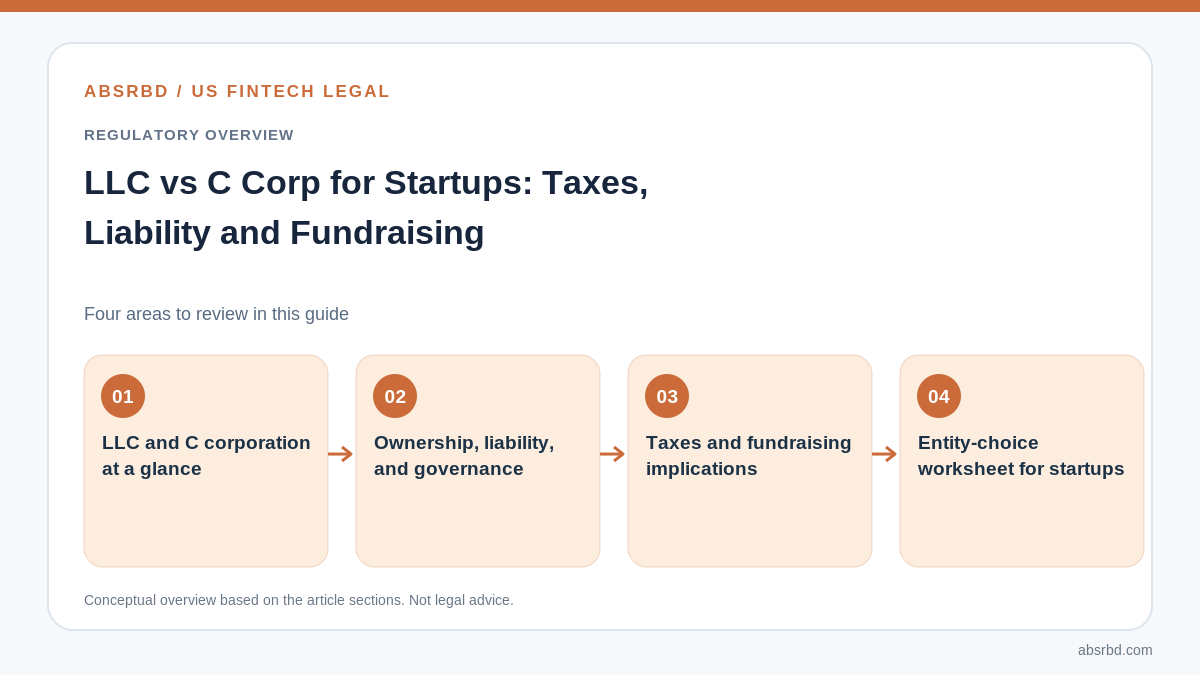
LLC and C corporation at a glance
An LLC, or limited liability company, is a state-law business entity owned by one or more members. Its operating agreement typically controls governance, economic rights and transfers of ownership.
A C corporation is a state-law corporation taxed under Subchapter C of the Internal Revenue Code. It is owned by shareholders, governed by a board of directors and managed day to day by officers.
| Decision factor | LLC | C corporation |
|---|---|---|
| Owners | Members | Shareholders |
| Ownership interests | Membership interests or units | Shares of stock |
| Governance | Flexible; member-managed or manager-managed | Shareholders, board of directors and officers have distinct roles |
| Default federal tax treatment | Usually disregarded-entity treatment for one owner or partnership treatment for multiple owners | Taxed as a separate corporate taxpayer |
| Owner tax reporting | Business income and loss generally pass through under default treatment | Shareholders generally report dividends or gains when applicable |
| Payroll and self-employment tax issues | Depend on tax classification and the owner’s role | Owners working for the company are generally employees receiving wages |
| Equity flexibility | Highly customizable, but arrangements can be complex | Well-established structure for common stock, preferred stock and stock options |
| Institutional venture capital | Often less attractive to traditional VC funds | Commonly preferred by venture investors |
| Liability protection | Generally protects members from company obligations | Generally protects shareholders from company obligations |
| Governance burden | Usually lighter and more flexible | More formal approvals, records and fiduciary structure |
| Potential public offering | Conversion would ordinarily be needed | Compatible with the conventional IPO path |
| Typical fit | Closely held, bootstrapped or cash-generating business | High-growth startup seeking institutional investment |
The answer is not simply that LLCs are “small” and corporations are “large.” A large business can operate as an LLC, while a small startup can form a C corporation. The right structure depends on the company’s expected ownership, financing and tax profile.
Ownership, liability and governance
How LLC ownership works
LLC owners are called members. An LLC may have one member or multiple members, subject to applicable state law and industry restrictions.
An operating agreement can define:
- Each member’s economic interest
- Voting rights
- Management authority
- Profit and loss allocations
- Distribution rules
- Transfer restrictions
- Procedures for admitting new members
- Buyout and departure provisions
- Rules for resolving deadlocks
This contractual flexibility is valuable when founders want economics or control rights that do not track a standard stockholding model. It can also make an LLC more complicated: investors, employees and tax advisers must understand rights that may be unique to that particular operating agreement.
How C corporation ownership works
C corporation owners are shareholders. Their ownership is represented by shares, and the corporation’s charter may authorize different classes or series of stock.
A venture-backed startup commonly uses:
- Common stock for founders and, often, employees
- Preferred stock for investors
- Stock options or other equity awards under an incentive plan
- Convertible instruments that may convert into stock under specified terms
The corporate model separates major responsibilities:
- Shareholders elect directors and approve certain fundamental transactions.
- The board of directors oversees the company and approves major decisions.
- Officers manage daily operations under the board’s authority.
These formal roles can require more administration, but they also create a familiar decision-making framework for investors, counsel and potential acquirers.
Liability protection is meaningful but not absolute
Both LLCs and corporations generally separate business liabilities from their owners’ personal assets. A member or shareholder is not ordinarily responsible for a company debt solely because that person owns part of the business.
However, entity status does not protect a founder from every risk. Personal exposure may still arise from:
- A personal guarantee of a loan, lease or other obligation
- The founder’s own fraud, negligence or unlawful conduct
- Certain unpaid taxes or statutory obligations
- Improper mixing of personal and company funds
- Inadequate authorization or documentation
- Circumstances in which a court permits the entity’s liability shield to be disregarded
Maintaining separate bank accounts, documenting approvals and treating the company as an independent legal entity are important under either structure.
Governance differences that matter to founders
An LLC can centralize authority in the founders or designated managers. A corporation generally requires a board and corporate approvals, even if the founders initially hold every role.
| Governance question | LLC approach | C corporation approach |
|---|---|---|
| Who manages the business? | Members or appointed managers | Officers under board oversight |
| Who approves major actions? | As stated in the operating agreement and applicable law | Board, and sometimes shareholders, under the charter, bylaws and applicable law |
| Are annual formalities required? | Requirements vary by state; internal formalities are usually flexible | State filings and corporate approvals are typically more formal |
| Can voting and economics differ? | Yes, through customized membership terms | Yes, through stock classes, voting agreements and related documents |
| Is the structure standardized? | Less standardized | More standardized, particularly for venture-backed companies |
Founders should not assume that flexibility is always simpler. A heavily negotiated LLC operating agreement may be more difficult to administer than conventional corporate documents.
Taxes: LLC vs. C corporation
The most important tax distinction is that LLC describes a legal structure, not a single federal tax regime.
Default LLC taxation
For federal income tax purposes, the default treatment is generally:
- A single-member LLC is disregarded as separate from its owner.
- A multi-member LLC is treated as a partnership.
- An eligible LLC may elect to be taxed as a corporation.
Under pass-through treatment, the LLC generally does not pay federal income tax as a separate entity. Instead, taxable income or loss passes through to the owners, who report their shares on their own returns.
That can create an important cash-flow issue: members may owe tax on allocated income even if the LLC does not distribute enough cash to cover the tax. A carefully drafted operating agreement may address tax distributions, but the details require professional advice.
Members who work in the business may also face self-employment and payroll tax questions. The result depends on the LLC’s tax classification, the member’s role and how compensation is structured.
The IRS overview of limited liability companies explains the basic federal classifications.
C corporation taxation
A C corporation is a separate federal taxpayer. It reports its income, deductions and tax liability on its own return.
Shareholders do not automatically report the corporation’s annual operating income. They may incur tax when they receive taxable dividends or dispose of shares at a gain. This produces the possibility of two levels of tax:
- The corporation may pay tax on its taxable income.
- Shareholders may pay tax on dividends or gains.
“Double taxation” is a useful shorthand, but it does not mean every dollar is always taxed twice. A startup may have losses, reinvest earnings rather than pay dividends, compensate employees through deductible wages or generate value primarily through appreciation in its shares. The actual result depends on the company’s finances and the owners’ circumstances.
The IRS corporation guidance provides an overview of federal corporate tax treatment.
Tax comparison for startup founders
| Tax issue | LLC with default pass-through treatment | C corporation |
|---|---|---|
| Who reports operating income? | Members generally report their allocated shares | The corporation reports its income |
| Can owners owe tax without receiving cash? | Yes, allocated taxable income may exceed distributions | Shareholders generally do not report undistributed corporate operating income solely because they own stock |
| Can losses reach founders’ returns? | Potentially, subject to basis, at-risk, passive-activity and other limitations | Corporate losses generally remain at the corporate level |
| How are working owners paid? | Rules depend on tax classification and member status | Founder-employees generally receive wages through payroll |
| Are dividends relevant? | Distributions are governed by pass-through tax rules rather than conventional corporate dividend treatment | Taxable dividends may create shareholder-level tax |
| Are state taxes uniform? | No | No |
State and local taxes can materially change the comparison. A startup may face income, franchise, gross-receipts, payroll or minimum taxes based on where it is formed and conducts business.
Potential qualified small business stock treatment
Certain C corporation shares may qualify as qualified small business stock under Internal Revenue Code Section 1202, potentially providing favorable federal treatment when detailed statutory requirements are met. Requirements concern matters such as the issuer, assets, business activities, original issuance and holding period.
This potential benefit does not apply automatically to every startup or every shareholder. Founders considering it should seek tax advice before issuing shares, changing entity type or selling stock.
Fundraising implications
Why venture investors commonly prefer C corporations
Traditional venture capital funds generally prefer to invest in C corporations, often corporations formed in Delaware. The reasons commonly include:
- Familiar preferred-stock rights
- Standardized financing documents
- Clear board governance
- Conventional stock option plans
- Easier administration across multiple financing rounds
- Compatibility with potential acquisitions and public offerings
- Avoidance of pass-through tax reporting for the fund and its investors
Some investment funds have tax-exempt or non-U.S. participants, or governing documents that restrict pass-through investments. An LLC’s allocations can create tax filings or categories of income that the fund does not want to receive.
An LLC is not legally prohibited from raising money. It can issue different membership interests and negotiate sophisticated investor protections. The practical question is whether the target investors are willing and able to invest in that structure.
When an LLC can fit the financing plan
An LLC may work well when the company expects funding from:
- Its founders
- Friends and family
- A small number of active private investors
- Investors comfortable receiving pass-through tax documents
- Strategic partners willing to negotiate customized membership rights
- Debt providers rather than equity investors
It can also fit a company designed to distribute operating cash rather than reinvest for rapid growth.
When a C corporation is usually the stronger fit
A C corporation is generally the more suitable starting point if the plan includes:
- Institutional seed or venture capital
- Multiple preferred-stock financing rounds
- A broad employee equity program
- Numerous shareholders
- International or tax-exempt fund investors
- A possible public offering
- A conventional venture-backed acquisition path
Entity choice cannot fix a weak business model or financing strategy. Before optimizing a company for investors, founders should also understand the broader reasons startups fail, including insufficient demand, cash constraints and team problems.
Delaware considerations
Delaware is a common incorporation state for venture-backed companies, but it is not automatically the best jurisdiction for every startup.
Why startups choose Delaware C corporations
Delaware offers a well-developed body of corporate law and a court system experienced in business disputes. Investors and their counsel are also familiar with Delaware corporate documents and governance practices.
For a startup pursuing institutional venture capital, that familiarity can reduce structural friction during financing. Some investors may require an existing company to convert or reorganize as a Delaware C corporation before closing an investment.
What Delaware formation does not do
Forming in Delaware does not mean the company can ignore other states. A Delaware entity operating elsewhere may need to:
- Register to do business in the states where it has sufficient activity
- Maintain a registered agent
- File reports and pay applicable state fees or taxes
- Comply with employment, licensing and tax rules where it operates
A startup based entirely in one state may therefore incur obligations in both Delaware and its operating state. Delaware also does not create federal tax advantages merely because the entity was formed there.
Delaware LLC vs. Delaware C corporation
Delaware supports both LLCs and corporations. The state’s LLC law allows extensive contractual flexibility, while its corporate law provides the familiar stock-and-board framework used in venture financing.
The relevant question is not simply “Delaware or home state.” Founders should first decide whether an LLC or corporation fits the business, then evaluate the formation state.
Founder equity and employee incentives
LLC equity can be flexible but administratively complex
An LLC may grant membership interests, profits interests or contractual incentives. These arrangements can be effective, but their tax and accounting treatment differs from conventional corporate stock options.
An employee who becomes an LLC member may also be treated differently for federal tax and payroll purposes than a corporate employee. That distinction can affect withholding, benefits administration and tax reporting.
C corporation equity is more standardized
C corporations commonly compensate employees and advisers with:
- Restricted stock
- Nonqualified stock options
- Incentive stock options for eligible employees
- Restricted stock units
- Other awards approved under an equity incentive plan
Each form has its own tax, securities-law and documentation requirements. The advantage is not that corporate equity is simple; it is that investors, lawyers, payroll providers and prospective employees are generally more familiar with it.
Founder decisions to document early
Regardless of entity type, founders should address:
- Ownership percentages
- Vesting or repurchase rights
- Intellectual property assignment
- Voting control
- Transfer restrictions
- Departure and termination scenarios
- Approval authority
- Dilution from future financing
- Treatment of unissued equity or membership interests
Delaying these decisions can create disputes and complicate due diligence.
Limitations for regulated and professional businesses
Entity choice may be constrained by industry rules. A state or federal regulator may impose requirements concerning ownership, control, capitalization, management or licensing.
Potential restrictions include:
- Requiring a professional corporation, professional LLC or another approved form
- Limiting ownership to licensed professionals
- Requiring regulatory approval for changes in control
- Restricting foreign ownership
- Requiring qualified officers, managers or directors
- Conditioning a license on minimum capital or bonding
- Requiring separate entities for particular regulated activities
These rules are especially relevant in fields such as financial services, insurance, healthcare, law, accounting and other licensed professions. Requirements differ by activity and jurisdiction; a structure accepted in one state may not be accepted in another.
Startups developing financial products should identify the regulated activity before selecting an entity. The fintech startups watchlist provides additional context on the market and regulatory issues that can shape fintech companies.
Can a startup convert from an LLC to a C corporation later?
Often, yes. Depending on the states involved, a company may use a statutory conversion, merger or another restructuring method.
However, conversion is not necessarily a simple administrative update. It may involve:
- Tax consequences for the company or its members
- New corporate governance documents
- Conversion of membership interests into stock
- Reworking employee or adviser incentive arrangements
- Assignment or consent requirements under contracts
- Updates to licenses, bank accounts and registrations
- Investor approval rights
- Changes to accounting and tax reporting
Starting as an LLC and converting before a venture round can work, but founders should not assume conversion will be costless or tax-neutral. The likely financing timeline should influence the original choice.
Entity-choice worksheet for startups
Use this worksheet to organize the decision before meeting with legal and tax advisers. Check the column that better describes the company’s expected path.
| Question | Points toward an LLC | Points toward a C corporation |
|---|---|---|
| Who will own the business? | A small, stable group of members | Founders, employees and multiple outside investors |
| How will the company be funded? | Founder capital, cash flow, debt or a few private investors | Institutional seed or venture capital |
| Will profits be distributed regularly? | Likely | Unlikely; earnings will probably be reinvested |
| Is pass-through taxation desirable? | Yes, after reviewing owner-level effects | No, or investor compatibility is more important |
| Will the company issue standard stock options? | Not a primary requirement | Yes |
| Are multiple equity rounds expected? | No or uncertain | Yes |
| Does the company need customized economic allocations? | Possibly | Usually not |
| Is an IPO a realistic long-term objective? | No | Potentially |
| Do target investors accept pass-through entities? | Yes | No or unknown |
| Is the business regulated? | The applicable regulator permits an LLC | The regulator or licensing plan favors a corporation |
| How important is governance flexibility? | High | Standardized governance is preferable |
| Where will the company operate? | Primarily in one state | Multiple states or an investor-driven Delaware structure |
Founder review checklist
Before finalizing the structure, obtain clear answers to these questions:
- [ ] Who are the initial owners, and what will each receive?
- [ ] Will ownership vest over time?
- [ ] Does the company expect institutional investment within the next several years?
- [ ] Have likely investors confirmed which entity types they can hold?
- [ ] Will the business distribute profits or reinvest them?
- [ ] How will working founders be compensated?
- [ ] Could pass-through income create tax obligations without matching cash distributions?
- [ ] Will employees or advisers receive equity?
- [ ] Does the business need common and preferred ownership classes?
- [ ] Is the company subject to professional or industry licensing?
- [ ] Does any regulator restrict ownership or control?
- [ ] Should the business form in its operating state or Delaware?
- [ ] What additional registrations would a Delaware entity need?
- [ ] Have a startup attorney and tax professional reviewed the proposed structure?
The U.S. Small Business Administration’s business launch resources can also help founders identify counseling and planning support.
Bottom line
An LLC is often the better fit for a closely held startup that values flexible governance, pass-through taxation and simpler ownership arrangements. A C corporation is usually the better fit for a high-growth startup seeking venture capital, standardized employee equity and multiple financing rounds.
Liability protection alone rarely decides the issue because both structures generally provide it. The decisive questions are who will own the company, how profits will be taxed, what kind of investors it will pursue, how employee equity will work and whether industry regulations limit the available choices.