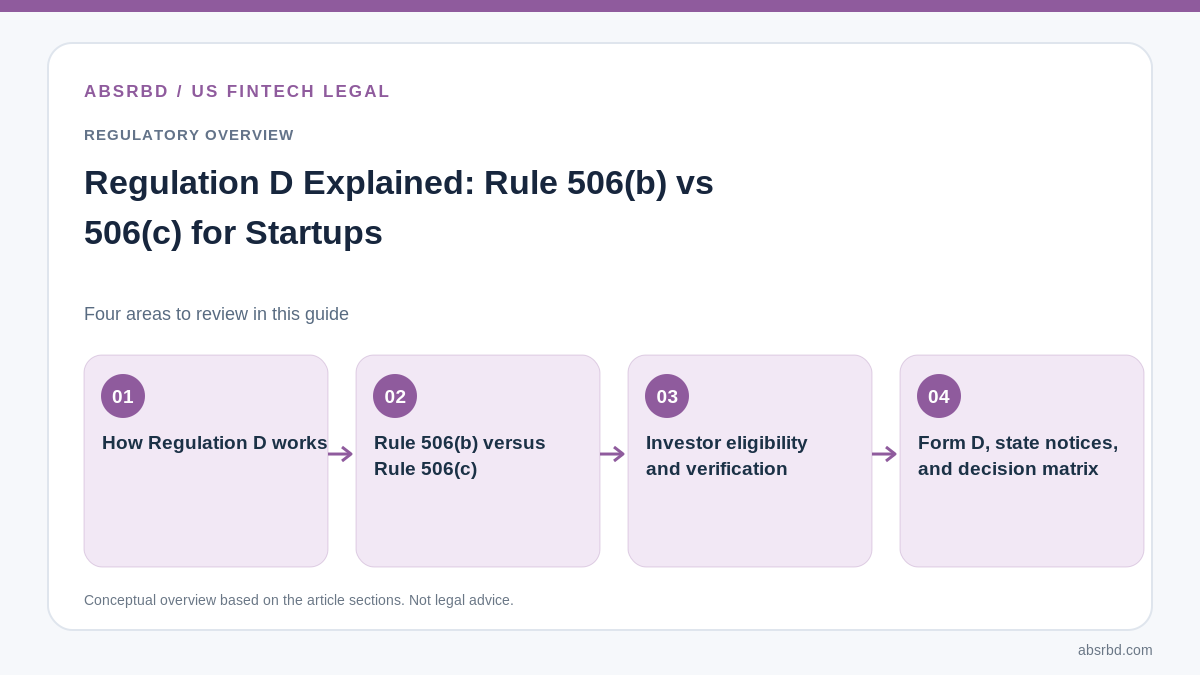
Regulation D is a Securities and Exchange Commission framework that allows eligible companies to raise capital through private securities offerings without registering the offering with the SEC. For many startups, the central choice is between:
- Rule 506(b): No general solicitation; permits an unlimited number of accredited investors and up to 35 sophisticated non-accredited investors.
- Rule 506(c): General solicitation is permitted, but every purchaser must be accredited and the issuer must take reasonable steps to verify that status.
Both routes allow an unlimited offering amount, generally involve restricted securities, require attention to “bad actor” disqualification rules, and typically require a Form D filing.
How Regulation D Works
The Securities Act of 1933 generally requires securities offerings to be registered with the SEC unless an exemption applies. Regulation D provides exemptions that startups and other private companies can use when selling equity, debt, or other securities.
Regulation D includes Rules 504 and 506. This guide focuses on Rules 506(b) and 506(c) because they are commonly considered by startups conducting private offerings.
What Regulation D does—and does not do
A valid Regulation D offering may exempt the transaction from federal registration, but it does not eliminate other legal obligations.
An issuer must still consider:
- Federal and state anti-fraud requirements
- Offering communications and disclosures
- Investor eligibility
- General solicitation restrictions
- “Bad actor” disqualification
- Form D filing requirements
- State notice filings and fees
- Transfer restrictions applicable to the securities
- Recordkeeping that supports reliance on the exemption
Regulation D securities are generally restricted securities, meaning investors ordinarily cannot freely resell them without registration or an available resale exemption.
The SEC provides an overview of these rules in its guidance on exempt offerings for small businesses.
Rule 506(b) vs. Rule 506(c)
The most important difference is straightforward: Rule 506(b) prohibits general solicitation but can include a limited number of qualified non-accredited investors; Rule 506(c) permits public marketing but requires verified accredited investors exclusively.
| Comparison point | Rule 506(b) | Rule 506(c) |
|---|---|---|
| Maximum offering amount | No federal dollar limit | No federal dollar limit |
| General solicitation | Not permitted | Permitted |
| Accredited investors | Unlimited number | All purchasers must be accredited |
| Non-accredited investors | Up to 35, subject to sophistication and disclosure requirements | Not permitted as purchasers |
| Accredited-status process | Issuer must have a reasonable belief that the investor is accredited | Issuer must take reasonable steps to verify accredited status |
| Public advertising | Generally incompatible with the exemption | Permitted, subject to securities-law requirements |
| Form D | Required after the first sale | Required after the first sale |
| Federal preemption of state registration | Generally available | Generally available |
| State notices and fees | May still apply | May still apply |
| Restricted securities | Yes | Yes |
When Rule 506(b) may fit
Rule 506(b) may be appropriate when a startup:
- Plans to approach investors privately
- Has an established network of prospective investors
- Does not need to advertise the offering publicly
- Wants the option to accept a limited number of sophisticated non-accredited investors
- Can maintain controls over who receives offering information
The critical operational issue is avoiding general solicitation. A company cannot select Rule 506(b) on paper while promoting the offering publicly in a way that conflicts with the exemption.
When Rule 506(c) may fit
Rule 506(c) may be appropriate when a startup:
- Wants to promote the offering publicly
- Plans to reach investors through websites, social media, events, or broad communications
- Will accept only accredited investors
- Has a reliable process for verifying each purchaser’s accredited status
- Is prepared to maintain verification records while protecting sensitive investor information
Rule 506(c) provides greater marketing flexibility, but that flexibility comes with a higher investor-verification burden.
General Solicitation and Public Communications
General solicitation can include communications that make an offering available to people with whom the issuer or its representatives do not have an appropriate private-offering relationship.
Potential examples include:
- Public social media posts announcing investment terms
- Unrestricted offering pages on a company website
- Mass emails to purchased or broadly compiled lists
- Public advertisements
- Open investment seminars or presentations promoted to the general public
- Media interviews that actively market the securities offering
Whether a communication constitutes general solicitation depends on its facts and context. Ordinary company publicity is not automatically an offering solicitation, but communications about fundraising, investment returns, security terms, or how to invest can create significant risk.
Rule 506(b): Control the audience before communicating terms
A 506(b) issuer should establish a communications process before sending offering materials. Useful controls include:
- Identifying recipients and documenting how the relationship arose
- Limiting access to offering documents
- Training founders and employees not to promote the offering publicly
- Coordinating communications by brokers, placement agents, and other intermediaries
- Reviewing fundraising statements in interviews, newsletters, pitch events, and social posts
- Preserving records of investor communications
A large online following or an investor’s appearance on a contact list does not, by itself, establish that a 506(b) solicitation is private.
Rule 506(c): Public marketing does not remove compliance duties
A 506(c) issuer may use general solicitation, but public marketing is not unrestricted. Offering statements remain subject to federal and state anti-fraud rules. Claims should be accurate, supportable, complete in context, and consistent across pitch decks, websites, presentations, and offering documents.
Allowing someone to view an advertisement is different from allowing that person to purchase. Every purchaser in a Rule 506(c) offering must be an accredited investor whose status has been reasonably verified.
Investor Eligibility and Verification
Rules 506(b) and 506(c) use different compliance standards for accredited investors.
Rule 506(b): Reasonable belief
Under Rule 506(b), an issuer must have a reasonable belief that an investor qualifies as accredited at the time of sale. The process is often supported by an investor questionnaire, representations, prior knowledge, supporting information, and follow-up where an answer is incomplete or inconsistent.
The rule does not impose the same mandatory reasonable-verification standard used under Rule 506(c). However, an issuer should not ignore warning signs or rely mechanically on unsupported answers when the surrounding facts call them into question.
Non-accredited investors under Rule 506(b)
Rule 506(b) permits up to 35 non-accredited purchasers. Each must possess sufficient knowledge and experience in financial and business matters to evaluate the merits and risks of the investment, either individually or together with a purchaser representative.
Including even one non-accredited purchaser can create substantial additional disclosure obligations. The issuer may need to provide:
- Specified business and offering information
- Financial statements appropriate to the offering
- Written disclosures within the required timeframe
- An opportunity for investors to ask questions and receive answers
- Information that is not materially different from information supplied to accredited investors
For that reason, some 506(b) offerings voluntarily accept only accredited investors even though the exemption can accommodate qualifying non-accredited purchasers.
Rule 506(c): Reasonable verification
Under Rule 506(c), checking a box or accepting an unsupported investor representation is generally not enough by itself. The issuer must take reasonable steps to verify that each purchaser is accredited.
The SEC’s framework is principles-based. Factors can include:
- The type of purchaser
- The information already known about the purchaser
- The nature and reliability of supporting information
- How the purchaser was solicited
- The minimum investment amount
- Whether the circumstances create reasons to question accredited status
The rule also identifies non-exclusive verification methods for certain natural-person investors. Depending on the qualification basis, these may involve:
- Reviewing specified income documentation and obtaining a representation concerning the current year
- Reviewing recent asset and liability information for net-worth verification
- Obtaining written confirmation from an eligible third party, such as a registered broker-dealer, SEC-registered investment adviser, licensed attorney, or certified public accountant
- Using another documented method that is reasonable under the particular circumstances
Because verification can involve tax, financial, and credit information, issuers should minimize unnecessary data collection and use secure handling procedures.
Practical distinction: Rule 506(b) centers on a reasonable belief that an investor is accredited. Rule 506(c) requires reasonable steps to verify accredited status.
This article does not provide a complete analysis of every accredited-investor category. Investor status should be evaluated under the current SEC definitions and the purchaser’s specific circumstances.
Form D Filing Requirements
Form D is the SEC notice filing used for Regulation D offerings. It provides information about the issuer, related persons, the exemption claimed, the offering size, the amount sold, investor counts, and certain payments to intermediaries.
When Form D is due
An issuer relying on Rule 506 generally must file Form D electronically through the SEC’s EDGAR system within 15 calendar days after the first sale of securities.
For this purpose, the first sale generally occurs when the first investor becomes irrevocably contractually committed to invest. It is not necessarily the date on which the issuer first advertises, distributes a pitch deck, or receives funds.
Form D filing process
-
Obtain EDGAR access.
Complete the SEC account and access process early enough to avoid a filing delay. -
Confirm the claimed exemption.
Determine whether the offering is proceeding under Rule 506(b) or Rule 506(c). -
Identify the first-sale date.
Track when the first purchaser becomes contractually committed. -
Collect required offering information.
Gather issuer details, executive and promoter information, offering amounts, investor data, and intermediary compensation. -
File Form D through EDGAR.
Submit the notice within the applicable deadline. -
Review amendment requirements.
Amendments may be necessary to correct material mistakes, report certain changes, or update a continuing offering. -
Coordinate state filings.
Use the Form D information to complete required state notices and pay applicable fees.
What Form D does not do
Form D is a notice filing. It is not:
- SEC approval of the offering
- A finding that the investment is suitable
- A substitute for satisfying Rule 506 conditions
- A replacement for offering disclosures
- A federal filing that automatically completes every state requirement
Form D becomes publicly accessible, so the issuer should review it carefully for accuracy and consistency with other offering materials.
State Securities Notices and Fees
Securities sold under Rule 506 are generally “covered securities,” which limits states’ ability to require separate registration or qualification of the offering. However, federal preemption does not eliminate state involvement.
States may still require:
- A copy of Form D
- A state notice filing
- Consent to service of process
- Filing fees
- Amendments or renewal notices for ongoing offerings
- Filings based on the residence of participating investors
State anti-fraud authority also remains in place.
Build a state filing map
A startup should not assume that filing Form D with the SEC automatically satisfies state requirements. Instead:
- List each investor’s state of residence.
- Identify the notice requirement and deadline in each relevant state.
- Determine whether electronic filing is available or required.
- Record filing fees and payment methods.
- Track amendments and ongoing-offering requirements.
- Preserve filing confirmations and correspondence.
State deadlines and procedures can vary. Review the current requirements for every jurisdiction connected to the offering.
Regulation D Decision Matrix
Use this matrix as an initial screening tool, not as a substitute for legal analysis.
| Startup’s situation | Rule 506(b) indication | Rule 506(c) indication |
|---|---|---|
| The offering will be promoted publicly | Poor fit | Stronger fit |
| The company will contact a controlled private network | Stronger fit | Possible |
| Public social media promotion is central to the fundraising plan | Poor fit | Stronger fit |
| A non-accredited investor may participate | Possible, subject to limits and added requirements | Not permitted |
| Every purchaser will be accredited | Possible | Required |
| The company wants to rely primarily on questionnaires and reasonable belief | Possible | Insufficient unless the overall process reasonably verifies status |
| The company can operate a formal verification process | Optional but useful | Required |
| The company wants fewer disclosure complications from non-accredited purchasers | Accept accredited investors only | All purchasers must be accredited |
| The company cannot reliably control public statements by its fundraising team | Higher compliance risk | More compatible with public outreach, but anti-fraud rules still apply |
| The company wants to avoid collecting sensitive verification documents directly | Possible | Consider qualified third-party verification |
Quick decision rule
Choose the compliance path before marketing begins:
- Use Rule 506(b) when the raise will remain private and the company can control solicitation.
- Use Rule 506(c) when public promotion is necessary and the company can verify every purchaser’s accredited status.
- Pause before accepting funds if communications, investor eligibility, or prior fundraising activity make the chosen exemption uncertain.
Startup Compliance Checklist
Before offering securities
- [ ] Define the security being offered and the terms of the offering.
- [ ] Select Rule 506(b) or Rule 506(c) before beginning outreach.
- [ ] Review whether founders, executives, promoters, or compensated solicitors create bad-actor concerns.
- [ ] Establish an investor-eligibility process.
- [ ] Prepare accurate and consistent offering disclosures.
- [ ] Set rules for websites, email, social media, events, and media statements.
- [ ] Create secure recordkeeping procedures.
- [ ] Begin the EDGAR access process.
- [ ] Identify potential federal and state filing obligations.
For a Rule 506(b) offering
- [ ] Avoid general solicitation.
- [ ] Document how prospective investors were identified.
- [ ] Restrict access to offering materials where appropriate.
- [ ] Support the reasonable belief that accredited purchasers qualify.
- [ ] Count non-accredited purchasers carefully.
- [ ] Evaluate sophistication and purchaser-representative issues.
- [ ] Provide the required disclosures before any sale to a non-accredited investor.
For a Rule 506(c) offering
- [ ] Confirm that only accredited investors may purchase.
- [ ] Select and document a reasonable verification method.
- [ ] Follow up on inconsistent or incomplete information.
- [ ] Protect sensitive investor records.
- [ ] Ensure public statements are accurate and consistent.
- [ ] Prevent unverified prospects from completing a purchase.
After the first sale
- [ ] Record the first-sale date.
- [ ] File Form D within 15 calendar days.
- [ ] Complete applicable state notice filings and fee payments.
- [ ] Track changes that may require a Form D amendment.
- [ ] Maintain subscription documents, questionnaires, verification records, and filing receipts.
- [ ] Apply transfer restrictions and update capitalization records.
- [ ] Monitor ongoing communications for consistency with the selected exemption.
Common Regulation D Mistakes
Marketing first and choosing an exemption later
Public promotion conducted before selecting Rule 506(b) can undermine the planned private-offering approach. The exemption and communications policy should be established before outreach starts.
Treating 506(c) self-certification as sufficient
A representation can form part of the record, but Rule 506(c) requires reasonable verification. The issuer should document what it reviewed, who performed the review, and why the process was reasonable.
Assuming accredited investors eliminate disclosure risk
Accredited-only offerings may avoid some prescriptive disclosure requirements applicable when non-accredited investors participate, but anti-fraud rules still apply. Material statements cannot be false or misleading, and material omissions can create liability.
Forgetting state filings
Federal preemption does not mean “no state paperwork.” Notice filings, fees, deadlines, and anti-fraud enforcement may still apply.
Using uncoordinated fundraising materials
A pitch deck, data room, Form D, subscription agreement, website, and founder presentation should not contain conflicting facts. Establish a review process and a single source of truth for key offering information.
Overlooking people involved in the offering
Bad-actor rules and broker-dealer issues can arise from the conduct or role of founders, executives, promoters, finders, and other participants. Paying transaction-based compensation to someone who is not properly registered can create additional legal concerns.
Key Takeaways
For most startups comparing SEC Rule 506(b) and Rule 506(c), the decision turns on two questions:
- Will the company use general solicitation?
- Can the company verify that every purchaser is accredited?
Rule 506(b) supports a private fundraising process and may include up to 35 sophisticated non-accredited purchasers, although doing so adds disclosure and compliance obligations. Rule 506(c) allows public solicitation but limits purchasers to verified accredited investors.
Whichever route applies, startups should coordinate offering communications, investor eligibility, Form D, state notices, disclosures, and recordkeeping from the beginning. Companies evaluating the broader financing environment can also review global venture capital funding trends for startups or explore additional fundraising resources on the startup blog.
This article provides general information about U.S. securities regulation and is not legal, tax, or investment advice. Regulation D requirements are fact-specific and may change; consult qualified securities counsel and current SEC and state guidance before conducting an offering.