The GENIUS Act is enacted federal law, not merely a legislative proposal. Signed on July 18, 2025, it establishes a licensing and supervisory framework for issuers of payment stablecoins in the United States.
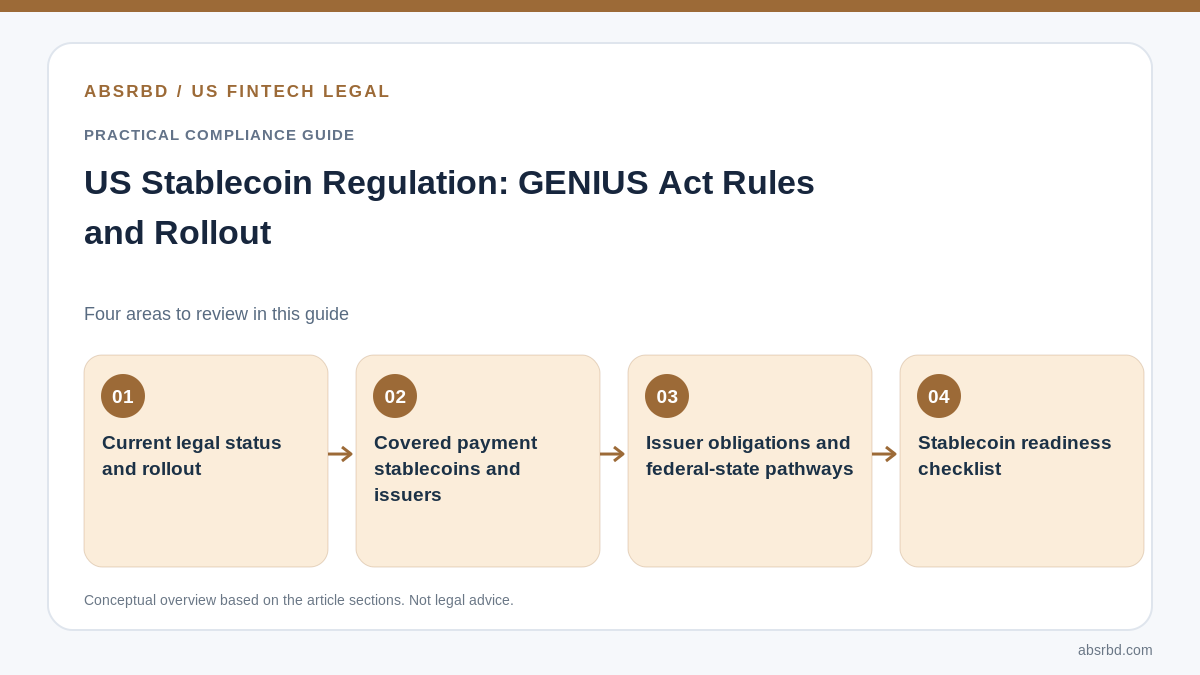
The law does not mean every operational requirement applied immediately on enactment. Its principal requirements take effect on the earlier of:
- January 18, 2027, which is 18 months after enactment; or
- 120 days after the primary federal payment stablecoin regulators issue final implementing regulations.
Federal regulators generally have until July 18, 2026 to issue implementing regulations. Issuers should therefore prepare now while monitoring federal rulemaking and state-regime certification.
Key distinction: Congress enacted the statutory framework, but regulations must supply important operational details—including application procedures, capital standards, liquidity requirements, and reserve-management rules.
Current Legal Status and GENIUS Act Rollout
The Guiding and Establishing National Innovation for U.S. Stablecoins Act, commonly called the GENIUS Act, creates the first dedicated US federal framework for payment stablecoin issuance.
The legislative timeline matters because some earlier government materials describe the bill before final enactment. For example, the US Department of the Treasury’s GENIUS Act statement followed Senate passage. The bill subsequently passed the House and was signed into law on July 18, 2025.
Enacted, effective, and pending requirements
| Regulatory element | Current legal position | What an issuer should do |
|---|---|---|
| GENIUS Act framework | Enacted as federal law | Map products and entities against the statutory definitions |
| Core issuer requirements | Established by statute, with the principal regime subject to the statutory effective-date formula | Build reserve, redemption, disclosure, compliance, and governance programs |
| Implementing regulations | Required from the relevant federal regulators | Monitor rulemaking by the Office of the Comptroller of the Currency and applicable banking regulators |
| Federal issuer approvals | Authorized by the law, with procedures and standards to be implemented by regulators | Identify the appropriate regulator and prepare application materials |
| State regulatory pathway | Available for qualifying issuers under a certified state framework | Confirm whether the relevant state regime is certified as substantially similar to the federal framework |
| Restrictions on nonpermitted issuance and distribution | Subject to statutory transition periods | Review issuance and distribution arrangements well before the applicable deadlines |
Important statutory dates
- July 18, 2025: The GENIUS Act was signed into law.
- July 18, 2026: General statutory deadline for federal implementing regulations.
- January 18, 2027: Eighteen-month effective-date backstop, unless final regulations trigger an earlier date.
- July 18, 2028: Three-year transition point relevant to restrictions on offering or selling payment stablecoins from issuers that do not qualify under the framework.
Final rules, agency interpretations, and state certifications may affect how these dates apply to a particular issuer or product.
What Counts as a Payment Stablecoin?
Under the GENIUS Act, a payment stablecoin is generally a digital asset designed for use as a means of payment or settlement where the issuer:
- Is obligated to convert, redeem, or repurchase the asset for a fixed amount of monetary value; and
- Represents that the asset maintains or is expected to maintain a stable value relative to that monetary amount.
The framework is directed at assets that function as redeemable payment instruments. It does not automatically treat every digital asset marketed as “stable” as a covered payment stablecoin.
Products requiring closer classification analysis
A company should conduct a product-specific analysis if the arrangement involves:
- A token representing a bank deposit;
- An asset whose value is linked to commodities, securities, an index, or another digital asset;
- An algorithmic mechanism without a fixed redemption obligation;
- A closed-loop balance usable only with one merchant or platform;
- A token issued outside the United States but offered to US customers; or
- A product combining payment, rewards, investment, or lending features.
Product labels are not decisive. Regulators are likely to examine the issuer’s redemption obligation, representations to users, reserve structure, distribution model, and actual economic function.
Who May Issue Payment Stablecoins?
The GENIUS Act centers the market on permitted payment stablecoin issuers. A “stablecoin issuer license” is a convenient shorthand, but the law creates several approval and supervision pathways rather than one universal license.
Federal and state issuer pathways
| Pathway | Typical issuer | Primary supervisor | Key considerations |
|---|---|---|---|
| Insured depository institution subsidiary | Subsidiary of an insured bank or credit union | Applicable federal banking or credit-union regulator | The issuing subsidiary must receive approval and comply with stablecoin-specific requirements |
| Federal qualified payment stablecoin issuer | Eligible nonbank issuer seeking a federal route | Office of the Comptroller of the Currency | OCC approval, supervision, examination, and federal prudential requirements apply |
| State qualified payment stablecoin issuer | Eligible entity approved under a qualifying state framework | Certified state payment stablecoin regulator | State regime must meet the federal substantial-similarity standard; the $10 billion threshold affects continued eligibility |
| Qualifying foreign issuer | Non-US issuer operating under a comparable foreign regime | US and home-country authorities, as applicable | Separate comparability, registration, reserve, and US-market conditions apply |
Federal pathway for nonbank issuers
A nonbank business seeking nationwide federal authorization can apply to become a federal qualified payment stablecoin issuer under the supervision of the Office of the Comptroller of the Currency.
An applicant should expect scrutiny of:
- Ownership and organizational structure;
- Management qualifications and governance;
- Reserve custody and investment policies;
- Redemption capacity;
- Capital and liquidity;
- Operational resilience and cybersecurity;
- Bank Secrecy Act and sanctions compliance;
- Financial reporting and audit controls;
- Recovery, resolution, and orderly wind-down planning; and
- Material service providers and technology dependencies.
The final application format and detailed approval standards depend on implementing regulations.
Pathway for bank and credit-union subsidiaries
An insured depository institution generally participates through an approved subsidiary rather than issuing directly without a separate stablecoin approval process. The appropriate federal banking agency—or the National Credit Union Administration for an applicable credit-union structure—oversees the approval and supervision.
The stablecoin subsidiary remains subject to the GENIUS Act’s requirements even when its parent institution already operates under federal banking supervision.
State-qualified issuer pathway
A qualifying issuer may operate under state supervision when:
- The state has established a payment stablecoin regulatory framework;
- The federal Stablecoin Certification Review Committee determines that the framework is substantially similar to the federal regime; and
- The issuer remains eligible for state supervision under the statutory size threshold and related rules.
The state pathway generally applies while the issuer has no more than $10 billion in consolidated payment stablecoins outstanding. An issuer that exceeds the threshold must ordinarily transition to federal supervision unless it receives permission to remain under state oversight.
State authorization alone is therefore not enough. The issuer must determine whether:
- The state has adopted a dedicated framework;
- That framework has received the necessary federal certification;
- The issuer has obtained state approval;
- Consolidated issuance remains within the threshold; and
- Growth projections require a future federal transition.
Core GENIUS Act Requirements for Issuers
Although detailed regulations will refine the compliance standards, the statute establishes the central obligations around reserves, redemption, disclosures, risk management, and financial-crime controls.
1. Maintain qualifying reserves on a one-to-one basis
A permitted issuer must maintain identifiable reserves supporting its outstanding payment stablecoins at least one-to-one.
Permitted reserve categories generally emphasize highly liquid, low-risk assets, including:
- US currency;
- Demand deposits or similarly eligible balances at insured depository institutions;
- Short-dated US Treasury obligations;
- Certain repurchase and reverse-repurchase agreements backed by eligible government obligations;
- Qualifying government money market funds invested in permitted assets;
- Eligible central-bank reserve balances; and
- Other assets approved under the regulatory framework.
Issuers should not assume that every cash equivalent or investment-grade instrument qualifies. Final rules may specify maturity limits, concentration controls, custodial arrangements, valuation methods, and diversification requirements.
2. Restrict reserve reuse
The law limits pledging, rehypothecation, and reuse of reserve assets. Narrow exceptions may be available for permitted liquidity management associated with redemptions and subject to regulatory conditions.
An issuer’s reserve policy should clearly document:
- Who legally owns each reserve account;
- Whether assets are held for the benefit of stablecoin holders;
- Which parties have custody or control;
- Whether any lien, pledge, or security interest exists;
- How intraday liquidity is managed; and
- How prohibited reuse is prevented and detected.
3. Provide timely redemption at a fixed value
Issuers need a published redemption policy that explains how holders can redeem stablecoins for the represented monetary value.
The policy should address:
- Eligible redeeming parties;
- Direct and indirect redemption channels;
- Settlement methods and timing;
- Minimum redemption amounts;
- Permitted fees;
- Identity-verification requirements;
- Processing during periods of market stress; and
- Suspension or delay conditions allowed by law.
A technically redeemable product may still create compliance risk if operational barriers make redemption impractical or materially inconsistent with public representations.
4. Publish reserve and circulation disclosures
Issuers must provide recurring public information about reserves and outstanding stablecoins. A disclosure program should be capable of reporting:
- Total payment stablecoins outstanding;
- Reserve value;
- Reserve composition by asset category;
- Custodians and account structure where disclosure is required;
- Valuation methodology;
- Relevant maturity information; and
- Changes from prior reporting periods.
Monthly reports are subject to examination by an independent registered public accounting firm, and senior executives have certification responsibilities. Larger issuers may face additional annual financial-statement audit requirements.
Marketing materials, dashboards, reserve reports, and accounting records should use consistent definitions. Conflicting circulation or reserve figures can create supervisory and consumer-confidence problems.
5. Maintain capital, liquidity, and risk-management controls
The statute authorizes regulators to establish standards for:
- Capital adequacy;
- Liquidity;
- Reserve diversification;
- Interest-rate and market risk;
- Operational risk;
- Cybersecurity;
- Custody;
- Business continuity;
- Recovery and resolution; and
- General risk management.
Issuers should separate three related but different concepts:
| Control | Primary purpose | Example question |
|---|---|---|
| Reserves | Back stablecoins in circulation | Are qualifying assets at least equal to outstanding tokens? |
| Liquidity | Meet redemption requests promptly | Can reserves be converted to cash during stress without material loss or delay? |
| Capital | Absorb operating and business losses | Can the issuer continue operating if revenue falls or a service provider fails? |
Having one dollar of reserves for each token does not, by itself, prove adequate liquidity or capital.
6. Comply with anti-money-laundering and sanctions rules
Permitted payment stablecoin issuers are treated as financial institutions for Bank Secrecy Act purposes. Their compliance programs should address:
- Customer identification and due diligence;
- Transaction monitoring;
- Suspicious activity reporting;
- Recordkeeping;
- Sanctions screening;
- Risk assessment;
- Independent testing;
- Designated compliance responsibility; and
- Training.
Issuers must also maintain the technological capability to comply with lawful orders involving stablecoins, including orders to freeze, seize, or burn assets when legally required.
This obligation should be reflected in smart-contract administration, key management, incident response, escalation procedures, and governance over privileged technical functions.
7. Avoid prohibited yield and misleading representations
A permitted issuer may not pay interest or yield to a holder solely for holding, using, or retaining the payment stablecoin. Product teams should review rewards, rebates, distribution incentives, and related arrangements to determine whether they could be characterized as prohibited issuer-paid yield.
Issuers also should not claim or imply that a payment stablecoin is:
- Backed by the full faith and credit of the United States;
- Guaranteed by the federal government;
- Covered by federal deposit insurance merely because reserves are held at an insured bank; or
- Legal tender.
Clear disclosures should distinguish the stablecoin from the reserve assets supporting it.
8. Prepare for insolvency and orderly wind-down
The GENIUS Act gives stablecoin holders a priority interest in required reserve assets in an issuer insolvency. Implementation still requires careful legal and operational planning.
Issuers should establish:
- Segregated reserve records;
- Holder and circulation ledgers;
- Reconciliation procedures;
- Custodian access arrangements;
- Redemption continuity plans;
- Wind-down triggers;
- Communication protocols; and
- A process for transferring or liquidating reserves.
Reserve segregation should work in practice, not only in contractual language.
Federal vs. State Pathway: How to Choose
The appropriate pathway depends on the issuer’s structure, scale, growth plans, and desired supervisory model.
| Decision factor | Federal pathway may fit when… | State pathway may fit when… |
|---|---|---|
| Expected issuance | Outstanding stablecoins may exceed $10 billion | Issuance is expected to remain within the state-pathway threshold |
| Geographic strategy | A unified federal supervisory relationship is preferred | The business has a strong connection to a qualifying state regime |
| Existing structure | The issuer is a bank subsidiary or seeks an OCC-supervised nonbank model | The issuer is eligible for approval by a certified state regulator |
| Growth planning | Early federal supervision could avoid a later transition | Near-term scale does not justify an immediate federal application |
| Regulatory readiness | The business can meet federal application and supervision requirements | The applicable state has completed certification and opened its approval process |
The decision should account for future scale, not merely current circulation. A state-qualified issuer approaching the $10 billion threshold needs a transition plan before crossing it.
Stablecoin Readiness Checklist
Use this checklist to identify gaps before applications and final implementation deadlines.
Product classification
- [ ] Document whether the asset meets the statutory definition of a payment stablecoin.
- [ ] Identify the legal entity obligated to redeem or repurchase it.
- [ ] Confirm the fixed monetary value represented to holders.
- [ ] Review whether deposit, securities, commodity, or other exclusions may apply.
- [ ] Map all US issuance, offering, distribution, and redemption activity.
Regulatory pathway
- [ ] Select a bank-subsidiary, OCC, or state-qualified pathway.
- [ ] Identify the primary regulator and any additional supervisory authorities.
- [ ] If using a state route, confirm that the state framework is federally certified.
- [ ] Model whether consolidated outstanding stablecoins could exceed $10 billion.
- [ ] Create a federal-transition plan if growth may exceed the state threshold.
- [ ] Track federal regulations, guidance, application forms, and effective dates.
Reserves and custody
- [ ] Maintain qualifying reserves of at least one-to-one against outstanding stablecoins.
- [ ] Classify every reserve asset against the statutory permitted categories.
- [ ] Document custody, ownership, segregation, and account-control arrangements.
- [ ] Detect liens, pledges, rehypothecation, and other prohibited encumbrances.
- [ ] Establish daily or more frequent reserve-to-circulation reconciliation.
- [ ] Conduct stress tests for concentrated redemption demand.
- [ ] Create backup arrangements for material banks and custodians.
Redemption and customer communications
- [ ] Publish a clear redemption policy.
- [ ] Define redemption timing, eligibility, fees, and settlement methods.
- [ ] Test redemption operations under normal and stressed conditions.
- [ ] Ensure marketing does not imply government backing or deposit insurance.
- [ ] Remove statements suggesting that the stablecoin is legal tender.
- [ ] Review rewards and incentives for potential prohibited yield.
Reporting and assurance
- [ ] Produce monthly reserve and circulation reports from controlled data.
- [ ] Engage an eligible independent public accounting firm.
- [ ] Assign executive certification responsibility.
- [ ] Reconcile public disclosures with accounting and blockchain records.
- [ ] Determine whether annual audited financial statements are required.
- [ ] Establish controls for correcting disclosure errors promptly.
Compliance and technology
- [ ] Implement a risk-based Bank Secrecy Act compliance program.
- [ ] Screen relevant parties and transactions for sanctions exposure.
- [ ] Maintain suspicious activity detection and escalation processes.
- [ ] Build the technical capacity to execute lawful freeze, seizure, and burn orders.
- [ ] Protect administrative keys through documented access controls.
- [ ] Test cybersecurity, incident response, and business continuity plans.
- [ ] Assess smart-contract, blockchain, oracle, cloud, and custody dependencies.
Governance and wind-down
- [ ] Assign board and senior-management responsibility for stablecoin compliance.
- [ ] Approve reserve, liquidity, redemption, and risk policies.
- [ ] Establish regulatory reporting and examination procedures.
- [ ] Maintain a current inventory of critical third parties.
- [ ] Prepare recovery and orderly wind-down plans.
- [ ] Preserve records needed to identify holders and process claims.
- [ ] Review contracts for insolvency, custody, and reserve-access risks.
Implementation Priorities for Issuers
A practical GENIUS Act program should proceed in the following order:
- Classify the product. Confirm that the asset is a covered payment stablecoin and identify the issuing entity.
- Choose the supervisory pathway. Compare the OCC, bank-subsidiary, and certified state options.
- Design the reserve model. Limit assets to qualifying categories and establish custody and reconciliation controls.
- Operationalize redemption. Document and test how stablecoins return to the issuer and how fiat value reaches holders.
- Build compliance capabilities. Integrate Bank Secrecy Act, sanctions, technical-control, and reporting requirements.
- Prepare regulator-ready evidence. Maintain policies, governance records, financial models, system diagrams, audits, and test results.
- Monitor implementation continuously. Update the program as agencies issue final regulations and states seek certification.
Business planning should also distinguish stablecoin payment demand from speculative digital-asset activity. Relevant market context can be found in US-focused data on cross-border payments and cryptocurrency investment trends.
Bottom Line
The GENIUS Act creates a federal payment stablecoin framework built around permitted issuers, one-to-one qualifying reserves, timely redemption, public disclosures, prudential supervision, and financial-crime controls.
The central implementation question is no longer whether Congress will enact a federal stablecoin law. It is which approval pathway an issuer will use and whether its operations will be ready when the statutory requirements become effective.
Because final regulations and state certifications can materially affect implementation, issuers should treat the statute as the baseline, monitor regulator actions, and obtain advice tailored to their entity structure and product.