KYC, short for Know Your Customer, is the process a financial institution uses to identify a customer, verify the customer’s identity, understand the purpose and expected nature of the relationship, and assess relevant financial-crime risks.
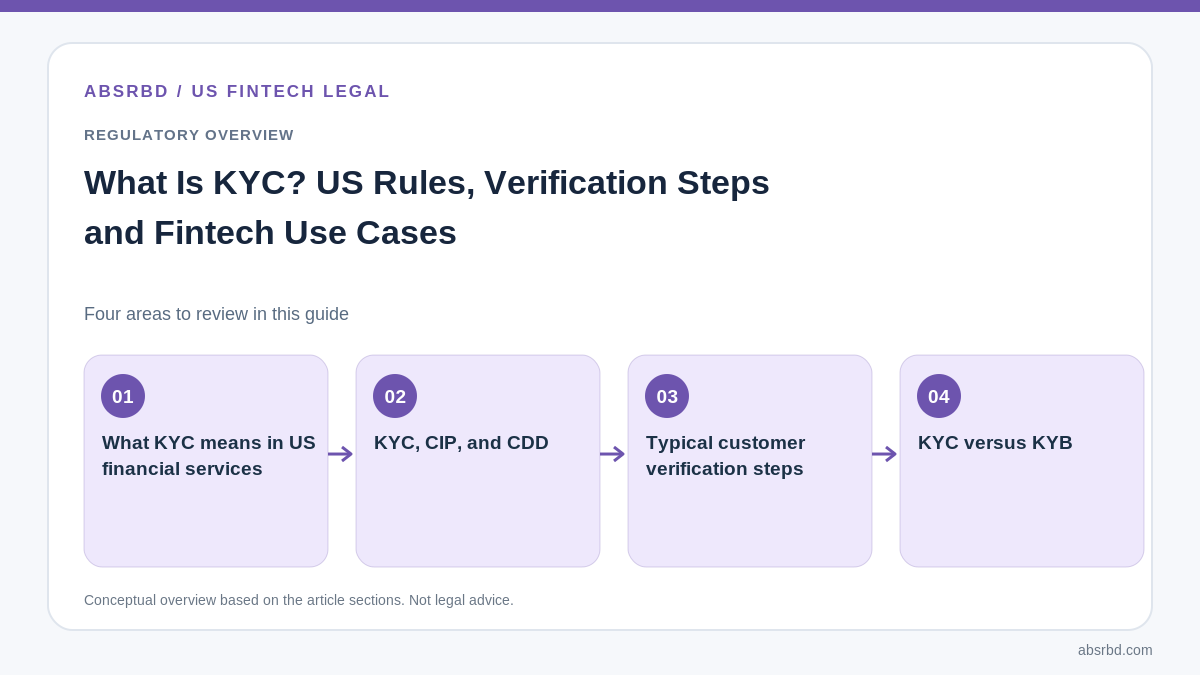
In the United States, KYC is not one stand-alone rule. It is an umbrella term for obligations and risk controls that may include a Customer Identification Program (CIP), Customer Due Diligence (CDD), sanctions screening, recordkeeping, and ongoing monitoring.
A typical KYC process for an individual includes:
- Collecting identifying information.
- Verifying the person’s identity.
- Screening required customer information.
- Assessing risk.
- Approving, rejecting, or escalating the application.
- Monitoring the relationship and updating records when appropriate.
The exact requirements depend on the institution’s regulatory status, products, customers, delivery channels, and risk profile.
What KYC Means in US Financial Services
KYC helps financial institutions determine whether a customer is who they claim to be and whether the relationship presents risks that require additional review.
US financial institutions commonly use KYC controls to:
- Prevent accounts from being opened under false or stolen identities.
- Support compliance with the Bank Secrecy Act and related rules.
- Detect information or activity that may indicate money laundering, fraud, sanctions exposure, or other financial crime.
- Understand how a customer expects to use an account or service.
- Maintain accurate customer records.
- Apply enhanced review when risk factors justify it.
Banks are subject to formal CIP requirements under rules implementing Section 326 of the USA PATRIOT Act. Other financial services businesses may operate under different legal and regulatory frameworks. For example, a money services business may have separate registration and compliance obligations. FinCEN provides an overview of money services business registration requirements.
A fintech company’s responsibilities depend on its business model. A fintech may be directly regulated, provide services through a regulated bank or financial institution, or perform part of the onboarding process on behalf of a partner. Contracting with a technology provider does not, by itself, remove the regulated institution’s compliance responsibilities.
Important: KYC is risk-based and context-specific. A process suitable for one institution, product, or customer population may not satisfy another institution’s obligations.
KYC, CIP, and CDD: What Is the Difference?
KYC, CIP, and CDD are related but not interchangeable.
| Concept | Primary purpose | Typical activities | When it applies |
|---|---|---|---|
| KYC | Broadly identify and understand customers | Identity collection, verification, screening, risk assessment, record updates and monitoring | Throughout the customer relationship |
| CIP | Establish a reasonable belief that the institution knows the customer’s true identity | Collect required identifying information, verify identity, keep records and perform required list checks | Primarily when opening an account |
| CDD | Understand the relationship and identify relevant risk | Determine the nature and purpose of the relationship, develop a risk profile and conduct ongoing monitoring | At onboarding and during the relationship |
| Enhanced due diligence | Address elevated or unusual risk | Obtain additional information, verify source-related details when appropriate, and apply closer review | When risk-based controls require escalation |
Customer Identification Program
For a covered bank, a CIP establishes procedures for forming a reasonable belief that it knows the true identity of each customer.
For an individual, information collected before account opening generally includes:
- Full legal name.
- Date of birth.
- Residential or business street address, subject to applicable exceptions.
- An identification number, such as a Social Security number or taxpayer identification number.
The institution must then verify identity using procedures appropriate to its risk assessment. Verification may use documents, non-documentary methods, or a combination of both.
Customer Due Diligence
CDD goes beyond confirming identity. It helps the institution understand why the customer is opening the account, how the account is expected to be used, and whether the relationship creates elevated risk.
CDD commonly involves:
- Understanding the nature and purpose of the relationship.
- Developing a customer risk profile.
- Monitoring activity to identify and report suspicious transactions when required.
- Updating customer information on a risk basis, including when material changes are detected.
For legal-entity customers, CDD may also involve identifying and verifying beneficial owners under applicable requirements. That is part of the boundary between individual KYC and business verification.
KYC and sanctions screening are not the same
Identity verification asks whether the applicant is who they claim to be. Sanctions screening checks relevant information against applicable sanctions data. One does not replace the other.
A customer may pass identity verification but require review because of a potential sanctions match. Conversely, a person may produce identity information that does not trigger a sanctions alert but still fail verification.
Typical KYC Process for an Individual Customer
A well-structured KYC workflow separates data collection, verification, screening, risk assessment, and decision-making. This makes results easier to explain, review, and audit.
1. Collect identifying information
The customer submits the information required for the account or service. Depending on the institution and product, this may include:
- Legal name.
- Date of birth.
- Residential address.
- Taxpayer or government identification number.
- Phone number and email address.
- Citizenship or residency information when relevant.
- Intended account use or expected activity.
- An identity document, if documentary verification is used.
Institutions should collect only the information necessary for applicable legal, compliance, fraud-prevention, and business purposes.
2. Validate the submitted data
Basic validation checks whether information is complete and structurally plausible before deeper verification begins.
Examples include:
- Confirming that required fields are present.
- Standardizing names and addresses.
- Checking whether a document is expired.
- Identifying obvious data inconsistencies.
- Detecting unsupported document types.
- Reviewing whether a submitted image is readable.
Validation alone does not prove identity. It primarily prevents incomplete or unusable applications from moving forward.
3. Verify the customer’s identity
Verification methods depend on the institution’s risk-based procedures.
Documentary verification may use:
- Driver’s licenses.
- State identification cards.
- Passports.
- Other acceptable government-issued documents.
Non-documentary verification may use:
- Comparisons with reliable independent data sources.
- Address or contact-point checks.
- Knowledge-based or account-based controls where appropriate.
- Additional documents or evidence.
- Direct contact with the applicant.
If the institution cannot verify identity with reasonable confidence, it may request more information, refer the application for manual review, restrict account functionality, or decline to open the account according to its procedures.
4. Perform required screening
The institution may screen customer information for sanctions exposure and other risk indicators relevant to its legal obligations and policies.
A screening alert is not automatically a confirmed match. Reviewers generally need to determine whether the alert relates to the same person by comparing available identifiers, such as:
- Full name and aliases.
- Date of birth.
- Address.
- Nationality.
- Identification numbers.
- Other distinguishing information.
The screening performed and the data used should match the institution’s obligations and risk profile.
5. Assess customer risk
Risk assessment determines whether standard onboarding is sufficient or whether additional review is needed.
Factors may include:
- Product or service requested.
- Customer type.
- Geographic exposure.
- Expected transaction patterns.
- Delivery channel, including remote onboarding.
- Identity-verification results.
- Screening results.
- Inconsistencies in the application.
- Fraud indicators or unusual behavior.
No single factor necessarily determines the outcome. Institutions generally evaluate the combination of available information.
6. Make and document the decision
The application may be:
- Approved when required checks are completed.
- Approved with limits when the product permits staged access or additional controls.
- Referred for manual review when results are inconclusive.
- Returned for more information when documents or data are incomplete.
- Rejected when identity cannot be verified or the relationship falls outside applicable requirements or risk tolerances.
The decision record should show what information was considered, which checks were completed, and why an exception or escalation occurred.
7. Conduct ongoing due diligence
KYC does not necessarily end when an account is opened. During the relationship, the institution may need to:
- Monitor transactions for unusual activity.
- Investigate material differences between expected and actual use.
- Review sanctions or other relevant screening alerts.
- Update customer records when information changes.
- Reassess risk after significant events.
- Request refreshed information when risk-based procedures call for it.
US rules do not create one universal schedule for refreshing every customer record. Update practices should reflect applicable requirements, triggering events, and the institution’s risk-based procedures.
Example of an eKYC Onboarding Flow
Electronic KYC, or eKYC, uses digital channels to collect and verify customer information. It does not change the underlying compliance objective: the institution must still establish sufficient confidence in the customer’s identity and apply appropriate due diligence.
A typical fintech eKYC flow looks like this:
- Account creation: The applicant provides contact details and agrees to required notices and terms.
- Identity data entry: The applicant submits their legal name, date of birth, address, and identification number.
- Document capture: If required, the applicant photographs an accepted identity document.
- Automated checks: Systems assess document quality, data consistency, and relevant independent information.
- Screening: Customer data is checked under the institution’s applicable screening procedures.
- Risk evaluation: Rules or models combine verification results, product context, fraud indicators, and other relevant factors.
- Exception handling: Unclear, conflicting, or potentially higher-risk cases move to manual review.
- Decision and record creation: The institution records the result and the basis for approval, escalation, or rejection.
- Post-onboarding controls: Monitoring and risk-based updates continue during the relationship.
For broader context on digital adoption and verification trends, see electronic KYC statistics.
Common Fintech KYC Use Cases
Fintech products may use KYC at different points depending on how the account or service works.
Digital bank and account onboarding
Remote account opening requires controls that can verify identity without an in-person interaction. The workflow may combine data checks, document review, fraud signals, and manual escalation.
Payment and money-transfer services
Payment services may need to identify customers before enabling certain transactions, account features, transfer volumes, or funding methods. Requirements depend on the service and regulatory framework.
Investment account opening
Brokerage and investment platforms collect identifying information during onboarding and may perform additional checks based on account type, customer profile, or regulatory obligations.
Digital lending
Lenders use identity verification to confirm applicant information and reduce impersonation or synthetic-identity risk. KYC identity checks are distinct from creditworthiness and underwriting decisions.
Cryptocurrency services
Certain cryptocurrency businesses may qualify as money services businesses or fall under other regulatory regimes. Their customer-identification obligations depend on the activities they perform, not simply on their use of blockchain technology.
Stored-value and wallet products
KYC requirements can vary according to product structure, functionality, transaction limits, funding methods, and the entities providing the service. Some products may use staged onboarding, but any tiering must align with applicable requirements.
KYC vs. KYB
KYC verifies and evaluates individual customers. KYB, or Know Your Business, focuses on business entities and the people who own or control them.
| Comparison point | KYC | KYB |
|---|---|---|
| Subject | An individual | A company or other legal entity |
| Core question | Is this person who they claim to be? | Does this business exist, and who owns or controls it? |
| Common information | Name, date of birth, address and identification number | Legal name, formation details, business address, registration information and ownership or control information |
| Verification focus | Personal identity | Entity existence, status, ownership and control |
| Typical complexity | Usually centered on one individual | May involve multiple entities, owners, controllers or corporate layers |
| Ongoing review | Changes in identity data, behavior or risk | Changes in entity status, ownership, control, activity or risk |
A business onboarding process often includes both KYB and KYC: the institution verifies the entity and separately verifies relevant individuals associated with it. Detailed business-verification procedures require a dedicated KYB analysis rather than treating KYB as a simple extension of personal identity checks.
KYC Onboarding Checklist
Use this checklist as a high-level framework for reviewing an individual customer onboarding flow. It is not a substitute for legal advice or institution-specific procedures.
Customer information
- [ ] Define which customers and account types are in scope.
- [ ] Collect required identifying information.
- [ ] Explain how customer information will be used and handled.
- [ ] Check applications for missing or inconsistent data.
- [ ] Support applicable exceptions and alternative address procedures.
Identity verification
- [ ] Define acceptable identity documents.
- [ ] Establish documentary and non-documentary verification methods.
- [ ] Check document validity and legibility.
- [ ] Compare information across available sources.
- [ ] Define what constitutes successful verification.
- [ ] Establish procedures for cases in which identity cannot be verified.
Screening and risk review
- [ ] Perform screening required by applicable obligations and policies.
- [ ] Distinguish possible matches from confirmed matches.
- [ ] Evaluate product, customer, geographic, and channel risk.
- [ ] Define triggers for additional due diligence.
- [ ] Route inconclusive or elevated-risk cases to qualified reviewers.
Decisions and records
- [ ] Document approval, escalation, restriction, or rejection decisions.
- [ ] Record which checks were performed.
- [ ] Retain required identifying information and verification records.
- [ ] Control access to sensitive customer data.
- [ ] Maintain an exception and override process.
- [ ] Test whether automated and manual workflows operate as intended.
Ongoing customer review
- [ ] Monitor for activity inconsistent with the customer profile.
- [ ] Define events that trigger customer-information updates.
- [ ] Reassess risk when material changes occur.
- [ ] Maintain procedures for screening alerts after onboarding.
- [ ] Review and update the workflow when regulations, products, or risks change.
Key Takeaways
- KYC is the broad process of identifying, verifying, and understanding a customer.
- CIP focuses on establishing a reasonable belief that the institution knows the customer’s true identity.
- CDD addresses the nature and purpose of the relationship, customer risk, and ongoing monitoring.
- A typical KYC workflow includes data collection, identity verification, screening, risk assessment, decisioning, recordkeeping, and ongoing review.
- eKYC performs these functions through digital channels but does not eliminate the underlying compliance obligations.
- KYC applies to individuals, while KYB focuses on businesses and their ownership or control structures.
- US requirements vary by institution, product, customer type, and regulatory status; there is no single universal KYC workflow for every financial service.
For more financial compliance and fintech guidance, visit the posts1 blog.