An accredited investor is a person or entity that meets at least one qualification standard in Rule 501(a) of the Securities Act of 1933. Individuals may qualify through income, net worth, certain professional credentials, or specified roles. Entities may qualify through their status, assets, investments, ownership, or relationship to a private fund or family office.
There is no SEC application or universal accredited-investor certificate. The issuer—or a party acting on its behalf—must determine whether an investor qualifies for the relevant securities offering. In offerings under Rule 506(c), the issuer must also take reasonable steps to verify accredited status.
At a glance: An individual commonly qualifies by exceeding $200,000 in annual income, exceeding $300,000 in joint income with a spouse or spousal equivalent, or exceeding $1 million in net worth excluding the primary residence. Other routes may apply.
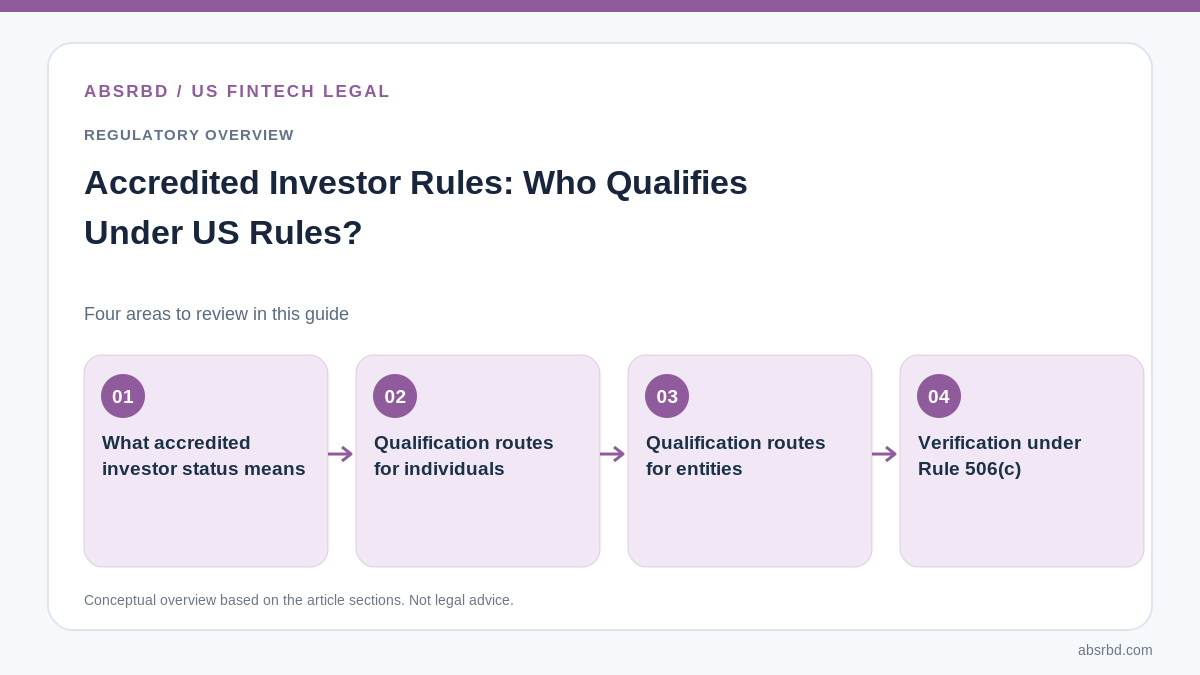
What accredited investor status means
The accredited investor definition identifies investors who may participate in certain unregistered securities offerings. It includes both natural persons and organizations.
Accredited status does not mean that:
- The SEC has approved or endorsed the investor.
- The SEC has reviewed or approved the investment.
- The investment is safe, liquid, or suitable.
- The investor is accredited permanently.
- Every issuer must accept the investor.
Private investments can involve substantial risk, limited disclosures, transfer restrictions, and little or no liquidity. Meeting an eligibility test does not replace financial, legal, tax, or investment due diligence.
The controlling definition appears in Rule 501(a) of Regulation D. Because the rules and SEC interpretations can change, issuers and investors should confirm the current requirements before relying on a qualification route.
Qualification routes for individuals
An individual needs to satisfy only one applicable route. The most common tests are income and net worth, but the definition also recognizes certain credentials and professional relationships.
| Qualification route | Core requirement | Important limitation |
|---|---|---|
| Individual income | Income exceeding $200,000 in each of the two most recent years, with a reasonable expectation of reaching the same level in the current year | The test applies to income, not gross assets or investment account balances |
| Joint income | Joint income with a spouse or spousal equivalent exceeding $300,000 in each of the two most recent years, with a reasonable expectation of reaching the same level in the current year | Documentation should support the joint-income calculation |
| Net worth | Individual or joint net worth with a spouse or spousal equivalent exceeding $1 million | The primary residence is excluded, and its related debt receives special treatment |
| Professional credentials | Holding an SEC-designated professional certification, designation, or credential in good standing | Only credentials designated by the SEC qualify |
| Issuer leadership | Serving in a specified director, executive officer, or general partner role connected to the issuer | The role must fall within the regulatory definition |
| Knowledgeable employee | Being a knowledgeable employee of the private fund issuing the securities | This route generally applies only to investments in that private fund |
| Qualifying family-office relationship | Being a family client of a qualifying family office | Additional conditions apply to the family office and investment decision |
Income test
An individual may qualify by having:
- Income exceeding $200,000 in each of the two most recent years; and
- A reasonable expectation of exceeding $200,000 in the current year.
Alternatively, the individual may use joint income with a spouse or spousal equivalent:
- Joint income exceeding $300,000 in each of the two most recent years; and
- A reasonable expectation of exceeding $300,000 in the current year.
A spousal equivalent is generally a cohabitant occupying a relationship equivalent to that of a spouse. The accredited-investor rules allow joint financial tests to include a spouse or spousal equivalent even when the securities are not purchased jointly.
For Rule 506(c) verification, an issuer may review tax records or other reliable income documentation rather than relying only on an investor’s statement.
Net-worth test
An individual qualifies when individual net worth—or joint net worth with a spouse or spousal equivalent—exceeds $1 million at the time of the investment.
A basic calculation is:
Net worth = qualifying assets − applicable liabilities
Assets may include cash, securities, investment accounts, retirement assets, and other property that can be appropriately valued. The primary residence requires separate treatment.
How to treat a primary residence
When calculating accredited-investor net worth:
- Do not count the primary residence as an asset.
- Generally, do not count debt secured by the primary residence as a liability up to the residence’s estimated fair market value.
- Count secured debt above the residence’s estimated fair market value as a liability.
- Generally count an increase in debt secured by the primary residence during the 60 days before the securities purchase as a liability, unless the increase resulted from acquiring the residence.
Because valuation and debt timing can materially affect the result, investors should not simply subtract a mortgage from a total that includes the home’s value.
Example net-worth calculation
Suppose an investor has:
- $700,000 in brokerage and retirement accounts;
- $400,000 in cash and other countable property;
- $80,000 in applicable liabilities; and
- A primary residence worth $600,000 with a $350,000 mortgage.
The residence is not counted as an asset. The mortgage generally is not counted as a liability because it does not exceed the residence’s estimated value, assuming no relevant recent increase in secured debt.
The resulting net worth would be:
$700,000 + $400,000 − $80,000 = $1,020,000
Because the rule requires net worth to exceed $1 million, this example would satisfy the threshold if the figures and treatment of liabilities were properly supported.
Professional certifications and credentials
An individual may qualify by holding an SEC-designated professional certification, designation, or credential in good standing.
The SEC has designated these securities licenses:
- General Securities Representative license: Series 7
- Licensed Investment Adviser Representative: Series 65
- Private Securities Offerings Representative license: Series 82
Passing an unrelated financial examination or holding a general business credential does not automatically establish accredited status. The credential must be one formally designated by the SEC, and the holder must satisfy the applicable good-standing requirement.
Directors, executive officers, and general partners
Certain individuals qualify because of their relationship to the issuer. This route covers specified:
- Directors;
- Executive officers; and
- General partners.
It may also cover those roles at a general partner of the issuer. Job titles alone are not always decisive: the person’s actual authority and responsibilities must fit the applicable definition, particularly when determining whether someone is an executive officer.
Knowledgeable employees of private funds
A knowledgeable employee may qualify to purchase securities issued by the private fund for which the person has the required relationship.
Depending on the circumstances, this category can include certain:
- Executive officers;
- Directors or trustees;
- General partners;
- Advisory board members;
- Affiliated management personnel; and
- Employees who have participated in the fund’s investment activities for the required period.
This is not a general-purpose accreditation route for every private investment. It is tied to the relevant private fund and the regulatory definition of a knowledgeable employee.
Qualification routes for entities
Entity qualification depends on the type of organization and the particular route used. Some organizations qualify because they are regulated financial institutions. Others must satisfy an asset or investment threshold.
| Entity route | General qualification standard |
|---|---|
| Listed regulated institutions | Certain banks, savings and loan associations, registered broker-dealers, insurance companies, registered investment companies, business development companies, and qualifying investment advisers |
| Certain private business development companies | Qualification based on the organization’s regulatory status |
| Qualifying employee benefit plans | Qualification may depend on plan assets, the decision-making fiduciary, or accredited status of participants in a self-directed plan |
| Certain organizations with more than $5 million in assets | Includes qualifying corporations, partnerships, limited liability companies, and Section 501(c)(3) organizations not formed for the specific investment |
| Certain trusts with more than $5 million in assets | The trust must not have been formed for the specific investment, and a financially sophisticated person must direct the purchase |
| Entities owning more than $5 million in investments | Covers qualifying entities not otherwise specifically listed, provided they were not formed for the specific investment |
| Entities whose equity owners are all accredited | Every equity owner must independently qualify |
| Qualifying family offices | Generally must have at least $5 million in assets under management and satisfy formation and decision-making conditions |
| Family clients of qualifying family offices | May qualify when the investment is directed by a person with sufficient financial and business knowledge |
Entities with more than $5 million in assets
Certain organizations may qualify when they have total assets exceeding $5 million and were not formed for the specific purpose of acquiring the offered securities. Covered organization types can include:
- Corporations;
- Partnerships;
- Limited liability companies; and
- Charitable organizations described in Section 501(c)(3).
Issuers should confirm that the entity type falls within the rule and that its formation history does not indicate it was created solely to make the investment.
Entities with more than $5 million in investments
A separate route applies to an entity that:
- Was not formed for the specific purpose of acquiring the offered securities; and
- Owns investments exceeding $5 million.
This route can cover entity types not otherwise specifically listed in Rule 501(a), including certain tribal organizations, governmental bodies, funds, and foreign entities.
“Investments” is a defined regulatory concept and should not automatically be treated as equivalent to total assets, revenue, enterprise value, or capital commitments.
Trusts
A trust may qualify if:
- Its total assets exceed $5 million;
- It was not formed for the specific purpose of purchasing the offered securities; and
- The investment is directed by a person with sufficient knowledge and experience in financial and business matters to evaluate the merits and risks.
Trust analysis may depend on the trust structure, its assets, the identity of the decision-maker, and whether another qualification route applies.
Entities owned entirely by accredited investors
An entity may qualify when all of its equity owners are accredited investors.
The issuer should identify every equity owner and confirm that each owner independently meets an individual or entity qualification route. Complex or layered ownership structures may require looking through intermediate entities rather than relying on a single representation from the investing entity.
Family offices and family clients
A family office may qualify when it:
- Has at least $5 million in assets under management;
- Was not formed for the specific purpose of acquiring the offered securities; and
- Has its prospective investment directed by a person capable of evaluating the investment’s merits and risks based on financial and business knowledge and experience.
A family client of a qualifying family office may also qualify when the applicable conditions are met.
Verification under Rule 506(c)
In a Rule 506(c) offering, all purchasers must be accredited investors, and the issuer must take reasonable steps to verify their status. A checked box or unsupported investor representation ordinarily should not be treated as the entire verification process.
Verification is different from the underlying qualification test:
- Qualification asks whether the investor meets a Rule 501(a) category.
- Verification asks whether the issuer took reasonable steps to establish that qualification.
The appropriate process depends on the investor, the qualification route, the available information, and the circumstances of the offering. Rule 506(c) provides a principles-based standard as well as non-exclusive verification methods for natural persons.
Common verification methods
| Qualification basis | Documents or evidence commonly reviewed |
|---|---|
| Income | IRS forms reporting income for the two most recent years, plus a written representation about expected current-year income |
| Net worth | Recent evidence of assets, a consumer credit report or similar liability evidence, and a written representation that all relevant liabilities were disclosed |
| Third-party confirmation | Written confirmation from an eligible registered broker-dealer, SEC-registered investment adviser, licensed attorney, or certified public accountant |
| Previously verified investor | Prior verification records and an updated written representation, subject to the applicable conditions and time limits |
| Professional credential | Records confirming the designated license or credential and its current standing |
| Entity qualification | Formation documents, financial records, asset or investment statements, regulatory records, ownership information, and authorized-person representations |
Verifying income
A non-exclusive verification method permits the issuer to review relevant Internal Revenue Service forms for the two most recent years, such as:
- Form W-2;
- Form 1099;
- Schedule K-1; or
- Form 1040.
The issuer must also obtain a written representation that the investor has a reasonable expectation of reaching the required income level in the current year.
Verifying net worth
For the net-worth route, supporting records generally need to address both assets and liabilities.
Evidence of assets may include:
- Bank statements;
- Brokerage or securities-account statements;
- Certificates of deposit;
- Tax assessments; and
- Independent appraisal reports.
Evidence of liabilities may include a consumer credit report from a nationwide consumer reporting agency. The investor also provides a written representation that all liabilities necessary to determine net worth have been disclosed.
Under the regulatory safe harbor, relevant documents generally must be dated within the preceding three months. If documents are older or do not meet the safe-harbor conditions, the issuer may still use a principles-based process, but it must be able to support why its verification steps were reasonable.
Using professional confirmation
An issuer may obtain written confirmation from certain professionals or regulated firms that they took reasonable steps to verify the investor’s accredited status within the prescribed period and determined that the investor qualifies.
Eligible confirmers include:
- Registered broker-dealers;
- SEC-registered investment advisers;
- Licensed attorneys; and
- Certified public accountants.
A confirmation should clearly identify the investor, the qualification basis, the verification period, and the confirming party. The issuer should also confirm the professional’s identity and eligibility.
Principles-based verification
The safe-harbor methods are not the only permissible approaches. An issuer can use other reasonable verification procedures based on factors such as:
- The investor’s claimed qualification category;
- The amount and reliability of information available;
- How the investor was identified or solicited;
- The minimum investment amount;
- Whether the investment was financed by another party;
- The presence of conflicting or incomplete information; and
- The risk that the documents are outdated or inaccurate.
A large minimum investment may support a verification analysis, but it does not automatically prove accredited status—especially if the issuer knows or has reason to believe that the investor borrowed the investment amount.
Founder checklist for investor qualification
Use this checklist when evaluating prospective investors in an offering that requires accredited status.
Before collecting documents
- [ ] Identify the exemption and determine whether accredited status must be verified.
- [ ] Use the current Rule 501(a) definition and applicable SEC guidance.
- [ ] Ask the investor to identify the specific qualification route being claimed.
- [ ] Avoid requesting documents unrelated to that route.
- [ ] Establish a secure method for receiving sensitive financial information.
- [ ] Set document-retention and access controls with legal counsel.
For an individual investor
- [ ] Determine whether the investor relies on income, joint income, net worth, credentials, an issuer role, or private-fund status.
- [ ] Confirm that income covers both required prior years and the expected current year.
- [ ] Exclude the primary residence from the net-worth asset calculation.
- [ ] Review mortgage debt for excess indebtedness or a relevant increase within 60 days.
- [ ] Confirm that a professional credential is SEC-designated and in good standing.
- [ ] Check whether a role-based qualification is limited to the issuer or private fund involved.
For an entity investor
- [ ] Confirm the entity’s legal type and formation date.
- [ ] Determine whether the entity relies on regulatory status, assets, investments, ownership, or another route.
- [ ] Distinguish total assets from “investments” when the chosen test requires investments.
- [ ] Confirm that the entity was not formed specifically to acquire the offered securities when that condition applies.
- [ ] If using the all-equity-owners route, verify every equity owner.
- [ ] Confirm that the person signing for the entity has authority to do so.
For Rule 506(c) verification
- Select the qualification route. Document the exact Rule 501(a) category the investor claims.
- Choose a verification method. Use a regulatory safe harbor or a defensible principles-based process.
- Review current evidence. Check dates, names, ownership, liabilities, license status, and any inconsistencies.
- Resolve discrepancies. Do not ignore conflicting information or unexplained funding sources.
- Record the determination. Preserve the basis for concluding that the investor qualifies.
- Protect investor data. Limit collection, transmission, access, and retention of tax and financial records.
- Recheck when necessary. Prior accreditation does not guarantee that the investor still qualifies.
Common qualification mistakes
Issuers and investors should avoid these recurring errors:
- Counting the primary residence as a net-worth asset;
- Assuming home equity counts toward the $1 million threshold;
- Treating gross revenue or company valuation as an entity’s assets or investments;
- Assuming every financial license qualifies;
- Treating a self-certification checkbox as sufficient Rule 506(c) verification;
- Relying on stale financial documents without further analysis;
- Assuming accreditation applies permanently;
- Failing to verify every owner under the all-equity-owners route;
- Using a private-fund knowledgeable-employee route for an unrelated investment; or
- Confusing accredited status with SEC approval or investment suitability.
Practical next steps
Investors should first identify the simplest qualification route they can document without disclosing unnecessary information. Issuers should establish a consistent verification policy before accepting subscriptions, while allowing for different evidence when investors qualify through different categories.
For official guidance, consult the SEC’s resources on exempt securities offerings and the current text of Rules 501 and 506. Securities counsel should review unusual ownership structures, trusts, family offices, foreign documentation, and any case in which the available evidence is incomplete or contradictory.
For broader market context, see current online trading statistics and global venture-capital funding trends for startups.
This article provides general information about U.S. accredited-investor requirements and is not legal, tax, or investment advice.