A fintech privacy policy should accurately explain what personal information the business collects, where it comes from, why it is used, who receives it, how long it is retained, and what choices or rights are available to consumers. It must reflect the company’s actual data flows—not a generic template.
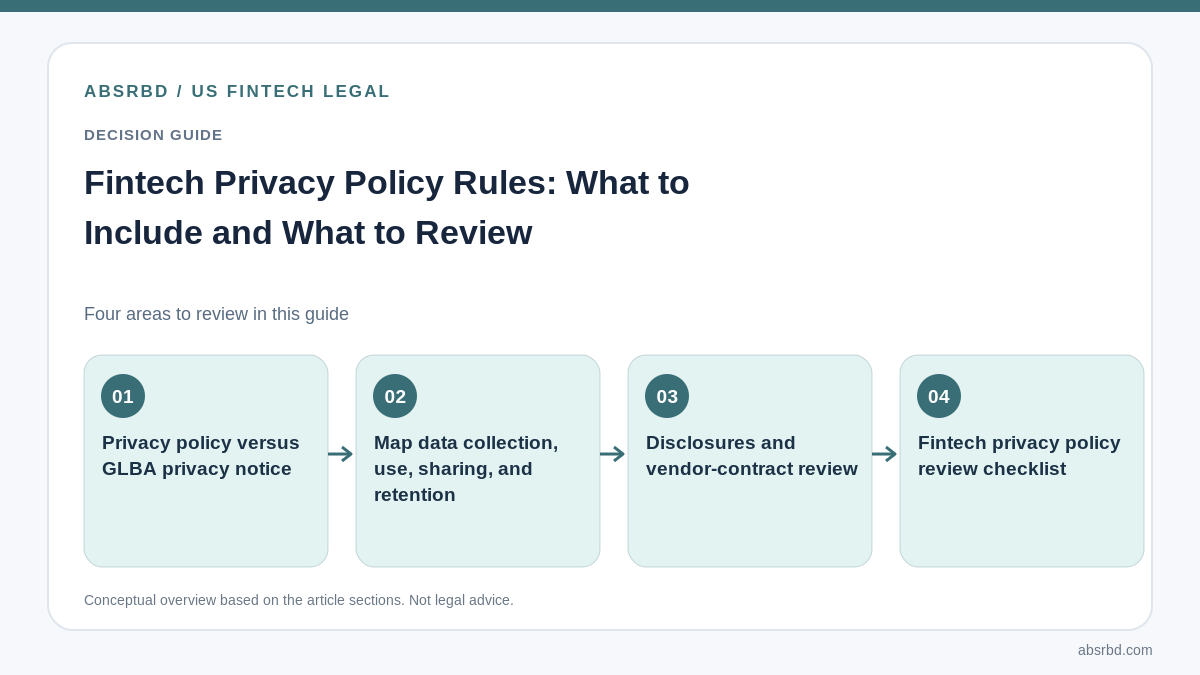
A public privacy policy is also not necessarily the same document as a privacy notice required under the Gramm-Leach-Bliley Act (GLBA). Depending on the business model, customer base, data involved, and applicable state laws, a fintech may need multiple coordinated notices.
Before publishing or revising a policy, review these five areas:
- The fintech’s products, legal entities, users, and geographic reach.
- End-to-end data collection, use, disclosure, sale, sharing, and retention.
- The relationship between the general privacy policy and any GLBA notices.
- State privacy requirements, including the scope of exemptions for financial data.
- Vendor contracts and whether they match public disclosures.
Important: This guide provides a review framework, not legal advice or a universal privacy policy template. Requirements vary by business model, jurisdiction, and the role each company plays in processing data.
Privacy Policy vs. GLBA Privacy Notice
A fintech privacy policy and a GLBA privacy notice may overlap, but they serve different purposes and should not be treated as interchangeable.
The Federal Trade Commission’s GLBA guidance explains that the law applies to financial institutions offering financial products or services to consumers. Other federal regulators may oversee particular institutions or activities.
Whether a company is covered—and which regulator or rule applies—requires a fact-specific analysis.
| Review dimension | General fintech privacy policy | GLBA privacy notice |
|---|---|---|
| Primary purpose | Describes the company’s broader personal-information practices | Provides disclosures required for covered financial institutions and nonpublic personal information |
| Typical audience | Website visitors, app users, applicants, customers, and other consumers | Consumers or customers within the scope of applicable GLBA privacy requirements |
| Data covered | May include device, website, marketing, account, identity, transaction, support, and inferred data | Focuses on nonpublic personal information within GLBA’s scope |
| Governing requirements | May be affected by federal consumer-protection principles and applicable state privacy laws | Governed by GLBA and implementing privacy rules, including applicable notice and opt-out provisions |
| Rights and choices | May describe state privacy rights, marketing preferences, cookie controls, and account-level choices | Describes applicable financial-information sharing practices and opt-out rights |
| Format | Usually a layered web or in-app policy | Often follows a regulator-prescribed or standardized notice format |
| Update triggers | New products, data uses, vendors, jurisdictions, or legal requirements | Changes relevant to GLBA disclosures and applicable notice obligations |
| Can one replace the other? | Not automatically | Not automatically |
Why the distinction matters
Using one document for every purpose can create gaps. For example:
- A GLBA notice may not explain website analytics, advertising technology, or mobile-app permissions.
- A general app privacy policy may not contain the structure or disclosures required for a GLBA notice.
- State-law exemptions may apply to certain financial information but not to every person, product, or dataset handled by the fintech.
- Different legal entities in the same corporate group may have different regulatory status or data practices.
The review should identify which notices are required, what each notice covers, and how the documents work together without contradicting one another.
Determine the Policy’s Scope Before Drafting
A privacy policy cannot be accurate until the company defines who and what it covers.
Identify covered legal entities and brands
List every entity, trade name, website, mobile application, and product that will rely on the policy. Determine whether all of them collect and use information in the same way.
A single policy may be appropriate when practices are genuinely aligned. Separate or supplemental notices may be clearer when:
- Products are operated by different legal entities.
- One entity is a financial institution and another is not.
- Consumer and business products process different information.
- A partner bank controls certain account-related processing.
- A product has state-specific or product-specific practices.
The policy should not suggest that one company controls processing that is actually performed independently by a bank, lender, payment network, employer, merchant, or other party.
Define the people covered
A fintech may process information about more than registered customers. The review should consider:
- Website visitors
- Mobile-app users
- Applicants
- Customers and authorized users
- Beneficial owners or business representatives
- Payment recipients and senders
- Customer-service contacts
- Prospective customers
- Individuals whose information is submitted by another user
If employees and job applicants are covered by separate notices, the public consumer policy should say so clearly rather than leaving its scope ambiguous.
Account for the operating model
The required disclosures depend heavily on what the product does. Relevant models may include:
- Digital banking interfaces
- Payments and money transmission
- Consumer or small-business lending
- Credit comparison or marketplace services
- Personal financial management
- Investment or insurance technology
- Identity verification and fraud-prevention services
- Embedded finance
- Financial-data aggregation
A company that merely provides software to a financial institution may have different obligations from a company that has a direct consumer relationship. Contracts and user-facing explanations should accurately distinguish those roles.
For market context, review current mobile banking statistics and digital banking statistics alongside the company’s own product and usage data.
Map Collection, Use, Sharing, and Retention
The policy should be the output of a data-mapping exercise, not the starting point. Marketing, product, engineering, security, compliance, customer support, and vendor-management teams may each know only part of the data lifecycle.
1. Inventory personal information
Document the categories of information collected directly and indirectly.
| Information category | Fintech examples | Possible source |
|---|---|---|
| Identity information | Name, date of birth, government identifier | Consumer, identity-verification provider |
| Contact information | Email, telephone number, mailing address | Consumer or business customer |
| Financial information | Account details, balances, payment information | Consumer, bank, payment partner |
| Transaction information | Purchases, transfers, payment history | Product activity or financial partner |
| Application information | Income, employment, requested product | Applicant or verification provider |
| Device and network data | IP address, device identifiers, browser type | Website, app, analytics tool |
| Usage information | Pages viewed, features used, interaction logs | Website or app |
| Location information | Approximate or precise location, if collected | Device, IP address, user permission |
| Communications | Support requests, chat messages, call records | Consumer and support systems |
| Derived information | Risk indicators, preferences, classifications | Internal analysis or service provider |
Only include categories the company actually collects. Broad, precautionary language can make the policy less useful and may create inaccurate representations.
2. Record the source of each category
A useful map distinguishes information collected:
- Directly from the consumer
- Automatically from a website, app, or device
- From financial institutions or payment networks
- From identity, fraud, credit, or verification providers
- From public records
- From affiliates or commercial partners
- From another user or business customer
The policy should explain indirect collection when it would not be obvious to the person concerned.
3. Link every category to a defined purpose
Avoid catch-all statements such as “for any business purpose.” Describe concrete uses, which may include:
- Opening and administering an account
- Processing transactions
- Verifying identity or eligibility
- Preventing fraud and misuse
- Providing customer support
- Maintaining and improving the product
- Personalizing the user experience
- Communicating about products or services
- Measuring website or app performance
- Meeting applicable legal and regulatory obligations
The mapping process should also identify incompatible or unexpected secondary uses. If a new use is materially different from what was previously disclosed, the company should review whether updated notice or consent is necessary before implementation.
4. Identify every recipient and processing role
“Sharing” is not a single activity. Document the data, recipient, purpose, contractual terms, and applicable legal classification for each disclosure.
Potential recipients include:
- Bank or credit-union partners
- Payment processors and networks
- Identity-verification providers
- Fraud-prevention vendors
- Cloud and hosting providers
- Analytics and advertising providers
- Customer-support platforms
- Credit bureaus or reporting agencies
- Professional advisers
- Affiliates
- Government or regulatory authorities when legally required
- Parties involved in a corporate transaction
State privacy laws may distinguish among disclosures to service providers or contractors, disclosures for targeted or cross-context behavioral advertising, and sales of personal information. A policy should use the terminology applicable to the company rather than labeling every transfer a “sale” or assuming that none qualify.
5. Establish retention criteria
A statement that information is kept “as long as necessary” is more useful when paired with meaningful criteria. Retention may depend on:
- The duration of the customer relationship
- The purpose for which information was collected
- Applicable recordkeeping obligations
- Fraud-prevention and risk-management needs
- Contractual requirements
- The time needed to establish or defend legal claims
- Whether information can be deleted, anonymized, or aggregated
The public policy does not need to expose sensitive internal controls. It should, however, align with the company’s documented retention schedule and actual deletion practices.
Review CCPA, CPRA, and Other State Privacy Disclosures
State privacy analysis should be based on the company’s consumers, thresholds, data, and processing activities. It should not assume that GLBA coverage removes the entire business from state privacy requirements.
Do not treat the GLBA exemption as automatically entity-wide
Under the California Consumer Privacy Act as amended by the California Privacy Rights Act, certain information collected, processed, sold, or disclosed pursuant to GLBA is treated differently under the statute. That does not necessarily mean every dataset or activity of a financial company is outside the CCPA.
For example, a fintech may need to assess separately:
- Website visitor information
- Advertising and analytics data
- Information about prospective users
- Data associated with products not covered by GLBA
- Business-contact information
- Data collected outside the financial customer relationship
Other states use different definitions, thresholds, exemptions, rights, and terminology. A multistate fintech should maintain a jurisdiction matrix instead of copying a California section into every policy.
Disclosures to evaluate
Where applicable, a state privacy section may need to address:
- Categories of personal information collected
- Sources of personal information
- Business or commercial purposes
- Categories of recipients
- Sales, sharing, or targeted-advertising practices
- Retention periods or retention criteria
- Rights to access, delete, correct, or obtain a copy of data
- Rights to opt out of specified processing
- Treatment of sensitive personal information
- Authorized-agent requests
- Appeal rights in states that require them
- Nondiscrimination for exercising privacy rights
- Methods for submitting and verifying requests
The policy should explain only rights that apply to the individual and the relevant processing. It may use a state-specific supplement when a single national section would become confusing or inaccurate.
Disclosures Every Fintech Policy Should Review
The final content will vary, but the following components should be assessed during drafting.
Policy identity and contact details
Clearly state:
- Which company or companies issue the policy
- Which websites, apps, and services it covers
- The effective or last-updated date
- How to contact the privacy team
- How consumers can submit applicable rights requests
A generic contact form may be insufficient if it does not reliably route privacy requests to the correct team.
Collection and use
Connect categories of information to purposes. Readers should be able to understand why sensitive financial, identity, or device data is needed.
Avoid copying statutory lists without tailoring them to the product. A long list of every possible data category can obscure the practices that matter.
Disclosure to third parties
Describe recipient categories and purposes with enough detail to distinguish operational providers from independent third parties. If banks or other financial partners provide their own privacy notices, explain the relationship and link to those notices where appropriate.
Cookies, analytics, and advertising
Review the website and app with technical tools and vendor records. The policy should match the trackers actually deployed, including those loaded through tag-management systems or software development kits.
Confirm whether the company uses data for:
- Essential site or app functions
- Performance measurement
- Product analytics
- Personalization
- Advertising measurement
- Targeted or cross-context behavioral advertising
Consent or opt-out mechanisms should match the disclosures and the laws applicable to the audience.
Consumer choices and privacy rights
For each right or choice, state:
- Who is eligible
- What the right covers
- How to submit a request
- What information is needed for verification
- Whether an authorized agent may act
- How the company will communicate its decision
- Whether an appeal process is available
Do not promise broader deletion or access rights than operational systems can support unless the business has intentionally adopted that standard.
Security statement
A privacy policy may provide a high-level description of administrative, technical, and physical safeguards. Avoid absolute claims such as “completely secure,” “fraud-proof,” or “we use the highest security available.”
Public language should be accurate without revealing configurations that could create security risk.
Policy changes
Explain how material changes will be communicated. The method should be appropriate to the nature of the change and the customer relationship rather than relying exclusively on a revised date that users are unlikely to notice.
Vendor Contracts Must Match the Privacy Policy
A policy review is incomplete without reviewing vendor relationships. A fintech can publish accurate disclosures today and become inaccurate tomorrow when a new software development kit, analytics provider, support tool, or data partner is introduced.
Vendor-contract review criteria
For each vendor that handles personal information, assess:
- Purpose: Is processing limited to documented services?
- Instructions: May the vendor use data only on the fintech’s instructions?
- Independent use: Can the vendor use information for advertising, profiling, product development, or its own commercial purposes?
- Data scope: Does the contract limit collection and access to what is necessary?
- Subprocessors: Must the vendor disclose or control downstream providers?
- Retention: What happens to data during and after the engagement?
- Deletion or return: Is there a workable process when services end?
- Consumer requests: Can the vendor support access, deletion, correction, and portability where required?
- Audit support: Can the fintech obtain information needed to evaluate compliance?
- Location and transfer: Where is data processed, and are relevant transfer terms addressed?
- Role classification: Do contractual labels match the parties’ actual conduct?
Contract terminology alone does not determine the relationship. If a provider uses information for its own purposes, describing it as a service provider in the privacy policy may be inaccurate.
Operational questions for vendor due diligence
Ask prospective privacy counsel, policy-review providers, or privacy-management vendors whether their review includes:
- Interviews with product, engineering, marketing, and compliance teams.
- Website, mobile-app, cookie, and software development kit analysis.
- A data inventory and flow map.
- GLBA notice comparison without treating it as the public policy.
- State-law scoping and exemption analysis.
- Vendor contract and data-use review.
- A redline explaining why each policy change is recommended.
- A process for future product and vendor changes.
A policy-only deliverable may be inadequate if the reviewer never verifies the underlying practices.
How to Evaluate a Fintech Privacy Policy Review Service
A qualified review should produce more than polished legal language.
| Evaluation criterion | Strong deliverable | Warning sign |
|---|---|---|
| Data discovery | Documented categories, sources, purposes, recipients, and systems | Policy drafted from a questionnaire completed by one person |
| Regulatory scope | Product- and data-specific analysis | Assumption that one exemption covers the entire company |
| GLBA coordination | Separate comparison of applicable notices and audiences | GLBA notice and website policy treated as identical |
| Vendor analysis | Review of key contracts and independent data uses | Vendors described only by category |
| State coverage | Jurisdiction matrix or documented scoping rationale | California language copied nationwide without analysis |
| Technical validation | Review of cookies, SDKs, and actual app permissions | Reliance only on existing policy text |
| Operational alignment | Rights and retention language tied to workflows | Promises that systems cannot fulfill |
| Change management | Defined review triggers and policy owner | One-time publication with no maintenance plan |
The business should retain ownership of factual accuracy. Outside counsel or a privacy vendor can identify requirements and draft language, but internal teams must verify that the description matches the product.
Fintech Privacy Policy Review Checklist
Use this checklist before launch, after major product changes, and during periodic policy reviews.
Scope and ownership
- [ ] The policy names the correct legal entity or entities.
- [ ] Covered brands, websites, applications, and products are identified.
- [ ] Covered categories of individuals are clear.
- [ ] Bank, affiliate, and technology-provider roles are accurately described.
- [ ] A named internal owner is responsible for policy maintenance.
Data mapping
- [ ] Personal-information categories match actual collection.
- [ ] Direct, automatic, third-party, and publicly available sources are documented.
- [ ] Every data category has a defined purpose.
- [ ] Recipient categories and disclosure purposes are documented.
- [ ] Sales, sharing, targeted advertising, and service-provider disclosures have been classified where applicable.
- [ ] Retention criteria align with the internal retention schedule.
GLBA and state-law coordination
- [ ] The company has assessed whether GLBA privacy requirements apply.
- [ ] The general policy and any GLBA notice are treated as distinct where necessary.
- [ ] The documents use consistent descriptions of products and sharing practices.
- [ ] State-law exemptions were evaluated by dataset and activity, not assumed to cover the whole entity.
- [ ] Applicable state rights and appeal processes are described accurately.
- [ ] Request methods are operational and monitored.
Vendors and tracking technologies
- [ ] Current vendors, subprocessors, cookies, pixels, and app SDKs have been inventoried.
- [ ] Contracts limit processing as required for the intended vendor role.
- [ ] Independent vendor uses are reflected in the policy.
- [ ] Vendor retention and deletion terms have been reviewed.
- [ ] Tracking disclosures match the technologies deployed.
- [ ] Consent and opt-out tools work as described.
Accuracy and usability
- [ ] The policy uses plain, specific language.
- [ ] Statutory terminology is explained where necessary.
- [ ] Links, email addresses, forms, and toll-free numbers work.
- [ ] Security statements avoid absolute promises.
- [ ] The effective date is current.
- [ ] Material-change notification practices are explained.
- [ ] Product, legal, marketing, engineering, and vendor-management stakeholders approved the factual content.
When to Review the Policy Again
Fintech privacy policies require frequent review because products and data ecosystems change quickly. Trigger a review when the company:
- Launches a new product or feature
- Enters a new state or consumer market
- Adds a bank, payments, analytics, advertising, or identity partner
- Changes eligibility, underwriting, fraud, or personalization practices
- Introduces a new category of personal information
- Uses existing information for a new purpose
- Deploys new website tags or mobile SDKs
- Changes retention practices
- Reorganizes legal entities or brands
- Becomes subject to a new privacy law or regulatory interpretation
The most reliable policy is one connected to product-development and vendor-onboarding processes. Privacy review should occur before a new data practice launches, not only after public language becomes outdated.
The Bottom Line
An effective fintech privacy policy is a verified description of real data practices. It should distinguish the public policy from any required GLBA privacy notice, address applicable state privacy requirements without overstating exemptions, and align with vendor contracts, tracking technologies, retention rules, and consumer-rights workflows.
The best review deliverable is not simply a rewritten policy. It is a coordinated package consisting of a data-flow map, applicability analysis, vendor findings, policy redline, and the review checklist needed to keep disclosures accurate as the fintech evolves.