The best KYC verification software is not necessarily the vendor with the longest feature list or widest advertised coverage. It is the solution that can verify your target customers, detect relevant fraud patterns, support your compliance requirements, integrate with your onboarding flow, and provide predictable economics at your expected volume.
For fintech buyers, the selection process should focus on eight dimensions:
- Identity verification methods
- Liveness and biometric controls
- Fraud detection
- Geographic and document coverage
- Integration and operational workflows
- Compliance evidence and auditability
- Privacy and security controls
- Pricing structure and total cost
Use the scorecard in this guide to compare KYC solutions consistently without relying on arbitrary vendor rankings.
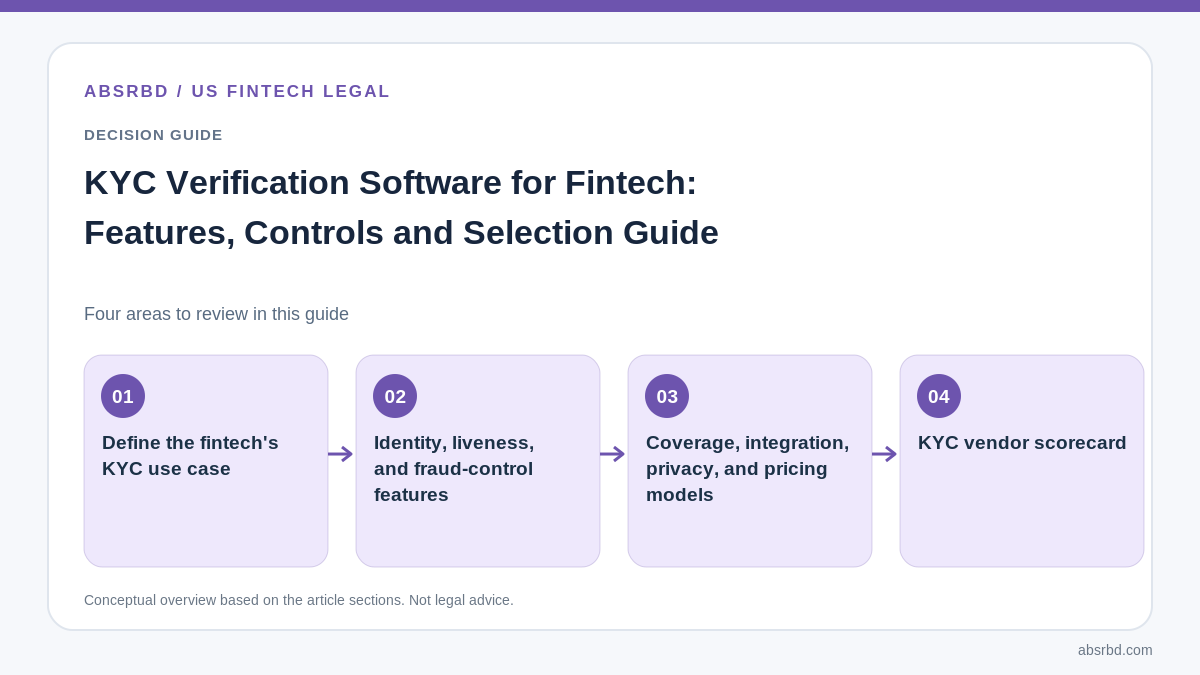
Define Your Fintech’s KYC Use Case
Before reviewing vendors, document the customers, products, jurisdictions, and risks the software must support. A provider that performs well for U.S. consumer onboarding may not be the right choice for cross-border users, thin-file applicants, or mobile-first products.
Establish the evaluation scope
Create a written requirements profile covering:
- Customer type: U.S. consumers, international consumers, or both
- Product: Payments, wallets, lending, remittance, investing, banking services, or another regulated financial product
- Onboarding channels: Mobile app, desktop web, assisted review, or embedded partner flow
- Geographic footprint: Customer residence, document-issuing countries, and restricted locations
- Expected volume: Normal monthly volume, seasonal peaks, and projected growth
- Risk profile: Identity theft, synthetic identity fraud, account farming, document tampering, or impersonation
- User characteristics: Thin credit files, new-to-country customers, older adults, or users with limited device capabilities
- Review model: Fully automated decisions, risk-based manual review, or mandatory analyst approval
- Regulatory relationships: Direct regulatory obligations, sponsor-bank requirements, and contractual compliance standards
This profile becomes the basis for vendor demonstrations and testing. It also prevents attractive but irrelevant capabilities from dominating the decision.
Separate mandatory requirements from preferences
Classify each requirement before contacting providers.
| Requirement level | Meaning | Example |
|---|---|---|
| Mandatory | The solution cannot be selected without it | Support for the identity documents used by core customers |
| High priority | Material effect on risk, conversion, or operations | Configurable fallback when automated verification fails |
| Preferred | Valuable but not essential at launch | No-code workflow editing |
| Future need | Likely to matter as the product expands | Additional countries or local data sources |
| Out of scope | Should not influence the purchase | Features unrelated to customer identity verification |
Mandatory requirements should be tested as pass-or-fail gates before vendors receive weighted scores.
Compare Identity, Liveness, and Fraud-Control Features
Identity verification software commonly combines multiple checks, but vendors package and execute them differently. Buyers should examine the quality, configurability, and evidence produced by each control—not merely whether the vendor lists it.
Identity verification methods
Evaluate which verification methods are available and when each can be used.
| Capability | What to examine | Questions for vendors |
|---|---|---|
| Identity document verification | Supported document types, image-quality checks, field extraction, and tamper detection | Which versions of each document are supported? How are damaged or expired documents handled? |
| Data-source verification | Sources used to corroborate identity attributes and limitations by jurisdiction | Which attributes are checked? What happens when a customer has a thin or missing record? |
| Barcode or machine-readable zone checks | Comparison between visible and encoded document data | Are inconsistencies surfaced as reasons or only as a final result? |
| NFC chip reading | Availability by document, country, mobile device, and SDK | Is NFC optional, recommended, or required for relevant documents? |
| Address verification | Accepted evidence and handling of address variations | Are normalization and unit-number differences configurable? |
| Taxpayer identifier checks | Availability, permitted use, and response detail | What customer consent or business purpose is required? |
| Age verification | Derivation from verified identity data and configurable age thresholds | Can different products apply different minimum-age rules? |
| Reverification | Ability to refresh selected evidence without repeating every check | Can reverification be triggered by document expiration or a risk event? |
A simple “document verification supported” label is insufficient. Ask vendors to demonstrate the exact documents, devices, and image conditions common to your customer base.
Liveness and face-matching controls
Liveness detection is intended to determine whether the biometric sample comes from a present person rather than a photo, replay, mask, or manipulated feed. Its effectiveness depends on capture design, attack detection, and implementation.
Compare:
- Passive liveness: Runs with little or no explicit action from the user.
- Active liveness: Requires movements, poses, spoken prompts, or other challenges.
- Face matching: Compares a selfie or video frame with the portrait on an identity document.
- Presentation-attack detection: Attempts to identify printed photos, screens, masks, or replay attacks.
- Injection-attack defenses: Addresses manipulated or externally supplied media introduced into the capture flow.
- Capture integrity: Detects camera obstruction, virtual cameras, rooted devices, emulators, or altered app environments where supported.
- Retry controls: Limits repeated attempts and identifies suspicious changes between submissions.
Ask how thresholds are set, whether they can be adjusted by risk tier, and what evidence is returned for manual review. A binary pass-or-fail result may not provide enough context for investigators or compliance testing.
Fraud signals beyond document checks
A genuine document does not always mean the applicant is the rightful holder. Effective eKYC software should make relevant fraud signals available without turning the onboarding decision into an opaque black box.
Useful controls can include:
- Duplicate identity or document detection
- Device and session intelligence
- IP address and geolocation inconsistencies
- Velocity rules across accounts, devices, or documents
- Email and phone risk signals
- Metadata and image-manipulation analysis
- Repeated biometric or portrait detection
- Identity attribute inconsistencies
- Emulator, proxy, or automation indicators
- Configurable risk rules and escalation thresholds
Determine whether these signals are included in the core product, sold as add-ons, or supplied by third parties. Also confirm whether the fintech can access reason codes and raw signals rather than receiving only a vendor-generated score.
Measure accuracy with your own traffic
Vendor benchmarks may not reflect your users, devices, document mix, or fraud exposure. Run a controlled evaluation using representative cases.
Track at least:
- Automated approval rate
- False rejection rate
- Manual-review referral rate
- Document capture failure rate
- Liveness failure and retry rate
- Completion time
- Customer abandonment
- Decision latency
- Confirmed fraud that passed verification
- Legitimate users incorrectly blocked
- Performance by document type, device, and customer segment
Do not optimize only for conversion. A high approval rate can conceal weak controls, while aggressive thresholds can create unnecessary abandonment and review costs.
Evaluate Coverage, Integration, Compliance, Privacy, and Pricing
Core verification accuracy is only one part of the purchase decision. A strong product can still be unsuitable if its coverage is shallow, integration is fragile, evidence is incomplete, or costs become unpredictable.
Verify geographic and document coverage
Advertised country counts can be misleading because support may differ by document type, version, capture method, and verification depth.
For each priority country, request a coverage matrix showing:
- Supported passports, driver’s licenses, national identity cards, and residence documents
- Supported document versions and issuing authorities
- Front-only, front-and-back, NFC, barcode, or machine-readable zone requirements
- Availability of database checks
- Supported languages and character sets
- Transliteration and name-matching behavior
- Mobile operating system and device limitations
- Known gaps or reduced-confidence documents
- Typical fallback when automated verification is unavailable
Test the documents that represent most of your expected volume. A broad global claim does not compensate for weak support in a core market.
Assess APIs, SDKs, and workflow integration
KYC software should fit the product experience and operating model without forcing the fintech to rebuild its onboarding stack.
Integration checklist
- [ ] REST API or another documented integration interface
- [ ] Native or compatible iOS and Android SDKs
- [ ] Responsive web capture
- [ ] Hosted and embedded workflow options
- [ ] Versioned API documentation
- [ ] Sandbox with realistic test cases
- [ ] Webhooks with retry and signature validation
- [ ] Idempotency support
- [ ] Configurable timeouts and retry behavior
- [ ] Clear error codes and reason codes
- [ ] Role-based access for operations teams
- [ ] Separate development, testing, and production environments
- [ ] Workflow configuration by product or risk tier
- [ ] Manual-review queue or integration with an existing case system
- [ ] Exportable decision records
- [ ] Accessibility and localization support
- [ ] Published change-management and deprecation practices
Ask the vendor to explain what happens when a dependent data source, mobile SDK, or document service is unavailable. Resilience and fallback behavior matter as much as the standard demonstration.
Review compliance support and auditability
KYC vendors provide tools and evidence; they do not automatically determine or satisfy every legal obligation for a fintech. Requirements depend on the product, regulated entity, customer type, jurisdiction, and partner relationships.
The software should support:
- Configurable verification policies
- Consistent application of approved rules
- Timestamped decision records
- Identity evidence and result retention controls
- Reason codes for approvals, failures, and referrals
- User and administrator audit logs
- Policy-version tracking
- Manual-review notes and reviewer attribution
- Data export for testing, examinations, or partner reviews
- Reverification triggers
- Documented control changes
If the fintech operates as a U.S. money services business, confirm its obligations independently, including whether registration applies. The Financial Crimes Enforcement Network provides official information on money services business registration. Software selection does not replace registration analysis, legal advice, or a risk-based compliance program.
For broader market context, see these electronic KYC statistics and adoption indicators.
Examine privacy and data governance
Identity verification can involve government-issued documents, facial images, device data, and other sensitive information. Vendor review should establish precisely what is collected, why it is collected, where it travels, and when it is deleted.
Request clear answers on:
- Data collected during capture and verification
- Purpose and legal basis assigned to each data category
- Whether biometric data or biometric-derived templates are created
- Default and configurable retention periods
- Deletion procedures and deletion verification
- Data residency and cross-border transfers
- Subprocessors and third-party data providers
- Use of customer data for model training or product improvement
- Customer consent and notice capabilities
- Access, correction, and deletion request support
- Encryption in transit and at rest
- Key-management practices
- Role-based and privileged access controls
- Security incident notification terms
- Independent security assessments and current certification scope
- Procedures at contract termination
Biometric and privacy requirements vary across U.S. states and use cases. Involve qualified privacy and legal teams when evaluating notices, consent, retention, and deletion obligations.
Compare pricing models and total cost
Pricing should be evaluated using realistic transaction paths rather than the lowest advertised unit price.
| Pricing model | How it works | Primary purchasing concern |
|---|---|---|
| Per verification | Fee for each completed verification attempt | Clarify whether retries and failed captures are billable |
| Per check | Separate charge for document, biometric, database, or fraud checks | Model the full bundle required for a typical customer |
| Tiered volume | Unit cost changes at defined volume levels | Review commitments, overages, and growth assumptions |
| Platform subscription | Recurring fee for access, administration, or workflow tools | Identify which usage fees remain separate |
| Minimum commitment | Contract requires a minimum spend or volume | Compare commitment with conservative forecasts |
| Success-based pricing | Fees depend on a defined completed or successful result | Confirm exactly how “success” is calculated |
| Hybrid pricing | Combines platform, usage, and add-on fees | Create a scenario-based total-cost model |
Include indirect costs such as:
- Engineering implementation and maintenance
- Manual-review labor
- Additional data-source fees
- Biometric or fraud-control add-ons
- Retry and reverification charges
- Premium support
- Data storage or export
- Custom reporting
- Contract minimums and overages
- Migration and termination assistance
- Lost conversion from unnecessary friction
- Fraud losses associated with weak controls
Model at least three scenarios: expected volume, lower-than-expected volume, and peak volume. Include the expected mix of passed, failed, retried, and manually reviewed applications.
KYC Vendor Scorecard
Use a scorecard only after applying mandatory pass-or-fail requirements. Weight each category according to the fintech’s product, customer base, and risk assessment rather than using a universal ranking.
Scoring scale
| Score | Interpretation |
|---|---|
| 0 | Not supported or no evidence supplied |
| 1 | Major gaps; extensive workaround required |
| 2 | Partially meets requirements |
| 3 | Meets core requirements |
| 4 | Exceeds requirements in meaningful ways |
| 5 | Strong fit validated through testing and evidence |
For each criterion, calculate:
Weighted score = criterion score × criterion weight
Set all weights so that they total 100%. Keep notes and supporting evidence beside every score.
Copyable vendor evaluation matrix
| Category | Evaluation criterion | Weight | Vendor score (0–5) | Evidence or test result |
|---|---|---|---|---|
| Identity | Priority document coverage | |||
| Identity | Document authenticity and tamper checks | |||
| Identity | Data-source verification fit | |||
| Identity | Thin-file and exception handling | |||
| Biometrics | Face-match performance | |||
| Biometrics | Passive or active liveness fit | |||
| Biometrics | Presentation and injection-attack controls | |||
| Fraud | Duplicate and velocity detection | |||
| Fraud | Device, network, and session signals | |||
| Fraud | Configurable rules and reason codes | |||
| Coverage | Country and document depth | |||
| Coverage | Language, device, and accessibility support | |||
| Integration | API and SDK quality | |||
| Integration | Sandbox and test tooling | |||
| Integration | Webhooks, resilience, and error handling | |||
| Operations | Manual-review workflow | |||
| Operations | Reporting and case evidence | |||
| Compliance | Audit logs and policy-version records | |||
| Compliance | Configurable retention and evidence exports | |||
| Privacy | Data minimization and deletion controls | |||
| Privacy | Biometric-data governance | |||
| Security | Access controls and security assurance | |||
| Commercial | Pricing transparency | |||
| Commercial | Total cost under modeled scenarios | |||
| Vendor | Support, incident response, and change management |
Mandatory vendor evidence
Do not score solely from sales presentations. Request:
- Detailed coverage documentation
- API and SDK documentation
- Sandbox access
- Sample decision outputs and reason codes
- Sample audit records
- Data-flow and architecture diagrams
- Subprocessor list
- Retention and deletion documentation
- Security assurance materials
- Service availability and support terms
- Incident response commitments
- Pricing schedule with add-ons and minimums
- Product change and deprecation policy
- References relevant to a similar use case, where available
Run a Structured Vendor Selection Process
A consistent procurement process makes comparisons more reliable and reduces the risk of choosing based on presentation quality.
- Document the use case. Define customer segments, products, jurisdictions, fraud risks, channels, and expected volume.
- Set pass-or-fail requirements. Eliminate providers that cannot meet mandatory coverage, privacy, security, or integration conditions.
- Issue the same requirements to each vendor. Use identical questions, scenarios, and definitions.
- Review documentation before demonstrations. Focus demonstrations on unresolved requirements rather than generic product tours.
- Test representative cases. Include common documents, difficult captures, legitimate exceptions, retries, and known fraud patterns.
- Measure customer and operational outcomes. Compare completion, referral, rejection, latency, and support requirements.
- Model total cost. Apply each pricing schedule to the same volume and transaction assumptions.
- Complete privacy, security, compliance, and legal reviews. Verify contractual terms against actual product behavior.
- Score the evidence. Record supporting documentation for every score and avoid undocumented impressions.
- Negotiate implementation and exit terms. Address support, service changes, data return, deletion, migration, and termination.
- Define post-launch monitoring. Track performance by segment and review threshold or product changes over time.
Final Selection Checklist
Before signing a contract, confirm that:
- [ ] Mandatory documents and customer locations were tested
- [ ] Identity, liveness, and fraud controls match the risk profile
- [ ] Legitimate exceptions have a defined fallback path
- [ ] Decision outputs include usable reason codes
- [ ] Manual-review requirements and staffing impact are understood
- [ ] APIs, SDKs, and webhooks were tested by engineering
- [ ] Data collection, residency, retention, and deletion are documented
- [ ] Biometric-data handling has been reviewed
- [ ] Security materials cover the services being purchased
- [ ] Compliance records can be exported and audited
- [ ] Pricing was modeled for retries, failures, add-ons, and peak volume
- [ ] Service, incident, and change-management terms are acceptable
- [ ] Data return and deletion obligations apply at termination
- [ ] Post-launch performance metrics and review owners are assigned
A defensible KYC software decision combines product testing, risk analysis, operational planning, and commercial modeling. Use the vendor scorecard to compare evidence under the same criteria, then select the provider that best fits your actual customers and controls—not the provider with the most expansive marketing claims.
Explore additional fintech compliance and identity-verification resources on the posts1 blog.