OFAC screening is the process of checking customers, beneficial owners, counterparties, transactions, and related data for potential sanctions restrictions administered by the U.S. Department of the Treasury’s Office of Foreign Assets Control.
There is no single screening method required for every organization. The underlying obligation is to avoid prohibited dealings and to block or reject transactions when applicable. An effective process is therefore risk-based: it uses authoritative sanctions data, screens relevant parties and payments at appropriate points, investigates potential matches, escalates credible concerns, and preserves an audit trail.
Important: OFAC restrictions vary by sanctions program and transaction. Screening software can identify potential matches, but it cannot by itself determine whether a transaction must be blocked, rejected, licensed, or permitted. Qualified sanctions counsel should address fact-specific legal questions.
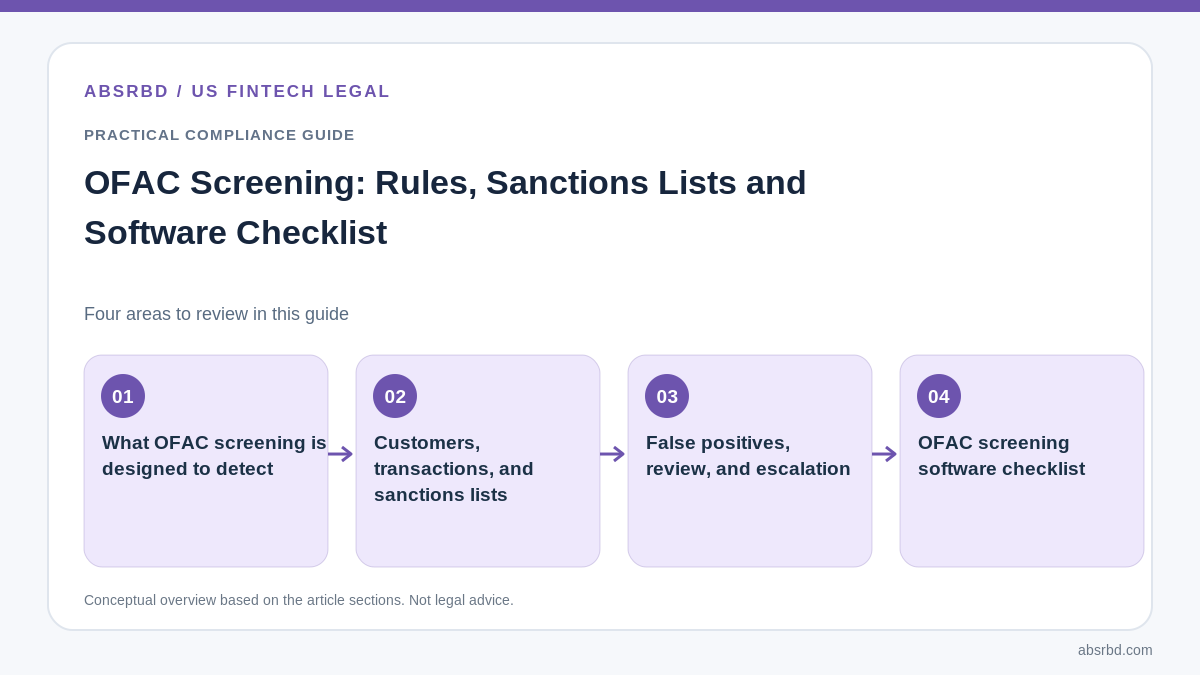
What OFAC screening is designed to detect
OFAC screening helps identify situations in which a proposed customer relationship or transaction may involve:
- A person or organization named on an OFAC sanctions list
- Property or interests in property owned by blocked persons
- An entity subject to OFAC’s 50 Percent Rule even though it is not separately listed
- A sanctioned jurisdiction or geographic region
- A vessel, aircraft, digital currency address, bank, or other identifier associated with a restricted party
- Activity restricted under a particular sanctions program
- Payment information that suggests an attempt to conceal a sanctioned party or location
Screening is only one control. Some prohibitions are based on conduct, location, ownership, or a sector-specific restriction rather than a direct name match.
Is OFAC screening legally required?
OFAC does not prescribe one universal screening system, matching threshold, or review frequency for all businesses. However, U.S. persons must comply with applicable OFAC sanctions, and enforcement can occur even when a party did not know it was engaging in prohibited conduct.
A company should design screening controls in proportion to its exposure. Relevant factors can include:
- Customer types and locations
- Products and services
- Transaction volume and speed
- Cross-border activity
- Payment methods and currencies
- Use of intermediaries or correspondent institutions
- Distribution channels
- Ownership complexity
- Prior alerts, violations, or control failures
The official OFAC Framework for Compliance Commitments describes a risk-based approach to sanctions compliance. It is guidance rather than a single operating specification for every organization.
Who falls within OFAC’s jurisdiction?
OFAC obligations commonly apply to:
- U.S. citizens and permanent residents, wherever located
- Persons and entities located in the United States
- Entities organized under U.S. law and their foreign branches
- Foreign subsidiaries of U.S. companies for certain sanctions programs
- Non-U.S. parties when conduct has a sufficient U.S. nexus or causes a U.S. person to violate sanctions
Jurisdiction and program coverage are fact-specific. A transaction involving U.S. dollars, U.S. financial institutions, U.S.-origin goods, or activity in the United States may require additional analysis.
Customers, transactions, and sanctions lists
A defensible screening procedure separates customer screening from transaction screening. The two processes use overlapping data, but they operate at different times and address different risks.
| Screening type | Typical subjects | Common screening points | Primary purpose |
|---|---|---|---|
| Customer screening | Customers, beneficial owners, controllers, directors, authorized users, guarantors | Onboarding, ownership changes, periodic review, sanctions-list updates | Identify restricted parties before or during a relationship |
| Counterparty screening | Vendors, agents, distributors, partners, financial institutions | Due diligence, contract approval, payment initiation, periodic review | Detect sanctions exposure through third parties |
| Transaction screening | Originators, beneficiaries, banks, addresses, countries, vessels, payment references | Before execution, during processing, after material data changes | Prevent or identify prohibited transfers |
| Portfolio rescreening | Existing customers and related parties | Following list updates, risk events, or scheduled reviews | Detect parties sanctioned after onboarding |
Organizations should define which data fields are screened, when screening occurs, and what happens when information is missing.
Customer and beneficial-owner screening
Customer screening should use enough identifying information to distinguish a real match from an unrelated person with a similar name. Depending on the customer type, relevant fields may include:
- Full legal name and aliases
- Date of birth
- Place of birth
- Nationality
- Residential or registered address
- Country of incorporation
- Government identification number
- Tax or company registration number
- Beneficial owners and ownership percentages
- Directors, controllers, and authorized signers
- Email addresses, telephone numbers, or other available identifiers
Identity verification and sanctions screening serve different purposes. Electronic identity checks can help establish who a customer is, while screening assesses whether that person or related party may be restricted. Organizations reviewing digital onboarding controls can use electronic KYC statistics and trends to understand the broader operational context, but identity verification should not be treated as a substitute for sanctions review.
The OFAC 50 Percent Rule
An entity does not need to appear by name on the Specially Designated Nationals and Blocked Persons List to be blocked.
Under OFAC’s 50 Percent Rule, an entity is generally considered blocked when one or more blocked persons own, directly or indirectly and individually or in the aggregate, 50% or more of it. This makes ownership analysis essential where customers or counterparties have corporate shareholders, holding companies, trusts, or layered ownership structures.
Control without 50% ownership does not automatically make an entity blocked under this rule. It can still create significant risk, however, and restrictions may arise under other sanctions authorities. Organizations should consult OFAC’s official guidance on entities owned by blocked persons when evaluating ownership.
Transaction screening
Transaction screening should assess more than the account holder’s name. Depending on the payment or activity, relevant data may include:
- Originator and beneficiary
- Ordering and intermediary financial institutions
- Account numbers and bank identifiers
- Payment references and free-text fields
- Shipping parties and ports
- Vessel or aircraft names and identifiers
- Countries, cities, addresses, and geographic codes
- Merchants, marketplaces, or payment processors
- Digital currency addresses when published by OFAC
- Related invoices, contracts, or trade documents
Cross-border payments often contain multiple parties and intermediaries, increasing the number of data elements that may require screening. For operational context, see these cross-border payment statistics.
Screening should occur early enough to stop a prohibited transaction where blocking or rejection is required. Rescreening may also be necessary if parties, payment instructions, ownership, or sanctions data change before completion.
Which sanctions sources should be screened?
The authoritative starting point is the U.S. Department of the Treasury’s OFAC website. Organizations should obtain list data directly from OFAC or verify that a provider promptly and accurately incorporates official updates.
| Source | What it contains | Screening implication |
|---|---|---|
| SDN List | Specially Designated Nationals and other blocked persons and property | A potential match may involve blocking requirements |
| Consolidated Non-SDN List | Several non-SDN sanctions lists combined for screening convenience | Restrictions vary by list and are not necessarily full blocking sanctions |
| OFAC Sanctions List Search | Official search interface for OFAC list data | Useful for manual research and alert investigation |
| Sanctions Programs and Country Information | Program-specific authorities, regulations, general licenses, and guidance | Required for determining the actual restriction, exception, or authorization |
| OFAC list data files | Machine-readable sanctions records and identifiers | Supports automated ingestion, version control, and rescreening |
Do not treat every OFAC list result the same
The SDN List generally identifies blocked persons and property. Non-SDN lists may impose narrower restrictions, such as limits on certain transactions, securities, accounts, or services.
A screening result should therefore identify:
- The specific list and sanctions program
- The matched person, entity, vessel, aircraft, or identifier
- The legal restriction associated with that record
- Any applicable ownership rule
- Whether a general or specific license may apply
- Whether the activity must be blocked, rejected, paused, or permitted
Screening against non-U.S. lists may be appropriate when an organization operates in other jurisdictions or has contractual obligations to do so. Those lists should not be mislabeled as OFAC requirements.
Geographic screening has limits
OFAC sanctions are not uniform country bans. Some programs are comprehensive, while others target specific persons, sectors, activities, or regions. A country-name hit is a reason to investigate, not an automatic legal conclusion.
Geographic controls should account for:
- Alternate place names and spellings
- Cities or regions sharing names across countries
- Postal codes and address formats
- Ports, airports, and shipping routes
- IP or device location where relevant and lawfully available
- Mismatches between stated residence and transaction location
- Program-specific regional restrictions
A risk-based OFAC screening procedure
A written procedure should assign responsibilities and make alert handling reproducible. The following workflow can be adapted to the organization’s products, customers, and sanctions exposure.
-
Define the screening population.
Document which customers, owners, counterparties, transactions, and data fields are in scope. -
Use authoritative sanctions data.
Record the source, list version, retrieval time, and method used to update screening systems. -
Set screening events.
Specify when screening occurs, such as onboarding, before payment execution, after ownership changes, and following relevant OFAC list updates. -
Configure matching rules.
Establish rules for exact, fuzzy, phonetic, transliterated, and identifier-based matching. Test the effect of thresholds on both missed matches and false positives. -
Route potential matches for review.
Prevent alerts from disappearing into an unmonitored queue. Assign review priority based on transaction status and potential sanctions impact. -
Compare available identifiers.
Review names, aliases, dates of birth, addresses, registration numbers, nationality, ownership, vessel identifiers, and other available data. -
Escalate credible matches.
Pause the relevant activity when appropriate and refer unresolved or probable matches to personnel authorized to make sanctions decisions. -
Determine the required action.
Assess the applicable program, ownership rules, licenses, exceptions, and reporting obligations. Distinguish blocking from rejection. -
Document the disposition.
Preserve the alert, evidence reviewed, decision, reviewer, timestamps, approvals, and action taken. -
Rescreen and test.
Rescreen relevant records after list updates and periodically test whether the process detects expected matches, handles updates, and retains complete records.
False positives, alert review, and escalation
A false positive occurs when a screening system identifies a possible match that, after review, is determined not to be the sanctioned party or otherwise restricted subject.
False positives are common when:
- A customer has a common name
- OFAC provides limited identifying information
- Names are transliterated from another writing system
- Data contains abbreviations or spelling differences
- A transaction includes incomplete party information
- Matching thresholds are too broad
- Geographic terms appear in unrelated payment references
High alert volume is not proof that a screening program is effective. Excessive false positives can delay legitimate transactions and make it harder for reviewers to identify significant alerts.
Alert-review sequence
Reviewers should use a consistent sequence rather than clearing alerts based only on a name mismatch.
-
Confirm what generated the alert.
Identify the matching field, OFAC record, list, program, and matching rule. -
Compare strong identifiers.
Registration numbers, passport details, dates of birth, addresses, and vessel identification numbers may be more probative than a name alone. -
Review aliases and transliterations.
Determine whether spelling differences are consistent with a known alias or language conversion. -
Analyze ownership and related parties.
A named customer may not match, while its owner or parent company creates sanctions exposure. -
Request missing information if appropriate.
Obtain additional identifying data without alerting a party in a way that could compromise a review or facilitate evasion. -
Record the conclusion.
State why the alert is a false positive, unresolved match, or probable match. Attach or reference the supporting evidence. -
Escalate uncertainty.
Reviewers should not force a clearance when available information cannot reliably distinguish the parties.
False-positive suppression controls
Previously cleared alerts may be suppressed or allowlisted only with safeguards. A suppression record should include:
- The exact customer or counterparty identifier
- The OFAC record that caused the original alert
- The distinguishing information
- The approved scope of suppression
- Reviewer and approver
- Creation and expiration dates
- Conditions requiring revalidation
- A mechanism to cancel suppression after sanctions-data changes
Broad name-based suppression is risky because it may hide a future true match involving a different person with the same name.
Blocking and rejection are different actions
| Outcome | General meaning | Operational response |
|---|---|---|
| False positive | The screened party is not the restricted subject | Clear the alert with documented evidence |
| Unresolved match | Available information is insufficient | Pause or restrict processing as appropriate and obtain further review |
| Blocked transaction or property | OFAC rules require property or funds to be frozen and retained rather than returned | Place the property in a blocked account or otherwise secure it, then follow applicable reporting rules |
| Rejected transaction | The transaction is prohibited but does not involve a blockable interest that must be retained | Do not process the transaction; follow applicable reporting rules |
| Authorized activity | A general license, specific license, exception, or other authorization applies | Document the authority and comply with its conditions |
Blocking and rejecting are legal determinations, not interchangeable software statuses. Organizations should consult the applicable sanctions program and OFAC guidance before releasing, returning, blocking, or rejecting funds.
Reports of blocked property and rejected transactions are governed by OFAC’s reporting regulations, including 31 CFR Part 501. Reporting methods and deadlines should be verified against the current rule and OFAC reporting instructions.
OFAC screening software checklist
OFAC screening software should support the organization’s defined procedure rather than substitute for it. Vendor evaluation should focus on verifiable capabilities, configuration, and auditability.
Sanctions-data management
- [ ] Imports data from authoritative OFAC sources
- [ ] Identifies the source list and sanctions program for each alert
- [ ] Records list versions and update timestamps
- [ ] Processes additions, removals, and amendments
- [ ] Triggers appropriate rescreening after list updates
- [ ] Supports structured identifiers, aliases, addresses, vessels, aircraft, and published digital currency addresses
- [ ] Distinguishes SDN and non-SDN restrictions
Name and identifier matching
- [ ] Supports exact and configurable fuzzy matching
- [ ] Handles aliases, reordered names, punctuation, and abbreviations
- [ ] Supports relevant transliteration and non-Latin scripts
- [ ] Uses dates of birth, locations, identification numbers, and other secondary fields
- [ ] Explains which field and rule generated an alert
- [ ] Allows threshold settings by risk or screening context
- [ ] Provides testing tools for known matches and near matches
Ownership and relationship review
- [ ] Stores beneficial owners and ownership percentages
- [ ] Represents direct and indirect ownership relationships
- [ ] Supports review of aggregate ownership by blocked persons
- [ ] Preserves historical ownership data
- [ ] Triggers rescreening when ownership changes
- [ ] Allows reviewers to document control relationships separately from ownership
Software may help organize ownership information, but OFAC’s 50 Percent Rule analysis can require legal and factual judgment that a simple name-screening engine cannot perform.
Transaction screening
- [ ] Screens originators, beneficiaries, intermediaries, and financial institutions
- [ ] Reviews relevant structured and free-text fields
- [ ] Supports geographic terms and alternate place names
- [ ] Can screen vessel, aircraft, bank, and account identifiers
- [ ] Operates at the point necessary to stop or hold a transaction
- [ ] Handles edited, repaired, or resubmitted payments
- [ ] Prevents transactions from bypassing unresolved high-priority alerts
Case management and escalation
- [ ] Creates a case for each relevant alert
- [ ] Assigns alerts by role, severity, or transaction status
- [ ] Supports documented reviewer and approver decisions
- [ ] Records evidence and comments without overwriting history
- [ ] Enforces escalation and approval rules
- [ ] Tracks unresolved alerts and service levels
- [ ] Separates false positives, blocked items, rejected transactions, and authorized activity
- [ ] Supports controlled suppression with expiration and revalidation
Audit, reporting, and governance
- [ ] Maintains immutable timestamps and user activity logs
- [ ] Preserves the list version used for each screening event
- [ ] Exports case evidence and decision histories
- [ ] Supports record-retention requirements
- [ ] Restricts access according to user roles
- [ ] Provides management reporting on alert volume and disposition
- [ ] Supports independent testing and quality assurance
- [ ] Documents configuration changes and approvals
- [ ] Allows retrieval of records for regulatory or internal review
Integration and operational resilience
- [ ] Integrates with customer, payment, and case-management systems
- [ ] Detects failed or incomplete data transfers
- [ ] Prevents silent screening failures
- [ ] Provides outage and backlog procedures
- [ ] Supports volume and latency requirements
- [ ] Protects sensitive customer and investigation data
- [ ] Defines vendor support, update, and incident-notification responsibilities
- [ ] Allows usable data export if the organization changes providers
Before purchase, test software with representative data rather than relying only on a demonstration. Include common names, aliases, transliterations, incomplete records, ownership scenarios, list removals, and transactions containing multiple parties.
Copyable OFAC screening procedure template
Use this concise template as a starting point and adapt it to applicable sanctions programs, products, and legal requirements.
1. Purpose
This procedure defines how the organization screens relevant customers, beneficial owners, counterparties, and transactions against applicable OFAC sanctions information.
2. Scope
- Business units:
- Products and services:
- Customer types:
- Transaction types:
- Related parties screened:
- Geographic coverage:
- Systems covered:
3. Authoritative data sources
- OFAC lists used:
- Program and country guidance reviewed:
- Data provider, if any:
- Update frequency:
- Person responsible for verifying updates:
- Procedure for failed updates:
4. Screening events
- Customer onboarding:
- Pre-transaction screening:
- Periodic customer review:
- Ownership or profile changes:
- OFAC list updates:
- Event-driven rescreening:
5. Matching configuration
- Exact-match rules:
- Fuzzy-match thresholds:
- Transliteration rules:
- Secondary identifiers:
- Geographic rules:
- Configuration owner:
- Testing and approval schedule:
6. Alert handling
- First-level reviewer:
- Required identifying data:
- Review time target:
- Escalation criteria:
- Escalation owner:
- Rules for pausing transactions:
- False-positive documentation standard:
7. Decision and reporting
- Authority to approve a false-positive disposition:
- Authority to determine blocking or rejection:
- Legal review triggers:
- OFAC reporting owner:
- Applicable reporting procedure:
- License and authorization documentation:
8. Recordkeeping
- Records retained:
- Retention period:
- Storage system:
- Access controls:
- Audit-log requirements:
- Suppression review schedule:
9. Testing and oversight
- Quality-assurance sample:
- Screening-system test frequency:
- List-update test:
- Ownership-analysis review:
- Management reporting:
- Issue remediation owner:
A screening procedure is effective only when staff follow it, list data remains current, alerts are reviewed promptly, and decisions can be reconstructed from retained records. Regular testing should examine the full process—from data capture and matching through escalation, legal determination, reporting, and final disposition.