A money transmitter license may be required when a business receives money or monetary value from one person and transmits it to another person or location. The decisive factors usually include the company’s role in the transaction, whether it controls customer funds, where customers are located, how funds move, and whether a state exemption applies.
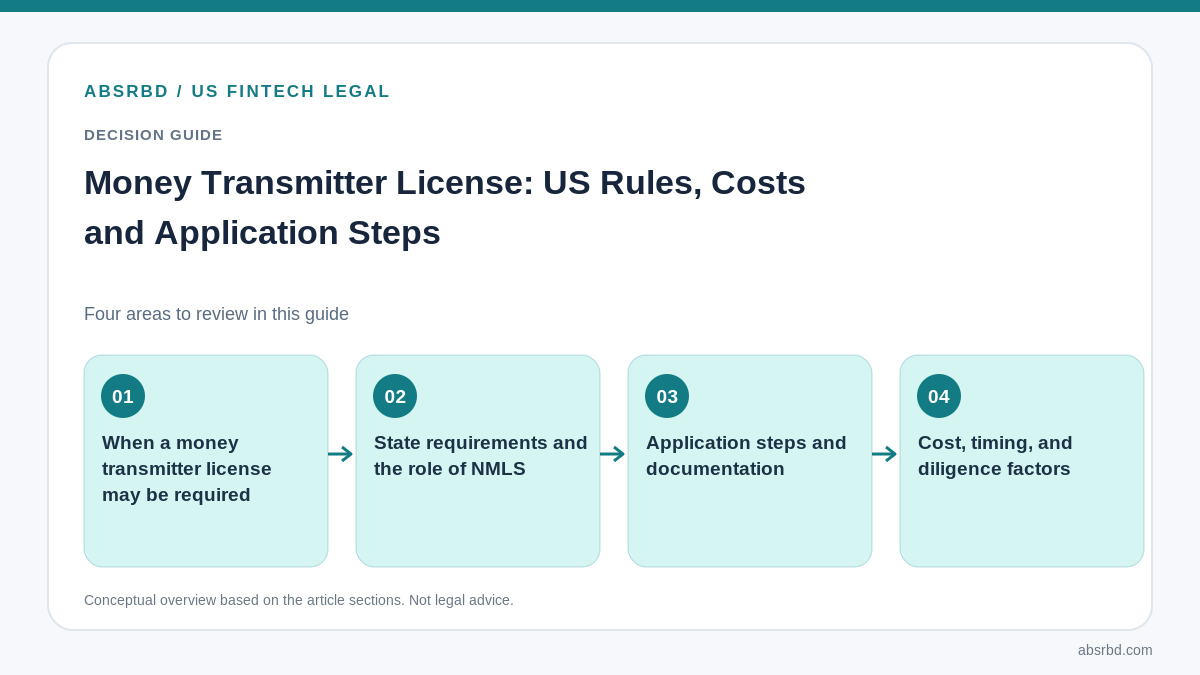
There is no single nationwide MTL license that authorizes money transmission in every state. State regulators issue licenses under their own laws, although many use the Nationwide Multistate Licensing System & Registry (NMLS) for applications, filings, and ongoing reporting.
Before launching, a company should complete a state-by-state licensing analysis, determine applicable financial requirements, and budget for more than application fees. Surety bonds, minimum net worth, financial statements, compliance operations, professional services, renewals, and examinations may all affect the total cost.
Important: This guide provides general commercial information, not legal advice. Money transmission laws and regulator interpretations change. Confirm current requirements with the relevant state regulator and qualified counsel before offering services.
When a Money Transmitter License May Be Required
The threshold question is not what a product is called. It is what the business actually does with customer money or monetary value.
An MTL requirement may arise when a company:
- Accepts funds from a sender for delivery to a recipient
- Holds or controls customer funds before settlement
- Facilitates domestic or cross-border remittances
- Operates stored-value or wallet functionality involving customer balances
- Issues or sells certain payment instruments
- Collects funds and later pays merchants, contractors, sellers, or other third parties
- Moves monetary value between users or accounts as an intermediary
The legal definition and available exclusions vary by state. A transaction flow that is exempt in one jurisdiction may require a license in another.
Questions that help identify a licensing trigger
A licensing assessment should answer the following questions:
-
Who contracts with the customer?
Identify the entity legally responsible for receiving and delivering funds. -
Who receives the money?
Determine whether the company, a bank, a licensed partner, or another intermediary initially takes possession. -
Who controls the funds?
Contract terms alone may not resolve this issue. Review bank-account access, ledger control, payment instructions, settlement authority, and the ability to redirect or delay funds. -
Who is the intended recipient?
Distinguish payments made to the company for its own goods or services from money accepted for transmission to a third party. -
Where are customers located?
State licensing exposure is generally evaluated according to the jurisdictions connected to the transaction, including the customer’s location. -
Does an exemption apply?
Potential exemptions can be narrow and fact-dependent. Their wording and regulator interpretation may differ between states. -
Is a licensed entity actually providing the regulated service?
Using a bank, payment provider, or licensed money transmitter does not automatically remove the company from licensing scope. Responsibilities must be supported by the transaction structure and contracts.
Common business models requiring closer review
| Business model | Why it may raise MTL questions | Key diligence issue |
|---|---|---|
| Peer-to-peer payments | Value moves between separate users | Whether the platform receives or controls funds |
| Marketplace payouts | Customer payments are distributed to sellers | Whether the platform acts as agent, intermediary, or funds custodian |
| Payroll or contractor payments | Funds are collected and paid to third parties | Who controls funds before disbursement |
| Cross-border remittances | Money is accepted in one jurisdiction and delivered elsewhere | State exposure, settlement structure, and licensed partners |
| Stored-value products | Users maintain balances for later payments or transfers | Who issues, holds, and redeems the value |
| Bill-payment services | Customer funds are forwarded to creditors or service providers | Whether a statutory exemption applies |
| Embedded payment products | Payment functionality is integrated into another platform | Allocation of regulated activities among the platform and providers |
Companies assessing international payment products should also evaluate market assumptions separately from licensing scope. Relevant demand and transaction context can be found in these cross-border payment statistics.
State Requirements and the Role of NMLS
Money transmission licensing is primarily state-based. Each state determines:
- Whether the proposed activity is regulated
- Which entity must hold the license
- What exemptions are available
- The required surety bond
- Minimum net-worth standards
- Application and renewal fees
- Required financial statements
- Background-check requirements
- Reporting and examination obligations
- Change-of-control and ownership approval procedures
Because requirements are jurisdiction-specific, an applicant should not use one state’s approval as proof that it can operate everywhere else.
What NMLS does—and does not do
NMLS is a centralized platform used by many state regulators to receive and administer license applications. It can standardize parts of the submission process, but it does not create a single national license.
| NMLS function | Practical meaning |
|---|---|
| Company record | The applicant maintains common legal, ownership, contact, and business information |
| License applications | Applications can be submitted to participating state agencies through the system |
| Individual records | Certain owners, officers, directors, or other control persons may need separate disclosures |
| Document submission | Applicants may upload financial statements, organizational documents, business plans, and other materials |
| Amendments | Material company, ownership, address, or operational changes may require updates |
| Renewals and reporting | Participating regulators may administer renewals and periodic filings through NMLS |
State regulators still review and decide applications. They may request state-specific documents, ask follow-up questions, impose license conditions, or require materials outside the common NMLS forms.
State harmonization does not eliminate state analysis
The Conference of State Bank Supervisors developed the Money Transmission Modernization Act to promote greater consistency in state regulation. However, model legislation is not itself a nationwide operating license.
Companies should verify:
- Whether a state has enacted relevant modernization provisions
- The effective date of those provisions
- Whether the state modified the model language
- Which regulations, guidance, or transition rules apply
- Whether the regulator’s current NMLS checklist reflects recent changes
A multistate applicant therefore needs both a common application package and a state-specific requirements matrix.
Application Steps and Documentation
A successful application process begins before forms are filed. Regulators generally need a coherent explanation of the applicant’s ownership, finances, product, transaction flow, controls, and ability to protect customer funds.
1. Map the product and flow of funds
Create a transaction-flow diagram showing:
- Each party to the transaction
- The entity receiving customer funds
- Every bank and payment account involved
- When the company obtains control of funds
- How payment instructions are created and approved
- The settlement path
- Refund, reversal, and failed-payment handling
- The party responsible for delivering funds to the recipient
The diagram should agree with customer agreements, partner contracts, bank arrangements, product screens, and accounting treatment.
2. Identify the applicant entity
Confirm which legal entity will conduct the regulated activity. Review:
- Formation and good-standing status
- Ownership structure
- Parent companies and subsidiaries
- Trade names
- Principal office and operational locations
- Officers, directors, managers, and other control persons
- Affiliates participating in the payment flow
A complex or changing ownership structure can increase documentation and review time.
3. Build a state licensing matrix
For each target state, record:
| Matrix field | What to document |
|---|---|
| Licensing conclusion | License required, exemption potentially available, or further analysis needed |
| Regulator | Agency responsible for money transmission oversight |
| Filing channel | NMLS or another required process |
| Application fee | Current regulator and system charges |
| Surety bond | Required amount or calculation method |
| Net worth | Applicable minimum and calculation rules |
| Financial statements | Required period, format, and level of assurance |
| Control-person filings | Individuals and entities requiring disclosure |
| State-specific documents | Forms, certifications, policies, or explanations |
| Renewal cycle | Renewal date and required submissions |
| Ongoing reports | Periodic, financial, transaction, or event-driven filings |
Record the source and verification date for every requirement. High-frequency review is important because licensing checklists and financial thresholds can change.
4. Prepare the core application package
Requirements differ, but an application package may include:
- Formation and organizational documents
- Certificates of good standing
- Ownership and organizational charts
- Management and control-person information
- Business plan
- Product descriptions
- Flow-of-funds diagrams
- Customer terms and disclosures
- Bank-account and settlement information
- Financial statements
- Financial projections
- Surety-bond documentation
- Compliance policies and procedures
- Information-security and business-continuity materials
- Litigation, regulatory, and disciplinary disclosures
- Details of agents, delegates, vendors, or outsourced providers
- Fingerprints, background checks, or personal financial information where required
All documents should describe the same operating model. Inconsistencies between the business plan, contracts, financial projections, and transaction diagram commonly create additional questions.
5. Confirm net-worth and financial-statement readiness
Determine how each state defines and calculates required net worth. Do not assume that:
- Cash on hand equals regulatory net worth
- Consolidated parent-company capital automatically satisfies the applicant’s requirement
- Unaudited statements will always be accepted
- Future fundraising can substitute for capital required at approval
- One financial-statement package will satisfy every regulator
Applicants should also consider whether the licensing entity will remain adequately capitalized after launch and operating expenses.
6. Arrange surety bonds
A surety bond is generally intended to support the applicant’s obligations under applicable state law. The required bond amount may be fixed, tiered, or linked to transaction activity, and states may adjust it under specified circumstances.
The bond amount is not the same as the bond premium:
- Bond amount: The penal sum required by the regulator
- Bond premium: The amount paid to the surety provider for issuing the bond
- Collateral: Assets a surety may require based on underwriting
Applicants should obtain underwriting feedback early. Financial condition, ownership, business history, projected volume, and the number of states can affect availability and commercial terms.
7. Submit common and state-specific filings
Complete the applicable company and control-person records, upload required documents, pay fees, and submit applications to the selected jurisdictions.
Before submission, verify that:
- Legal names and addresses are consistent
- Ownership percentages reconcile across all forms
- Financial statements match reported figures
- Disclosures are complete
- State-specific documents are included
- Bonds use the correct obligee and required form
- Authorized signers have completed certifications
8. Manage regulator questions
Treat follow-up requests as part of the application, not as an exception. Assign owners for legal, financial, product, security, banking, and compliance responses.
A response tracker should include:
- Requesting regulator
- Date received
- Response deadline
- Internal owner
- Documents required
- Dependencies
- Submission date
- Open follow-up items
Prompt answers help, but completeness and consistency are more important than speed alone.
9. Complete approval conditions before launch
A regulator may require additional evidence or final documentation before authorizing activity. Do not treat an application submission, NMLS status change, or preliminary communication as permission to operate.
Confirm the effective license status directly and document any conditions, restrictions, or post-approval obligations.
10. Establish ongoing license management
Licensing continues after approval. Build controls for:
- Renewals
- Periodic reports
- Financial-statement submissions
- Surety-bond maintenance
- Net-worth monitoring
- Material-event notifications
- Changes in officers or control persons
- Address and trade-name changes
- New products or transaction flows
- Ownership changes
- Regulatory examinations
- Complaint records
- Record retention
Money Transmitter License Cost
There is no reliable universal price for obtaining a money transmitter license. Total cost depends on the states selected, the applicant’s financial condition, ownership complexity, bond underwriting, documentation readiness, and the amount of professional work needed.
Main cost categories
| Cost category | What it includes | Primary cost drivers |
|---|---|---|
| Application and system fees | State filing charges and applicable platform fees | Number of jurisdictions and filing type |
| License and renewal fees | Initial license charges and recurring renewals | State fee schedules |
| Surety-bond premiums | Payments to obtain and maintain required bonds | Bond amount, credit quality, financial strength, and underwriting |
| Surety collateral | Assets potentially required by the bond provider | Applicant risk profile and aggregate bond exposure |
| Regulatory net worth | Capital maintained to satisfy state requirements | State rules and business activity |
| Financial reporting | Preparation, review, or audit of statements | Required assurance level and accounting readiness |
| Background checks | Fingerprints, reports, and related processing | Number and location of control persons |
| Legal and licensing support | Scope analysis, application preparation, and regulator responses | State count, product complexity, and ownership structure |
| Compliance operations | Policies, monitoring, training, reporting, and complaint handling | Product risk, transaction volume, and staffing model |
| Technology and security | Controls, documentation, testing, and operational systems | Existing infrastructure and regulator expectations |
| Examination readiness | Records, reconciliations, remediation, and support | Quality of controls and regulatory activity |
Capital requirements are not ordinary fees
Net worth and surety collateral should be modeled separately from filing expenses:
- Application fees are generally direct expenditures.
- Bond premiums are recurring operating costs.
- Surety collateral can restrict access to cash or other assets.
- Minimum net worth is capital that must remain available within the licensed entity under applicable rules.
- Compliance staffing and systems create continuing operational expense.
This distinction is important when comparing a direct licensing strategy with a structure that relies on regulated partners.
How Long the Licensing Process Takes
There is no dependable single timeline for all money transmitter license applications. Review periods differ by state and can change based on application quality, regulator workload, business complexity, and the number of follow-up questions.
Factors that commonly affect timing
- Completeness of the initial submission
- Availability of required financial statements
- Surety-bond underwriting
- Background-check processing
- Complex or international ownership
- Changes to the product during review
- Unclear flow of funds
- Inconsistencies between documents
- Delayed responses to regulator questions
- Reliance on unfinalized bank or vendor relationships
- Applications filed in many states at once
- Material disclosures requiring additional review
A practical sequencing approach
Applicants can choose among three common rollout models:
| Rollout model | Advantages | Trade-offs |
|---|---|---|
| File broadly at once | Supports a wider planned launch footprint | Higher upfront cost and more concurrent regulator requests |
| File in prioritized waves | Spreads workload and incorporates lessons from early filings | Nationwide coverage develops more gradually |
| Start with limited states | Reduces initial licensing scope | Commercial reach may be constrained, and expansion still requires additional filings |
State prioritization should reflect customer location, expected volume, partner requirements, financial thresholds, regulatory complexity, and operational capacity—not market size alone.
Direct Licensing vs. Using a Licensed Partner
Commercial planning often includes a choice between applying directly and structuring services through a regulated provider. A partner model is not automatically an exemption, so the actual allocation of funds control and legal responsibility must be reviewed.
| Evaluation factor | Direct state licensing | Licensed-partner model |
|---|---|---|
| Regulatory control | Greater direct responsibility and control | Dependent on contract and partner program |
| Launch scope | Limited by obtained licenses and approvals | May support faster access where the structure is valid |
| Upfront investment | Application, bond, capital, and buildout costs | Integration, program, transaction, and oversight costs |
| Product flexibility | Changes remain subject to the company’s own license obligations | Changes may require partner approval |
| Compliance operations | Built and maintained internally | Responsibilities are shared but not eliminated |
| Dependency risk | Less reliance on one program provider | Exposure to partner restrictions or termination |
| Long-term economics | Can improve with sufficient scale, depending on the model | May remain variable with usage and contract terms |
When evaluating providers, ask exactly which entity receives funds, holds accounts, issues customer terms, handles complaints, performs reconciliations, and bears loss or refund obligations.
For broader market benchmarking—not as a substitute for licensing analysis—review this fintech startups watchlist.
MTL Due-Diligence Checklist
Use this checklist before selecting states, requesting budgets, or starting applications.
Product and transaction structure
- [ ] Document every product that moves money or monetary value.
- [ ] Create an end-to-end flow-of-funds diagram.
- [ ] Identify who receives, holds, controls, and transmits funds.
- [ ] Map customer, recipient, bank, processor, vendor, and partner roles.
- [ ] Confirm how refunds, reversals, chargebacks, and failed payments work.
- [ ] Reconcile product descriptions with contracts and account structures.
Licensing scope
- [ ] Identify customer locations and planned launch states.
- [ ] Analyze licensing triggers in each target jurisdiction.
- [ ] Document any potential exemption and its factual conditions.
- [ ] Confirm whether NMLS is the required filing channel.
- [ ] Record regulator links, source documents, and verification dates.
- [ ] Establish a schedule for checking requirement changes.
Corporate and ownership readiness
- [ ] Confirm the correct applicant entity.
- [ ] Prepare organizational and ownership charts.
- [ ] Identify all reportable control persons.
- [ ] Review litigation, regulatory, bankruptcy, and disciplinary disclosures.
- [ ] Confirm entity names, addresses, and ownership percentages across records.
Financial readiness
- [ ] Compare state net-worth requirements.
- [ ] Determine whether the applicant has sufficient qualifying capital.
- [ ] Identify required financial-statement periods and assurance levels.
- [ ] Obtain preliminary surety-bond terms.
- [ ] Separate filing expenses, bond premiums, collateral, and capital needs.
- [ ] Budget for renewals, reporting, examinations, and compliance staff.
Application package
- [ ] Prepare a consistent business plan.
- [ ] Finalize flow-of-funds diagrams.
- [ ] Assemble formation and good-standing documents.
- [ ] Prepare financial statements and projections.
- [ ] Compile policies, customer terms, and material partner agreements.
- [ ] Complete background-check and fingerprint requirements.
- [ ] Review every state-specific checklist before filing.
Post-approval operations
- [ ] Assign responsibility for renewals and regulatory reports.
- [ ] Monitor net worth and bond coverage.
- [ ] Create material-change notification procedures.
- [ ] Maintain complaint and transaction records.
- [ ] Prepare for regulatory examinations.
- [ ] Review new products and states before launch.
- [ ] Track ownership, management, banking, and address changes.
The Bottom Line
A US money transmitter license strategy should begin with the transaction flow, not the application form. Determine whether the company receives or controls customer funds, analyze each target state, and test any proposed exemption against the actual operating model.
For commercial planning, build a total-cost model that includes filing fees, surety bonds, collateral, net-worth requirements, financial reporting, professional support, compliance operations, renewals, and examinations. NMLS can centralize parts of the process, but state regulators retain authority over licensing decisions and state-specific requirements.
The strongest applications are consistent, financially prepared, and operationally complete before filing. A clear licensing matrix and the due-diligence checklist above can help identify gaps before they become costly regulator questions or launch delays.