Choosing a sponsor bank for a fintech requires more than comparing pricing and API documentation. The strongest partner is the bank whose program appetite, operational capacity, oversight process, service levels, reserve requirements, complaint procedures, and exit terms fit the fintech’s business model.
Before signing a sponsor-bank agreement, verify five areas:
- Program fit: The bank supports the intended products, customers, transaction types, geographies, and growth profile.
- Operational readiness: Its systems, staffing, vendors, and escalation paths can support the program.
- Oversight expectations: Approval, monitoring, audit, reporting, and change-management requirements are documented.
- Commercial and legal terms: Fees, reserves, service levels, liability, suspension rights, and termination triggers are measurable.
- Wind-down feasibility: The contract explains how customers, funds, data, complaints, and pending transactions will be handled at exit.
The framework below helps fintech teams compare prospective partners consistently. It is not a substitute for advice from qualified banking and regulatory counsel.
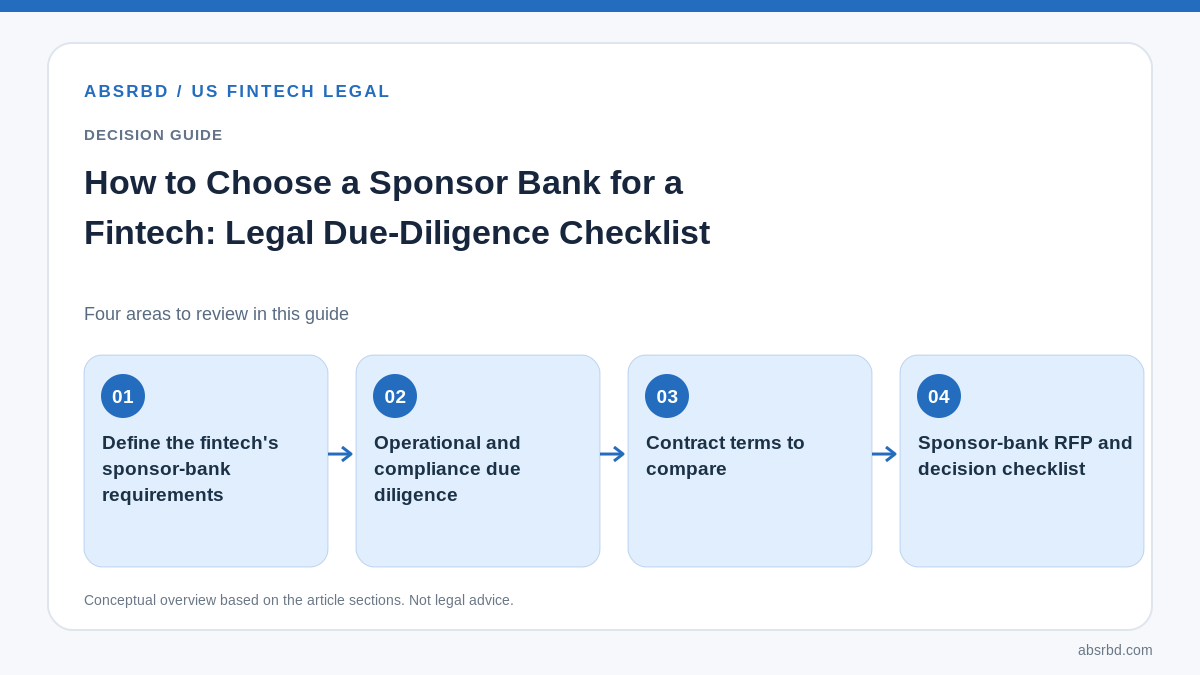
Define the Fintech’s Sponsor-Bank Requirements
A fintech should define its requirements before requesting proposals. Without a written program profile, banks may make different assumptions about the product, making their proposals difficult to compare.
Build a complete program profile
Give each prospective bank the same material facts and forecasts.
| Requirement area | Information to define |
|---|---|
| Product | Deposit account, payment service, card program, lending product, or other proposed service |
| Customer | Consumer or business; target industries; expected risk characteristics |
| Geography | States and territories served; domestic or cross-border activity |
| Transaction profile | Payment rails, transaction types, expected frequency, average values, and peak volumes |
| Funds flow | How funds enter, move through, and leave the program |
| Customer experience | Onboarding, account access, statements, support, disputes, and account closure |
| Distribution | Direct-to-consumer, embedded finance, marketplace, employer, or another channel |
| Technology | Core platform, APIs, processors, identity tools, fraud systems, and critical vendors |
| Growth assumptions | Launch volume, expected customer growth, seasonal peaks, and long-term capacity needs |
| Support model | Service hours, channels, expected response times, and escalation requirements |
| Program changes | Expected roadmap, new features, new markets, or additional payment rails |
| Exit needs | Data portability, customer migration, reserve release, and transition period |
Volume assumptions should be supported by defensible market and operating data rather than optimistic projections. Relevant planning inputs may include U.S. neobanking statistics and, where applicable, cross-border payment statistics.
Separate essential requirements from preferences
Classify each criterion before evaluating proposals:
- Mandatory: A requirement the program cannot launch without.
- Preferred: Important but potentially negotiable.
- Optional: Useful if the cost and implementation effort are reasonable.
- Disqualifying: A condition that makes the relationship unsuitable.
Examples of possible disqualifiers include unsupported customer segments, inadequate processing capacity, prohibited transaction types, unacceptable reserve terms, or termination provisions that do not allow an orderly transition.
Confirm the bank’s strategic fit
A bank may be technically capable of supporting a fintech without being strategically committed to the program. Ask:
- Does the proposed program fit the bank’s documented risk appetite?
- Has the bank approved comparable products or customer segments?
- Which internal committee or executive approves the relationship?
- Are material capabilities already operational, or dependent on future development?
- How many new programs is the bank onboarding during the same period?
- What internal resources will be assigned before and after launch?
- What circumstances could cause the bank to reduce support for the program?
Request written confirmation of material limitations. Sales presentations should not be treated as a substitute for approved program terms.
Conduct Operational and Compliance Due Diligence
Due diligence should test whether the bank can support the proposed program in practice—not merely whether it expresses interest.
Verify the institution and proposed contracting parties
Confirm the identity and role of every entity in the proposed arrangement. The contracting entity, chartered bank, technology provider, processor, and other vendors may not be the same organization.
The due-diligence file should include:
- Full legal names of contracting entities
- Bank charter and primary regulator
- FDIC insurance status, where applicable
- Organizational structure relevant to the program
- Authorized contract signatories
- Material subcontractors and technology providers
- Evidence of required corporate approvals
- Publicly available enforcement or consent-order information relevant to the relationship
The Federal Deposit Insurance Corporation provides official resources for researching FDIC-insured institutions. Counsel should review the results and determine whether additional state or federal records are relevant.
Evaluate oversight and approval processes
The goal is to understand how the bank will review the program and how quickly it can make decisions.
Ask the bank to describe:
- Initial product and launch approval stages
- Documentation required at each stage
- Testing and certification requirements
- Marketing and disclosure review procedures
- Approval processes for product, vendor, pricing, and geographic changes
- Monitoring and reporting expectations
- Issue-escalation and remediation procedures
- Audit and examination support
- Circumstances that permit immediate restrictions or suspension
Focus on concrete workflow. For example, “marketing requires bank approval” is incomplete unless the agreement or operating procedure also identifies submission requirements, reviewers, target response times, escalation paths, and treatment of urgent corrections.
Test operational capacity
A sponsor-bank proposal should be evaluated against expected and stressed operating conditions.
| Capability | Due-diligence questions | Evidence to request |
|---|---|---|
| Onboarding | What volumes can be reviewed? How are exceptions handled? | Workflow documentation, testing criteria, capacity assumptions |
| Transaction processing | Which rails, limits, cutoffs, and settlement windows are supported? | Processing specifications, holiday schedules, exception procedures |
| Reconciliation | How frequently are records reconciled? Who investigates breaks? | Sample reports, escalation procedures, resolution targets |
| Fraud operations | How are suspected fraud events reported and escalated? | Escalation matrix, case workflow, reporting format |
| Account restrictions | Who can place or remove holds or restrictions, and how are urgent cases handled? | Procedures, authorization matrix, response targets |
| Customer support | Which inquiries require bank involvement? | Contact model, escalation tiers, hours of operation |
| Incident response | How are outages, security events, and processing failures communicated? | Incident plan, notification matrix, status-report format |
| Business continuity | What alternatives exist if a critical service becomes unavailable? | Continuity summary, testing schedule, recovery objectives |
| Reporting | Which operational and management reports are provided? | Report catalog, sample reports, delivery schedule |
| Scalability | What happens when actual volume exceeds forecasts? | Capacity thresholds, notice requirements, expansion process |
Do not rely solely on a platform demonstration. Request sample reports, operating procedures, implementation dependencies, and named escalation roles.
Review critical vendors and dependencies
A bank may depend on processors, core systems, middleware providers, card networks, or other third parties. These dependencies can affect implementation time, issue resolution, and exit options.
Determine:
- Which services are performed by the bank and which by other providers
- Whether the fintech must sign separate vendor contracts
- Which party controls each vendor relationship
- Whether key vendors can be replaced without renegotiating the entire program
- How subcontractor changes are communicated and approved
- Whether vendor outages are included in service-level commitments
- Who owns implementation configurations and program-specific work product
- Whether data can be exported in a usable format at termination
If a proposal depends on capabilities that are not yet contracted, integrated, or tested, treat them as future capabilities rather than current ones.
Examine complaint and dispute handling
Complaint management is both a customer-experience issue and a material operating dependency. The agreement should distinguish ordinary support contacts from complaints, disputes, fraud claims, and legal or regulatory escalations.
Compare prospective banks on:
- Complaint definitions and classification rules
- Intake channels and required data fields
- Escalation thresholds
- Response and resolution targets
- Bank review or approval requirements
- Root-cause analysis expectations
- Reporting frequency and format
- Treatment of repeat or systemic complaints
- Record-retention requirements
- Handling of complaints received after termination
Request sample complaint reports and escalation workflows. A statement that complaints will be handled “promptly” is less useful than defined categories, deadlines, owners, and escalation procedures.
Compare Sponsor-Bank Contract Terms
Commercial proposals should be converted into a side-by-side contract matrix. The most important terms are those that affect launch certainty, operating continuity, financial exposure, and the ability to exit.
Sponsor-bank contract checklist
| Contract area | Terms to compare | Questions to resolve |
|---|---|---|
| Scope | Products, customers, geographies, rails, and excluded activities | Does the written scope match the approved business plan? |
| Implementation | Milestones, dependencies, testing, acceptance, and launch approval | What happens if either party misses a milestone? |
| Fees | Setup, minimum, per-account, per-transaction, support, and termination fees | Which fees are fixed, variable, pass-through, or adjustable? |
| Service levels | Availability, processing, reporting, review, and support targets | Are metrics objective, measurable, and tied to remedies? |
| Reserves | Amount, formula, funding, replenishment, use, and release | Can the bank change the reserve, and under what conditions? |
| Program changes | Approval requirements and implementation timelines | Can the bank reject or delay a material roadmap item? |
| Data | Access, permitted use, retention, security, and export | Can required data be retrieved during and after termination? |
| Complaints | Intake, escalation, reporting, and post-termination handling | Are deadlines and decision rights documented? |
| Audit rights | Scope, frequency, notice, cost, and remediation | Are requests proportionate and operationally feasible? |
| Liability | Indemnities, exclusions, caps, and uncapped claims | Do the terms reflect each party’s controllable risks? |
| Suspension | Triggers, notice, scope, and cure rights | Can restrictions be narrowed instead of stopping the program? |
| Termination | Cause, convenience, notice, cure periods, and fees | Is there enough time to find and implement a replacement? |
| Wind-down | Customer communications, funds, data, disputes, and migration | Is there an enforceable transition process? |
| Regulatory change | Required modifications and cost allocation | How will urgent changes be implemented and priced? |
Make service levels measurable
A meaningful service-level agreement identifies:
- The service being measured
- The measurement method
- Data source and reporting frequency
- Exclusions and maintenance windows
- Severity levels
- Response and resolution targets
- Escalation procedures
- Repeated-failure consequences
- Available remedies
- Termination rights for chronic failure
Service credits alone may not protect a fintech from operational disruption. Consider whether repeated failures trigger corrective action, executive escalation, expanded support, or termination assistance.
Key service levels may cover:
- API and platform availability
- Transaction processing and file delivery
- Reconciliation breaks
- Critical incident notification
- Customer escalation response
- Complaint review
- Approval of marketing or program changes
- Data exports and reporting
- Implementation milestones
Analyze reserve requirements carefully
“Reserve” can refer to different financial protections. The contract should define the purpose and operation of each required balance.
Clarify:
- Purpose: What exposure is the reserve intended to cover?
- Calculation: Is it a fixed amount, percentage, formula, or discretionary amount?
- Funding: When must the reserve be funded?
- Location: Where is the money held, and who controls the account?
- Permitted use: What events allow the bank to draw from it?
- Notice: Must the bank notify the fintech before or after a draw?
- Replenishment: How quickly must a shortfall be restored?
- Adjustment: Can the required amount increase, and based on what criteria?
- Reporting: What statements or supporting calculations will be provided?
- Release: When and how will unused funds be returned after termination?
Avoid terms that permit unlimited or unexplained reserve increases. If discretion is unavoidable, negotiate objective factors, notice, supporting calculations, escalation rights, and maximum exposure where possible.
Scrutinize suspension and termination rights
A bank may require broad rights to protect itself, but the contract should still address process and proportionality.
Review:
- Events permitting immediate suspension
- Whether suspension can apply to a feature or customer segment instead of the entire program
- Required notice, when legally and operationally possible
- Cure periods for remediable breaches
- Rights to challenge factual errors
- Treatment of existing customers during suspension
- Access to data and support while a dispute is pending
- Termination for convenience
- Minimum notice periods
- Early termination fees
- Continuing obligations after termination
Terms such as “reputational risk,” “unsafe activity,” or “material concern” may be commercially significant if left undefined. Counsel should assess whether objective examples, consultation requirements, or escalation procedures can be added.
Require a workable wind-down plan
Wind-down language should be negotiated before launch, not after the relationship deteriorates.
The agreement should address:
- Whether new customer acquisition stops immediately or in phases
- Treatment of existing accounts and pending transactions
- Customer-notification responsibilities and approval procedures
- Continued servicing during the transition
- Access to statements, transaction records, and complaint files
- Data format, delivery schedule, and migration support
- Handling of returns, disputes, chargebacks, and fraud claims
- Fees for transition services
- Reserve retention and release
- Destruction or return of confidential information
- Continued access to required reports
- Cooperation with a replacement institution
- A final deadline for closing the program
A transition period is useful only if essential services remain available. Confirm that processing, reporting, customer support, dispute handling, and data access continue for the required duration.
Red Flags When Comparing Sponsor Banks
A single concern may be negotiable. Multiple unresolved concerns usually justify pausing or rejecting the proposal.
Watch for:
- Material capabilities described verbally but omitted from the proposal
- Unclear identity of the actual contracting bank
- A product outside the bank’s stated program appetite
- Heavy reliance on uncontracted or untested vendors
- No named executive sponsor or implementation owner
- Approval processes without target turnaround times
- Service levels measured solely by the bank
- Broad fee or reserve increases without objective criteria
- Immediate suspension rights without a practical escalation process
- Termination rights that do not provide transition support
- Restrictions on data export or replacement-bank migration
- Complaint procedures without deadlines or ownership
- Pricing that excludes material pass-through costs
- Launch dates dependent on unresolved internal approvals
- Pressure to sign before due-diligence materials are provided
Sponsor-Bank RFP and Decision Process
Use the same request for proposal and evidence list for every candidate. Consistency makes trade-offs visible and reduces the risk that an attractive price obscures a material legal or operational limitation.
Step 1: Issue a structured RFP
Include:
- Fintech and ownership overview
- Product description
- Customer and geographic scope
- Funds-flow diagram
- Transaction and growth forecasts
- Technology architecture
- Vendor list
- Implementation timeline
- Required service levels
- Reporting requirements
- Reserve and pricing questions
- Proposed contract term
- Termination and wind-down expectations
- Required evidence and response format
Require banks to mark each requirement as:
- Supported now
- Supported with configuration
- Supported through a third party
- Planned but not currently available
- Not supported
Step 2: Conduct written due diligence
Create a secure repository for corporate, technical, operational, financial, and contractual materials. Track unanswered questions, conflicting responses, and assumptions requiring contract language.
Step 3: Hold functional review sessions
Separate sales discussions from detailed review sessions covering:
- Product and implementation
- Operations and customer support
- Technology and data
- Complaints and escalations
- Commercial terms and reserves
- Contract, termination, and wind-down
Ask the prospective bank to include the people who will operate and approve the program, not only its business-development team.
Step 4: Score candidates consistently
Use a scorecard with buyer-selected weights.
| Evaluation category | Example criteria |
|---|---|
| Program fit | Product, customer, geography, transaction, and growth alignment |
| Operational capability | Capacity, reconciliation, incidents, support, and continuity |
| Technology | Integration maturity, reporting, data access, and vendor dependencies |
| Oversight process | Approval clarity, review timelines, monitoring, and escalation |
| Customer handling | Complaint, dispute, fraud, and account-restriction processes |
| Commercial terms | Total cost, minimums, pass-through expenses, and adjustment rights |
| Financial exposure | Reserves, indemnities, liability caps, and termination fees |
| Contract flexibility | Change management, cure rights, suspension, and renewal |
| Exit readiness | Transition period, data portability, migration support, and reserve release |
| Strategic commitment | Executive sponsorship, staffing, roadmap alignment, and capacity |
Document both the score and the supporting evidence. A high score based on unverified commitments should be marked as conditional.
Step 5: Negotiate from an issues list
Maintain a single issues list that records:
- Proposed term
- Fintech position
- Bank position
- Business impact
- Legal or operational owner
- Required evidence
- Agreed resolution
- Contract section where the resolution appears
Do not close an issue merely because the parties agreed during a meeting. Confirm that the final agreement, schedule, operating procedure, or service-level exhibit reflects the resolution.
Step 6: Complete final approval conditions
Before signing, confirm that:
- Required internal approvals have been obtained
- Material vendors have been identified
- Implementation dependencies are assigned
- Pricing schedules are complete
- Service levels are attached
- Reserve mechanics are documented
- Complaint procedures are approved
- Suspension and termination terms are understood
- The wind-down plan is contractually supported
- Remaining assumptions are listed as closing or launch conditions
Copyable Sponsor-Bank RFP Template
The following outline can be adapted for a sponsor-bank selection process.
Company and program
- Legal name and ownership structure
- Product description and customer value proposition
- Target customer segments
- Proposed launch states and expansion plan
- Transaction types and payment rails
- Forecast volumes and peak capacity
- Funds-flow diagram
- Customer-support model
- Technology and vendor architecture
Bank capabilities
- Supported products and customer segments
- Geographic and transaction restrictions
- Implementation requirements and typical dependencies
- Processing, reconciliation, and reporting capabilities
- API, file, and data-export options
- Business-continuity approach
- Critical-vendor dependencies
- Current capacity and scalability constraints
Oversight and operating process
- Product approval stages
- Required policies and documentation
- Testing and launch criteria
- Marketing and change-approval process
- Monitoring and reporting expectations
- Issue and incident escalation
- Complaint and dispute procedures
- Audit and remediation process
Commercial proposal
- Implementation fees
- Recurring minimums
- Account and transaction charges
- Support and reporting fees
- Third-party pass-through costs
- Pricing adjustment rights
- Reserve formula and release conditions
- Initial term and renewal provisions
- Termination and transition fees
Contract and exit
- Service-level commitments
- Suspension triggers
- Cure periods
- Termination rights
- Transition-services period
- Data-delivery obligations
- Customer-communication process
- Treatment of pending disputes and transactions
- Replacement-bank migration support
- Reserve release timeline
Required attachments
- Proposed agreement and schedules
- Full pricing schedule
- Implementation plan
- Service-level exhibit
- Sample operational reports
- Escalation matrix
- Complaint workflow
- Business-continuity summary
- Data-export specification
- Wind-down or transition-services terms
Final Sponsor-Bank Selection Checklist
Before selecting a sponsor bank, confirm that the answer to each question is documented:
- [ ] Does the bank support the complete program as proposed?
- [ ] Are product, customer, geography, and transaction restrictions explicit?
- [ ] Have all contracting entities and critical vendors been identified?
- [ ] Are implementation milestones and dependencies realistic?
- [ ] Are approval and change-review timelines measurable?
- [ ] Can the bank support projected and peak volumes?
- [ ] Are complaint and dispute procedures operationally workable?
- [ ] Are service levels objective and supported by useful remedies?
- [ ] Is total pricing clear, including pass-through and exit costs?
- [ ] Are reserve calculations, draw rights, and release terms defined?
- [ ] Are suspension triggers and cure rights sufficiently clear?
- [ ] Does the termination period allow a realistic migration?
- [ ] Will required data remain accessible during wind-down?
- [ ] Are transition services and costs documented?
- [ ] Are material sales commitments included in binding documents?
- [ ] Have banking counsel and relevant internal stakeholders reviewed the final agreement?
The best sponsor-bank partnership is not necessarily the cheapest or fastest to launch. It is the relationship whose capabilities and contract terms remain workable during growth, operational problems, strategic changes, and an eventual transition.