KYB verification—short for Know Your Business verification—is the process of confirming that a company is legitimate, active, appropriately authorized, and owned or controlled by the people it claims. It is commonly used when onboarding merchants, suppliers, corporate customers, platforms, and other business counterparties.
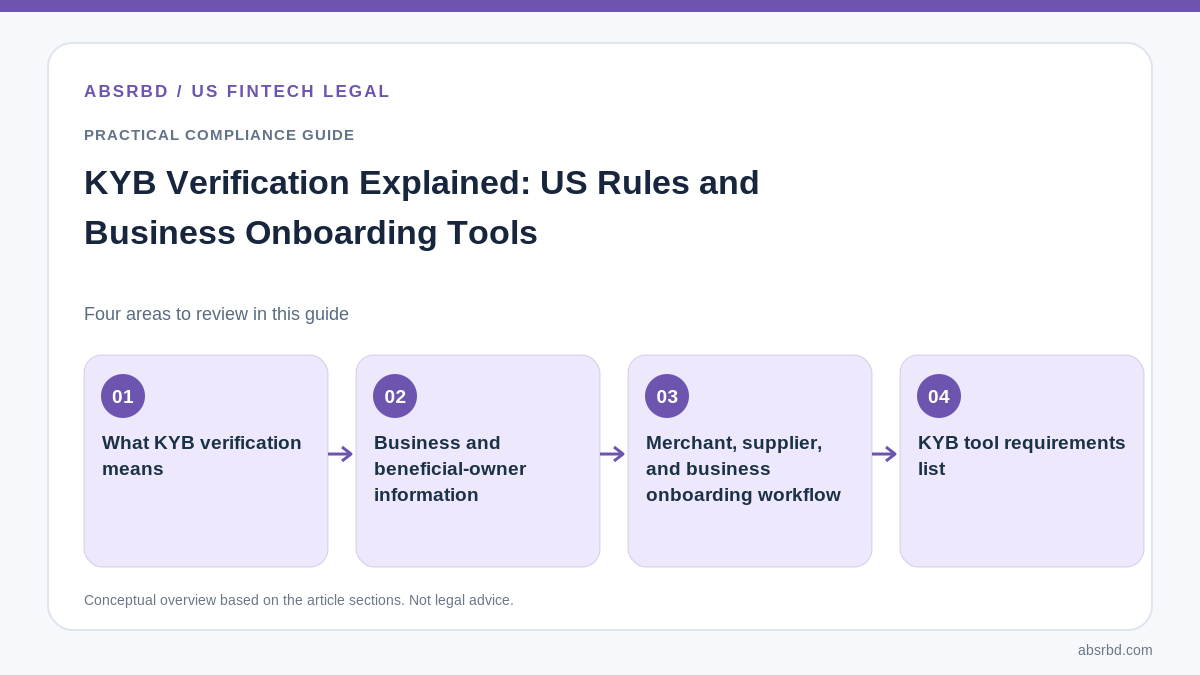
A practical KYB process should answer four questions:
- Does the business legally exist?
- Who owns or controls it?
- Is it authorized to conduct the proposed activity?
- Does onboarding it create sanctions, fraud, regulatory, or reputational risk?
There is no single US law requiring every company to perform the same KYB procedure. Requirements depend on the organization’s industry, regulatory status, location, products, and relationship with the business being reviewed.
What KYB Verification Means
KYB verification evaluates a business entity and its associated owners or controllers. The process may include checking corporate registrations, addresses, tax identifiers, licenses, ownership records, sanctions exposure, and operational details.
A company might conduct KYB before:
- Opening an account for a corporate customer
- Approving a merchant to accept payments
- Adding a supplier to a procurement system
- Onboarding a marketplace seller
- Entering a distribution or referral relationship
- Providing financial or regulated services to a legal entity
- Granting access to a business platform or API
KYB vs. KYC
KYB and KYC are related but have different subjects.
| Dimension | KYB verification | KYC verification |
|---|---|---|
| Primary subject | Company, partnership, nonprofit, or other legal entity | Individual person |
| Core question | Is this business legitimate, authorized, and acceptably low-risk? | Is this person who they claim to be? |
| Typical information | Legal name, formation details, address, EIN, licenses, ownership structure | Name, date of birth, address, identity document |
| Associated-party checks | Beneficial owners, control persons, directors, authorized representatives | Usually the individual customer |
| Common use cases | Merchant, supplier, corporate account, or platform onboarding | Consumer account or individual service onboarding |
KYB often contains a limited identity-verification component because a business acts through individuals. However, checking an authorized representative or beneficial owner does not replace verification of the company itself. Organizations tracking changes in identity technology can also review these electronic verification statistics and trends.
How US KYB Requirements Work
The United States does not have one universal “KYB law” that creates an identical checklist for every business relationship. Instead, obligations come from multiple sources.
Federal customer due diligence requirements
Certain regulated financial institutions must follow the Bank Secrecy Act and applicable Financial Crimes Enforcement Network rules. FinCEN’s Customer Due Diligence Rule includes requirements concerning legal-entity customers and beneficial owners, subject to defined exceptions.
The rule applies to specified categories of covered financial institutions rather than every US company. A contractual KYB review conducted by a marketplace or procurement team therefore may not follow the same legal standard as account opening by a covered financial institution.
Where the rule applies, institutions must follow the definitions and requirements in the regulation. They should not assume that an internal ownership threshold or a software provider’s default configuration satisfies the applicable legal standard.
Money services business registration
A money services business may have federal registration obligations and, depending on its activities, state licensing requirements. During onboarding, a partner can check whether an MSB appears in FinCEN’s registration records.
FinCEN cautions that inclusion in its registration database is not a recommendation, certification of legitimacy, or endorsement. Registration also should not be confused with state authorization. See FinCEN’s official guidance on money services business registration.
Sanctions restrictions
US persons must comply with sanctions administered by the US Department of the Treasury’s Office of Foreign Assets Control. A business may present sanctions risk even when its own name does not appear on a sanctions list, including where blocked persons own the entity under applicable OFAC rules.
A KYB workflow should therefore support assessment of:
- The legal entity
- Relevant aliases and trade names
- Beneficial owners
- Controlling parties
- Geographic exposure
- Changes in ownership after onboarding
A possible name match is not automatically a confirmed match. It requires review using identifiers such as address, jurisdiction, registration number, date of birth, or other available information.
State registrations and licenses
State records can help establish whether a business was formed, registered to operate, or remains in good standing. Regulated activities may require separate licenses from state or federal authorities.
The evidence needed depends on the activity. A formation record proves that an entity was created; it does not necessarily prove that the entity may legally provide a regulated service.
Beneficial ownership reporting is a separate process
Government beneficial ownership reporting and private-sector KYB serve different purposes. A company’s filing with a government authority should not automatically be treated as a substitute for risk-based onboarding.
Federal beneficial ownership reporting requirements have also been subject to significant legal and regulatory changes. Businesses should consult current FinCEN guidance rather than relying on an old checklist or assuming that all domestic entities have the same reporting duties.
Business and Beneficial-Owner Information to Assess
The required information should be proportionate to the relationship and supported by reliable evidence. Asking for more data does not necessarily produce better verification; each field should have a defined purpose.
Core business information
| Information | What it helps establish | Possible evidence or source |
|---|---|---|
| Full legal name | Entity’s registered identity | State registry or formation document |
| Trade name or DBA | Public-facing identity | Assumed-name filing or business records |
| Entity type | Legal structure and applicable rules | Articles of incorporation, organization, or partnership records |
| Formation jurisdiction | Location of legal creation | Secretary of State or equivalent registry |
| Registration number | Distinguishes similarly named entities | Government registry |
| Principal business address | Operating location and geographic risk | Registry, utility record, lease, or other business evidence |
| Employer Identification Number | Tax identity, where relevant | IRS-issued documentation supplied by the business |
| Business activities | Whether the proposed relationship is plausible | Application, website, contracts, invoices, or operating records |
| Licenses | Authorization for regulated activity | Issuing regulator’s database |
| Contact details | Ability to reach and authenticate the business | Corporate domain, telephone, and verified representative |
| Ownership structure | Persons or entities behind the applicant | Ownership chart, company records, or attestations |
| Expected use | Whether future activity aligns with the stated purpose | Application and commercial agreement |
A trade name should not be mistaken for the underlying legal entity. Contracts and account records should clearly identify which entity is responsible for the relationship.
Beneficial owners and control persons
A beneficial owner is generally a person who owns a qualifying interest in a legal entity, although the precise definition and threshold depend on the applicable rule. Control can also matter even when a person does not meet an ownership threshold.
Relevant information may include:
- Full legal name
- Ownership percentage
- Nature of ownership, including indirect ownership
- Role or control authority
- Residential address
- Date of birth
- Government-issued identification, when required
- Nationality or jurisdictional connections, when relevant and lawful to collect
- Relationship to parent companies, trusts, or intermediary entities
Ownership must sometimes be traced through multiple corporate layers. For example, if one company owns the applicant, the review may need to continue through the parent company until the relevant natural persons or other required controlling parties are identified.
Authorized representatives
KYB should also establish that the person submitting the application can act for the company. Useful controls include:
- Confirming a corporate email address
- Checking the representative’s title
- Obtaining a board resolution or authorization letter when appropriate
- Verifying authority directly with an independently sourced company contact
- Recording who approved the relationship and when
Verifying a representative’s identity alone does not prove that the representative has authority to bind the business.
Merchant, Supplier, and Business Onboarding Workflow
A well-designed workflow separates data collection, verification, risk decisions, and ongoing review.
1. Define the relationship and required standard
Identify why the business is being onboarded and which rules apply. Determine whether the applicant will be a merchant, supplier, corporate customer, seller, partner, or regulated intermediary.
The use case should drive the evidence requested. A low-risk office supplier and a payments merchant generally do not require identical review.
2. Collect standardized business information
Use a structured application rather than relying on unformatted emails. Require the applicant to provide its legal identity, registration details, address, business activity, ownership information, and authorized representative.
Make required and optional fields explicit. Explain why sensitive information is collected and how it will be handled.
3. Verify the legal entity
Compare the application with authoritative or reliable sources. Check:
- Whether the entity exists
- Whether its status is active
- Whether names and registration numbers match
- Whether the jurisdiction is consistent
- Whether the stated address is plausible
- Whether required licenses are current
Differences should be resolved rather than silently overwritten. A minor formatting variation is different from a mismatch involving the legal name, jurisdiction, or registration number.
4. Identify ownership and control
Determine which owners and controllers must be collected under the applicable regulation or internal policy. Trace indirect ownership where required and document how ownership percentages were calculated.
Complexity alone does not prove misconduct, but unexplained layers, nominee arrangements, or inconsistent ownership records may require escalation.
5. Screen relevant parties
Screen the business and required associated parties against the lists and risk sources appropriate to the relationship. The process may include sanctions, enforcement, licensing, or adverse-information checks where lawful and relevant.
Screening should support:
- Alias and alternate-name matching
- Transliteration where names use different writing systems
- Entity and individual matching
- Disposition of false positives
- Evidence of when the search occurred
- Rescreening after list or ownership changes
6. Assign a documented risk result
Combine the verification findings with factors such as geography, industry, ownership complexity, delivery channel, transaction model, and regulatory status.
The result should lead to a defined action:
- Approve
- Approve with conditions
- Request additional evidence
- Escalate for enhanced review
- Reject
- Pause pending clarification
The decision record should explain the result rather than showing only an unexplained score.
7. Configure ongoing monitoring and refresh
KYB is not necessarily a one-time check. Set review triggers based on the relationship’s risk and expected duration.
Useful triggers include:
- Change of legal name or address
- New beneficial owner or control person
- License expiration
- Change in business model
- Material change in transaction activity
- New sanctions or enforcement information
- Merger, acquisition, dissolution, or inactive status
- Return of communications or loss of contact
How KYB Differs by Onboarding Use Case
| Use case | Primary concern | Common focus areas |
|---|---|---|
| Merchant onboarding | Fraud, prohibited activity, payment risk, and misrepresented products | Business activity, website, ownership, processing model, licenses |
| Supplier onboarding | Vendor legitimacy, conflicts, sanctions, and operational reliability | Registration, tax details, ownership, bank-detail controls, authority to contract |
| Marketplace seller onboarding | Fake storefronts, counterfeit activity, and account misuse | Legal entity, representative, product category, address, ownership |
| Corporate customer onboarding | Regulatory eligibility and account-use risk | Legal status, beneficial owners, control persons, expected activity |
| Regulated partner onboarding | Authorization and compliance dependency | Federal and state licenses, registration status, ownership, service scope |
The same business may require different evidence in different contexts. A valid corporate registration may be sufficient to establish existence but insufficient to approve a regulated merchant category.
KYB Software Requirements
KYB software should support the organization’s actual decision process, not merely return a “verified” badge. Buyers should evaluate source coverage, ownership handling, workflow controls, and the quality of evidence behind each result.
Essential capabilities
Business registry coverage
The tool should disclose:
- Which US states and jurisdictions it covers
- Which data comes directly from registries
- How frequently records are updated
- Whether historical and current statuses are distinguished
- How it handles unavailable or non-digitized records
- Whether international coverage is needed and available
Beneficial ownership workflows
Look for support for:
- Direct and indirect ownership
- Multi-layer corporate structures
- Ownership-percentage calculations
- Control-person collection
- Documentary evidence
- Applicant attestations
- Manual review when automated sources are incomplete
A provider should not present estimated ownership as verified ownership without clearly labeling the distinction.
Screening and match resolution
The software should make it possible to understand why a result matched. Reviewers need access to the identifiers, source, matching logic, and disposition history.
Required controls may include:
- Configurable match sensitivity
- Alias handling
- False-positive disposition
- Escalation queues
- Rescreening
- Audit history
- Separation between possible and confirmed matches
Workflow configuration
A useful system should support different requirements for merchants, suppliers, and other business types. Configuration may include:
- Conditional application fields
- Risk-based document requests
- Approval levels
- Exception handling
- Case assignment
- Service-level tracking
- Automated and manual review paths
Evidence and auditability
Each decision should be reproducible. The platform should preserve:
- Data submitted by the applicant
- Sources consulted
- Search date and time
- Documents reviewed
- Changes made during review
- Screening results
- Reviewer notes
- Approval or rejection rationale
- Subsequent refreshes
Data security and governance
Because KYB may involve personal information about owners and representatives, assess:
- Role-based access
- Encryption practices
- Data retention controls
- Deletion capabilities
- Subprocessor disclosure
- Incident-notification terms
- Data-location options
- Export and portability
- Logging of user access and changes
Security claims should be supported by appropriate documentation rather than accepted as marketing language.
KYB Vendor Requirements List
Use this checklist when preparing a request for information, request for proposal, or vendor demonstration.
Data and coverage
- [ ] Identifies supported US jurisdictions and entity types
- [ ] Discloses authoritative and third-party data sources
- [ ] Shows source update frequency
- [ ] Distinguishes legal names from DBAs and aliases
- [ ] Returns entity status, jurisdiction, and registration number
- [ ] Supports federal and state license checks where needed
- [ ] Explains coverage gaps and fallback procedures
- [ ] Provides international coverage if the business requires it
Ownership and associated parties
- [ ] Collects beneficial owners and control persons
- [ ] Handles direct and indirect ownership
- [ ] Supports multi-level ownership diagrams
- [ ] Records ownership percentages and calculation logic
- [ ] Verifies authorized representatives
- [ ] Allows documentary evidence and attestations
- [ ] Flags unresolved or inconsistent ownership information
Screening
- [ ] Screens entities and relevant individuals
- [ ] Supports aliases, spelling variations, and transliteration
- [ ] Distinguishes possible from confirmed matches
- [ ] Provides source details for every alert
- [ ] Supports false-positive disposition
- [ ] Retains reviewer reasoning
- [ ] Offers event-based or scheduled rescreening
- [ ] Alerts users to material status changes
Workflow and decisions
- [ ] Supports different rules for merchants, suppliers, and corporate customers
- [ ] Allows configurable risk factors and escalation paths
- [ ] Separates automated results from human approval
- [ ] Supports requests for additional information
- [ ] Records conditional approvals and exceptions
- [ ] Produces an exportable audit trail
- [ ] Provides APIs, webhooks, and manual-review interfaces as needed
- [ ] Includes operational reporting without obscuring case-level evidence
Security and commercial terms
- [ ] Documents security and access controls
- [ ] Defines retention and deletion options
- [ ] Identifies subprocessors and data locations
- [ ] Specifies uptime, support, and incident terms
- [ ] Explains pricing for searches, monitoring, documents, and manual reviews
- [ ] Allows export of records when the contract ends
- [ ] Defines responsibility for inaccurate or unavailable source data
- [ ] Provides a process for regulatory and data-source changes
Questions to Ask During a KYB Software Demonstration
A demonstration should use realistic cases rather than a simple, clean entity record. Ask the vendor to show how the system handles:
- A business using a DBA that differs from its legal name
- An inactive or dissolved company
- A merchant with a required state license
- A company owned through two or more parent entities
- An owner who produces a possible sanctions match
- Conflicting addresses across data sources
- A change in beneficial ownership after approval
- A registry that is temporarily unavailable
- A false positive requiring reviewer disposition
- Export of the complete evidence and decision history
The strongest KYB tool is not necessarily the one with the fastest initial response. It is the one that provides sufficient coverage, transparent evidence, configurable controls, and a defensible record of the final decision.
Final Implementation Checklist
Before launching a KYB verification process, confirm that the organization has:
- Defined which business relationships require review
- Identified the laws, regulations, contracts, and internal policies that apply
- Established required business and ownership information
- Chosen reliable verification sources
- Defined sanctions and licensing checks
- Created escalation and exception procedures
- Assigned approval authority
- Set retention and access rules
- Established refresh periods and event-based review triggers
- Tested the workflow with complex and incomplete cases
- Documented how software results inform—not replace—human decisions
KYB compliance is most effective when legal requirements, operational risk, and software capabilities are aligned. A generic “business verified” result is rarely enough; organizations need to know what was checked, which sources supported the result, who owns or controls the entity, and why the business was approved.
For additional compliance and onboarding resources, visit the posts1 blog.
This article provides general information and is not legal advice. US requirements vary by activity, regulatory status, jurisdiction, and the facts of each relationship.