The Truth in Lending Act requires covered creditors to disclose the cost and key terms of consumer credit clearly and at specified times. Regulation Z, which implements TILA, establishes the detailed rules for calculating and presenting the annual percentage rate (APR), finance charge, amount financed, payment schedule, and other terms.
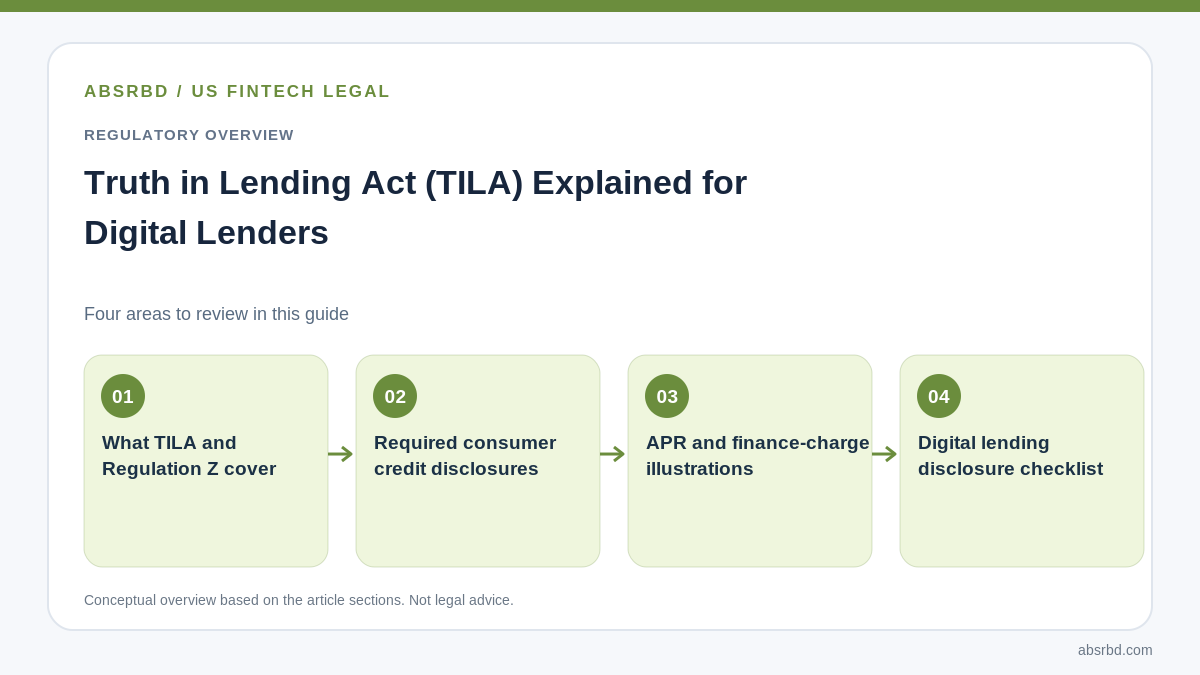
For digital lenders, compliance depends on more than displaying a rate in an app. The lender must determine whether the transaction is covered, identify the correct disclosure regime, calculate terms accurately, deliver disclosures before the applicable deadline, and preserve evidence of what the consumer received.
In brief: TILA generally applies when a creditor regularly extends credit to individuals for personal, family, or household purposes and the credit carries a finance charge or is payable in more than four installments. Important exemptions and product-specific rules apply.
This guide provides general information, not legal advice. Digital lenders should review the current CFPB Regulation Z text and official interpretations for the rules applicable to each product.
What TILA and Regulation Z Cover
TILA is the federal statute. Regulation Z, codified at 12 CFR Part 1026, contains the implementing requirements used in day-to-day compliance.
The rules cover several categories of consumer credit, including:
- Closed-end installment loans
- Open-end lines of credit
- Credit cards
- Certain dwelling-secured loans
- Certain leases or deferred-payment arrangements that legally qualify as credit
The applicable disclosures differ by product. A fixed-term personal loan does not follow the same disclosure framework as a revolving line of credit.
The basic coverage test
A transaction is generally within TILA’s scope when all of the following conditions apply:
- A creditor extends or offers credit.
- The credit is offered to a consumer, generally an individual rather than an organization.
- The credit is primarily for personal, family, or household purposes.
- The credit is subject to a finance charge or payable by written agreement in more than four installments.
- No specific exemption removes the transaction from coverage.
Regulation Z’s definition of “creditor” includes additional conditions, such as whether the person regularly extends covered consumer credit and whether the obligation is initially payable to that person. A digital platform’s commercial label—such as marketplace, facilitator, or technology provider—does not determine its legal role.
Closed-end and open-end credit
Correctly classifying the product is essential because the two categories have different disclosure requirements.
| Classification | Core characteristic | Common digital product example | Primary Regulation Z framework |
|---|---|---|---|
| Closed-end credit | The consumer receives credit for a defined transaction or term | Fixed-term online installment loan | Sections 1026.17 and 1026.18 |
| Open-end credit | The consumer may make repeated transactions under a plan, subject to replenishing credit | Digital revolving line of credit | Sections 1026.5 through 1026.16 |
| Dwelling-secured credit | Credit is secured by real property or a dwelling | Online home-equity or mortgage product | General rules plus product-specific provisions |
A product does not become open-end credit merely because the lender expects repeat customers. The plan must satisfy Regulation Z’s open-end credit definition.
Consumer purpose versus business purpose
TILA generally does not cover credit extended primarily for a business, commercial, or agricultural purpose. The stated purpose on an application is relevant, but it is not always conclusive. The actual use of proceeds and the surrounding facts may matter.
Digital lenders should document how they classify mixed-purpose transactions. Factors may include:
- The consumer’s stated use of proceeds
- The relationship between the transaction and the borrower’s occupation or business
- The size and nature of the transaction
- Whether the proceeds will primarily benefit a business or the individual’s household
- Supporting documents collected during underwriting
Credit to an organization is generally exempt, but using a business name or entity in the application does not automatically resolve every purpose question.
Common exemptions and limitations
Regulation Z includes several exemptions. The availability of an exemption should be confirmed for the specific transaction rather than applied solely by product name.
| Potential exemption | General scope | Important qualification |
|---|---|---|
| Business or commercial credit | Credit primarily for business or commercial purposes | Mixed-purpose transactions require a factual analysis |
| Agricultural credit | Credit primarily for agricultural purposes | The purpose must be established and documented |
| Organizational credit | Credit extended to an entity rather than a natural person | Transaction structure and obligor identity matter |
| Certain high-dollar consumer credit | Credit above the annually adjusted threshold | The exemption generally does not apply when credit is secured by real property or by personal property used or expected to be used as the consumer’s principal dwelling |
| Certain student loans | Specified loans made, insured, or guaranteed under qualifying federal programs | The exemption is program-specific |
| Certain public utility credit | Credit involving regulated utility services | Coverage depends on the nature of the service and charges |
| Securities or commodities accounts | Specified credit involving securities or commodities transactions | The regulatory conditions must be met |
Because the dollar threshold is adjusted periodically, lenders should use the current CFPB figure rather than hard-code a permanent amount into a policy or decision engine.
Required Consumer Credit Disclosures
TILA disclosures are intended to let consumers understand and compare the cost of credit before becoming obligated. The required content, format, and timing depend on whether the product is closed-end or open-end.
Core closed-end credit disclosures
For a typical closed-end consumer loan, applicable disclosures under Regulation Z may include:
- Creditor identity
- Amount financed
- Itemization of the amount financed, unless the consumer receives it at the required time or validly chooses not to receive it
- Finance charge
- Annual percentage rate
- Payment schedule, including the number, amounts, and timing of payments
- Total of payments
- Late-payment charges
- Prepayment terms, where applicable
- Security interest, including identified property securing the obligation
- Demand feature, if applicable
- Required deposit, if applicable
- Insurance or debt-cancellation terms, where relevant
- Reference to the credit contract for information about nonpayment, default, and related provisions
Not every item applies to every loan. Certain transactions, particularly dwelling-secured credit, carry additional or different disclosure requirements.
Meaning of the principal disclosure terms
| Disclosure term | Practical meaning |
|---|---|
| Amount financed | The amount of credit provided to or on behalf of the consumer, calculated under Regulation Z |
| Finance charge | The dollar cost of consumer credit, including covered interest and fees |
| APR | The credit cost expressed as an annual rate under the prescribed calculation rules |
| Total of payments | The amount the consumer will have paid after making all scheduled payments |
| Payment schedule | The number, amount, and timing of scheduled payments |
| Total sale price | For applicable credit sales, the total price including the down payment and scheduled payments |
The amount financed is not always the same as the loan’s face amount or the cash deposited into the borrower’s account. Prepaid finance charges and amounts paid to third parties can affect the calculation.
Formatting and presentation requirements
For closed-end credit, key disclosures generally must be:
- Clear and conspicuous
- In writing and in a form the consumer may keep
- Provided before consummation
- Grouped together and segregated from unrelated information where required
- Presented using the terminology prescribed by Regulation Z
- Calculated consistently with the regulation and its appendices
The terms “finance charge” and “annual percentage rate” generally receive particular prominence.
A lender should not rely on the promissory note alone unless the required disclosures are presented in a compliant manner. Similarly, a rate shown in an advertisement, prequalification screen, or offer summary is not necessarily a substitute for the required transaction disclosures.
When disclosures must be delivered
For most closed-end credit, the required disclosures must be provided before consummation. Consummation occurs when the consumer becomes contractually obligated under applicable state law—not necessarily when funds are disbursed.
Digital lenders should identify the precise point of contractual obligation in their workflow. Depending on the governing law and process, it may be associated with:
- Electronic signature
- Acceptance of final terms
- Completion of a lender counter-signature
- Another event established by the contract and applicable law
Providing disclosures after the consumer clicks the final acceptance button may be too late if that action creates the legal obligation.
Open-end credit disclosures
Open-end plans follow a different framework. Depending on the product, required information may include:
- Circumstances under which a finance charge may be imposed
- Applicable periodic rates and corresponding APRs
- The method used to determine the balance subject to a finance charge
- Membership, annual, transaction, or other plan fees
- Minimum-payment terms
- Grace-period or free-ride information
- Security interests
- Billing-rights information
- Periodic statement information
- Changes in account terms
- Renewal disclosures, where applicable
Initial disclosures are generally required before the first transaction under the plan, subject to specific regulatory rules and exceptions. Periodic statements and change-in-terms notices have separate timing and content requirements.
Electronic delivery and E-SIGN
TILA disclosures may generally be delivered electronically when the process complies with applicable electronic-disclosure requirements, including the federal Electronic Signatures in Global and National Commerce Act where required.
A digital disclosure process should address:
- Affirmative consent to electronic records when legally required
- Required disclosures about hardware and software access
- A method for withdrawing electronic consent
- Delivery in a form the consumer can retain
- Reliable access across supported devices
- Evidence of the version delivered
- Date and time of delivery
- Records of consent and transaction acceptance
A checkbox stating “I agree” does not, by itself, establish that every electronic-delivery requirement has been met.
APR and Finance-Charge Illustrations
The APR is a standardized annual measure of credit cost. It is not always the same as the contract interest rate, and it generally cannot be calculated by simply dividing the finance charge by the amount borrowed.
The calculation may depend on:
- Amount financed
- Finance charge
- Payment amounts
- Number of payments
- Payment intervals
- When funds are advanced
- When fees are paid
- Irregular first or final payment periods
- Product-specific calculation rules
What may be included in the finance charge?
A finance charge generally includes charges imposed as an incident to or condition of extending credit. Depending on the transaction, this may include:
- Interest
- Transaction charges
- Loan or origination fees
- Points
- Service fees tied to extending credit
- Certain insurance or debt-cancellation charges when exclusion conditions are not satisfied
Some charges may be excluded when the regulatory conditions are met. Examples can include certain application fees charged to all applicants, bona fide late-payment charges, and specified third-party or real-estate-related fees.
The label assigned to a fee is not controlling. A “service,” “platform,” “membership,” or “processing” fee may still be a finance charge if it is imposed as an incident to or condition of credit.
Illustrative APR examples
The following simplified examples explain the concepts. They are not substitutes for an approved calculation system or the methods in Regulation Z.
| Scenario | Amount financed | Finance charge | Payment structure | Approximate APR |
|---|---|---|---|---|
| One-year single-payment loan | $950 | $50 | One payment of $1,000 after one year | 5.26% |
| One-year installment loan | $1,000 | Approximately $100 | Twelve monthly payments totaling $1,100 | Approximately 17.9% |
| Open-end plan with a monthly periodic rate | Varies by balance | Varies | Monthly periodic rate of 1.5% | 18% corresponding APR |
Example 1: Fee withheld from proceeds
Assume a loan has a face amount of $1,000, but a $50 covered origination fee is withheld. The consumer receives $950 and must repay $1,000 in one payment after one year.
- Amount financed: $950
- Finance charge: $50
- Total of payments: $1,000
- Approximate APR: 5.26%
The fee changes the amount financed even though the contractual note amount is $1,000.
Example 2: Monthly installment loan
Assume the consumer receives $1,000 and repays a total of $1,100 through 12 monthly payments.
The finance charge is approximately $100, or 10% of the amount financed. However, the APR is approximately 17.9% because the consumer repays principal throughout the year rather than keeping the full $1,000 for the entire term.
This illustrates why the following shortcut is unreliable:
finance charge ÷ amount financed = APR
The formula ignores payment timing and declining principal.
Example 3: Open-end periodic rate
If an open-end plan uses a monthly periodic rate of 1.5%, the corresponding annual percentage rate is:
1.5% × 12 = 18%
Other fees or account activity may require additional treatment under the open-end disclosure rules. The corresponding APR does not necessarily describe the consumer’s total dollar cost for a particular billing cycle.
APR accuracy and tolerances
Regulation Z includes calculation methods, rounding rules, and tolerances for certain transactions. The applicable tolerance can vary by product and circumstance. A lender should not assume that an APR is compliant merely because it is close to an internal estimate.
A sound calculation process should:
- Identify every charge associated with the transaction.
- Classify each charge as included in or excluded from the finance charge.
- Calculate the amount financed.
- Map the exact payment dates and amounts.
- Apply the correct Regulation Z calculation method.
- Test rounding and applicable tolerances.
- Compare the disclosed terms with the final contract and servicing system.
Additional Digital Lending Risks
Dynamic pricing and late-stage changes
If underwriting, bank-account verification, or fraud review changes the rate, fee, amount, or payment schedule, the final disclosure must reflect the terms on which the consumer becomes obligated.
Controls should prevent the platform from:
- Displaying an outdated APR after repricing
- Using a preliminary fee in the final disclosure
- Changing the payment schedule without regenerating disclosures
- Allowing acceptance while a disclosure update is pending
- Funding terms that differ from the accepted terms
Mobile and app presentation
A disclosure may be technically available but still create risk if the consumer cannot reasonably access or retain it. Digital lenders should test:
- Small-screen rendering
- Font scaling
- Tables and payment schedules
- Download and print functions
- Links to incorporated documents
- Screen-reader compatibility
- Session expiration behavior
- Disclosure access after account creation
- Delivery when a consumer changes devices
Material terms should not be obscured by unrelated interface elements or contradicted by more prominent marketing language.
Advertising trigger terms
Regulation Z also governs consumer credit advertising. If an advertisement states specified “triggering terms,” additional disclosures may be required.
Marketing review should cover:
- Website landing pages
- Rate calculators
- Prequalification screens
- Emails and text messages
- Mobile-app notifications
- Affiliate content
- Social media advertisements
- Comparison widgets
Disclosures in a later application flow do not necessarily cure an incomplete or misleading advertisement.
Product-specific rights and notices
Certain products carry obligations beyond the standard disclosures. For example, some transactions secured by a consumer’s principal dwelling may involve a right to rescind, while purchase-money residential mortgage transactions are generally treated differently.
Digital lenders should maintain a product-level requirements matrix rather than use a single disclosure package for every form of consumer credit.
Digital Lending Disclosure Checklist
Use this checklist when designing or reviewing a TILA and Regulation Z disclosure process.
1. Confirm coverage and legal roles
- [ ] Identify the legal creditor for each transaction.
- [ ] Confirm that the obligation is initially payable to the identified creditor.
- [ ] Determine whether the creditor regularly extends covered consumer credit.
- [ ] Verify whether the borrower is a consumer or an organization.
- [ ] Document whether the credit purpose is personal, family, household, business, commercial, or agricultural.
- [ ] Evaluate any claimed exemption using the current regulation and official interpretations.
- [ ] Check the current annually adjusted exemption threshold where relevant.
- [ ] Identify any dwelling or real-property security interest.
2. Classify the product
- [ ] Determine whether the product is closed-end or open-end credit.
- [ ] Identify product-specific Regulation Z provisions.
- [ ] Map every fee and charge to its regulatory treatment.
- [ ] Determine whether special timing, notice, or rescission requirements apply.
- [ ] Confirm that marketing terminology matches the legal product structure.
3. Validate the calculations
- [ ] Calculate the amount financed under Regulation Z.
- [ ] Identify all prepaid finance charges.
- [ ] Confirm which third-party charges are included or excluded.
- [ ] Calculate the finance charge.
- [ ] Calculate the APR using the prescribed method.
- [ ] Test irregular periods and irregular payment amounts.
- [ ] Apply the correct rounding rules and tolerances.
- [ ] Reconcile the disclosure with the contract, funding record, and servicing schedule.
4. Review disclosure content
- [ ] Use the prescribed labels, including “annual percentage rate” and “finance charge.”
- [ ] State the creditor’s identity correctly.
- [ ] Provide the applicable payment schedule.
- [ ] State the total of payments.
- [ ] Describe late-payment and prepayment terms where required.
- [ ] Identify applicable security interests.
- [ ] Include the amount-financed itemization when required.
- [ ] Add product-specific notices and disclosures.
- [ ] Remove contradictory rates or terms from offer summaries and contracts.
5. Test timing and electronic delivery
- [ ] Identify when consummation occurs under applicable state law.
- [ ] Deliver final closed-end disclosures before consummation.
- [ ] Deliver open-end disclosures by the applicable deadline.
- [ ] Obtain electronic-delivery consent when required.
- [ ] Provide disclosures in a form the consumer can retain.
- [ ] Prevent acceptance before required documents are available.
- [ ] Regenerate disclosures when material terms change.
- [ ] Record the document version, delivery time, and acceptance event.
6. Test the digital experience
- [ ] Review disclosures on all supported screen sizes.
- [ ] Confirm that tables and payment schedules remain readable.
- [ ] Test keyboard and screen-reader access.
- [ ] Verify that download and print functions work.
- [ ] Ensure links remain active during the decision period.
- [ ] Confirm that consumers can retrieve accepted disclosures later.
- [ ] Test interrupted sessions and device changes.
- [ ] Verify that customer-support scripts do not contradict written disclosures.
7. Maintain evidence and monitoring
- [ ] Preserve the exact disclosure version delivered to each consumer.
- [ ] Retain calculation inputs and outputs.
- [ ] Document the fee-classification rationale.
- [ ] Keep evidence of electronic consent and delivery.
- [ ] Reconcile a sample of funded loans with their disclosures.
- [ ] Monitor complaints involving rates, fees, or payment amounts.
- [ ] Review affiliate and partner advertising.
- [ ] Update rules when Regulation Z, official interpretations, or annual thresholds change.
- [ ] Apply the correct record-retention period for each product; Regulation Z generally requires retention of evidence for at least two years, with longer periods for certain provisions and products.
A Practical Review Workflow
Digital lenders can organize TILA compliance into a repeatable seven-step process:
- Map the product. Document the legal structure, parties, purpose, term, payment mechanics, security interests, and fees.
- Determine coverage. Apply the creditor, consumer-purpose, installment, finance-charge, and exemption tests.
- Select the disclosure framework. Identify the closed-end, open-end, or product-specific requirements.
- Configure calculations. Implement tested logic for the amount financed, finance charge, APR, and payment schedule.
- Control the acceptance sequence. Ensure the consumer receives retainable final disclosures before the legally relevant event.
- Preserve transaction evidence. Store the disclosure version, calculation data, delivery record, consent, and accepted contract.
- Monitor production results. Compare disclosed terms with funded and serviced accounts, and investigate discrepancies promptly.
TILA compliance is therefore both a legal and a systems-design responsibility. Accurate templates will not prevent errors if pricing, document generation, electronic delivery, contracting, and servicing systems use inconsistent data.
Key Takeaways
- TILA establishes federal consumer credit disclosure requirements; Regulation Z supplies the detailed implementation rules.
- Coverage depends on the creditor, consumer purpose, transaction structure, finance charge, installment count, and available exemptions.
- Closed-end and open-end products require different disclosure packages.
- APR is a standardized calculation based on cost and payment timing, not merely the contract rate or a simple fee percentage.
- Covered fees must be included in the finance charge even when they use nonfinancial labels.
- Final disclosures must reflect the transaction the consumer actually accepts.
- Digital delivery requires careful control of timing, retainability, electronic consent, document versions, and audit evidence.
- Policies and systems should be checked frequently against the current CFPB Regulation Z requirements.
For broader industry context, see revenue-based finance statistics or browse additional lending and finance articles.