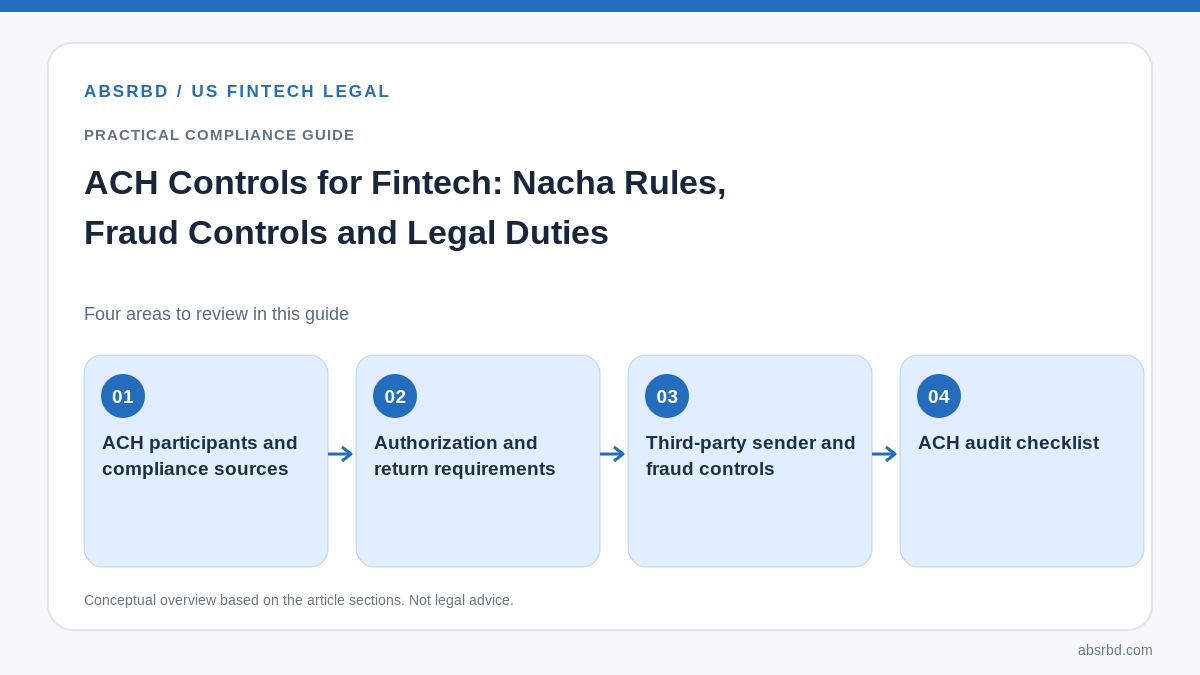
ACH compliance requires a fintech to do four things well: identify its role in each transaction, follow the current Nacha Operating Rules incorporated into its banking agreements, meet applicable legal obligations, and maintain evidence that its controls work.
Nacha rules are private network rules—not federal law—but violations can still lead to returned entries, fines, indemnification claims, processing restrictions, or termination by an originating bank. Separate laws may also apply based on the transaction, customer type, product design, and the fintech’s regulatory status.
This guide focuses on authorization, returns, third-party senders, fraud controls, and ACH audit readiness in the United States.
Important: Nacha updates its rules regularly. Use the current rules, implementation dates, and guidance available from Nacha when evaluating a live program. This article is an operational overview, not legal advice.
ACH Participants and Sources of Compliance
A fintech should not begin its compliance analysis with its marketing label. “Payments platform,” “processor,” and “embedded finance provider” do not determine obligations under the ACH network. The actual transaction flow and contracts do.
Identify each ACH participant
| Participant | Function in an ACH transaction | Primary compliance focus |
|---|---|---|
| Originator | Instructs the creation of ACH entries, such as payroll credits or subscription debits | Authorization, entry accuracy, customer disclosures, revocations and record retention |
| Originating Depository Financial Institution (ODFI) | Financial institution that transmits entries into the ACH network | Originator due diligence, warranties, exposure controls, returns and third-party oversight |
| ACH Operator | Processes ACH files between participating financial institutions | Network processing and settlement |
| Receiving Depository Financial Institution (RDFI) | Receives entries and posts them to Receiver accounts | Posting, return processing, notifications of change and consumer claims |
| Receiver | Person or organization whose account is credited or debited | Grants authorization when required and may dispute unauthorized or improper entries |
| Third-Party Sender | Intermediary that transmits entries on behalf of an Originator through an ODFI and does not have a direct origination agreement with that ODFI | Originator oversight, risk assessment, monitoring, agreements and Nacha audit duties |
| Third-Party Service Provider | Performs ACH-related functions for another participant | Contractual controls, data handling, processing accuracy and applicable audit duties |
| Nested Third-Party Sender | Third-Party Sender operating through another Third-Party Sender | Role transparency, registration, downstream due diligence and layered monitoring |
A single fintech may perform several functions. For example, it may provide software to one customer, act as a Third-Party Sender for another, and originate entries for its own business operations. Each flow should be classified separately.
Separate Nacha rules from law and contracts
An effective compliance inventory distinguishes four sources of obligation:
| Source | What it governs | Why the distinction matters |
|---|---|---|
| Nacha Operating Rules | ACH entry formats, participant warranties, authorizations, returns, risk controls, audits and network enforcement | These are network rules incorporated through participation and service agreements; they are not statutes |
| Bank and vendor contracts | Processing limits, reserves, prefunding, prohibited uses, service levels, indemnities and termination rights | A contract may impose stricter controls than the minimum network requirement |
| Federal and state law | Consumer protections, commercial payment rights, sanctions, privacy, electronic records and other legal duties | Legal obligations may overlap with or exceed Nacha requirements |
| Internal policies | Customer acceptance standards, approval limits, monitoring procedures and escalation rules | Internal controls must match actual operations and contractual commitments |
Relevant legal frameworks may include the Electronic Fund Transfer Act and Regulation E for covered consumer transactions, state commercial law—including Article 4A of the Uniform Commercial Code for certain commercial funds transfers—and federal sanctions requirements. Bank Secrecy Act and anti-money-laundering responsibilities depend on the entity’s legal status and role.
A bank agreement cannot automatically transfer every legal or regulatory duty to a fintech, and a fintech contract cannot eliminate the ODFI’s responsibilities under the Nacha rules.
Build an ACH Compliance Program in Seven Steps
1. Map every ACH flow
Document each product and use case from the initial payment instruction through settlement, return, correction, and reconciliation.
For every flow, record:
- Whether it is a credit or debit
- Whether the Receiver is a consumer or an organization
- The Standard Entry Class, or SEC, code
- The Originator, ODFI, processor, Third-Party Sender and other providers
- How authorization is collected
- When funds or services are released
- Which party receives returns and Notifications of Change
- Which system stores supporting records
- Contractual volume and exposure limits
Do not assume one control works for every SEC code. Authorization methods, evidence requirements, and return risks differ across use cases.
2. Create a role and obligation matrix
Assign each requirement to a named owner. The matrix should connect rules and contracts to operating procedures.
At minimum, include:
- Originator onboarding
- Authorization language and evidence
- SEC-code selection
- File creation and approval
- Account validation where required
- Transaction and batch limits
- Fraud monitoring
- Return and Notification of Change handling
- Sanctions controls
- Complaint and dispute escalation
- Record retention
- Third-party oversight
- Annual ACH audit work
3. Review the ODFI agreement
The ODFI agreement is a core control document. It commonly defines permitted entries, processing deadlines, exposure limits, reserve rights, security procedures, audit access, and termination events.
Compare contractual requirements with actual system settings. A policy that permits activity prohibited by the bank agreement is not an effective policy.
4. Validate authorization by use case
Confirm that each debit has a valid authorization appropriate to the Receiver, channel, and SEC code. The organization should be able to retrieve evidence promptly rather than reconstruct it after a dispute.
5. Monitor returns and corrections
Returns are not merely back-office events. They can reveal authorization failures, inaccurate account information, deceptive Originators, or ineffective onboarding.
Monitor return activity by:
- Originator
- SEC code
- Product
- Return reason
- Transaction amount
- Customer tenure
- Time since account or payment-instruction change
6. Apply layered fraud controls
Use preventive, detective, and responsive controls rather than relying on one identity or account check. Controls should reflect whether the fintech sends credits, initiates debits, or supports both.
7. Test and document the program
A compliant policy is not enough. Testing should establish whether controls are configured correctly, exceptions are investigated, corrective actions are completed, and retained evidence supports the organization’s representations.
ACH Authorization Requirements
An ACH debit generally requires authorization from the Receiver in a form permitted for the relevant entry type. The Originator should be able to show what the Receiver authorized, when authorization occurred, which account was involved, and how revocation may be submitted.
Authorization control matrix
| Control area | What to verify |
|---|---|
| Authorization method | The method is permitted for the customer type, channel and SEC code |
| Clear terms | The authorization identifies whether the entry is one-time or recurring and states its timing or frequency clearly |
| Amount | The amount or method for determining it is explained accurately |
| Account information | Routing and account data are collected and stored securely |
| Identity and assent | Records connect the authorization to the Receiver and demonstrate affirmative agreement |
| Copy or notice | Required copies, notices or confirmations are delivered and retained |
| Revocation | Customers have a functioning way to revoke future entries where applicable |
| Retention | Evidence remains accessible for the period required by current rules, contracts and law |
| Production | Staff can retrieve authorization evidence when requested by the ODFI or during a dispute |
Common authorization failures
Frequent problems include:
- Treating acceptance of general terms as authorization for every ACH debit
- Using the wrong SEC code for the actual initiation channel
- Failing to distinguish one-time and recurring debits
- Changing the amount, timing, or frequency without addressing notice requirements
- Continuing recurring debits after an effective revocation
- Retaining only payment processor logs without the authorization text shown to the Receiver
- Allowing an Originator to submit entries before onboarding is complete
- Being unable to produce records in a readable form
Account validation and fraud screening are different controls
Account validation helps establish that account information is usable or connected to the person presenting it. It does not by itself prove that a particular transaction was authorized.
A sound process separately evaluates:
- Account status or validity
- Connection between the customer and account
- Customer authorization for the specific payment
- Fraud risk associated with the transaction
- Compliance with the applicable SEC-code rules
ACH Returns and Notifications of Change
An ACH return sends an entry back through the network using a return reason code. A Notification of Change, or NOC, tells the Originator that account information should be corrected for future entries.
Treat return deadlines as code-specific
Return windows vary according to the reason, customer type, and entry type. Some administrative returns move on short banking-day timelines, while certain consumer claims may be made over a longer period.
A fintech should maintain a current return matrix rather than rely on a single deadline.
| Matrix field | Purpose |
|---|---|
| Return or NOC code | Identifies the network reason |
| Plain-language meaning | Helps operations staff understand the event |
| Applicable entry types | Prevents use of a code outside its proper context |
| Response deadline | Supports timely processing under current rules |
| Required evidence | Identifies statements, records, or approvals needed |
| Reinitiation status | States whether and under what conditions another entry is permitted |
| Customer action | Defines suspension, outreach, correction, or termination |
| Escalation threshold | Routes significant or repeated issues to risk or compliance |
Monitor more than total return volume
Aggregate reporting can hide a high-risk Originator inside a larger portfolio. Return monitoring should identify:
- Unauthorized return patterns
- Administrative errors involving invalid or closed accounts
- Repeated insufficient-funds events
- Returns following recent customer onboarding
- Concentrations tied to one Originator or sales channel
- Sudden changes in amount, frequency, or geography
- Reinitiated entries that do not satisfy current rule conditions
- NOCs that remain unresolved before subsequent entries
Nacha establishes return-rate monitoring requirements and network thresholds. Because those requirements may change, compliance teams should use the current Nacha rules rather than hard-code old thresholds into policies or audit templates.
Define an escalation ladder
A practical response framework may include:
- Investigate the cause. Determine whether the event reflects customer behavior, data quality, authorization weakness, or possible fraud.
- Correct operational errors. Update account information, SEC-code logic, notices, or file controls.
- Restrict activity. Reduce limits, require prefunding, delay funds availability, or pause specific entry types when permitted by contract.
- Obtain remediation. Require the Originator to provide a corrective-action plan and supporting evidence.
- Suspend or terminate. Stop processing when risk cannot be controlled or contractual requirements are breached.
- Document the decision. Retain the evidence, analysis, approval, and follow-up date.
Third-Party Sender Oversight
A fintech acting as a Third-Party Sender occupies a significant control position between Originators and the ODFI. It should understand both its direct obligations and the warranties its ODFI makes when entries enter the network.
Core Third-Party Sender controls
A Third-Party Sender program should address:
- Identification of all Originators and nested relationships
- Written agreements defining ACH responsibilities
- Due diligence before allowing origination
- Ongoing monitoring of business models and transaction behavior
- Credit and settlement exposure
- Return-rate and unauthorized-entry monitoring
- Security procedures and access management
- Restrictions on downstream processors or senders
- Annual risk assessment and risk-management activities where required
- Annual Nacha rules compliance audit where applicable
- Prompt disclosure of material changes to the ODFI
- Exit and file-blocking procedures
Originator due diligence
Risk-based onboarding should determine whether an Originator’s expected ACH activity is plausible and supportable. Relevant information can include:
- Legal identity and ownership
- Business model and customer base
- Intended debit and credit use cases
- Expected monthly volume and maximum transaction size
- Refund, cancellation and revocation practices
- Authorization methods
- Prior processing history
- Financial capacity and settlement exposure
- Customer complaint history available to the reviewer
- Use of additional processors or nested Third-Party Senders
Due diligence should continue after approval. Changes in products, volumes, owners, websites, authorization language, or downstream providers may require reassessment.
Nested Third-Party Sender risk
Nested arrangements can obscure the party that recruited and controls an Originator. They may also separate the ODFI from the systems holding authorization records and monitoring data.
Before permitting a nested relationship, establish:
- Who performs Originator due diligence
- Who can approve or reject an Originator
- Which party sets and enforces limits
- How the ODFI obtains required information
- Who monitors returns and suspicious patterns
- How quickly downstream files can be stopped
- Whether audit and record-access rights extend through every layer
- How rule changes and corrective actions reach downstream parties
ACH Fraud Controls for Fintechs
ACH risk management should cover both unauthorized debits and fraudulent credits. Credit-push fraud, account takeover, altered payment instructions, synthetic identities, and insider activity require different controls from debit authorization disputes.
Recommended control layers
| Stage | Example controls |
|---|---|
| Customer onboarding | Identity verification, business verification, ownership review, account validation and use-case assessment |
| Access | Multifactor authentication, role-based permissions, device monitoring and session controls |
| Payment setup | Dual approval, beneficiary verification, velocity limits and validation of account changes |
| File creation | File integrity checks, separation of duties and restricted file access |
| Pre-transmission review | Duplicate detection, amount thresholds, anomaly detection and sanctions screening where applicable |
| Settlement | Exposure limits, prefunding, reserves and delayed release based on risk |
| Post-settlement monitoring | Return trends, complaints, unusual activity and reconciliation exceptions |
| Incident response | File suspension, ODFI escalation, evidence preservation and customer communication procedures |
Protect changes to payment instructions
A legitimate customer account can be compromised after onboarding. Apply additional controls when a user:
- Changes a linked bank account
- Adds a new beneficiary
- Modifies settlement instructions
- Resets authentication credentials
- Increases transaction limits
- Submits an unusually large or atypical payment
- Attempts to bypass approval workflows
High-risk changes may require step-up authentication, independent confirmation through a previously verified channel, or a temporary hold.
Align control strength with settlement exposure
The organization should know its potential loss if an Originator fails, commits fraud, or generates delayed returns. Exposure analysis should consider:
- Daily and batch volume
- Maximum transaction amount
- Funds-release timing
- Return windows
- Originator financial condition
- Concentration by industry or customer
- Reserve and prefunding arrangements
- Contractual recovery rights
ACH Audit Checklist and Template
Nacha requires annual compliance audits for participating financial institutions and specified Third-Party Senders and Third-Party Service Providers. Confirm the organization’s exact audit scope under the current rules and its ODFI agreement.
The following template can support an internal review or evidence request. It is not a substitute for the current Nacha audit criteria.
Governance and scope
- [ ] Inventory all ACH products, flows, SEC codes and legal entities.
- [ ] Identify the Originator, ODFI, RDFI, Third-Party Sender and service providers for each flow.
- [ ] Obtain the current Nacha rules and applicable implementation dates.
- [ ] Review ODFI, processor, Originator and downstream provider agreements.
- [ ] Assign accountable owners for operations, risk, compliance, security and legal review.
- [ ] Confirm that policy scope matches actual production activity.
Authorization
- [ ] Sample authorizations across customer types, channels and SEC codes.
- [ ] Verify that authorization language matches the transaction presented.
- [ ] Confirm delivery of required notices, copies, or confirmations.
- [ ] Test whether authorization evidence can be retrieved promptly.
- [ ] Review revocation handling and suppression of future entries.
- [ ] Verify retention settings against current rules, law and contracts.
- [ ] Confirm that account validation and fraud screening controls are operating as designed.
File and transaction controls
- [ ] Review user access to payment creation, approval and transmission.
- [ ] Test dual-control and segregation-of-duties requirements.
- [ ] Verify transaction, batch, customer and exposure limits.
- [ ] Review duplicate-file and duplicate-entry controls.
- [ ] Confirm approval and monitoring for account-instruction changes.
- [ ] Reconcile transmitted, accepted, settled and returned entries.
- [ ] Test incident procedures for stopping files or suspending Originators.
Returns and NOCs
- [ ] Confirm return and NOC codes are routed to responsible teams.
- [ ] Test code-specific processing deadlines.
- [ ] Review unauthorized, administrative and overall return monitoring.
- [ ] Test alerts and escalations against current network thresholds.
- [ ] Review reinitiated entries for compliance with applicable conditions.
- [ ] Confirm that NOCs are corrected before later entries when required.
- [ ] Inspect corrective actions for Originators with adverse trends.
Third-party oversight
- [ ] Maintain a complete list of Third-Party Senders, service providers and nested relationships.
- [ ] Verify due diligence before onboarding each Originator.
- [ ] Review ongoing monitoring and periodic reassessment.
- [ ] Confirm that agreements provide access to records and audit evidence.
- [ ] Verify required registrations and disclosures through the ODFI.
- [ ] Review annual risk assessments and remediation plans.
- [ ] Test the ability to suspend downstream origination promptly.
Fraud and security
- [ ] Evaluate controls for debit fraud, credit-push fraud and account takeover.
- [ ] Review multifactor authentication and privileged access.
- [ ] Test anomaly, velocity and amount-based monitoring.
- [ ] Review controls for new beneficiaries and changed bank accounts.
- [ ] Assess sanctions-screening responsibilities and escalation paths.
- [ ] Examine recent incidents, root-cause findings and corrective actions.
- [ ] Verify preservation of logs, authorization evidence and investigation records.
Audit report fields
For each finding, record:
| Field | Required information |
|---|---|
| Requirement | Rule, contract clause, policy, or legal obligation tested |
| Control owner | Person or team accountable for the control |
| Test performed | Sample, configuration review, interview, or reperformance |
| Evidence | Records reviewed and their retention location |
| Result | Effective, partially effective, or ineffective |
| Risk | Operational, fraud, credit, legal, or network exposure |
| Remediation | Specific corrective action |
| Due date | Agreed completion date |
| Validation | Evidence that remediation was independently retested |
Maintaining ACH Compliance Between Audits
An annual audit should validate the program, not temporarily create it. Use a change-management process to review new Nacha rules, bank requirements, products, vendors, and transaction patterns throughout the year.
A sustainable schedule includes:
- Continuous: Fraud alerts, file controls, sanctions processes and reconciliation
- Daily or operational-cycle review: Returns, NOCs, limit exceptions and settlement exposure
- Monthly: Originator-level trends, complaints, unauthorized activity and access exceptions
- Quarterly: High-risk customer reviews, control metrics and remediation status
- Annually: Formal ACH rules compliance audit, risk assessment and policy approval
- Event-driven: Review after incidents, material product changes, new SEC codes, new ODFIs, acquisitions, or nested Third-Party Sender relationships
The key test is whether the fintech can prove that each ACH entry was properly authorized, accurately coded, appropriately monitored, and processed under clearly assigned responsibilities. A documented role map, current return matrix, layered fraud controls, and evidence-based audit process provide the foundation for that proof.
For broader payment-market context, see the latest analysis of contactless payment statistics and cross-border payment statistics.