US payment processing is not governed by a single license or rulebook. A fintech’s obligations depend on how money moves, which payment method is used, whether the company controls funds, the types of customers involved, and the states in which it operates.
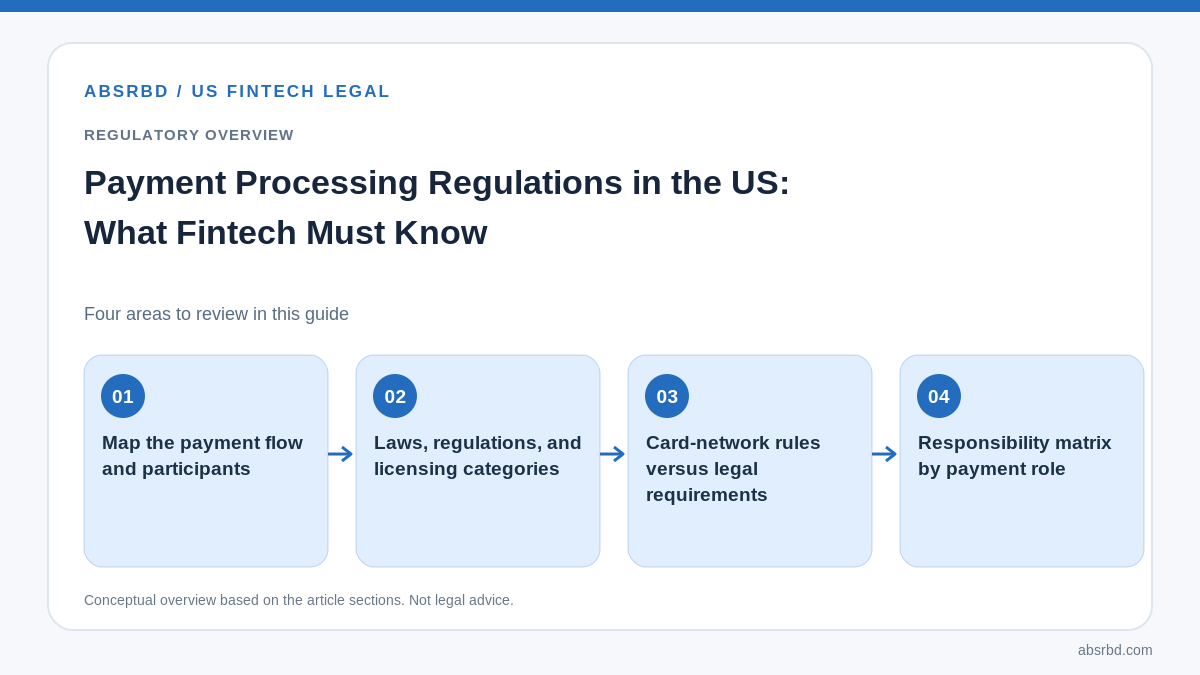
The practical compliance sequence is:
- Map the complete funds flow.
- Identify every participant and its legal role.
- Classify the payment method and customer type.
- Determine which federal and state requirements apply.
- Separate legal obligations from card-network and banking-partner rules.
- Assign each compliance function to an accountable party.
- Reassess the model whenever the product, contract, geography, or funds flow changes.
A contract can allocate operational tasks, but it generally cannot eliminate obligations imposed directly by law on a regulated party.
Important: This article provides a high-level US framework, not legal advice. Payment laws, state licensing interpretations, enforcement priorities, and network rules change frequently. Fintechs should confirm current requirements with qualified counsel and relevant regulators before launching or changing a payment product.
Map the Payment Flow and Participants
Regulatory analysis should begin with the actual movement of money—not the terminology used in sales materials or platform agreements.
A useful funds-flow map should show:
- Who initiates the payment
- Who authorizes or authenticates the payer
- Which entity receives payment instructions
- Which entity holds, receives, or controls customer funds
- Where funds are held at each stage
- Which bank accounts are used
- Which institution performs clearing and settlement
- Who credits the merchant or recipient
- Who manages refunds, disputes, reversals, and reserves
- Whether funds cross state or national borders
- Whether the transaction involves a consumer, business, or both
Typical Card-Payment Flow
A simplified card transaction may involve the following sequence:
- The customer submits card credentials to a merchant.
- The merchant or payment interface sends the transaction for authorization.
- A gateway or technical processor transmits transaction data.
- The merchant acquirer or acquiring bank submits the authorization through the card network.
- The card network routes the request to the issuer.
- The issuing bank approves or declines the transaction.
- Clearing and settlement occur through the participating financial institutions and network.
- The merchant receives proceeds, typically net of fees, refunds, reserves, or other contractual adjustments.
This model changes when a platform receives funds before paying sellers, maintains balances, controls payout timing, or sends money to third parties. Those changes can affect licensing, anti-money laundering responsibilities, safeguarding arrangements, and consumer-protection exposure.
For an overview of the payment instruments that can change this analysis, see common payment methods and how they work.
Questions That Reveal Regulatory Risk
The following questions help distinguish a technical service provider from a company performing a regulated financial function:
- Does the fintech take possession or control of funds?
- Can it redirect, delay, freeze, return, or release funds?
- Are funds held for longer than necessary to complete settlement?
- Does the company maintain customer balances or stored value?
- Can one user send funds to another user?
- Are payouts made to a party other than the original merchant?
- Is the service offered directly to consumers?
- Does the product support international transfers or foreign recipients?
- Which entity appears in customer-facing terms and disclosures?
- Which entity bears losses from unauthorized transactions, fraud, or merchant insolvency?
No single answer determines the result. Regulators generally evaluate the substance of the activity, including contractual rights and operational control.
Laws, Regulations, and Licensing Categories
US payment services can fall under several overlapping legal regimes. Applicability depends on the product and the role performed.
| Regulatory category | What it generally addresses | Why it matters to fintechs |
|---|---|---|
| Federal consumer financial law | Disclosures, error resolution, unauthorized electronic transfers, unfair or deceptive practices, and other consumer protections | Consumer-facing payment products may create duties for financial institutions and service providers |
| Bank Secrecy Act and anti-money laundering rules | Customer identification, transaction monitoring, reporting, recordkeeping, and AML programs | Money services businesses and regulated financial institutions may have direct obligations; partners may impose related controls |
| State money transmission laws | Licensing, permissible investments, bonding, reporting, examinations, and consumer protection | Receiving money for transmission or holding stored value may trigger requirements in multiple states |
| Sanctions rules | Prohibited dealings with sanctioned parties, jurisdictions, and blocked property | Payment participants need controls proportionate to their sanctions exposure |
| Privacy and information-security laws | Collection, use, disclosure, storage, and protection of personal or financial information | Duties can arise under federal law, state law, and partner contracts |
| Commercial and banking law | Allocation of rights and liabilities among payment participants | Account agreements and transaction types can change the applicable legal framework |
| Card-network and partner rules | Operating standards, fraud controls, disputes, data security, and merchant oversight | These requirements can be contractually mandatory even when they are not statutes |
Electronic Fund Transfer Act and Regulation E
The Electronic Fund Transfer Act and its implementing rule, Regulation E, establish protections for certain electronic fund transfers involving consumer accounts. The framework addresses areas such as disclosures, unauthorized transfers, error-resolution procedures, and access devices.
Whether Regulation E applies depends on the product, account, transaction, and role of the entity involved. A processor supporting a bank may perform operational tasks, while the financial institution remains directly responsible for duties imposed on it.
The official rule and commentary are available in the Consumer Financial Protection Bureau’s Regulation E resource. Product teams should use the current rule and official interpretations rather than relying on a short summary.
Bank Secrecy Act and AML Obligations
The Bank Secrecy Act framework can apply directly to banks and certain nonbank financial businesses, including money services businesses. Depending on its activities, an entity may need to consider:
- Registration requirements
- A written anti-money laundering program
- Customer identification or verification controls
- Suspicious activity monitoring and reporting
- Currency transaction reporting where applicable
- Recordkeeping and information-sharing requirements
- Independent testing and designated compliance responsibility
A fintech that processes payments is not automatically a money transmitter merely because money is involved. Federal regulations contain definitions and exclusions that may apply to certain payment-processing activity conducted through qualifying clearance and settlement systems. The precise facts—including who contracts with whom, who controls funds, and whether activity extends beyond payment for goods or services—are critical.
Banking partners may also require controls that go beyond a fintech’s direct statutory obligations. Those contractual requirements support the bank’s own risk-management and regulatory responsibilities.
State Money Transmitter Licensing
State licensing is one of the most fact-specific areas of US payment services regulation. A company may need to analyze each state in which it conducts regulated activity or serves residents.
State requirements can include:
- A money transmitter license
- Surety bonds
- Minimum net worth
- Permissible investment requirements
- Background checks
- Periodic financial and transaction reports
- Regulatory examinations
- Consumer disclosures
- Record retention
- Change-of-control approval or notice
- Complaint-handling procedures
An analysis under federal money-services rules does not replace state review. A business can reach different conclusions under federal and state law because the definitions, exemptions, and regulatory interpretations are not identical.
Fintechs should also avoid treating a bank relationship as an automatic substitute for licensing. Whether a bank partnership changes the analysis depends on the legal structure, applicable exemptions, agency relationships, contracts, and actual operations.
OFAC Sanctions Compliance
The US Department of the Treasury’s Office of Foreign Assets Control administers economic and trade sanctions. Payment companies may encounter sanctions risk through customers, merchants, recipients, beneficial owners, banks, locations, or transaction details.
A risk-based sanctions framework may include:
- Screening relevant parties against applicable sanctions lists
- Evaluating geographic and transactional risk
- Escalating potential matches
- Blocking or rejecting transactions when legally required
- Maintaining records
- Addressing ownership and control, not only exact-name matches
- Updating controls when sanctions programs change
Sanctions compliance is distinct from AML compliance. The programs overlap operationally, but they address different legal requirements and should not be treated as interchangeable.
Consumer Protection and UDAAP Risk
The Consumer Financial Protection Act prohibits unfair, deceptive, or abusive acts or practices in connection with consumer financial products or services. Other federal and state consumer-protection laws may also apply.
Payment-related risk can arise when:
- Fees are not clearly disclosed
- Marketing differs from actual product behavior
- Funds are held longer than represented
- Refund or dispute procedures are misleading
- Consumers cannot obtain promised support
- Material limitations are hidden in technical terms
- A company misrepresents the protections available for a payment method
Compliance review should therefore cover the entire customer experience—not just formal terms and conditions.
Privacy and Information Security
Payment companies often handle account information, identity data, transaction records, device information, and fraud signals. Applicable requirements may arise from federal financial privacy rules, state privacy and data-security laws, bank-partner standards, and contractual commitments.
A fintech should document:
- What information it collects
- Why each data element is needed
- Which parties receive it
- Where it is stored and processed
- How long it is retained
- Which security controls protect it
- How consumers can exercise applicable privacy rights
- How incidents are identified, escalated, and reported
The relevant privacy framework depends on the entity, data, customer, jurisdiction, and nature of the financial service.
Card-Network Rules Versus Legal Requirements
Card-network operating rules are private contractual standards. They are not federal statutes or regulations, although they operate alongside legal requirements and can be enforced through network participation agreements.
| Dimension | Laws and regulations | Card-network and partner rules |
|---|---|---|
| Source of authority | Congress, federal agencies, state legislatures, and state regulators | Card networks, acquiring banks, sponsor banks, and other contractual counterparties |
| Who is directly bound | Entities within the law’s jurisdiction and scope | Participants that agree to the applicable contracts, directly or through another party |
| Enforcement | Courts, regulators, licensing authorities, and law-enforcement agencies | Networks and contractual counterparties through assessments, restrictions, remediation, or termination |
| Typical subject matter | Licensing, consumer rights, AML, sanctions, privacy, disclosures, and financial safeguards | Transaction processing, merchant conduct, dispute programs, fraud controls, data security, and operating procedures |
| Ability to allocate tasks | Limited by the governing law | Often allocated extensively by contract, subject to network approval and oversight |
| Consequences of noncompliance | Civil, administrative, licensing, or potentially criminal consequences depending on the violation | Contractual liability, assessments, withheld funds, operating limits, or loss of access |
Why the Distinction Matters
A fintech may comply with card-network requirements and still violate a statute. It may also satisfy minimum legal requirements but breach its acquiring-bank agreement.
For example:
- A network dispute deadline may differ from a statutory consumer error-resolution timeline.
- A bank may impose merchant-monitoring standards beyond an explicit legal minimum.
- A network can restrict a merchant category without making that business illegal.
- A contractual reserve can protect an acquirer from risk without satisfying state safeguarding requirements that apply to another entity.
Compliance inventories should therefore label every obligation by source:
- Federal law or regulation
- State law or regulation
- Regulatory guidance or order
- Card-network rule
- Bank-partner requirement
- Customer or merchant contract
- Internal risk policy
This prevents contractual standards from being mischaracterized as law and helps teams identify which requirements can be negotiated.
Responsibility Matrix by Payment Role
The responsible party depends on the product structure and governing agreements. The following matrix is a starting point, not a universal allocation.
| Compliance function | Bank or financial institution | Processor or technology provider | Merchant or platform | Card network |
|---|---|---|---|---|
| Regulatory licensing | Typically responsible for its banking charter and bank-specific permissions | Must assess licenses required for its own nonbank activities | Must assess licenses triggered by platform, stored-value, or funds-control activities | Not a substitute for government licensing |
| Consumer disclosures | Often directly responsible when it provides the regulated account or service | May generate or deliver disclosures under contract | May be responsible for its own fees, terms, and representations | May prescribe certain transaction or brand disclosures |
| Error and dispute operations | May hold direct duties for covered accounts or transfers | Frequently supplies intake, data, workflow, or investigation support | Handles merchant evidence, refunds, and customer communications as allocated | Establishes network dispute procedures |
| AML program | Direct obligations generally apply to covered regulated institutions and businesses | May have direct duties if independently regulated; often performs controls for a partner | May conduct onboarding and monitoring assigned by contract | Sets risk and monitoring expectations for participants |
| Sanctions controls | Maintains controls for its own customers and transactions | May screen parties or transactions and escalate alerts | Supplies accurate customer, merchant, and recipient information | May block access or impose program restrictions |
| Merchant onboarding | Oversees risk within its acquiring or sponsor role | Performs identity, business, and risk checks when delegated | Provides complete and accurate ownership and activity information | Sets eligibility and monitoring standards |
| Transaction monitoring | Monitors activity within its regulatory and risk perimeter | Operates rules, models, alert queues, or case-management systems | Reviews behavior specific to its users or sellers | Supplies network-level fraud signals and programs |
| Data protection | Protects data it collects and controls | Protects payment and customer data in its systems | Secures its interfaces, credentials, and customer records | Establishes contractual security standards |
| Record retention | Retains records required for its obligations | Retains operational and compliance records as required or contracted | Retains merchant, customer, and transaction documentation | Maintains network transaction and program records |
| Regulatory reporting | Files reports required of the regulated institution | Supports filings or files directly where it has an independent duty | Reports where its own regulated status requires it | Provides information to participating institutions |
| Complaints and remediation | Oversees complaints concerning its products and regulatory duties | Operates support and escalation processes as assigned | Addresses product, fulfillment, and seller complaints | May require remediation for rule violations |
Delegation Does Not Equal Transfer of Accountability
A bank can hire a fintech to perform onboarding, monitoring, customer service, or transaction processing. That delegation does not necessarily transfer the bank’s legal responsibility.
Similarly, a fintech cannot assume that its partner owns every compliance function. The fintech may have independent obligations arising from:
- Its own licenses
- Its direct relationship with consumers or merchants
- Its control over funds
- Its marketing claims
- Its handling of personal information
- Its contractual commitments
- Its role as a service provider to a regulated institution
The operating agreement should identify who performs each task, but the legal analysis must separately identify who remains accountable.
How to Build a Payments Compliance Matrix
A compliance matrix turns the funds-flow analysis into an operating document.
1. List Products and Transaction Types
Separate products when their structures differ. Examples include merchant card acceptance, wallet balances, consumer transfers, marketplace payouts, and cross-border payments.
Do not assume that one legal conclusion applies to every feature offered under the same brand.
2. Identify Every Participant
Record each participant’s full legal name and function, including:
- Customer
- Merchant or seller
- Platform operator
- Processor
- Gateway
- Acquiring bank
- Issuing bank
- Sponsor bank
- Card network
- Custodial institution
- Settlement institution
- Compliance vendors and subcontractors
3. Document Funds and Data Flows
Create separate maps for:
- Authorization
- Clearing
- Settlement
- Refunds
- Reversals
- Disputes
- Reserves
- Failed payments
- Suspended or frozen funds
- Customer and merchant data
A data-flow map is necessary because the entity processing personal information may differ from the entity controlling funds.
4. Classify Each Requirement by Authority
For every obligation, record whether it comes from:
- Federal law
- State law
- A regulatory order or license condition
- A card-network rule
- A bank agreement
- A merchant or customer contract
- Internal policy
Include the relevant jurisdiction, product, payment method, and customer category.
5. Assign Operational and Legal Owners
Use two ownership columns:
- Operational owner: The party performing the task
- Accountable entity: The party that remains legally or contractually responsible
This distinction is particularly important for bank-fintech partnerships and outsourced compliance functions.
6. Record Evidence and Escalation Paths
For each control, identify:
- Required evidence
- System of record
- Review frequency
- Exception criteria
- Escalation owner
- Approval authority
- Record-retention period
- Testing or quality-assurance process
7. Establish Change Triggers
Require reassessment when the company:
- Adds a payment method
- Enters a new state
- Begins serving consumers
- Adds stored balances or delayed payouts
- Changes its banking or acquiring partner
- Expands to international transactions
- Supports new merchant categories
- Changes refund, reserve, or dispute procedures
- Gains new authority over customer funds
- Adds a new vendor to the payment chain
International activity adds further legal, operational, and sanctions considerations. Teams evaluating expansion can use cross-border payment statistics and market context alongside a jurisdiction-specific legal assessment.
Payments Compliance Matrix Template
| Product or flow | Participant | Activity performed | Funds controlled? | Governing authority or contract | Operational owner | Accountable entity | Required evidence | Review trigger |
|---|---|---|---|---|---|---|---|---|
| Example: merchant card payment | Acquiring bank | Sponsors merchant acceptance and settlement | Depends on structure | Banking law, card-network rules, acquiring agreement | Named team or provider | Named legal entity | Approval and monitoring records | Partner or flow change |
| Example: merchant card payment | Processor | Transmits authorization and settlement data | Depends on structure | Processing agreement and applicable law | Named operations team | Named legal entity | Transaction logs and control reports | System or feature change |
| Example: marketplace payout | Platform | Directs payments to sellers | Depends on structure | State and federal analysis, partner contracts | Named product team | Named legal entity | Funds-flow map and legal review | New state or payout model |
Replace the examples with the company’s actual entities, accounts, contracts, and transaction paths. Each row should point to supporting evidence rather than relying on a general statement that a partner “handles compliance.”
Prelaunch Compliance Checklist
Before launching a US payment product, confirm that the company has:
- [ ] Mapped authorization, clearing, settlement, refunds, disputes, and reserves
- [ ] Identified every entity that receives or controls funds
- [ ] Classified customers as consumers, businesses, merchants, or other relevant categories
- [ ] Completed federal money-services and state licensing analyses
- [ ] Documented applicable consumer-protection requirements
- [ ] Assigned AML and sanctions responsibilities
- [ ] Distinguished legal duties from network and partner rules
- [ ] Reviewed customer-facing fees, claims, disclosures, and support procedures
- [ ] Documented privacy and information-security responsibilities
- [ ] Assigned both operational owners and accountable legal entities
- [ ] Established complaint, incident, and regulatory escalation procedures
- [ ] Defined evidence, testing, and record-retention requirements
- [ ] Created a process for monitoring legal and network-rule changes
- [ ] Required a new review when funds flow, geography, partners, or product features change
The Core Compliance Principle
Payment processor compliance follows function, control, and funds flow—not branding alone. A company described as a “technology provider” may still perform regulated activity, while a processor that transmits data without controlling funds may face a different set of obligations.
The strongest approach is to maintain a current funds-flow map and a payments compliance matrix that identifies:
- The source of each requirement
- The entity legally accountable
- The party performing the control
- The evidence proving performance
- The events that require reassessment
That framework helps fintechs distinguish government requirements from private network rules, identify gaps between partners, and update compliance decisions as their payment model evolves.