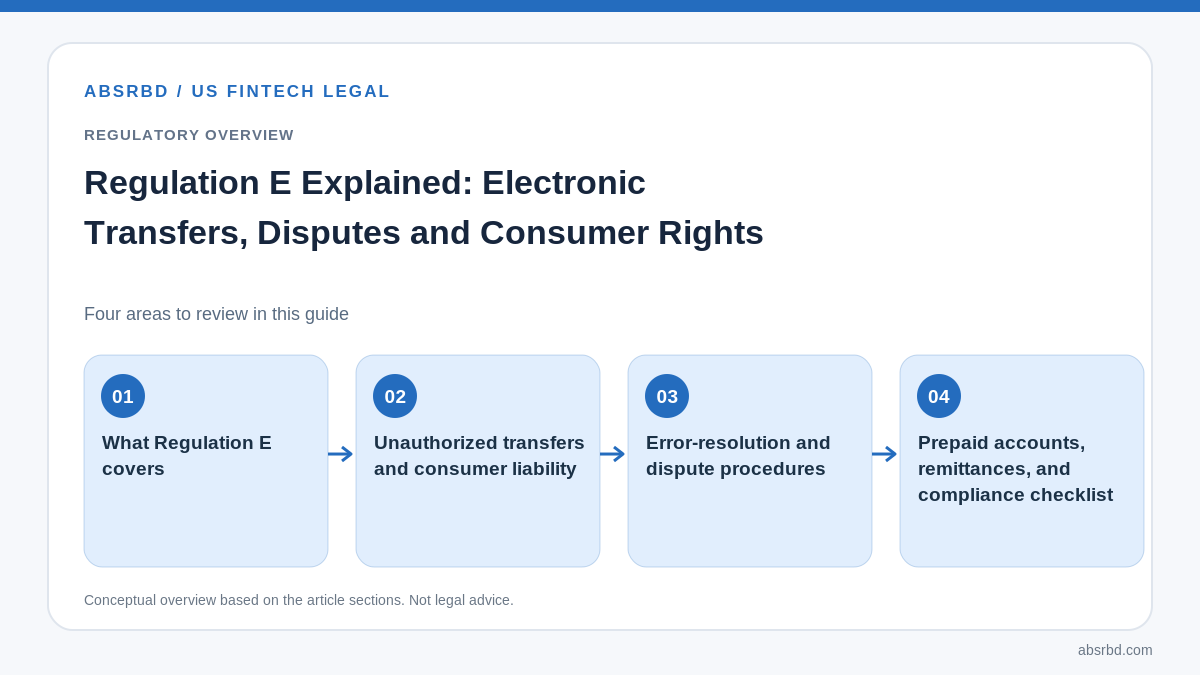
Regulation E is the federal rule that implements the Electronic Fund Transfer Act (EFTA). It protects U.S. consumers using electronic fund transfers from personal accounts and establishes requirements for disclosures, unauthorized-transfer liability, error resolution, recurring-payment cancellation, prepaid accounts, and certain international remittance transfers.
The most important practical rule is simple: report a lost access device or an incorrect electronic transfer immediately. Waiting can increase a consumer’s potential liability or reduce available protections.
Regulation E at a Glance
| Question | General rule |
|---|---|
| What does Regulation E govern? | Electronic fund transfers involving consumer accounts used primarily for personal, family, or household purposes |
| Who must comply? | Financial institutions and, for certain provisions, other entities such as remittance transfer providers |
| What transfers are commonly covered? | Debit card purchases, ATM transactions, direct deposits, recurring electronic debits, and many online or mobile transfers |
| How long does a consumer generally have to report a statement error? | No later than 60 days after the institution sends the first periodic statement showing the error |
| How quickly should a lost or stolen access device be reported? | Within two business days after learning of the loss or theft to preserve the lowest liability limit |
| Can recurring electronic transfers be stopped? | Generally yes, by notifying the financial institution at least three business days before the scheduled transfer |
| Can an international remittance be canceled? | Often within 30 minutes after payment, if regulatory conditions are met and the funds have not been picked up or deposited |
These are general federal rules. Specific protections can depend on the transaction, the type of account, when notice was given, and whether the institution satisfied Regulation E’s disclosure and investigation requirements.
What Regulation E Covers
Regulation E applies primarily to an electronic fund transfer, or EFT: a transfer of funds initiated electronically that debits or credits a consumer’s account.
A covered consumer account is generally an account established primarily for personal, family, or household purposes. It can include:
- Checking accounts
- Savings accounts
- Payroll card accounts
- Government benefit accounts
- Certain prepaid accounts
- Other qualifying consumer asset accounts
Common examples of covered electronic transfers
Regulation E commonly applies to:
- ATM withdrawals and deposits
- Debit card purchases
- Direct deposit of wages or government benefits
- Recurring electronic bill payments
- Electronic withdrawals authorized by a consumer
- Transfers initiated through online banking
- Transfers initiated through mobile banking
- Certain person-to-person transfers involving a consumer account
- International remittance transfers covered by the rule
The continuing growth of app-based account access makes these protections increasingly relevant. For context on adoption and usage patterns, see these mobile banking statistics.
Transactions that may fall outside Regulation E
Not every movement of money is a covered EFT. Regulation E contains exclusions and specialized rules for particular transaction types. Examples may include:
- Transfers originated by check or a similar paper instrument
- Certain transfers within a financial institution between a consumer’s own accounts
- Certain securities or commodities transfers
- Transfers through systems used primarily between financial institutions or businesses
- Some telephone-initiated transactions that do not meet the rule’s conditions
- Transactions involving accounts established primarily for business or commercial purposes
Coverage depends on the facts, not simply on whether technology was involved. A business account, for example, generally does not become a consumer account merely because its owner uses a debit card or mobile app.
EFTA and Regulation E: What Is the Difference?
The Electronic Fund Transfer Act and Regulation E are related but not identical.
| Term | Meaning |
|---|---|
| Electronic Fund Transfer Act | The federal statute establishing consumer rights and responsibilities for electronic fund transfers |
| Regulation E | The implementing regulation containing detailed coverage, disclosure, liability, and error-resolution rules |
| Official interpretations | Regulatory commentary that helps institutions and consumers understand how specific provisions apply |
The Consumer Financial Protection Bureau administers Regulation E. The authoritative rule and official interpretations are available in the CFPB’s Electronic Fund Transfers regulation, 12 CFR Part 1005.
Required Consumer Disclosures
Regulation E requires covered institutions to provide information that helps consumers understand how electronic transfers work and how to report problems.
Depending on the product and transaction, required disclosures may address:
- Consumer liability for unauthorized transfers
- Contact information for reporting errors or lost access devices
- Types of transfers available and applicable limitations
- Fees for electronic transfers
- The consumer’s right to receive transaction documentation
- Stop-payment procedures for recurring transfers
- The institution’s potential liability for failing to make certain transfers
- Confidentiality circumstances
- Error-resolution rights and procedures
Institutions may also have to provide terminal receipts, periodic statements, change-in-terms notices, or permitted alternatives for certain account types.
A change-in-terms notice is generally required in advance when specified changes would increase fees or consumer liability, reduce available transfer types, or impose stricter transfer limits.
Unauthorized Electronic Transfers and Consumer Liability
An unauthorized electronic fund transfer is generally a transfer initiated by someone other than the consumer, without actual authority, from which the consumer receives no benefit.
However, a transaction is not necessarily “unauthorized” under Regulation E merely because the consumer later regrets it. The definition generally does not include transfers initiated:
- By a person whom the consumer furnished with the access device, unless the consumer has notified the institution that the person is no longer authorized
- With fraudulent intent by the consumer or someone acting with the consumer
- Because of an institution or employee error
Those transactions may involve other contractual or legal issues, but they are not automatically treated as unauthorized EFTs under Regulation E.
Liability after a lost or stolen access device
Potential consumer liability depends heavily on how quickly the loss or theft is reported.
| When the consumer notifies the institution | General potential liability |
|---|---|
| Within two business days after learning of the loss or theft | Up to $50 |
| More than two business days after learning of the loss or theft | Up to $500 under the regulatory calculation |
| More than 60 days after a statement showing an unauthorized transfer was sent | Potential liability for subsequent transfers occurring after the 60-day period if the institution establishes that timely notice would have prevented them |
The $500 rule is not automatically a flat charge. Regulation E uses a liability calculation based on when the unauthorized transfers occurred and when the consumer notified the institution.
The institution generally may impose Regulation E liability only when the applicable conditions are met, including requirements related to an accepted access device, a means of identifying the consumer, and required disclosures.
Unauthorized transfers appearing on a statement
If an unauthorized transfer appears on a periodic statement, the consumer should notify the financial institution no later than 60 days after the statement was sent.
Delaying beyond that period can expose the consumer to liability for additional unauthorized transfers that occur after the 60-day deadline. The institution generally must establish that those later transfers could have been prevented if the consumer had provided timely notice.
Regulation E permits deadline extensions when a consumer’s delay resulted from extenuating circumstances, such as an extended trip or hospitalization.
What to do immediately
- Contact the financial institution. Use the telephone number or reporting channel in the account disclosures or statement.
- Block the access device if appropriate. Ask whether the debit card, credential, or other access method should be disabled.
- Identify each disputed transaction. Record the date, amount, merchant or recipient, and reason for the dispute.
- Request a case or confirmation number.
- Follow up in writing if requested. The institution may require written confirmation within a specified period.
- Monitor the account for additional activity.
- Keep all records. Save statements, notices, correspondence, screenshots, and delivery confirmations.
Regulation E Error Resolution and Dispute Procedures
Regulation E’s error-resolution process covers more than stolen-card transactions. A qualifying error may include:
- An unauthorized electronic fund transfer
- An incorrect EFT to or from the consumer’s account
- An omitted EFT that should appear on a statement
- A bookkeeping or computational error involving an EFT
- Receipt of an incorrect amount of money from an electronic terminal
- An EFT that is not properly identified
- A consumer’s request for required information or clarification about an EFT
A general request for account information is not always an error notice. The consumer should clearly identify the transaction and explain why it is believed to be incorrect.
How to submit an error notice
The notice generally must:
- Reach the institution no later than 60 days after it sends the first statement reflecting the alleged error
- Enable the institution to identify the consumer’s name and account
- Indicate why the consumer believes an error exists
- State the type, date, and amount of the suspected error, when possible
Consumers may generally provide notice orally or in writing. An institution can ask for written confirmation within 10 business days after an oral notice. If the consumer does not provide requested written confirmation on time, the institution may not be required to provide provisional credit while it continues the investigation.
Standard investigation timeline
The applicable timeline can vary, but the standard process generally works as follows:
- The consumer reports the error. Notice usually must be provided within the 60-day statement period.
- The institution investigates promptly. It generally has 10 business days to determine whether an error occurred.
- Provisional credit may be required. If the institution needs more time, it may generally take up to 45 days to investigate if it provisionally credits the disputed amount within the initial period and meets related requirements.
- The consumer receives access to provisional funds. When provisional credit is required, the institution must generally make the funds available within the regulatory timeframe.
- The institution completes its investigation. Certain transactions may qualify for a longer investigation period, including some transactions involving new accounts, point-of-sale debit card activity, or transfers initiated outside the United States.
- The institution reports the result. It generally must communicate its determination within three business days after completing the investigation.
- A confirmed error is corrected. The institution generally must correct the error promptly, including applicable interest and fees when required.
- A rejected claim must be explained. If the institution determines that no error occurred, it must provide a written explanation and tell the consumer that supporting documents are available upon request.
For certain new accounts, the initial investigation period may be 20 business days rather than 10. Because exceptions and extended timelines are fact-specific, consumers should review every notice from the institution rather than assuming provisional credit is permanent.
Provisional credit is not a final decision
Provisional credit gives the consumer temporary access to disputed funds while an investigation continues. It does not mean the institution has accepted the claim.
If the institution later determines that no error occurred, it may reverse the provisional credit after providing the required notice and following the applicable procedures.
Stopping or Canceling Recurring Electronic Transfers
Regulation E provides a stop-payment right for preauthorized electronic fund transfers scheduled to recur at substantially regular intervals.
To stop a scheduled transfer, a consumer generally must notify the financial institution at least three business days before the transfer date.
Stop-payment procedure
- Contact the financial institution at least three business days before the scheduled debit.
- Identify the company or payee, expected amount, and scheduled date.
- State clearly that the consumer is stopping a preauthorized electronic transfer.
- Obtain confirmation or a reference number.
- Provide written confirmation if the institution requests it.
- Separately notify the payee if the underlying payment authorization or service agreement is also being canceled.
An institution may require written confirmation within 14 days after an oral stop-payment request. If the consumer does not provide it, the oral order may cease to bind the institution after that period.
Stopping a transfer is not the same as canceling a contract
A stop-payment order directs the financial institution not to process a particular electronic debit. It does not necessarily cancel:
- A subscription
- A membership
- A loan obligation
- An insurance policy
- A service agreement
- The consumer’s duty to pay by another method
Consumers should address both the bank instruction and the agreement with the payee.
Changes to recurring transfer amounts
For a recurring transfer that varies in amount, the payee generally must provide advance notice of the amount and date, subject to permitted alternatives such as an agreed range. Consumers should review these notices and act before the three-business-day stop-payment deadline when necessary.
Prepaid Accounts Under Regulation E
Regulation E includes specialized protections for covered prepaid accounts. Depending on the product and circumstances, these protections can include:
- Upfront fee disclosures
- Access to account information or transaction history
- Error-resolution procedures
- Limits on liability for unauthorized transfers
- Rules governing certain overdraft or credit features
- Requirements concerning account agreements and other disclosures
Prepaid coverage can apply to products such as certain general-purpose reloadable cards, payroll card accounts, and government benefit accounts. Gift cards and similar products may be subject to different or additional provisions.
Identity verification can affect protections
Error-resolution and liability protections for some prepaid accounts can depend on whether the consumer has registered the account and whether the institution has completed its consumer-identification and verification process.
Prepaid users should:
- Register the account promptly when registration is available
- Keep the card and account agreement
- Review the fee disclosures
- Protect the card number, PIN, and login credentials
- Check transaction history regularly
- Report loss, theft, or unauthorized activity immediately
International Remittance Transfer Protections
Regulation E also contains rules for certain electronic transfers sent by consumers in the United States to recipients in other countries. These are known as remittance transfers.
Covered remittance providers generally must give consumers disclosures showing key transaction information, which can include:
- The amount transferred
- Fees charged by the provider
- Certain taxes
- The exchange rate
- The amount expected to be received
- The date funds will be available
- Error-resolution and cancellation information
Readers examining the scale and direction of international money movement can also consult these cross-border payment statistics.
Remittance cancellation rights
A sender generally has 30 minutes after payment to cancel a remittance transfer if:
- The cancellation request allows the provider to identify the transfer
- The sender supplies the requested contact information
- The recipient has not picked up the funds or had them deposited into an account
Different timing rules can apply to remittances scheduled in advance. For certain transfers scheduled at least three business days before the transfer date, the cancellation request generally must be received at least three business days before that date.
Remittance errors
A consumer generally must report a qualifying remittance error within 180 days after the disclosed date on which the funds were supposed to be available to the recipient.
Potential errors can include:
- The wrong amount being paid to the recipient
- Funds not being available by the disclosed date
- A computational or bookkeeping error
- Failure to make the transfer as instructed
- A request for required information or clarification
The provider generally has up to 90 days to investigate and determine whether an error occurred, followed by required notice and any applicable remedy.
Consumer Regulation E Checklist
Use this checklist when managing an electronic-transfer problem:
- [ ] Confirm that the transaction involved a personal, family, or household account.
- [ ] Identify whether the transaction was electronic.
- [ ] Record when the transfer first appeared on the statement.
- [ ] Report a lost or stolen access device immediately.
- [ ] Do not wait for a replacement card before disputing transactions.
- [ ] Submit statement errors within 60 days after the relevant statement was sent.
- [ ] Identify each disputed transfer by date and amount.
- [ ] Explain why the transaction is unauthorized or incorrect.
- [ ] Provide written confirmation within 10 business days if requested.
- [ ] Save the dispute number and all correspondence.
- [ ] Treat provisional credit as temporary until the investigation is complete.
- [ ] Request the documents used in the institution’s decision if the claim is denied.
- [ ] For recurring debits, submit a stop-payment request at least three business days in advance.
- [ ] Cancel the underlying agreement with the payee separately when necessary.
- [ ] For remittances, act within the 30-minute cancellation period when applicable.
- [ ] Review the current CFPB rule for exceptions or specialized requirements.
Regulation E Compliance Checklist for Institutions
This high-level checklist can help organizations review their Regulation E procedures. It is not a substitute for product-specific legal and compliance analysis.
Coverage and disclosures
- [ ] Classify consumer accounts and covered electronic fund transfers correctly.
- [ ] Provide required initial disclosures before the first covered transfer or at the required time.
- [ ] Disclose fees, transfer limitations, liability rules, and reporting procedures clearly.
- [ ] Deliver required receipts, periodic statements, or permitted account-information alternatives.
- [ ] Send advance change-in-terms notices when required.
- [ ] Maintain specialized disclosures for covered prepaid and remittance products.
Unauthorized transfers and errors
- [ ] Accept timely oral and written error notices through disclosed channels.
- [ ] Record the date each notice is received.
- [ ] Apply the correct 10-, 20-, 45-, or 90-day investigation period.
- [ ] Request written confirmation without misrepresenting oral-notice rights.
- [ ] Provide provisional credit when required.
- [ ] Give consumers timely access to provisionally credited funds.
- [ ] Include required fees and interest when correcting confirmed errors.
- [ ] Send written investigation results within the applicable period.
- [ ] Make relied-upon documents available after a no-error determination.
- [ ] Calculate consumer liability under the rule rather than applying a blanket amount.
Recurring transfers, prepaid accounts, and remittances
- [ ] Process timely stop-payment orders for recurring electronic debits.
- [ ] Maintain procedures for oral requests and written confirmations.
- [ ] Distinguish a stop-payment request from revocation of the payee’s authorization.
- [ ] Apply the correct prepaid-account disclosure and error-resolution procedures.
- [ ] Track prepaid registration and identity-verification status when relevant.
- [ ] Provide required remittance disclosures before payment and on receipts.
- [ ] Maintain a process for timely remittance cancellations.
- [ ] Investigate remittance errors within the applicable period.
- [ ] Preserve evidence supporting disclosures, investigations, credits, and notices.
Key Takeaway
Regulation E gives consumers meaningful protections for electronic transfers, but many of those protections depend on prompt notice. Consumers should report lost access devices immediately, dispute statement errors within 60 days, and submit recurring-payment stop orders at least three business days before the scheduled debit.
Institutions, meanwhile, need procedures that correctly classify transactions, capture oral and written notices, calculate liability, issue provisional credit when required, and meet the specialized rules for prepaid accounts and international remittances. Because Regulation E is detailed and subject to regulatory interpretation, the current CFPB Regulation E text and official interpretations should be used for transaction-specific decisions.