The best AML compliance software is not necessarily the platform with the longest feature list. It is the system that can reliably ingest your data, apply relevant monitoring and screening logic, produce explainable alerts, support efficient investigations, and preserve evidence of every decision.
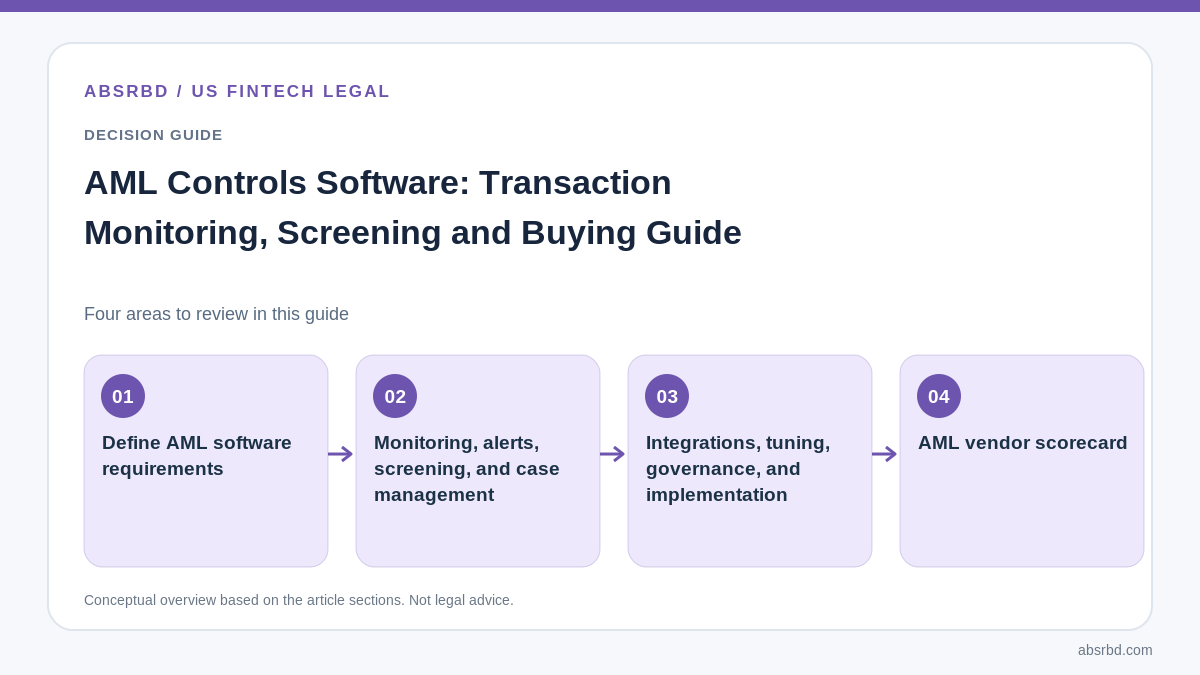
A strong AML software evaluation should prioritize:
- Transaction monitoring coverage and explainability
- Alert quality, routing, and disposition workflows
- Screening capabilities appropriate to the organization
- Integrated case management and audit trails
- Tools for measuring and reducing false positives
- Data integrations, validation, and lineage
- Controlled rule and model tuning
- Security, resilience, and access governance
- Implementation effort and total cost of ownership
The following framework can be used to compare AML platforms without relying on unsupported vendor rankings.
Define AML Software Requirements Before Comparing Vendors
Start with business requirements, data constraints, and investigation workflows—not vendor demonstrations. A platform can appear capable in a scripted presentation while failing to support the institution’s actual products, transaction types, or data environment.
Document the operating context
Create a requirements profile covering:
| Requirement area | Questions to answer |
|---|---|
| Business activities | Which products, payment methods, customer types, and jurisdictions must the software support? |
| Transaction channels | Will it monitor wires, ACH transfers, cards, cash activity, checks, peer-to-peer payments, or other channels? |
| Processing mode | Which use cases require real-time decisions, near-real-time alerts, or scheduled batch processing? |
| Data volume | What are the current and projected numbers of customers, accounts, transactions, alerts, and cases? |
| Investigation model | Are alerts reviewed centrally, by business line, or across multiple legal entities? |
| Screening scope | Which customer, counterparty, payment, and reference data fields must be screened? |
| Existing systems | Which core banking, payment, data warehouse, identity, CRM, and reporting systems require integration? |
| Governance | Who may create, test, approve, publish, and retire monitoring logic? |
| Evidence retention | What configurations, alert decisions, case records, and change histories must be preserved? |
| Deployment constraints | Are there requirements for software as a service, private cloud, specific regions, or customer-managed infrastructure? |
Organizations assessing whether their activities fall within a money services business context can review the IRS Money Services Business Information Center. Software procurement should reflect the organization’s documented obligations and risk assessment; the platform does not determine those obligations.
Separate mandatory requirements from preferences
Classify each requirement before issuing a request for proposal:
- Mandatory: The vendor must satisfy the requirement to remain under consideration.
- High priority: Materially affects risk coverage or operating efficiency.
- Preferred: Valuable but not essential for initial deployment.
- Future requirement: Likely to be needed as products, transaction volumes, or jurisdictions change.
- Out of scope: Not required for this procurement.
This classification prevents attractive but peripheral features from outweighing critical data, monitoring, and case-management deficiencies.
Establish measurable success criteria
Requirements should be testable. Replace broad statements such as “supports flexible monitoring” with criteria such as:
- Can authorized users configure thresholds without vendor engineering?
- Can rules use customer, account, transaction, counterparty, and historical behavior data?
- Can the system explain why each alert was generated?
- Can investigators see all related alerts, entities, transactions, notes, and documents in one case?
- Can reviewers reconstruct who changed a rule, when it changed, and who approved it?
- Can the platform identify rejected, delayed, duplicated, or incomplete input records?
Industry data can help inform capacity assumptions, but internal volumes should drive sizing. Relevant context may also be available in money-as-a-service statistics and electronic KYC statistics.
Compare Monitoring, Alerts, Screening, and Case Management
AML software products may combine several functions in one platform or provide them as separate modules. Buyers should evaluate each capability independently and then assess how well the functions work together.
| Capability | Primary purpose | What to evaluate |
|---|---|---|
| Transaction monitoring | Detect activity matching defined behavioral or transactional scenarios | Scenario coverage, data inputs, thresholds, explainability, historical analysis, testing tools |
| Alert management | Prioritize and route generated alerts | Queues, risk scoring, assignment rules, service-level tracking, deduplication, escalation |
| Screening | Compare parties or transaction data against selected risk data | Matching logic, list support, update controls, field handling, review workflow |
| Case management | Organize investigations and document decisions | Entity linking, timelines, notes, attachments, approvals, audit history, exports |
| Analytics and reporting | Measure system and team performance | Dashboards, configurable metrics, scheduled reports, raw-data access, export options |
Transaction monitoring software
Transaction monitoring software evaluates activity against defined rules, scenarios, behavioral patterns, or models. The evaluation should focus on whether the platform can support the organization’s relevant use cases with available data.
Key capabilities include:
- Rules using transaction amount, frequency, velocity, direction, geography, channel, and counterparty attributes
- Historical and peer-based comparisons where appropriate
- Aggregation across accounts, products, entities, or time periods
- Configurable lookback periods and thresholds
- Support for scheduled and event-driven processing
- Clear explanations showing which condition generated an alert
- Version control for rules, models, thresholds, and supporting data
- Back-testing or simulation before production changes
- Data-quality checks and exception handling
- Reprocessing when corrected data becomes available
Ask vendors to demonstrate a complete scenario lifecycle: configuration, test execution, approval, deployment, alert creation, investigation, and later modification. A visual rule builder is useful only if the resulting logic remains controlled, testable, and explainable.
Alert management
An alert queue should help investigators identify what requires attention and why. It should not function merely as a list of undifferentiated records.
Evaluate whether the platform supports:
- Risk-based prioritization
- Assignment by team, business line, geography, or expertise
- Related-alert grouping and deduplication
- Workload balancing
- Escalation and approval paths
- Standardized disposition reasons
- Required investigation fields
- Aging and service-level indicators
- Bulk actions with appropriate restrictions
- Quality-control sampling
- Reopening and reassignment with preserved history
Reviewers should be able to move from an alert to the underlying transactions, customer information, prior alerts, linked entities, and relevant case history without repeatedly switching systems.
Screening capabilities
Screening functionality may cover customers, counterparties, payments, or other records. In an AML platform comparison, focus on operational fit rather than a simple claim that screening is included.
Compare:
- Supported record types and data fields
- Exact, fuzzy, phonetic, and transliteration matching options
- Treatment of aliases, dates of birth, addresses, and identifiers
- Configurable match thresholds
- List ingestion and update controls
- Handling of incomplete or reordered names
- Suppression or allow-list governance
- Rescreening after list or customer-data changes
- Alert explanations and matched-field visibility
- Integration with case management
- Evidence showing which list version and matching configuration were used
A screening module should make potential matches understandable to reviewers. A score without the matched terms, fields, list data, and decision history provides limited investigative value.
Case management
Case management is the operational record of an investigation. It should connect relevant data and preserve a chronological history of activity.
Essential case-management features include:
- Creation of cases from one or more alerts
- Consolidated views of customers, accounts, transactions, and related parties
- Entity and relationship linking
- Investigation notes and structured questionnaires
- Document and evidence attachments
- Tasks, ownership, due dates, and escalation
- Reviewer and approver workflows
- Standardized case dispositions
- Search across current and historical cases
- Full activity logs
- Configurable exports and reports
- Role-based restrictions for sensitive cases
The system should preserve earlier decisions rather than overwrite them. Investigators and auditors must be able to distinguish the original record from later corrections, comments, or approvals.
Evaluate False Positives and Alert Quality
In day-to-day AML operations, a “false positive” commonly refers to an alert that is reviewed and closed without escalation. That does not always mean the monitoring logic was defective. Some alerts are reasonable based on the information available at generation time but are resolved through investigation.
The goal is therefore not simply to minimize alerts. It is to improve alert quality without creating unjustified gaps in coverage.
Metrics the software should support
| Metric | What it helps evaluate |
|---|---|
| Alerts generated by scenario | Which monitoring logic creates the workload |
| Closure or disposition rate | How alerts are resolved |
| Alerts escalated to cases | How often alerts require deeper investigation |
| Median review time | Operational effort by alert type |
| Repeat alerts | Whether the same activity repeatedly enters review |
| Alert age | Queue backlogs and bottlenecks |
| Quality-review overturn rate | Consistency and accuracy of investigator decisions |
| Alert volume after a change | Operational effect of rule or threshold modifications |
| Data exceptions | Whether incomplete or delayed data affects results |
These measures should be segmented by scenario, customer category, product, channel, and other relevant dimensions. An aggregate closure rate may conceal a poorly performing rule or a data problem limited to one business line.
Tools for controlled tuning
Look for functionality that allows teams to:
- Create a proposed rule, threshold, or model change.
- Test it against historical or representative data.
- Compare expected alert volume and affected populations.
- Review sample alerts produced by the proposed configuration.
- Document the reason for the change.
- Obtain required approvals.
- Deploy the approved version on a defined date.
- Monitor outcomes after release.
- Roll back the change if necessary.
Vendors should demonstrate these controls inside the product. If testing and approvals depend on spreadsheets, email, or vendor support tickets, determine how those external records will be governed and retained.
Assess Integrations, Data Quality, and Architecture
AML compliance software depends on complete, timely, and correctly mapped data. Advanced analytics cannot compensate for missing transaction records or unreliable customer identifiers.
Integration requirements
Request technical details for every proposed connection:
- REST or other application programming interfaces
- Batch files and supported formats
- Streaming or event-based ingestion
- Database connectors
- Data warehouse or lake integrations
- Authentication methods
- Encryption in transit and at rest
- Retry and reconciliation mechanisms
- Duplicate-record handling
- Error queues and notifications
- Data latency expectations
- API usage limits
- Export and bulk-retrieval options
Do not evaluate integrations by counting prebuilt connectors alone. A connector must support the required fields, volumes, update frequency, and error handling.
Data quality controls
The platform should make data failures visible. Evaluate support for:
- Required-field validation
- Format and schema checks
- Referential integrity checks
- Transaction-count and value reconciliation
- Duplicate detection
- Late or missing feed identification
- Source-to-target mapping documentation
- Data lineage
- Exception dashboards
- Reprocessing after correction
- Notifications to accountable teams
Ask what happens when a feed is incomplete. The system should not silently process partial data as though the input were complete.
Entity resolution and data linkage
If the product links customers, accounts, counterparties, addresses, or devices, ask the vendor to explain:
- Which identifiers drive the linkage
- How conflicting identifiers are handled
- Whether confidence scores are available
- How users can review or correct links
- Whether manual changes are logged
- How linkage changes affect historical alerts and cases
- Whether the logic is deterministic, probabilistic, or both
Entity resolution can improve investigations, but incorrect links may also create misleading relationships. Buyers should test linkage accuracy using representative records.
Review Tuning, Governance, and Audit Evidence
A platform must support controlled change as monitoring logic, data sources, and business activity evolve.
Configuration governance
The system should distinguish between users who can:
- Propose configurations
- Develop or edit rules
- Execute tests
- Review test results
- Approve changes
- Deploy changes
- Modify production access
- Review audit logs
Ask whether these permissions can be separated and whether emergency changes follow a documented approval path.
Audit trail requirements
A useful audit trail should record:
- User identity
- Date and time
- Previous and new values
- Reason for the change
- Related approval
- Effective date
- Affected rule, model, list, alert, case, or workflow
- Deployment status
- Rollback activity
The vendor should demonstrate how evidence is searched and exported. “Audit logs are available” is not sufficient if retrieving them requires a custom support request.
Model and rule explainability
For each alert, reviewers should be able to determine:
- Which scenario, rule, or model generated it
- Which version was active
- What data contributed to the result
- Which threshold or condition was met
- How any risk score was calculated or categorized
- Whether the alert was affected by suppression or prioritization logic
If machine-learning functionality is offered, ask how the vendor monitors performance, controls retraining, documents changes, and provides explanations to investigators.
Plan Implementation Before Signing
Implementation effort should be evaluated during vendor selection, not after contracting.
A practical implementation sequence
- Confirm scope and ownership. Define the products, entities, transaction channels, data sources, and workflows included in the initial release.
- Map and profile data. Identify required fields, source systems, quality issues, identifiers, and historical-data availability.
- Configure integrations. Build feeds, validation rules, reconciliation controls, and error handling.
- Configure monitoring and screening. Establish initial logic, thresholds, routing, and permissions.
- Design investigation workflows. Configure queues, case templates, dispositions, approvals, and quality review.
- Test end to end. Validate data ingestion, processing, alerts, cases, permissions, audit trails, and exports.
- Train each user group. Provide role-specific training for investigators, managers, administrators, and technical teams.
- Run controlled acceptance testing. Record defects, owners, remediation, and approval decisions.
- Deploy with monitoring. Track data feeds, alert volumes, system performance, and operational issues after launch.
- Complete post-implementation review. Compare actual outcomes with the documented success criteria.
Request a responsibility matrix showing which tasks belong to the vendor, implementation partner, internal technology team, compliance operations, and data owners.
Calculate total cost of ownership
The license fee may represent only part of the cost. Compare:
- Platform subscription or license
- Charges based on users, customers, transactions, alerts, or modules
- Implementation and data migration
- Integration development
- Cloud infrastructure or hosting
- Data-list subscriptions
- Vendor-managed tuning or support
- Training
- Testing environments
- Storage and retention
- API or data-export charges
- Professional services
- Future module or volume increases
- Contract termination and data extraction
Commercial terms should specify how usage is measured and what happens if volumes exceed forecasts.
Use a Scripted AML Platform Comparison
Vendor demonstrations should use the same scenarios and evaluation criteria. Without a standard script, each vendor will emphasize its strongest features, making direct comparison difficult.
Recommended buying process
- Issue requirements and data assumptions. Give every vendor the same description of workflows, volumes, systems, and mandatory capabilities.
- Screen for mandatory criteria. Remove products that cannot satisfy essential deployment, integration, security, or functional requirements.
- Run scripted demonstrations. Require vendors to complete identical tasks rather than present only prepared slides.
- Conduct a proof of concept. Use synthetic, masked, or otherwise appropriately controlled representative data and predefined expected outcomes.
- Validate technical and security claims. Review architecture, access controls, resilience, auditability, and independent assurance materials available from the vendor.
- Check implementation support. Confirm staffing, responsibilities, dependencies, training, and escalation paths.
- Compare total cost and contract terms. Model expected volumes and foreseeable growth.
- Score independently. Have evaluators record ratings and evidence before discussing a consensus score.
Tasks to include in a demonstration
Ask each vendor to demonstrate how a user would:
- Ingest a transaction file and identify rejected records
- Configure and test a monitoring scenario
- Explain why a specific alert was created
- Group related alerts into a case
- Review linked customers, accounts, and transactions
- Assign and escalate an investigation
- Record a disposition and approval
- Change a threshold through a controlled workflow
- Retrieve the history of a configuration change
- Export alerts, cases, and audit evidence
- Identify a delayed or incomplete source feed
- Produce metrics by scenario and disposition
Record whether each task was completed using standard product functionality, configuration, custom development, or a future roadmap item.
AML Vendor Scorecard
Use the scorecard below as a starting point. Adjust the weights before reviewing vendors so they reflect the organization’s priorities.
Rate each category from 1 to 5:
- 1 — Does not meet the requirement
- 2 — Meets it only through substantial customization or manual work
- 3 — Meets the core requirement
- 4 — Meets the requirement well with minor limitations
- 5 — Fully meets the requirement with strong evidence and usability
Calculate each weighted result as:
Weighted score = rating ÷ 5 × category weight
| Evaluation category | Suggested weight | Evidence to request |
|---|---|---|
| Transaction monitoring | 18% | Scenario demonstration, explainability, testing and version-control evidence |
| Alert and case management | 14% | End-to-end investigation, assignment, approval, search, and audit workflow |
| Screening | 8% | Matching demonstration, list controls, rescreening, and matched-field visibility |
| False-positive analysis and tuning | 12% | Historical testing, change approval, outcome comparison, and rollback |
| Integrations and data management | 15% | Architecture, sample mappings, reconciliation, exceptions, and data lineage |
| Governance and auditability | 10% | Access controls, change history, approvals, and evidence exports |
| Implementation and support | 8% | Project plan, responsibility matrix, training, and support model |
| Security and resilience | 8% | Security documentation, recovery approach, access architecture, and incident process |
| Commercial terms | 7% | Complete pricing model, volume assumptions, renewal terms, and exit provisions |
| Total | 100% |
Add pass-or-fail gates
Some requirements should not be averaged into a total score. Mark them as mandatory gates, such as:
- Required deployment model
- Necessary data integrations
- Minimum security controls
- Acceptable recovery capabilities
- Required audit-trail functionality
- Data-location restrictions
- Ability to export organizational data in a usable format
- Contractual terms that meet internal procurement standards
A high overall score should not compensate for failure on a mandatory requirement.
Copy-ready vendor comparison table
| Category | Weight | Vendor A rating | Vendor A evidence | Vendor B rating | Vendor B evidence | Vendor C rating | Vendor C evidence |
|---|---|---|---|---|---|---|---|
| Transaction monitoring | 18% | ||||||
| Alert and case management | 14% | ||||||
| Screening | 8% | ||||||
| Tuning and alert quality | 12% | ||||||
| Integrations and data | 15% | ||||||
| Governance and auditability | 10% | ||||||
| Implementation and support | 8% | ||||||
| Security and resilience | 8% | ||||||
| Commercial terms | 7% | ||||||
| Weighted total | 100% |
Use the AML vendor scorecard during requirements gathering, demonstrations, proof-of-concept testing, and final commercial review. Require evaluators to cite observed evidence for every score rather than rating products from sales claims alone.
Final AML Software Buying Checklist
Before selecting a platform, confirm that the team has:
- Defined in-scope products, channels, entities, data sources, and workflows
- Separated mandatory requirements from preferences
- Documented expected transaction, customer, alert, and case volumes
- Tested monitoring logic with representative scenarios
- Evaluated alert explanations and investigator usability
- Reviewed screening configuration and evidence
- Tested case creation, escalation, approval, and search
- Measured data ingestion, validation, and reconciliation
- Confirmed how incomplete or delayed feeds are handled
- Reviewed false-positive analysis and tuning controls
- Verified rule, model, and configuration versioning
- Tested role-based permissions and segregation of duties
- Retrieved audit evidence without vendor assistance
- Validated export options and data portability
- Reviewed implementation responsibilities and dependencies
- Compared total cost under expected growth scenarios
- Recorded proof for every score and mandatory gate
- Obtained approval from compliance, technology, security, operations, legal, and procurement stakeholders as applicable
The final decision should be based on demonstrated fit, not feature count. AML compliance software creates the most value when monitoring, alerting, screening, case management, data controls, and governance work as one explainable and auditable operating process.