Buy now, pay later providers in the United States are not governed by a single BNPL statute. The applicable rules depend on how the product is structured, including the number of payments, whether a finance charge applies, how consumers access the credit, which entity originates the loan, and where the borrower resides.
A typical no-interest pay-in-four plan may fall outside some traditional closed-end credit requirements under the Truth in Lending Act. That does not make it unregulated. Federal consumer-protection, electronic payment, fair-lending, credit-reporting, and unfair-practices rules may still apply. State law may also require lending licenses, disclosures, fee restrictions, servicing controls, and collection procedures.
Regulatory status: This article reflects federal authorities and Consumer Financial Protection Bureau materials issued through June 2024. BNPL rules and agency interpretations are update-sensitive. Providers should confirm the current federal position and applicable state requirements before changing a product or compliance program.
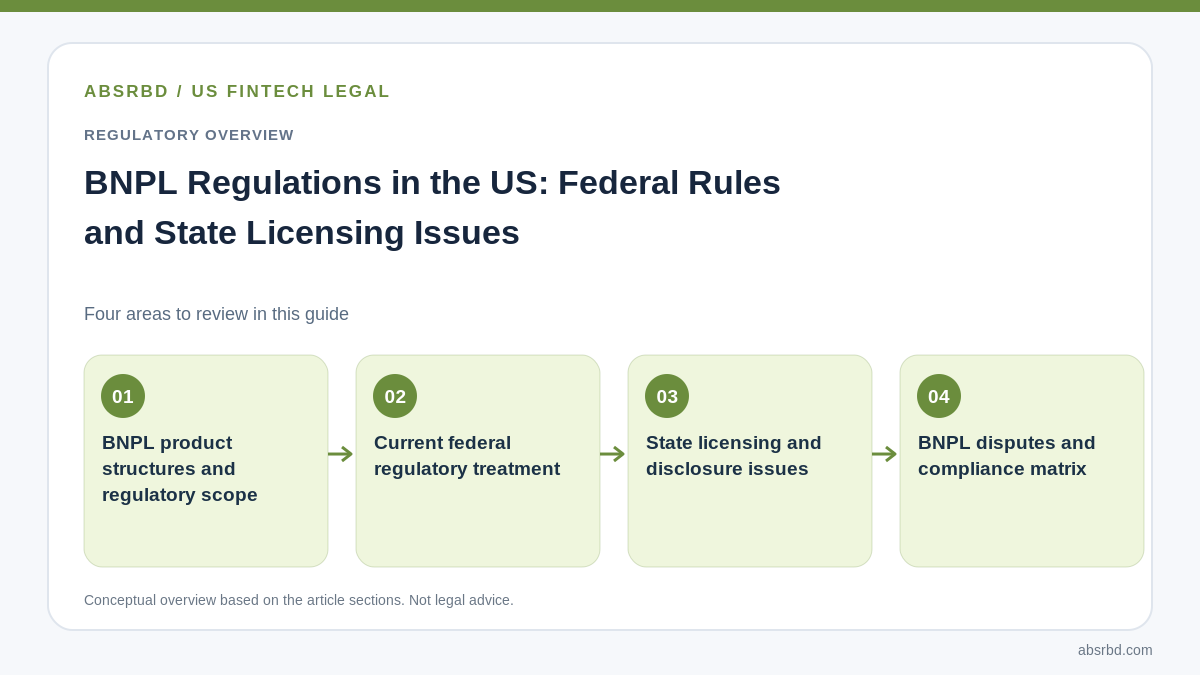
BNPL Product Structures Determine Regulatory Scope
“Buy now, pay later” describes several different forms of consumer credit rather than one legally defined product. Compliance analysis must begin with the actual contract, payment schedule, fees, account design, and flow of funds.
| BNPL structure | Common characteristics | Key regulatory questions |
|---|---|---|
| Pay-in-four | Purchase divided into four payments, often without stated interest | Is there a finance charge? Does the payment schedule trigger Regulation Z? Is a digital account used to access credit? |
| Longer-term installment loan | Repayment over several months, sometimes with interest | Do federal closed-end disclosure rules apply? Is the originator licensed in the borrower’s state? |
| Revolving or reusable credit line | Consumer can make repeated purchases against an available limit | Does the product constitute open-end credit? Are periodic statements, billing-error procedures, and account-opening disclosures required? |
| Digital account linked to BNPL loans | Consumer uses an app, credential, virtual card, or other account to access credit | Does the account qualify as a “credit card” and the provider as a “card issuer” under the CFPB’s interpretation? |
| Bank-originated program | A bank originates credit while a nonbank operates parts of the program | Which party is the creditor? Which obligations apply to the bank, program manager, servicer, and merchant? |
| Merchant-specific installment plan | Credit is available only for purchases from a particular merchant | Is the merchant a creditor? Does a third party purchase or service the receivable? Which state laws cover retail installment sales? |
Product features that can change the legal analysis
Compliance teams should document at least the following features:
- Number and timing of required payments
- Whether the first payment is treated as a down payment
- Interest, membership charges, expedited-payment fees, late fees, and other charges
- Whether consumers can use the product repeatedly
- Whether access occurs through an app, virtual card, credential, or digital user account
- Identity of the lender, creditor, servicer, merchant, payment processor, and debt collector
- Use of automatic debit or other electronic fund transfers
- Credit-reporting and underwriting practices
- States in which consumers reside
- Procedures for returns, cancellations, refunds, unauthorized transactions, and billing disputes
Marketing labels do not control the result. Calling a product “interest-free,” “split pay,” or “not a credit card” does not override the legal effect of its actual design.
Current Federal Regulatory Treatment of BNPL
Truth in Lending Act and Regulation Z
The Truth in Lending Act, implemented by Regulation Z, establishes disclosure and other requirements for consumer credit. Its application to BNPL depends partly on whether the credit carries a finance charge or is payable by written agreement in more than four installments, excluding a down payment.
As a result:
- A no-interest pay-in-four product may fall outside traditional closed-end Regulation Z coverage when it has no finance charge and does not exceed the installment threshold.
- A longer-term plan may be covered when repayment extends beyond the statutory installment threshold.
- A product may be covered if a charge constitutes a finance charge, even when the provider does not describe the charge as interest.
- A revolving or reusable credit product may be subject to open-end credit rules.
- A digital account used to access BNPL credit may trigger credit-card provisions under the Consumer Financial Protection Bureau’s interpretation discussed below.
Whether a fee is a finance charge requires analysis of why it is imposed and whether it is incident to or a condition of receiving credit. Providers should not assume that every subscription, service, convenience, or expedited-payment fee is outside Regulation Z.
The primary federal reference is Regulation Z, 12 CFR Part 1026.
CFPB treatment of digital BNPL accounts
In May 2024, the CFPB issued an interpretive rule addressing digital user accounts consumers use to access BNPL loans. The Bureau stated that covered BNPL lenders can be “card issuers” and that qualifying digital user accounts can be “credit cards” for purposes of Regulation Z.
Under that interpretation, affected providers may have obligations associated with credit-card accounts even when each underlying BNPL loan is closed-end credit. Relevant protections include:
- Periodic billing statements
- Billing-error investigation and resolution
- Consumer rights concerning disputed charges
- Refund and credit handling when goods or services are returned or canceled
- Restrictions on certain creditor actions while a billing dispute is pending
The interpretation does not mean every BNPL product is identical to a conventional revolving credit card. Providers must determine whether their particular access method and account structure fall within the definitions used by Regulation Z and the CFPB.
Because an agency interpretive rule can be revised, withdrawn, limited by enforcement policy, or challenged in court, compliance teams should verify its current status rather than relying solely on the May 2024 publication.
Regulation E and automatic payments
Regulation E governs electronic fund transfers rather than the underlying extension of credit. It can apply when a BNPL provider initiates payments from a consumer’s checking account, debit card, or other covered account.
Operational issues may include:
- Valid authorization for recurring electronic debits
- Providing a copy of the authorization when required
- Notice when the amount of a recurring transfer varies
- Procedures for stopping preauthorized transfers
- Restrictions on conditioning credit on repayment through preauthorized recurring electronic fund transfers
- Handling unauthorized or incorrect transfers
A loan billing dispute and an electronic fund transfer error are not necessarily the same issue. A consumer may dispute the merchant transaction, the BNPL balance, the debit from a deposit account, or all three. The provider’s intake process should identify each issue and route it to the correct procedure.
Other federal laws that can apply
| Federal authority | Potential BNPL relevance |
|---|---|
| Equal Credit Opportunity Act and Regulation B | Prohibits discrimination in credit transactions and may require adverse-action notices when an application is denied or terms are changed based on creditworthiness |
| Fair Credit Reporting Act | Applies when providers obtain consumer reports, furnish account information, or use report data for eligibility decisions |
| Consumer Financial Protection Act | Prohibits unfair, deceptive, or abusive acts or practices in consumer financial products and services |
| Federal Trade Commission Act | Prohibits unfair or deceptive practices within the Federal Trade Commission’s jurisdiction |
| Fair Debt Collection Practices Act | May govern third-party collectors and other entities that meet the statutory definition of a debt collector |
| Servicemembers Civil Relief Act | May affect interest, collection, default, and court procedures for eligible servicemembers |
| Military Lending Act | May apply to certain consumer credit extended to covered borrowers, subject to the law’s scope and exclusions |
Federal disclosure priorities
Even where a traditional Regulation Z disclosure form is not required, unclear or misleading communications can create consumer-protection risk. Disclosures should accurately explain:
- Total number of payments
- Amount and due date of each payment
- Interest and all potential fees
- Consequences of a missed or failed payment
- Automatic payment terms
- Return and refund procedures
- Dispute rights and contact channels
- Credit-reporting practices
- Collection practices and possible account restrictions
Disclosures should appear before the consumer commits to the transaction. Material terms should not be placed only in optional links or delivered after purchase.
State Licensing and Disclosure Issues
Federal treatment does not eliminate state-law analysis. A state may classify a BNPL arrangement as a loan, consumer credit transaction, retail installment sale, or another regulated product even when the plan does not carry interest.
State requirements can apply to the lender, servicer, program manager, merchant, debt collector, or assignee. The result may depend on the borrower’s location, the identity of the originating entity, and the allocation of responsibilities among program participants.
State-law issues to assess
A state review should address:
- Consumer lending or finance-company licensing
- Retail installment sales requirements
- Interest and fee limits
- Treatment of late, returned-payment, subscription, and expedited-payment fees
- State-specific disclosures and contract language
- Required notices before default, acceleration, or collection
- Servicing and complaint-handling requirements
- Restrictions on automatic payments
- Credit-reporting requirements
- Debt collection licensing and conduct rules
- Record-retention and examination obligations
- State unfair or deceptive acts and practices laws
- Rules governing refunds, cancellations, and merchant disputes
This review should be completed before a provider offers credit to residents of a new state. A national launch followed by retrospective licensing analysis can expose the provider to unlicensed-lending, contract-enforceability, restitution, and examination risks.
Bank partnerships do not end the analysis
When a bank originates BNPL credit, the bank may have federal or state-law advantages that differ from those of a nonbank. However, the presence of a bank does not automatically resolve every licensing or compliance question.
The parties should document:
- Which entity makes the credit decision
- Which entity is identified as the creditor
- Who funds and initially owns the receivable
- When and how receivables are transferred
- Who sets pricing and underwriting criteria
- Who services the account
- Who receives complaints and disputes
- Who bears losses and compliance responsibility
- Which entity communicates with consumers and merchants
State regulators may examine the substance of a program rather than relying only on contract labels. Preemption, interest exportation, agency, and “true lender” questions require product-specific legal analysis.
A practical state review process
- Map the product. Record every payment, fee, agreement, consumer interaction, and funds flow.
- Identify each regulated role. Determine which parties act as lender, creditor, servicer, broker, merchant, collector, or assignee.
- Classify the transaction by state. Evaluate consumer loan, retail installment, sales finance, and other potentially relevant statutes.
- Check licensing triggers. Review origination, servicing, brokering, collection, and assignment requirements separately.
- Review economic limits. Test interest and every mandatory or optional fee under applicable state rules.
- Localize documents and workflows. Add state notices, contract provisions, complaint routes, and collection controls.
- Create change controls. Require legal and compliance approval before changing fees, payment schedules, originators, or servicing practices.
- Monitor regulatory developments. Track legislation, regulations, enforcement actions, license guidance, and examination findings.
BNPL Disputes, Returns, and Refunds
A strong BNPL dispute process distinguishes among different types of consumer complaints. Treating every complaint as a simple merchant return can cause the provider to miss federal or state error-resolution obligations.
Common dispute categories
| Consumer issue | Possible legal or operational framework | Required routing question |
|---|---|---|
| Consumer did not authorize the purchase | Regulation Z, Regulation E, fraud procedures, or multiple frameworks | Was the disputed event the extension of credit, use of an access device, an account debit, or all three? |
| Merchant did not deliver goods | Billing-dispute rights, contract terms, merchant-acquiring rules, or state law | Does the provider have responsibility to investigate or withhold collection? |
| Goods were returned but balance remains | Regulation Z crediting rules, refund policy, merchant agreement | Has the merchant confirmed the return, and when must the credit be posted? |
| Wrong amount or duplicate charge | Billing-error or electronic-transfer error procedures | Where did the incorrect amount originate? |
| Automatic debit occurred after cancellation | Regulation E, authorization terms, servicing controls | Was authorization revoked, and did the provider receive notice in time? |
| Consumer disputes information on a credit report | Fair Credit Reporting Act | Did the dispute come directly from the consumer or through a consumer reporting agency? |
| Payment was misapplied | Servicing, billing-error, and state-law requirements | Which account and installment should have received the payment? |
Dispute-handling workflow
- Capture the complete complaint. Record the transaction, payment, merchant, date, amount, and remedy requested.
- Classify every component. A single complaint may contain a billing dispute, unauthorized transfer claim, refund request, and credit-reporting dispute.
- Apply the correct deadline. Use the timeframe associated with each applicable law rather than one universal service standard.
- Control collection activity. Flag the account and limit automated collection, late-fee, adverse-reporting, or account-blocking actions where required.
- Gather evidence. Obtain the credit agreement, checkout disclosures, authorization records, transaction logs, merchant records, delivery evidence, and communications.
- Investigate consistently. Apply documented standards without shifting the entire evidentiary burden to the consumer.
- Communicate the result. Explain the determination, any credit or correction, the remaining balance, and available escalation path.
- Correct connected systems. Update servicing, payment, merchant, collection, and credit-reporting records.
- Retain an audit trail. Preserve the complaint, investigation, evidence, decision, notices, and corrective actions.
- Analyze recurring problems. Use complaint data to identify merchant, product, authorization, and servicing failures.
BNPL Compliance Matrix
The following matrix can be adapted into a product-launch and monitoring control sheet.
| Compliance issue | Trigger to test | Core control | Evidence to retain | Primary owner |
|---|---|---|---|---|
| Product classification | New payment schedule, fee, access method, or reusable account | Written legal classification of each product variation | Product memo, agreement, funds-flow diagram | Legal |
| Regulation Z coverage | Finance charge, extended installment schedule, open-end credit, or digital access account | Determine applicable disclosure, statement, refund, and billing-error rules | Applicability analysis and approved disclosures | Legal and compliance |
| Digital account treatment | App, virtual credential, virtual card, or user account accesses BNPL credit | Assess CFPB credit-card interpretation and current status | Account design records and legal analysis | Product and legal |
| Electronic payments | Debit card, ACH, or recurring account withdrawals | Obtain valid authorization and maintain transfer-error procedures | Authorization and payment logs | Payments operations |
| Fair lending | Underwriting, limits, pricing, account suspension, or collections | Test policies and outcomes for prohibited discrimination | Model documentation, decision records, testing results | Fair-lending compliance |
| Adverse action | Denial or unfavorable credit decision within Regulation B | Generate accurate and timely notices where required | Notice and reason-code records | Credit operations |
| Credit reporting | Consumer report use or account furnishing | Maintain permissible-purpose, accuracy, and dispute controls | Furnishing files and dispute records | Credit reporting |
| State licensing | Lending, servicing, brokering, or collection in a state | Confirm required licenses before launch | License inventory and state analysis | Licensing team |
| State disclosures | State-specific credit or retail installment rules | Deliver localized agreements and notices | Version-controlled document archive | Compliance |
| Fees | Late, failed-payment, membership, convenience, or expedited-payment charge | Review finance-charge treatment, authorization, and state limits | Fee analysis and consumer disclosures | Legal and finance |
| Merchant returns | Cancellation, non-delivery, or returned goods | Reconcile merchant confirmation with consumer balance | Return and credit records | Merchant operations |
| Billing disputes | Consumer alleges an incorrect or unauthorized charge | Investigate, communicate, and correct within applicable rules | Complete dispute file | Servicing |
| Collections | Delinquency, default, assignment, or third-party collection | Apply federal and state conduct, notice, and licensing controls | Collection notes and communications | Collections |
| Complaints | Consumer contacts provider, merchant, regulator, or review channel | Centralize intake, escalation, root-cause analysis, and reporting | Complaint register and remediation records | Compliance |
| Regulatory change | New law, rule, interpretation, or enforcement action | Assess impact and assign implementation deadlines | Change log and approval records | Regulatory change management |
Pre-Launch BNPL Compliance Checklist
Before releasing or materially changing a BNPL product, confirm that:
- [ ] The product structure and funds flow are documented.
- [ ] The Regulation Z analysis addresses installments, finance charges, account access, and the CFPB’s digital-account interpretation.
- [ ] Electronic payment authorizations and Regulation E procedures have been reviewed.
- [ ] Required federal and state consumer disclosures are approved.
- [ ] Lending, servicing, and collection licenses have been assessed for each launch state.
- [ ] Every fee has been reviewed under federal and state law.
- [ ] Fair-lending controls cover underwriting, limits, pricing, servicing, and collections.
- [ ] Adverse-action notices use accurate reasons supported by decision data.
- [ ] Credit-reporting policies address permissible purpose, accuracy, and disputes.
- [ ] Merchant contracts allocate responsibility for returns, refunds, fraud, and delivery disputes.
- [ ] Billing-error and transfer-error workflows are separate but coordinated.
- [ ] Collection and reporting systems can suppress actions during protected disputes.
- [ ] Complaint data is monitored by product, merchant, state, and issue type.
- [ ] Regulatory developments are assigned to a named owner for ongoing review.
Maintaining a Current BNPL Compliance Program
BNPL compliance should be treated as a continuous process rather than a one-time launch review. Product changes that appear minor—such as adding a fifth payment, introducing a membership fee, issuing a virtual credential, or changing the originating entity—can alter the regulatory analysis.
At minimum, providers should review their compliance matrix when:
- A federal agency issues or changes BNPL guidance
- A state adopts a licensing or disclosure requirement
- The payment schedule or fee model changes
- A reusable account or virtual card is introduced
- Credit reporting begins or expands
- A new bank, servicer, collector, or merchant platform joins the program
- Complaint or dispute volumes reveal a recurring problem
- The provider enters a new state
For market context, see the latest BNPL statistics and adoption data. BNPL is consumer credit and should not be conflated with commercial funding products covered in these revenue-based finance statistics.
This article provides general information, not legal advice. Product-specific federal and state analysis should be completed by qualified counsel before launch or material modification.