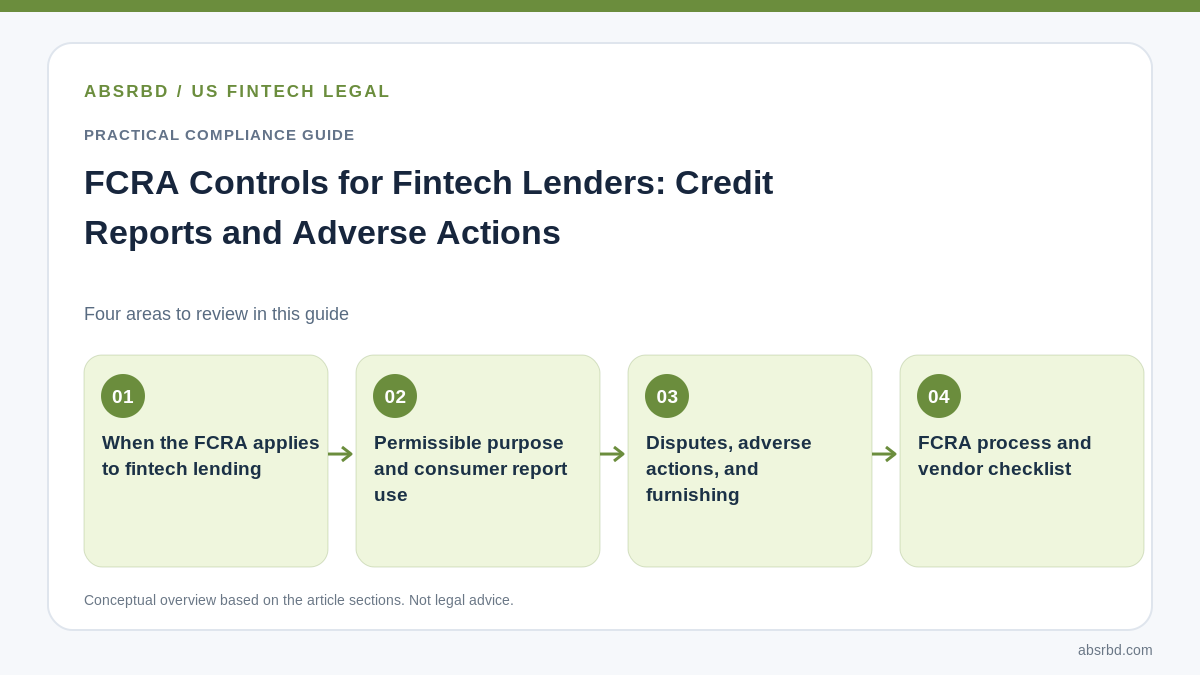
A fintech lender’s Fair Credit Reporting Act compliance program should control four activities: obtaining consumer reports only for a permissible purpose, documenting how reports affect decisions, sending complete adverse action notices when required, and managing disputes and furnished data accurately.
The FCRA may apply even when a lender calls its process a “soft pull,” uses alternative data, relies on an automated underwriting model, or outsources reporting and notice delivery to a vendor. The legal analysis depends on the data source, purpose, use, and parties involved—not the product label.
Scope note: This guide addresses federal FCRA requirements for consumer report use, disputes, adverse actions, and furnishing. State consumer reporting laws and other federal lending requirements may impose additional obligations. Legal counsel should review the rules applicable to a specific product and workflow.
When the FCRA Applies to Fintech Lending
The FCRA generally becomes relevant when a fintech lender:
- Obtains a consumer report from a consumer reporting agency;
- Uses report information to make or review a credit decision;
- Takes adverse action based in whole or in part on that information;
- Furnishes account information to a consumer reporting agency; or
- Receives a dispute about information it furnished.
A company can have more than one role. A lender may be a user of consumer reports during underwriting and a furnisher after reporting account performance.
Key FCRA terms
| Term | Practical meaning for a fintech lender |
|---|---|
| Consumer report | Information communicated by a consumer reporting agency about a consumer’s creditworthiness, credit standing, credit capacity, character, reputation, personal characteristics, or mode of living and used or expected to be used for an FCRA-regulated eligibility decision. |
| Consumer reporting agency | An entity that regularly assembles or evaluates consumer information to provide consumer reports to third parties. This can include nationwide credit bureaus and certain specialty reporting agencies. |
| User | A lender or other business that obtains and uses a consumer report for an authorized purpose. |
| Furnisher | A business that supplies account or transaction information to a consumer reporting agency. |
| Adverse action | In a credit context, an unfavorable decision covered by the FCRA, such as denying an application or taking certain unfavorable actions on an existing account. |
| Dispute | A consumer’s challenge to the accuracy or completeness of information in a consumer reporting file or furnished by a lender. |
Alternative data can still create FCRA obligations
Cash-flow records, rental history, telecommunications data, fraud indicators, and other nontraditional information are not automatically outside the FCRA. If an entity acting as a consumer reporting agency assembles or evaluates the information and provides it for an eligibility decision, the resulting product may be a consumer report.
Fintech lenders should classify each data source before integrating it into underwriting. The review should identify:
- Who collected or evaluated the information;
- Whether that provider is acting as a consumer reporting agency;
- What the provider says the product may be used for;
- Whether the lender uses it for a credit eligibility decision;
- Whether report information enters an automated model or manual review; and
- What downstream notice, dispute, and retention duties follow.
The same review should cover fraud and identity-verification products. A vendor’s marketing label does not determine whether a product is a consumer report.
Permissible Purpose and Consumer Report Use
A lender must have a permissible purpose before obtaining a consumer report. For ordinary credit operations, that commonly includes using a report in connection with a credit transaction involving the consumer and involving the extension of credit, account review, or collection of an account.
Written instructions from the consumer can also provide a permissible purpose in appropriate circumstances. However, collecting broad consent language is not a substitute for identifying the actual statutory basis for each report request.
Operational controls for permissible purpose
A compliant access process should do more than place an authorization clause in an application. It should connect every report request to a specific consumer, transaction, and approved purpose.
Use the following workflow:
- Classify the data product. Determine whether the vendor supplies consumer reports or another type of information.
- Identify the permissible purpose. Record the FCRA basis for application underwriting, account review, collection, or another authorized use.
- Certify the purpose to the reporting agency. Ensure the certification and contract accurately describe the intended use.
- Restrict system access. Limit report ordering and viewing to personnel and systems with an approved business need.
- Bind the request to a transaction. Store the application, account, or collection reference associated with each pull.
- Prevent secondary use. Do not reuse report data for a different purpose unless that use has its own permissible basis.
- Retain an audit trail. Preserve the requesting user or service, timestamp, data source, purpose code, and related transaction.
- Review exceptions. Investigate duplicate pulls, bulk access, unusual employee activity, and requests without a valid account reference.
“Soft pull” does not mean “no FCRA rules”
The industry distinction between a hard inquiry and a soft inquiry can matter to consumers and reporting practices, but it does not create a permissible purpose. A lender still needs lawful grounds to obtain a consumer report regardless of how the inquiry is displayed or whether it affects a credit score.
Account review must remain connected to the account
A lender may have a permissible purpose to review an existing account, but access should be tied to genuine account administration. Controls should prevent teams from using account-review access for unrelated marketing, prospecting, or analytics that were not covered by the original purpose.
Disputes, Adverse Actions, and Furnishing
These workflows are closely connected but should not be merged operationally. A dispute concerns accuracy or completeness; an adverse action notice explains the consumer’s FCRA rights after report information contributed to an unfavorable decision; furnishing controls govern information sent to reporting agencies.
Consumer dispute handling
A furnisher may receive disputes through two principal channels:
| Dispute channel | How it reaches the lender | Core response |
|---|---|---|
| Indirect dispute | A consumer disputes information with a consumer reporting agency, which sends the dispute to the furnisher | Conduct an investigation, review the information provided by the agency, report the results, and correct reporting when required |
| Direct dispute | A consumer sends a qualifying dispute directly to the furnisher at the appropriate address | Conduct a reasonable investigation, review relevant information, report results to the consumer, and notify reporting agencies of necessary corrections |
Not every complaint is necessarily a qualifying direct dispute under Regulation V, but customer-service labels should not determine the outcome. A complaint alleging that furnished information is inaccurate may require escalation to the dispute team.
A practical dispute workflow
- Capture the dispute date and source. Record whether it came from a reporting agency, consumer, regulator, attorney, or another channel.
- Verify the account and disputed field. Identify the consumer, account, reporting agency, reporting period, and specific data element at issue.
- Preserve all submitted information. Keep documents, attachments, agency codes, narrative text, and internal notes.
- Investigate the underlying records. Compare the disputed data with payment history, transaction records, servicing notes, account terms, adjustments, and prior corrections.
- Avoid automated confirmation without review. Matching furnished data to the lender’s own database is not enough if the database may contain the error being disputed.
- Determine the result. Conclude whether the information is accurate, inaccurate, incomplete, unverifiable, or associated with the wrong consumer.
- Correct all affected reporting. When required, update or delete the information and notify each relevant consumer reporting agency.
- Send required communications. Deliver the applicable result or insufficiency notice within the governing deadline.
- Address systemic errors. If the issue may affect other accounts, expand the review beyond the individual dispute.
- Retain evidence. Preserve the records reviewed, investigator actions, decision, communications, and reporting updates.
Investigation deadlines depend on the dispute channel and circumstances. Workflow timers should therefore be based on the date received, source, and applicable rule rather than a generic customer-service deadline.
Adverse action notices
A lender must provide an FCRA adverse action notice when it takes adverse action based in whole or in part on information in a consumer report. The report does not need to be the only reason for the decision.
Common triggers can include:
- Denying a credit application;
- Declining to extend the amount of credit requested where the decision qualifies as adverse action;
- Revoking credit;
- Taking an unfavorable action on an existing account based on a consumer report; or
- Making a decision based partly on report-derived attributes used by an underwriting model.
The FCRA notice must include:
- A statement that the decision was based in whole or in part on information from a consumer reporting agency;
- The reporting agency’s name, address, and toll-free telephone number when applicable;
- A statement that the reporting agency did not make the decision and cannot explain the specific reasons for it;
- Notice of the consumer’s right to obtain a free copy of the report from that agency by requesting it within 60 days; and
- Notice of the consumer’s right to dispute the accuracy or completeness of information in the report.
If a credit score was used in taking adverse action, additional score-related disclosures generally include:
- The numerical credit score used;
- The range of possible scores under the model;
- The key factors that adversely affected the score;
- The date the score was created; and
- The name of the person or entity that provided the score.
When the number of recent credit inquiries is a key factor, the required key-factor disclosure can differ from the usual four-factor limit.
Adverse action workflow for automated lending
Fintech lenders need to preserve the connection between the data used and the final decision. A reliable process should:
- Record every consumer report and score used in the decision;
- Track whether the report affected eligibility, pricing, amount, or account treatment;
- Capture the reporting agency associated with each input;
- Preserve the score, score date, range, provider, and key factors when applicable;
- Trigger the correct notice template;
- Populate agency-specific contact details;
- Validate the notice before delivery;
- Record the final notice and delivery event; and
- Reissue or correct notices if a material generation error is discovered.
A vendor-generated decision does not eliminate the lender’s responsibility to determine whether consumer report information contributed to the result.
When an FCRA adverse action notice is not triggered
An FCRA adverse action notice is generally not required solely because a lender made an unfavorable decision. The FCRA trigger is that consumer report information played a role in the adverse action.
The lender should still preserve evidence showing which data sources were used. That record supports the decision to send—or not send—an FCRA notice.
Furnisher Duties and Credit Reporting Controls
A fintech lender that sends account information to a consumer reporting agency becomes a furnisher and assumes a separate set of responsibilities.
Core furnishing controls include:
- Establishing written policies and procedures appropriate to the nature, size, complexity, and scope of the furnishing activity;
- Supplying information with attention to accuracy and integrity;
- Correcting and updating information when necessary;
- Responding appropriately to disputes;
- Reporting account status consistently across systems and agencies;
- Preventing information from being associated with the wrong consumer;
- Managing the date of first delinquency correctly when that field is required; and
- Reviewing policies periodically and updating them when business or reporting practices change.
Data fields that warrant heightened review
Furnishing quality assurance should focus on fields that materially affect a consumer’s file, including:
- Consumer identifiers;
- Account ownership and responsibility;
- Account status;
- Current balance;
- Credit limit or original amount;
- Scheduled payment amount;
- Payment history;
- Delinquency status;
- Date of first delinquency;
- Charge-off or collection status;
- Account closure status;
- Bankruptcy-related coding where applicable;
- Dispute indicators; and
- Deletion or suppression instructions.
Negative information notice
A furnisher that reports negative information to a nationwide consumer reporting agency generally must notify the consumer. The notice can be provided before furnishing or within 30 days after furnishing the negative information.
The FCRA includes model language for this purpose. Lenders should confirm that their notice timing, content, and delivery records match their actual furnishing process.
Reconciliation and correction
Credit reporting should be reconciled against the lender’s authoritative servicing records. A recurring quality-control process should identify:
- Files rejected by a reporting agency;
- Accounts omitted unexpectedly;
- Status changes that failed to transmit;
- Inconsistent balances or dates;
- Corrections that did not appear in the next reporting cycle;
- Deleted accounts that were later reinserted;
- Dispute indicators that were not added or removed correctly; and
- Differences among consumer reporting agencies receiving the same account data.
Corrections should be verified after transmission. Sending an update is not the same as confirming that the reporting agency processed it successfully.
FCRA Process and Vendor Checklist
The following checklist can be used for internal reviews, vendor diligence, and implementation testing.
Governance and data inventory
- [ ] Assign accountable owners for report access, adverse action notices, disputes, and furnishing.
- [ ] Inventory every consumer reporting agency and data provider.
- [ ] Classify each product as a consumer report, non-report data, or a product requiring legal review.
- [ ] Map report data from ordering through decisioning, storage, notice generation, and deletion.
- [ ] Document applicable retention and access rules.
- [ ] Maintain current written procedures for each FCRA workflow.
- [ ] Establish an escalation path for suspected systemic errors.
Permissible purpose and access
- [ ] Document a permissible purpose for every report-use case.
- [ ] Confirm that contracts and purpose codes match actual use.
- [ ] Link each report request to a consumer and transaction.
- [ ] Apply role-based access controls.
- [ ] Disable access promptly when personnel or vendor roles change.
- [ ] Monitor unusual, duplicate, or unsupported inquiries.
- [ ] Prevent report data from being reused for unauthorized purposes.
- [ ] Retain request and access logs.
Adverse action notices
- [ ] Define which product and account decisions can trigger an FCRA notice.
- [ ] Track whether consumer report information contributed to each decision.
- [ ] Use the correct consumer reporting agency contact information.
- [ ] Include the required free-report and dispute-right statements.
- [ ] Include credit score disclosures when a score was used.
- [ ] Test templates for missing, truncated, or mismatched fields.
- [ ] Preserve the exact notice sent to the consumer.
- [ ] Record the delivery method, timestamp, and status.
- [ ] Create a process for corrected notices.
Dispute management
- [ ] Centralize indirect and direct dispute intake.
- [ ] Route disputes received through customer service or other nonstandard channels.
- [ ] Calculate deadlines from the correct receipt date.
- [ ] Provide investigators with all relevant information.
- [ ] Prevent unsupported automated verification.
- [ ] Record the evidence and reasoning behind each outcome.
- [ ] Correct all affected reporting agencies when required.
- [ ] Confirm that corrections were processed.
- [ ] Monitor repeat disputes and recurring root causes.
- [ ] Escalate issues that may affect multiple consumers.
Furnishing
- [ ] Maintain written accuracy and integrity policies.
- [ ] Validate files before transmission.
- [ ] Reconcile accepted, rejected, corrected, and deleted records.
- [ ] Test critical status, balance, payment, and delinquency fields.
- [ ] Control the date of first delinquency.
- [ ] Apply dispute indicators appropriately.
- [ ] Provide negative information notices when required.
- [ ] Monitor reporting after servicing transfers or platform migrations.
- [ ] Review reporting logic after product changes.
- [ ] Verify corrections in subsequent reporting results.
Vendor diligence
Ask each consumer reporting, decisioning, servicing, notice, and furnishing vendor:
- What FCRA role does the vendor perform?
- Which data products does it consider consumer reports?
- How does it restrict access by permissible purpose?
- What audit logs can it provide?
- How does it identify the reports and scores used in a decision?
- Can it preserve the exact model inputs and output associated with an application?
- How are adverse action notices generated, tested, and delivered?
- How are disputes received, routed, timed, and documented?
- How are data corrections transmitted and confirmed?
- What controls prevent cross-consumer data matching errors?
- How does the vendor notify the lender of outages, rejected files, or compliance defects?
- What happens to consumer report data when the contract ends?
- Can the lender audit the relevant controls and obtain supporting evidence?
- Which subcontractors handle report data or regulated workflows?
- How quickly must the vendor escalate a potentially systemic error?
Vendor contracts should clearly allocate operational tasks, access rights, incident reporting, correction responsibilities, record availability, and termination procedures. Contract delegation does not by itself transfer the lender’s legal responsibility.
Evidence to Keep for an FCRA Audit
A lender should be able to reconstruct what happened without relying on employee memory or a vendor’s current interface.
Useful evidence includes:
| Compliance area | Records to preserve |
|---|---|
| Consumer report access | Request date, user or system, consumer, transaction, provider, product, purpose code, and permissible-purpose basis |
| Decisioning | Reports and scores used, relevant model version, decision timestamp, outcome, and report contribution |
| Adverse action | Final notice, reporting agency details, score disclosures, delivery method, timestamp, and delivery status |
| Disputes | Intake record, submitted documents, records reviewed, investigation notes, result, response, and corrections |
| Furnishing | Source data, transmitted files, acceptance and rejection reports, corrections, deletions, and reconciliation results |
| Vendor oversight | Due-diligence results, contracts, control reports, incidents, remediation plans, and testing records |
| Training and governance | Current procedures, approvals, training completion, monitoring results, and issue escalation records |
Authoritative FCRA Resources
Compliance teams should verify requirements against current primary and regulatory materials:
- Consumer Financial Protection Bureau FCRA compliance resources
- CFPB Regulation V, 12 CFR Part 1022
- Federal Trade Commission credit reporting resources
- United States Code, Title 15, Chapter 41
Because regulatory guidance and reporting practices can change, fintech lenders should review their FCRA controls regularly and whenever they add a data source, decision model, servicing platform, reporting agency, or compliance vendor.
For related coverage, explore the publication’s credit articles. Teams evaluating lending models can also review revenue-based finance statistics while keeping consumer reporting analysis separate from broader market research.