A U.S. business that qualifies as a money services business (MSB) generally must register with the Financial Crimes Enforcement Network (FinCEN) by filing FinCEN Form 107 within 180 days after the business is established. Registration is usually renewed every two years.
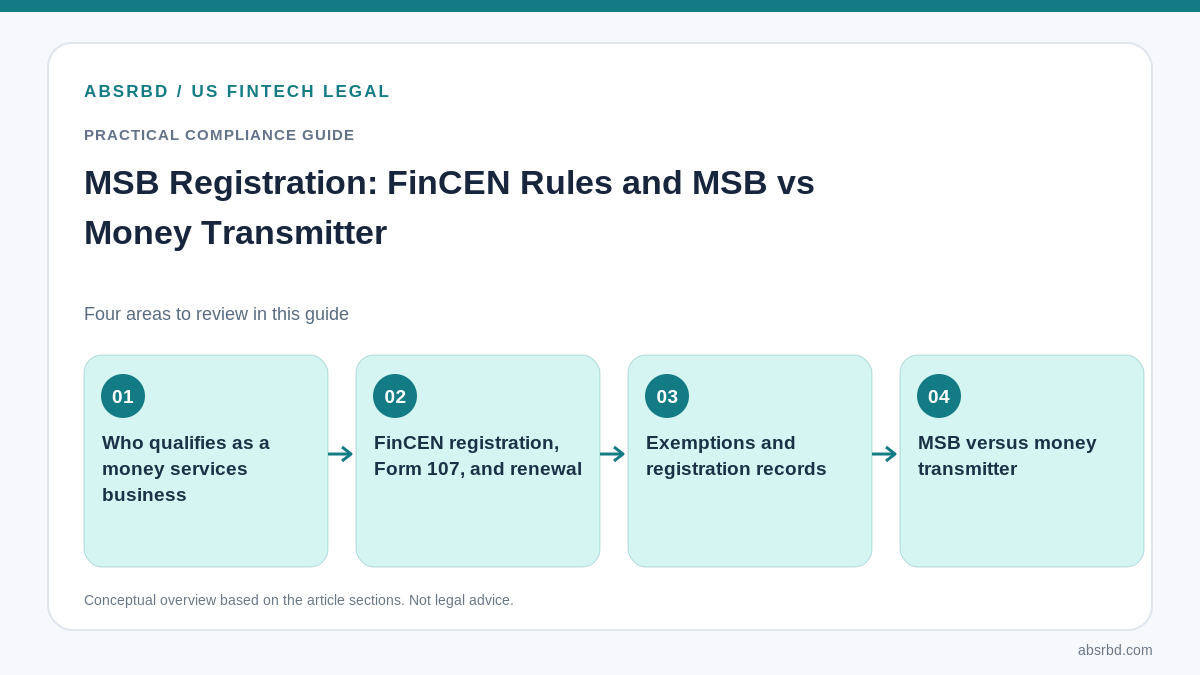
However, federal MSB registration is not the same as a state money-transmitter license. A company may need FinCEN registration, state licensing, both, or neither, depending on its activities, business relationships, and where it operates.
Important: FinCEN registration is not an approval, certification, or license. It is one component of federal Bank Secrecy Act compliance. Businesses should evaluate their specific facts with qualified legal or compliance professionals.
Who Qualifies as a Money Services Business?
FinCEN’s MSB definition covers specified financial activities conducted wholly or substantially within the United States. The legal analysis focuses on what the business actually does—not whether it describes itself as a fintech company, payments platform, software provider, or financial intermediary.
Under federal regulations, the principal MSB categories include:
| MSB category | General federal threshold or rule |
|---|---|
| Dealer in foreign exchange | More than $1,000 in currency or other monetary instruments for one person in one day |
| Check casher | More than $1,000 for one person in one day |
| Issuer or seller of traveler’s checks or money orders | More than $1,000 for one person in one day |
| Provider or seller of prepaid access | Governed by activity-specific prepaid-access rules and exemptions |
| Money transmitter | No general minimum transaction threshold |
| U.S. Postal Service | Included in the federal definition but exempt from the standard registration requirement |
The $1,000 threshold generally applies to one or more transactions conducted for the same person during a single day. It should not be assumed to apply to money transmission.
When a Business May Be a Money Transmitter
A money transmitter generally accepts currency, funds, or other value that substitutes for currency from one person and transmits it to another person or location. Transmission can occur by electronic or other means.
Common business models that require careful analysis include:
- Payment and remittance platforms
- Digital wallets with transfer functionality
- Bill-payment services
- Marketplace payment flows
- Payroll and disbursement platforms
- Foreign-exchange transfer services
- Businesses handling convertible virtual currency or other value that substitutes for currency
Not every company involved in a payment is automatically a money transmitter. Federal regulations contain exclusions that can apply to certain payment processors, technology providers, settlement participants, and persons transmitting funds as an integral part of another transaction. These exclusions are conditional and highly dependent on the actual flow of funds, contracts, counterparties, and role of the business.
Questions to Resolve Before Registering
Before filing Form 107, document clear answers to these questions:
- What financial service does the company provide?
- Does it accept or control customer funds or value?
- From whom are funds accepted?
- To whom or where are they transmitted?
- Is the company acting on its own behalf or solely as another MSB’s agent?
- Does a transaction threshold apply to the relevant MSB category?
- Does a specific statutory or regulatory exclusion apply?
- Are the activities conducted wholly or substantially in the United States?
- Does the company operate under multiple legal entities or trade names?
A business should not register merely because registration appears prudent. An unnecessary or inaccurate filing can create confusion about the company’s regulatory status, while failure to register when required can create significant compliance exposure.
How to Complete FinCEN MSB Registration
FinCEN Form 107 is the form used for initial MSB registration, renewal, re-registration, and certain corrections. It is filed electronically through the BSA E-Filing System.
1. Confirm the Registering Legal Entity
Identify the legal entity that performs the regulated activity. Review affiliated entities separately rather than assuming one filing automatically covers an entire corporate group.
Confirm the entity’s:
- Exact legal name
- Trade or “doing business as” names
- Principal business address
- Employer Identification Number or other taxpayer identification number
- Formation and ownership information
- Branch and agent structure
- Types of money services offered
2. Determine Whether an Exemption Applies
The most common registration exemption applies when a business is an MSB solely because it serves as an agent of another MSB.
This exemption is narrow. A company that performs regulated services on its own behalf may have an independent registration obligation even if it also acts as an agent. The principal MSB’s registration does not automatically cover an agent’s separate business activities.
Banks and certain entities already regulated under other federal financial regulatory regimes may be outside the MSB definition. Whether an exclusion applies should be verified under the current rule rather than inferred from a company’s license, charter, partner, or industry label.
3. Gather the Information Required by Form 107
The current Form 107 and its instructions should be reviewed before filing. Information commonly required includes:
- Legal and trade names
- Business and mailing addresses
- Taxpayer identification details
- Organizational form
- Ownership or control information
- Types of MSB activities conducted
- States or territories where services are offered
- Number of branches or agents
- Filing type, such as initial registration or renewal
The filing should match the company’s organizational records, contracts, website disclosures, compliance program, and state licensing submissions.
4. File Within 180 Days
A newly established MSB generally must submit its initial registration within the 180-day period beginning the day after the business is established.
“Established” should not automatically be treated as the company’s incorporation date. The relevant date may depend on when the entity begins operating as an MSB. Businesses should document how they selected the date used to calculate the filing deadline.
5. Save the Filing and Track Its Status
After submission, retain:
- A complete copy of Form 107
- The filing confirmation
- The filing date and registration period
- Supporting ownership and entity records
- The analysis supporting the company’s MSB classification
- The analysis supporting any claimed exemption
- The next renewal deadline
The FinCEN MSB registrant search can help verify that a filing appears in the public database. Appearance in that database does not mean FinCEN has approved, examined, certified, or licensed the business.
Renewal and Re-Registration Requirements
MSB registration is not permanent. It generally must be renewed every two years.
For a business filing an initial registration, the first renewal is generally due by December 31 of the second calendar year following the calendar year in which the initial registration was filed. Subsequent renewals follow a two-year cycle. The current Form 107 instructions should be used to confirm the applicable deadline.
Events That May Require Re-Registration
A business should review the re-registration rules when significant organizational changes occur. Relevant events can include:
- A change in ownership or control
- A transfer of a significant ownership interest
- A change requiring a new taxpayer identification number
- A substantial increase in the number of agents
- A restructuring, merger, or acquisition affecting the registered entity
Do not wait until the next scheduled renewal to evaluate a material change. Some events can trigger a separate 180-day re-registration period.
Corrections may also be necessary if a filing contains inaccurate or incomplete information. Use the current Form 107 instructions to determine whether to submit a correction, re-registration, or renewal.
Exemptions and Required Registration Records
An exemption from Form 107 does not necessarily remove every federal compliance obligation. The scope of the exemption matters.
Agent Exemption
A person that qualifies as an MSB solely because it is an agent of another MSB generally does not have to register independently.
This treatment may not apply when the agent:
- Provides MSB services outside the agency relationship
- Contracts directly with customers for separate regulated services
- Accepts or transmits funds on its own behalf
- Acts as an agent for one service but independently offers another
- Operates through another legal entity not covered by the agency arrangement
The principal MSB should maintain appropriate information about its agents. Both parties should clearly document their roles, services, and allocation of compliance responsibilities.
Entities Outside the MSB Definition
The federal MSB definition excludes certain entities, including banks and some persons registered with and functionally regulated or examined by the Securities and Exchange Commission or Commodity Futures Trading Commission.
These exclusions are not a general exemption for every company associated with a bank, broker-dealer, investment adviser, commodities business, or regulated partner. The exclusion must apply to the specific person and activity at issue.
Records to Retain
A registered MSB generally must retain its registration form and supporting records for five years. It must also maintain required information about its agents and make applicable records available to FinCEN or other authorized authorities upon request.
A practical registration file should contain:
- Filed Form 107 and confirmation
- Renewal and correction filings
- Registration deadline calculations
- Organizational and ownership records
- Agent agreements and current agent information
- Branch information
- Service and funds-flow descriptions
- Written exemption or classification analysis
- Relevant legal or compliance advice
- Internal approvals for the filing
Records should be updated when the business adds products, changes its funds flow, expands through agents, or reorganizes its corporate structure.
MSB vs. Money Transmitter
“Money services business” and “money transmitter” are related but not interchangeable terms.
An MSB is a broader federal regulatory category. A money transmitter is one type of MSB under FinCEN regulations. The term “money transmitter” is also used in state licensing laws, but each state may define and regulate the activity differently.
| Comparison point | Federal MSB status | State money-transmitter status |
|---|---|---|
| Primary regulator | FinCEN, a bureau of the U.S. Department of the Treasury | The relevant state financial regulator |
| Legal framework | Federal Bank Secrecy Act regulations | Individual state statutes and regulations |
| Main filing | FinCEN Form 107 | State-specific license application, commonly coordinated through NMLS |
| Scope | Multiple categories, including money transmission, check cashing, foreign exchange, and certain prepaid-access activities | Usually focuses on receiving money for transmission or issuing specified payment instruments |
| Transaction threshold | Depends on MSB category; money transmission has no general federal minimum | Depends on state law |
| Geographic effect | Federal registration | Authority to conduct covered activity in the particular state |
| Renewal | Generally every two years | Varies by state |
| Regulatory meaning | Registration, not authorization or endorsement | A state license authorizes covered activity subject to state requirements |
Can a Company Need Both?
Yes. A company engaged in money transmission may need to:
- Register with FinCEN as a federal MSB.
- Obtain licenses in each state where its activities require one.
- Maintain federal and state compliance programs.
- Complete separate federal and state reporting and renewal obligations.
FinCEN registration does not replace a state money-transmitter license. Likewise, holding one or more state licenses does not replace Form 107 when federal registration is required.
State requirements may include applications, financial reviews, background checks, surety bonds, permissible investment requirements, examinations, reporting, and ongoing renewals. Because those rules differ by jurisdiction, they should be addressed through a separate state money-transmitter licensing analysis rather than treated as part of the FinCEN filing.
Registration Does Not Complete BSA Compliance
Form 107 is only one element of federal compliance. A covered MSB may also have obligations involving:
- A written, risk-based anti-money laundering program
- Designation of responsible compliance personnel
- Employee training
- Independent review
- Customer and transaction controls appropriate to the business
- Suspicious Activity Report filing
- Currency Transaction Report filing
- Recordkeeping and information requests
- Agent monitoring
An MSB generally must develop, implement, and maintain its anti-money laundering program within 90 days after the business is established. The exact requirements depend on the services offered and applicable federal rules.
The business should ensure its Form 107 filing, AML program, product descriptions, transaction monitoring, and state licensing positions describe the same operating model.
MSB Registration Checklist
Use this checklist for an initial registration or renewal review.
Applicability
- [ ] Identify every financial service the business offers.
- [ ] Diagram how money or other value moves through the product.
- [ ] Determine which federal MSB category may apply.
- [ ] Apply the correct transaction threshold, if any.
- [ ] Evaluate all potentially relevant exclusions.
- [ ] Confirm whether the company acts as an agent, principal, or both.
- [ ] Analyze each legal entity separately.
- [ ] Document the conclusion and supporting facts.
Form 107 Filing
- [ ] Confirm the date the business became an MSB.
- [ ] Calculate the 180-day initial filing deadline.
- [ ] Gather legal names, trade names, addresses, and tax information.
- [ ] Verify ownership and control information.
- [ ] Identify services, branches, states, and agents accurately.
- [ ] File through the BSA E-Filing System.
- [ ] Save the submitted form and filing confirmation.
- [ ] Verify the public registration record after processing.
Ongoing Maintenance
- [ ] Record the two-year renewal deadline.
- [ ] Maintain required registration records for five years.
- [ ] Keep the agent list and related records current.
- [ ] Review ownership and organizational changes for re-registration triggers.
- [ ] Reassess MSB status when launching a new product.
- [ ] Compare federal registration with state licensing requirements.
- [ ] Keep the registration aligned with the AML program and actual operations.
Official FinCEN Resources
Use current regulatory materials when evaluating or completing a filing:
- FinCEN Money Services Business Registration
- BSA E-Filing System
- FinCEN MSB Registrant Search
- Electronic Code of Federal Regulations: 31 CFR Part 1022
FinCEN rules, forms, and guidance can change. Check the current Form 107 instructions and official FinCEN materials before filing or relying on an exemption.
Related Industry Research
For broader market context, see the latest Money as a Service statistics and the fintech startups watchlist.