A founder vesting agreement determines how a founder earns the right to keep startup equity over time. Its central purpose is to prevent a departing founder from retaining a disproportionate ownership stake after contributing for only a short period.
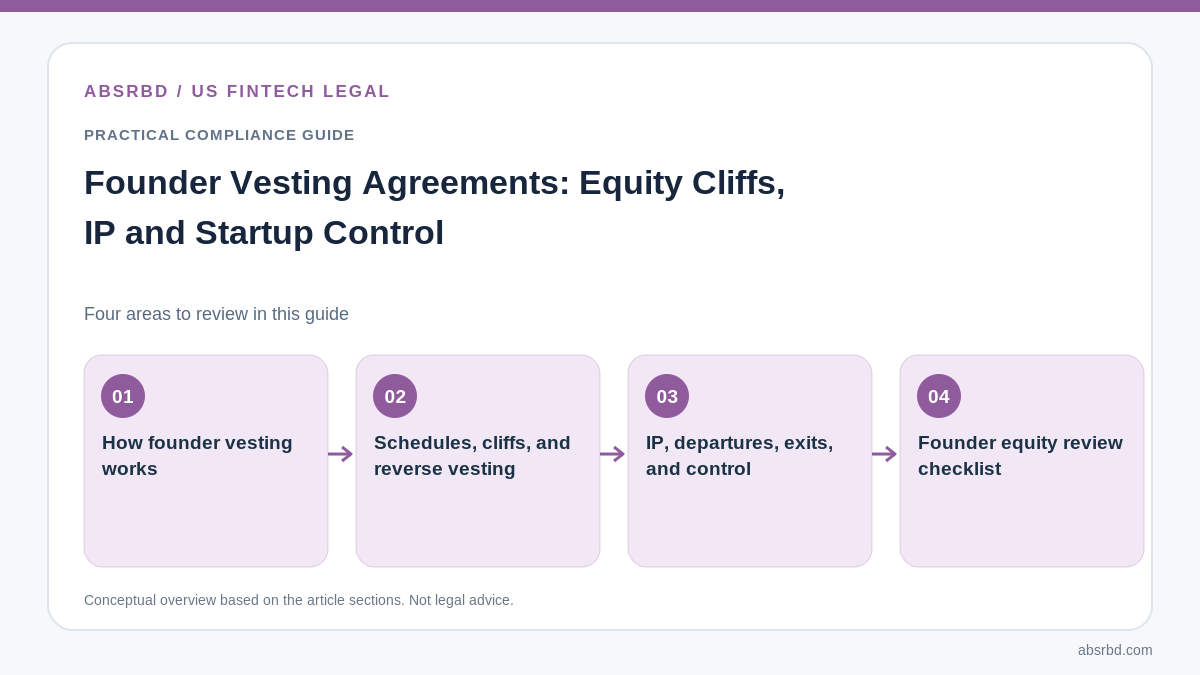
For U.S. startups, founder vesting is often implemented through restricted stock subject to the company’s repurchase right rather than through stock options. The agreement should clearly address the vesting schedule, cliff, departure scenarios, intellectual property, acquisition treatment, voting rights, and dispute procedures.
Legal and tax note: This article provides general U.S.-focused information, not legal or tax advice. Corporate, employment, securities, intellectual-property, and tax rules vary by jurisdiction and circumstances. Founders should have qualified counsel review their documents before issuing equity or changing vesting terms.
How founder vesting works
Under a typical founder equity arrangement, the founder receives shares at formation or shortly afterward, but some or all of those shares remain subject to vesting conditions.
If the founder stops providing services before all shares vest, the company may have the right to repurchase the unvested portion. The price and procedure for that repurchase depend on the governing documents.
Core vesting terms
A founder vesting agreement should identify:
- Equity grant: The number and class of shares issued to the founder.
- Vesting commencement date: The date on which vesting begins.
- Vesting period: The total period over which the equity becomes vested.
- Cliff: An initial period during which no incremental equity vests.
- Vesting frequency: Monthly, quarterly, annual, or milestone-based vesting.
- Repurchase right: The company’s right to acquire unvested shares after the founder’s service ends.
- Repurchase price: The amount the company must pay for repurchased shares.
- Service definition: The work or relationship that allows vesting to continue.
- Acceleration: Whether an acquisition, termination, or other event causes faster vesting.
- Approval requirements: Any board, stockholder, or contractual approvals needed to issue or repurchase shares.
These terms may appear in more than one document. The controlling package can include a restricted stock purchase agreement, stock plan, board consent, stockholder agreement, bylaws, proprietary information and inventions agreement, and related equity records.
Vesting does not always mean shares are issued later
Founder equity can be structured in several ways:
| Structure | When the founder receives the equity interest | What vesting controls |
|---|---|---|
| Restricted stock subject to reverse vesting | Shares are generally issued at the beginning | The company’s right to repurchase unvested shares |
| Stock options | Shares are acquired only after exercise | When the right to exercise the option is earned |
| Milestone-based equity | Timing depends on the agreement | Whether stated performance or business milestones have been achieved |
| Hybrid schedule | Depends on the underlying instrument | A combination of time, service, and milestone requirements |
Founders should not assume that “four-year vesting” operates identically across these structures. Ownership, voting, tax, and repurchase consequences can differ.
Founder vesting schedules, cliffs, and reverse vesting
A founder vesting schedule establishes when equity becomes protected from the company’s repurchase right. The schedule may be time-based, milestone-based, or a combination of both.
Illustrative four-year founder vesting schedule
The following example is illustrative only, not a recommendation.
Assume a founder receives 4,800,000 shares subject to:
- Four years of total vesting
- A one-year cliff
- Monthly vesting after the cliff
- A vesting commencement date matching the founder’s agreed service start date
The result could look like this:
| Time from vesting start | Newly vested shares | Total vested shares | Vested percentage |
|---|---|---|---|
| Before 12 months | 0 | 0 | 0% |
| At 12 months | 1,200,000 | 1,200,000 | 25% |
| At 18 months | 600,000 | 1,800,000 | 37.5% |
| At 24 months | 600,000 | 2,400,000 | 50% |
| At 36 months | 1,200,000 | 3,600,000 | 75% |
| At 48 months | 1,200,000 | 4,800,000 | 100% |
After the first anniversary, this example vests 100,000 shares each month for the remaining 36 months.
The actual agreement must specify what happens when a founder leaves on or near a vesting date. It should also state whether vesting is calculated daily, monthly, or according to another convention.
What a cliff does
A cliff delays the first vesting event until the founder completes a minimum service period.
In the illustrative schedule above:
- Departure after 10 months would generally leave no shares vested.
- Continued service through 12 months would generally cause 25% to vest at once.
- Vesting would then continue monthly.
A cliff can protect the company and the other founders when a participant leaves early. However, the parties should consider whether a full cliff remains appropriate when a founder has already worked on the business before incorporation.
Crediting work performed before the agreement
Founders sometimes begin building technology, validating a market, or developing intellectual property before equity documents are signed. If the team intends to recognize that work, the agreement can use an earlier vesting commencement date or provide partial vesting at issuance.
Any credit should be explicit. Informal statements such as “we will count the earlier work later” can create conflicting expectations and difficult ownership disputes.
Relevant questions include:
- When did the founder begin providing substantial services?
- Was the founder working full time or part time?
- What intellectual property or other assets were created?
- Did all founders understand that prior work would receive vesting credit?
- Has the board properly documented the agreed treatment?
Time-based versus milestone-based vesting
| Consideration | Time-based vesting | Milestone-based vesting |
|---|---|---|
| Measurement | Continued service over a stated period | Completion of defined outcomes |
| Administration | Usually straightforward | Requires evidence that each milestone was met |
| Main risk | Time served may not reflect contribution | Vague or disputed milestones can block vesting |
| Best drafting focus | Start date, service status, and vesting frequency | Objective criteria, deadlines, verification, and partial completion |
| Typical dispute | Whether service continued through a vesting date | Whether the founder actually achieved the milestone |
Milestones should be objectively measurable. Terms such as “successful launch,” “meaningful revenue,” or “investor-ready product” may be interpreted differently unless the agreement defines them.
What reverse vesting means
Reverse vesting generally means the founder receives shares upfront, but the company can repurchase the unvested shares if the founder’s service ends.
The agreement should answer four practical questions:
-
What triggers the repurchase right?
Examples may include resignation, termination, death, disability, or a change in the founder’s service relationship. -
Which shares can be repurchased?
The right may apply only to unvested shares, although other transfer or purchase rights can exist in separate documents. -
What is the repurchase price?
The price may be the original purchase price, fair market value, or another contractually defined amount. -
How is the right exercised?
The documents should state the notice period, payment process, authorization requirements, and treatment of stock certificates or electronic records.
The company should follow the actual repurchase procedure. A contractual right that is never timely or properly exercised may not produce the intended result.
IP, founder departures, exits, and startup control
Vesting cannot resolve every founder risk. It works best when aligned with intellectual-property assignments, governance documents, service obligations, and exit provisions.
Align equity with intellectual-property ownership
A founder can vest equity while important code, designs, inventions, domains, data, trademarks, or business materials remain outside the company. That mismatch may create problems during financing, commercial partnerships, or an acquisition review.
A founder equity package should be coordinated with written provisions covering:
- Assignment of relevant pre-formation intellectual property
- Assignment of intellectual property created during the founder’s service
- Identification of excluded prior inventions or materials
- Treatment of third-party and open-source materials
- Confidentiality obligations
- Return or deletion of company information after departure
- Authority to sign documents needed to confirm company ownership
Vesting and IP assignment perform different functions. Vesting allocates economic ownership over time; an IP assignment establishes who owns specified intellectual property. One should not be treated as a substitute for the other.
Define departure scenarios before conflict occurs
A useful founder vesting agreement does not merely say that vesting stops when a founder “leaves.” It defines what ending service means and how different circumstances are handled.
| Departure scenario | Terms to review |
|---|---|
| Voluntary resignation | Vesting cutoff date, notice obligations, and treatment of unvested shares |
| Termination without cause | Vesting cutoff, possible acceleration, and required approvals |
| Termination for cause | Definition of cause, decision-making authority, and dispute process |
| Reduced role or part-time service | Whether vesting continues, pauses, or changes |
| Death or disability | Acceleration, repurchase rights, estate treatment, and insurance coordination |
| Removal from an officer position | Whether service in another capacity continues vesting |
| Board removal but continued employment | Whether the equity agreement distinguishes governance from service |
Definitions matter. A founder may stop being an officer or director while continuing to work as an employee or consultant. If vesting depends on continuous “service,” the agreement should define which relationships qualify.
Address acquisition acceleration explicitly
Acceleration determines whether unvested equity vests earlier after an acquisition or another specified event.
Two common approaches are:
- Single-trigger acceleration: Vesting accelerates when one event occurs, such as a qualifying change in control.
- Double-trigger acceleration: Vesting accelerates only when a change in control is followed by a second event, commonly a qualifying termination or material reduction in the founder’s role.
The agreement should define:
- What transactions qualify as a change in control
- Whether an asset sale is included
- How much unvested equity accelerates
- Whether acceleration is full or partial
- The period during which the second trigger can occur
- What counts as termination without cause or resignation for good reason
- Whether the acquiring company’s assumption or replacement of the equity affects acceleration
Ambiguous acceleration language can complicate an acquisition precisely when the parties need a clear capitalization picture.
Understand the control implications
Economic vesting and corporate control are not necessarily the same thing. A founder may be able to vote issued shares before they vest, unless the applicable documents provide otherwise.
Founders should determine:
- Whether unvested shares carry voting rights
- Whether the company holds a proxy over unvested shares
- Whether repurchased shares lose voting rights immediately
- Who can approve the founder’s termination
- Who decides whether a repurchase or acceleration condition has occurred
- Whether a departing founder retains board appointment rights
- How transfer restrictions affect sales, gifts, or estate planning
- Whether multiple agreements contain inconsistent voting provisions
These questions are particularly important when two founders hold similar stakes. A vesting arrangement intended as economic protection may also shift voting power after one founder leaves.
Plan for financing and due diligence
Investors and acquirers may review whether founder equity, vesting, and IP records are complete and internally consistent. Founders preparing for institutional fundraising should keep the capitalization table, board approvals, stock purchase documents, and IP assignments aligned.
For broader context, review current global venture capital funding trends and how company readiness can matter before pursuing larger financings, including startup mega-rounds of $100 million or more.
Reduce the risk of founder disputes
Disputes often arise from unclear expectations rather than the concept of vesting itself. Common friction points include:
- Different understandings of the vesting start date
- Unrecorded promises to credit pre-incorporation work
- Disagreement over whether a founder resigned or was terminated
- Unclear definitions of cause or good reason
- Missed repurchase notices or deadlines
- Conflicts between the equity agreement and governance documents
- Unresolved ownership of pre-existing intellectual property
- Oral promises of acceleration
- Incorrect capitalization-table updates
The documents should identify the governing law, notice procedures, amendment requirements, and forum or process for resolving disputes. Each founder should retain a complete, signed copy of the final agreement package.
Tax and administrative issues to review
Founder stock can create tax consequences at issuance, during vesting, at repurchase, and upon sale.
When substantially nonvested property is transferred in connection with services, a founder may need to evaluate whether to make an election under Section 83(b) of the Internal Revenue Code. The federal filing deadline is generally 30 days after the property transfer, and missing it can materially change the tax treatment.
Founders should promptly consult a qualified tax adviser about:
- Whether Section 83 applies
- Whether an 83(b) election is available and appropriate
- The correct transfer date
- Valuation and purchase-price support
- Filing and record-retention requirements
- State and local tax treatment
- Consequences of repurchase, acceleration, or a later sale
The company should also maintain executed agreements, payment evidence, board consents, capitalization records, and copies of relevant notices. The U.S. Small Business Administration provides additional business launch counseling resources for entrepreneurs seeking general startup guidance.
How to review a founder vesting agreement
Use this process before signing or amending founder equity documents:
-
Confirm the equity being issued.
Verify the number and class of shares, purchase price, ownership percentage assumptions, and required approvals. -
Map the complete vesting schedule.
Record the commencement date, cliff, vesting frequency, end date, and any milestone conditions. -
Calculate several departure examples.
Determine the vested and unvested amounts if the founder leaves before the cliff, immediately after it, halfway through the schedule, and shortly before full vesting. -
Examine the repurchase mechanics.
Identify who can exercise the right, the applicable price, the notice deadline, and what happens if the company does not act. -
Compare every definition across the document package.
Check that “service,” “cause,” “good reason,” “change in control,” and similar terms do not conflict. -
Review IP and confidentiality documents.
Confirm that relevant pre-formation and future work is assigned appropriately and that exclusions are documented. -
Analyze control rights.
Determine who votes unvested shares, how board rights change after departure, and who decides whether triggering events occurred. -
Model an acquisition.
Apply the acceleration language to a hypothetical sale followed by continued employment, termination, resignation, or a reduced role. -
Address tax deadlines immediately.
Ask a qualified adviser whether Section 83(b) or other tax rules apply. Do not wait until the next tax-return filing season. -
Complete formal approvals and records.
Obtain required signatures and board actions, document payment, and update the capitalization table and stock ledger.
Founder equity review checklist
Use this checklist when evaluating a founder vesting agreement or preparing questions for counsel.
Equity and authorization
- [ ] The agreement states the exact number and class of shares.
- [ ] The purchase price and payment method are documented.
- [ ] Required board and stockholder approvals have been obtained.
- [ ] The capitalization table matches the signed documents.
- [ ] The founder has copies of all final agreements and consents.
Vesting schedule
- [ ] The vesting commencement date is explicit.
- [ ] Any credit for pre-incorporation work is documented.
- [ ] The cliff length and cliff vesting amount are clear.
- [ ] Post-cliff vesting frequency is defined.
- [ ] Milestones use objective completion criteria.
- [ ] Treatment of partial months or periods is stated.
- [ ] The agreement explains when vesting stops.
Repurchase and departure
- [ ] The company’s repurchase right is clearly defined.
- [ ] The repurchase price can be calculated from the document.
- [ ] Notice, payment, and exercise deadlines are stated.
- [ ] Resignation and termination scenarios are addressed.
- [ ] Cause, good reason, disability, and service are defined where relevant.
- [ ] Changes from full-time to part-time service are covered.
- [ ] Death and estate treatment have been reviewed.
Intellectual property
- [ ] Relevant pre-formation IP is listed and assigned where appropriate.
- [ ] Excluded prior inventions or materials are identified.
- [ ] Future work-product assignment obligations are documented.
- [ ] Confidentiality and information-return obligations are included.
- [ ] Third-party and open-source material has been reviewed.
Exits and control
- [ ] Change-in-control events are precisely defined.
- [ ] Single- or double-trigger acceleration is stated clearly.
- [ ] Full versus partial acceleration is specified.
- [ ] Treatment by an acquiring company is addressed.
- [ ] Voting rights for unvested shares are understood.
- [ ] Board and appointment rights after departure are clear.
- [ ] Transfer restrictions are consistent across agreements.
Tax and administration
- [ ] A tax adviser has reviewed the equity issuance.
- [ ] Any applicable Section 83(b) deadline has been identified.
- [ ] The company retains evidence of payment and issuance.
- [ ] The stock ledger and capitalization table are current.
- [ ] Amendment and dispute-resolution procedures are understood.
A founder vesting agreement should make difficult scenarios predictable before relationships, roles, or ownership expectations change. Clear schedules, enforceable repurchase procedures, aligned IP documents, and explicit exit provisions protect both the startup and the founders who continue building it.