A fintech may need investment adviser registration when it receives compensation for providing advice about securities as part of its business. Automated recommendations, model portfolios, asset-allocation tools, and subscription-based investing apps can trigger the same analysis as human advice.
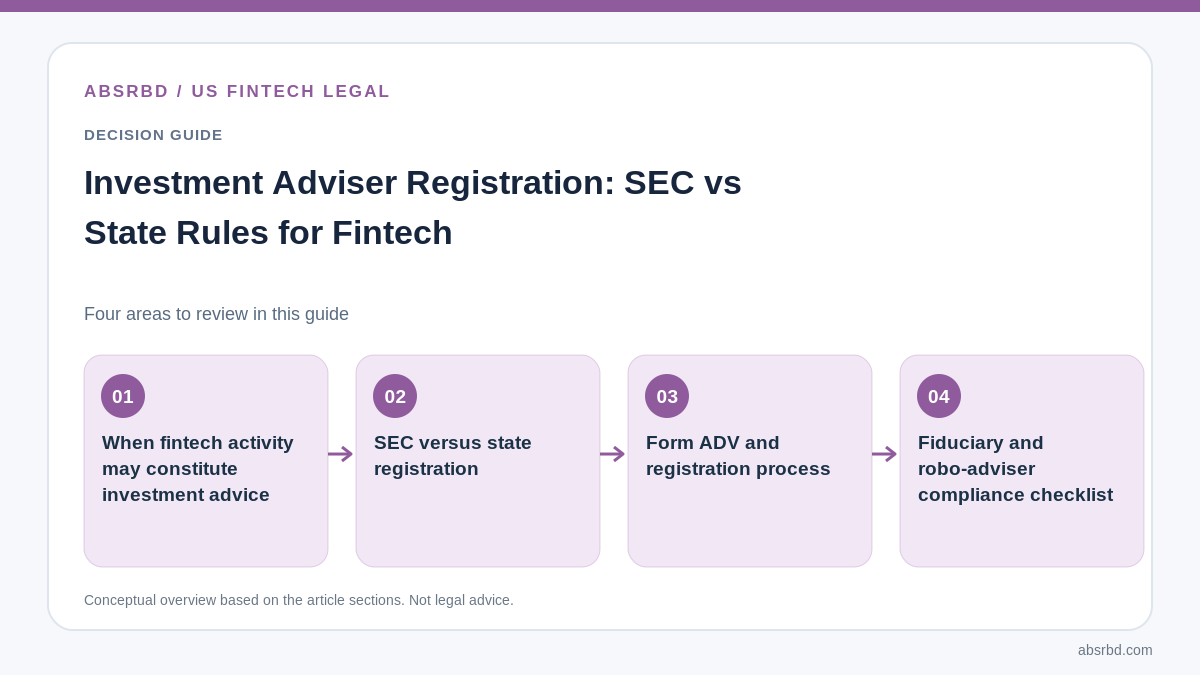
Registration jurisdiction generally depends on the adviser’s regulatory assets under management, or RAUM:
- Less than $25 million: State registration is generally the starting point.
- $25 million to $100 million: State registration usually applies if the adviser’s home state requires registration and examines advisers.
- $100 million to $110 million: The adviser may generally choose SEC registration.
- At least $110 million: SEC registration is generally required.
- Below $90 million after SEC registration: The adviser generally must transition to state registration unless another SEC eligibility basis applies.
These are federal framework rules, not a complete decision by themselves. Fintechs must also examine state law, available exemptions, the location of clients and investment adviser representatives, and specialized SEC eligibility provisions.
Important: Registration is not SEC or state approval of an adviser, its technology, or its investment performance.
When Fintech Activity May Constitute Investment Advice
The federal definition of an investment adviser generally focuses on three elements:
- Advice or analysis concerning securities
- Compensation for that activity
- Providing the service as part of a business
A company’s branding does not control the outcome. Calling a product an “education platform,” “financial wellness tool,” or “software service” will not prevent investment adviser treatment if the actual product provides compensated securities recommendations.
Activities that may trigger registration
A registration analysis is particularly important when a fintech:
- Recommends stocks, exchange-traded funds, bonds, or other securities
- Creates or manages model portfolios for users
- Recommends securities-based asset allocations
- Rebalances customer portfolios automatically
- Uses questionnaires to generate personalized investment recommendations
- Advises users whether to buy, hold, or sell securities
- Selects other investment advisers or portfolio managers for customers
- Charges subscription or platform fees connected to investment recommendations
- Receives indirect compensation for directing users toward particular investments
Advice does not necessarily need to be delivered by a person. An algorithm can provide investment advice when its output constitutes a securities recommendation.
Activities that may present a lower registration risk
Some products may fall outside investment adviser registration when they are limited to:
- General financial education without individualized securities recommendations
- Budgeting, savings, or cash-flow tools that do not recommend securities
- Administrative technology licensed to registered financial institutions
- General market information that is not tailored to a user
- Tools through which users make their own selections without recommendations
The distinction between education and advice depends on substance. Personalization, calls to action, portfolio construction, compensation, and the user experience should all be evaluated together.
Fintech registration trigger matrix
| Product feature | Registration concern | Key question |
|---|---|---|
| General articles about investing | Lower | Is the information genuinely impersonal and broadly distributed? |
| Risk questionnaire followed by educational content | Moderate | Does the output merely explain concepts, or recommend an investment strategy? |
| Questionnaire that generates an ETF portfolio | High | Is the platform recommending securities based on user information? |
| Automated portfolio rebalancing | High | Does the company exercise discretion or provide ongoing securities advice? |
| Software sold only to registered advisers | Context-dependent | Is the fintech merely a technology vendor, or does it influence recommendations to end clients? |
| Referral marketplace for advisers | Context-dependent | Is compensation tied to recommendations, client referrals, or adviser selection? |
| Model portfolio marketplace | High | Who creates, updates, recommends, and implements the models? |
Certain statutory exclusions or exemptions may apply, but they are fact-specific. Fintechs should not assume that software, automation, or the absence of human advisers creates an exclusion.
SEC vs State Investment Adviser Registration
The Investment Advisers Act of 1940 allocates regulatory responsibility between the Securities and Exchange Commission and state securities authorities. The principal office, RAUM, business model, and applicable exceptions determine where an adviser registers.
Registration comparison
| Decision factor | SEC registration | State registration |
|---|---|---|
| Primary regulator | U.S. Securities and Exchange Commission | Securities authority in each applicable state |
| Typical RAUM position | Generally required at $110 million or more; generally available beginning at $100 million | Generally applies below $100 million, subject to the mid-sized adviser rules |
| Mid-sized advisers | May qualify if the home state does not require registration or does not subject advisers to examination | Usually required when the home state registers and examines the adviser |
| Main application | Form ADV through the Investment Adviser Registration Depository | Form ADV through IARD, plus state-specific requirements |
| Additional jurisdictions | State notice filings may still be required | Registration may be required in multiple states |
| Individual personnel | Investment adviser representatives may require state registration | State registration or qualification commonly applies |
| Governing requirements | Federal Advisers Act and SEC rules | State statutes, regulations, orders, and administrative practices |
| Examination authority | SEC | Applicable state regulator |
The $100 million threshold and registration buffer
Fintechs should use regulatory assets under management, not revenue, valuation, app downloads, total linked accounts, or assets merely visible through a dashboard.
Under the general buffer:
- An eligible adviser with $100 million to less than $110 million in RAUM may register with the SEC.
- An adviser generally must register with the SEC upon reaching $110 million.
- Once SEC-registered, an adviser generally does not need to withdraw until RAUM falls below $90 million.
The buffer reduces repeated movement between SEC and state registration when assets fluctuate around $100 million.
Rules for mid-sized advisers
A mid-sized adviser generally has between $25 million and $100 million in RAUM. It is usually prohibited from registering with the SEC when:
- It is required to register as an adviser in the state where it maintains its principal office and place of business; and
- That state subjects registered advisers to examination.
If the home state does not require registration or does not examine advisers, SEC registration may be available. The analysis should be documented rather than inferred from the company’s location.
Other routes to SEC registration
A fintech that does not qualify based on RAUM may still be eligible under a specific federal provision. Potential categories include certain:
- Advisers required to register in 15 or more states
- Advisers to registered investment companies or business development companies
- Pension consultants meeting the applicable asset threshold
- Advisers under common control with an SEC-registered adviser
- Newly formed advisers that reasonably expect to become SEC-eligible within the prescribed period
- Internet investment advisers meeting the SEC rule’s conditions
Each category has technical requirements. Eligibility should be confirmed before the corresponding Form ADV representation is made.
State registration does not end at the home state
A state-registered adviser may need registration, notice filings, or exemption analysis in other states where it has clients or a place of business. States may apply different rules concerning:
- De minimis client exemptions
- Institutional clients
- Private fund advisers
- Solicitors and promoters
- Investment adviser representatives
- Net capital or bonding requirements
- Financial statements
- Advisory contracts
- Branch offices
- Fees and renewals
Model rules published by the North American Securities Administrators Association can influence state requirements, but they do not become law unless adopted by a state.
SEC-registered advisers may still have state obligations
Federal registration does not eliminate every state filing. An SEC-registered adviser may need to:
- Make state notice filings
- Pay state notice-filing fees
- Register qualifying investment adviser representatives
- Maintain required state records for local personnel
- Comply with generally applicable state antifraud authority
A jurisdiction analysis should therefore cover both the advisory entity and each person providing advice, soliciting clients, managing accounts, or supervising advisory activities.
Form ADV and the RIA Registration Process
Form ADV is the central registration and disclosure document for investment advisers. It is filed electronically through the Investment Adviser Registration Depository, commonly called IARD.
What each part of Form ADV covers
| Form ADV component | Purpose | Typical audience |
|---|---|---|
| Part 1A | Regulatory information about ownership, business activities, clients, assets, affiliations, disciplinary matters, and operations | SEC and state regulators; publicly accessible information |
| Part 1B | Additional information required for state applicants | State regulators |
| Part 2A | Plain-English firm brochure describing services, fees, conflicts, methods, risks, disciplinary information, and business practices | Advisory clients and prospects |
| Part 2B | Brochure supplement for certain supervised persons providing advice | Advisory clients |
| Part 3 / Form CRS | Concise relationship summary for SEC-registered advisers serving retail investors | Retail investors |
| Schedules and disclosure reporting pages | Additional ownership, organizational, disciplinary, and other required details | Regulators and the public, as applicable |
Form ADV is not merely an administrative form. Its disclosures must match the adviser’s contracts, website, product interface, policies, fee calculations, and actual operations.
Step-by-Step Registration Path
1. Define the advisory service
Document exactly what the platform does from onboarding through account closure. Include:
- User questionnaires
- Recommendation logic
- Portfolio construction
- Rebalancing
- Trading authority
- Human support
- Fee collection
- Referrals and revenue sharing
- Third-party custodians, brokers, and model providers
This product map supports both the registration analysis and later Form ADV disclosures.
2. Identify the advisory entity and personnel
Determine which legal entity enters into the client relationship and provides the advice. Then identify individuals who:
- Develop or approve investment recommendations
- Communicate advice to clients
- Manage portfolios
- Solicit advisory clients
- Supervise advisory activities
- Have access to client assets or sensitive information
The entity’s registration and the registration of its investment adviser representatives are related but separate workstreams.
3. Calculate regulatory assets under management
Calculate RAUM using the instructions to Form ADV. Do not substitute a marketing metric or a general “assets on platform” figure.
A fintech that offers non-discretionary advice, manages model portfolios, or works through another financial institution should examine whether and how relevant accounts qualify for the RAUM calculation.
4. Determine SEC eligibility and state jurisdiction
Create a written jurisdiction matrix covering:
- Principal office and place of business
- Current and projected RAUM
- Home-state registration and examination status
- Client locations
- Offices and personnel in other states
- Potential SEC exemptions or special eligibility categories
- State de minimis and other exemptions
- Required notice filings
Projecting growth is useful, but anticipated growth alone does not necessarily establish current SEC eligibility.
5. Establish IARD access and prepare Form ADV
The applicant must obtain access to IARD, fund its account for applicable filing fees, and prepare the required parts of Form ADV.
Drafting should involve the teams responsible for:
- Product design
- Portfolio management
- Engineering and data
- Marketing
- Finance
- Legal and compliance
- Customer support
- Vendor management
This cross-functional review helps prevent discrepancies between regulatory disclosures and the live product.
6. Build the compliance program before filing
Registration is not the final compliance step. The adviser should be prepared to operate under applicable requirements when registration becomes effective.
Core documents commonly include:
- Written compliance policies and procedures
- Code of ethics
- Advisory agreements
- Privacy notices
- Business continuity procedures
- Information-security controls
- Portfolio management and trading procedures
- Marketing review procedures
- Books-and-records controls
- Conflict-of-interest inventory
- Vendor oversight procedures
- Complaint handling and escalation procedures
The required content depends on the business. A generic policy manual that does not reflect the platform’s actual systems may create additional risk.
7. Submit the application and address regulator questions
After submission, the SEC or state regulator may request clarification, amendments, supporting documents, or revised disclosures. State regulators may also review contracts, financial statements, ownership documents, qualifications, and compliance materials.
Product launches and client onboarding should be coordinated with the effective date of registration and any required representative approvals.
8. Maintain the filing after registration
Registered advisers must keep Form ADV accurate through annual and other-than-annual amendments. They must also manage applicable:
- Brochure delivery
- Form CRS delivery and updating
- State notice filings
- Registration renewals
- Representative registrations
- Books and records
- Regulatory examinations
- Material changes to services, fees, ownership, conflicts, or disciplinary information
A change-management process should route relevant product and business decisions to compliance before implementation.
Fiduciary Duties for Fintech Investment Advisers
SEC-registered investment advisers owe clients a fiduciary duty under federal law. State-registered advisers are subject to state fiduciary and antifraud standards, which may differ in detail.
The federal fiduciary duty is commonly described through duties of care and loyalty. In practical terms, an adviser should:
- Provide advice in the client’s best interest
- Seek to understand the client’s objectives when advice is personalized
- Conduct an appropriate investigation into recommended investments
- Monitor accounts when the agreed relationship includes monitoring
- Seek best execution when responsible for selecting broker-dealers or executing transactions
- Make full and fair disclosure of material conflicts
- Eliminate conflicts or provide disclosure sufficiently specific for informed consent
- Avoid misleading statements and omissions
A disclosure buried in legal terms may not resolve a conflict if clients cannot understand its nature and significance.
Common fintech conflicts to assess
A fintech adviser should inventory conflicts created by:
- Proprietary funds or affiliated products
- Payments from asset managers
- Revenue sharing
- Cash-sweep arrangements
- Broker or custodian relationships
- Different fee levels among portfolios
- Recommendations favoring higher-margin products
- Subscription tiers that affect investment treatment
- Referral compensation
- Model-provider compensation
- Use of customer data for commercial purposes
- Performance-based marketing incentives
- Employees trading in securities also recommended to clients
The inventory should identify the conflict, affected clients, financial incentive, disclosure location, controls, testing method, and responsible owner.
Robo-Adviser Registration and Compliance
A robo-adviser is generally an investment adviser that uses algorithmic or software-based tools to provide investment advice through an online platform. Automation changes how advice is delivered; it does not remove fiduciary obligations.
For industry context, see these robo-adviser statistics and market indicators.
The SEC internet adviser exemption
An internet adviser that is not otherwise eligible for SEC registration may examine the federal internet adviser rule. The rule is narrower than the ordinary meaning of “online adviser.”
Under the SEC’s amended framework, reliance generally requires an operational interactive website through which the adviser provides investment advice to clients exclusively through the qualifying digital platform. Human-delivered advice and the platform’s actual operating history can affect eligibility.
A mobile app or website alone is not enough. Fintechs relying on this rule should document:
- How the platform qualifies as an interactive website
- How advice is generated and delivered
- Whether any client receives advice from personnel
- Whether the platform has been operational for the required period
- Whether Form ADV accurately states the basis for SEC eligibility
- How ongoing compliance with the exemption is monitored
The SEC adopted amendments to the internet adviser exemption in 2024, with a compliance date in 2025. Companies should verify the current version of the rule and related Form ADV instructions before filing.
Algorithm-specific fiduciary issues
A robo-adviser’s compliance program should address the complete algorithm lifecycle:
- Questionnaire design: Determine whether questions gather enough information for the promised service.
- Input validation: Identify inconsistent, incomplete, or implausible customer responses.
- Portfolio mapping: Document how customer inputs lead to particular portfolios.
- Testing: Test algorithms before release and after material changes.
- Exception handling: Establish procedures for account anomalies and customers who do not fit available models.
- Change control: Review and approve changes to assumptions, constraints, scoring, or portfolio assignments.
- Monitoring: Detect errors, drift, outages, or outcomes inconsistent with disclosed methodology.
- Client communication: Explain the service’s scope, limitations, risks, and use of customer information.
- Recordkeeping: Preserve relevant versions, approvals, tests, disclosures, and client communications.
- Third-party oversight: Review externally sourced models, data, software, and portfolio inputs.
Disclosures should match the digital experience
Robo-adviser disclosures should clearly explain matters such as:
- Whether the service is discretionary or non-discretionary
- What information the algorithm considers
- What information it does not consider
- Whether users can impose restrictions
- How and when portfolios are rebalanced
- Whether tax consequences are considered
- The role of human personnel
- Fees and underlying investment expenses
- Use of affiliated or proprietary products
- Material limitations of available portfolios
- Circumstances in which the service may be unsuitable
- How users can update their financial information
- How users can contact the adviser about account changes or errors
Interface text, onboarding flows, marketing pages, contracts, and Form ADV brochures should describe the service consistently.
RIA Licensing Checklist for Fintechs
Use this checklist to organize an investment adviser registration project. It is not a substitute for applying the current SEC rules and relevant state laws to the company’s facts.
Registration analysis
- [ ] Identify the legal entity providing advice
- [ ] Confirm whether the product provides advice about securities
- [ ] Identify all direct and indirect compensation
- [ ] Determine whether advice is provided as part of a business
- [ ] Evaluate applicable exclusions and exemptions
- [ ] Calculate regulatory assets under management
- [ ] Identify the principal office and place of business
- [ ] Determine whether SEC or state registration applies
- [ ] Analyze every state with clients, offices, or advisory personnel
- [ ] Confirm whether state notice filings will be required
- [ ] Determine whether investment adviser representatives must register
- [ ] Document the legal basis for the jurisdiction decision
Form ADV preparation
- [ ] Establish and fund the IARD account
- [ ] Complete Form ADV Part 1A
- [ ] Complete Part 1B where required
- [ ] Draft the Part 2A firm brochure
- [ ] Prepare applicable Part 2B brochure supplements
- [ ] Prepare Form CRS if required
- [ ] Review ownership and disciplinary disclosures
- [ ] Reconcile client types and RAUM calculations
- [ ] Confirm that fees match contracts and product screens
- [ ] Confirm that conflicts match actual revenue arrangements
- [ ] Compare Form ADV disclosures with marketing claims
- [ ] Conduct a final cross-functional accuracy review
Fiduciary and operational readiness
- [ ] Adopt written compliance policies and procedures
- [ ] Designate the responsible compliance personnel
- [ ] Adopt a code of ethics
- [ ] Create a conflicts inventory
- [ ] Review advisory agreements
- [ ] Establish portfolio management and trading controls
- [ ] Implement best-execution review where applicable
- [ ] Establish marketing review and substantiation procedures
- [ ] Create books-and-records retention controls
- [ ] Review custody implications
- [ ] Implement privacy and information-security controls
- [ ] Establish vendor due diligence and monitoring
- [ ] Create complaint and incident escalation procedures
- [ ] Establish an annual review process
- [ ] Build a regulatory filing and renewal calendar
Additional robo-adviser controls
- [ ] Document algorithm methodology and assumptions
- [ ] Validate questionnaire logic
- [ ] Test portfolio mapping and rebalancing
- [ ] Establish model-change approval procedures
- [ ] Monitor data quality and software errors
- [ ] Preserve algorithm versions and test results
- [ ] Explain the role and limitations of automation
- [ ] Review whether human interactions affect internet adviser eligibility
- [ ] Test disclosures against the actual customer journey
- [ ] Establish procedures for customers whose needs do not fit available portfolios
How to Evaluate Registration Counsel or a Compliance Provider
A useful adviser registration provider should do more than populate Form ADV. Before engagement, ask whether the scope includes:
- A written SEC-versus-state jurisdiction analysis
- RAUM methodology review
- Multi-state registration and notice-filing analysis
- Investment adviser representative requirements
- Form ADV Parts 1 and 2
- Form CRS analysis
- Advisory agreement review
- Fintech and robo-adviser disclosures
- Compliance policies tailored to the operating model
- Algorithm governance and testing controls
- Regulator comment responses
- Post-registration filing support
- Examination readiness
- A clear list of exclusions and additional fees
Request a responsibility matrix showing what the provider will draft, what management must supply, and who will maintain each document after registration.
Fintechs should also budget sufficient operational runway for compliance personnel, filing expenses, systems, testing, and ongoing updates—not only the initial application. Broader capital-market context is available in this overview of global venture funding trends for startups.
Final Registration Decision Framework
Before filing, the fintech should be able to answer five questions clearly:
- Does the product provide compensated advice about securities?
- Which entity and individuals provide or supervise that advice?
- What is the adviser’s correctly calculated RAUM?
- Does SEC registration, state registration, or a valid exemption apply?
- Can the company operate in accordance with its Form ADV disclosures and fiduciary obligations from the effective date forward?
If any answer depends on future product changes, projected assets, informal practices, or disclosures that do not match the live platform, the registration plan needs further review.
Because SEC rules, Form ADV instructions, and state requirements change, verify the current requirements through the U.S. Securities and Exchange Commission and each relevant state securities regulator before submitting an application.