Regulation Crowdfunding, commonly called Reg CF, allows eligible U.S. companies to raise up to $5 million during a 12-month period by offering securities to the public online. The offering must be conducted through a single online platform operated by an intermediary registered with the Securities and Exchange Commission (SEC)—either a broker-dealer or a funding portal—and the intermediary must be a FINRA member.
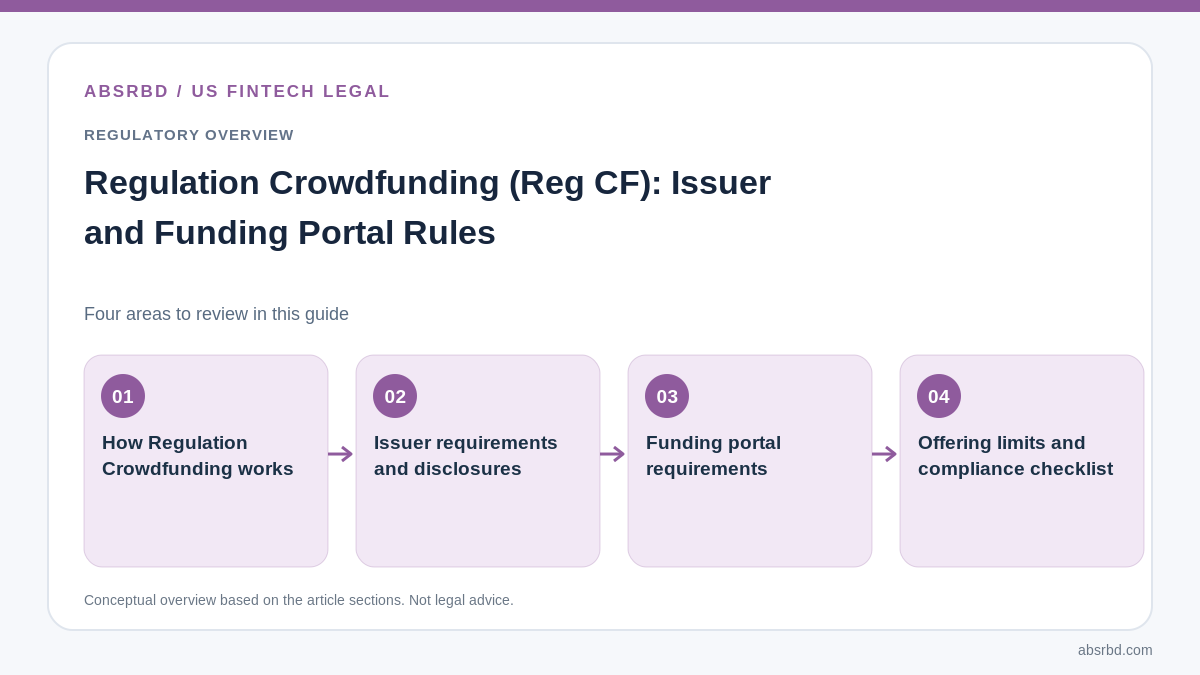
Reg CF is not simply an online fundraising campaign. It is a regulated securities offering with prescribed disclosures, investor-protection procedures, financial-statement requirements, advertising restrictions, and ongoing reporting obligations.
Important: Offering limits and financial thresholds can be adjusted for inflation. Confirm current figures in the SEC’s Regulation Crowdfunding guidance and Regulation Crowdfunding rules in 17 CFR Part 227 before beginning an offering.
How Regulation Crowdfunding Works
A compliant Reg CF offering involves three principal participants:
| Participant | Primary role |
|---|---|
| Issuer | Offers securities, prepares required disclosures, provides financial information, and completes ongoing reporting |
| Registered intermediary | Operates the online platform, conducts required screening, provides investor education, facilitates communications, and manages the offering process |
| Investor | Reviews the disclosures, makes required representations, and submits an investment commitment through the platform |
The basic structure is as follows:
- The issuer selects a registered intermediary. Each Reg CF offering must be conducted exclusively through one intermediary’s platform.
- The issuer prepares and files Form C. The filing describes the company, offering, ownership, financial condition, risks, and intended use of proceeds.
- The intermediary publishes the offering information. Required disclosures must generally be publicly available on the platform for at least 21 days before securities are sold.
- Investors submit commitments through the platform. The intermediary applies the required account-opening, education, acknowledgment, and investment-limit procedures.
- Funds remain with a qualified third party. A funding portal cannot hold or possess investor funds or securities.
- The offering closes if its conditions are met. At minimum, the disclosed target amount must be reached by the deadline. If it is not reached, investor funds must be returned.
- The issuer completes post-offering filings. These may include a final progress update and annual reports on Form C-AR.
Reg CF may be used for equity, debt, convertible instruments, or other securities, provided the offering terms and investor rights are fully and accurately disclosed.
Issuer Eligibility Requirements
Reg CF is generally available only to eligible U.S. issuers. A company should determine eligibility before spending money on offering preparation or platform onboarding.
Companies that generally cannot rely on Reg CF
Ineligible issuers include:
- Companies organized outside the United States
- Companies already subject to SEC reporting requirements under the Securities Exchange Act of 1934
- Investment companies and certain companies excluded from the Investment Company Act definition
- Blank-check companies with no specific business plan
- Companies whose business plan is to merge with or acquire an unidentified company
- Issuers disqualified under the applicable “bad actor” rules
- Issuers that previously sold securities under Reg CF but failed to file required annual reports during the preceding two years
Eligibility must also be assessed for relevant predecessors, affiliates, control persons, directors, officers, and significant owners where the rules require it.
Maximum offering amount
An issuer may raise an aggregate maximum of $5 million under Reg CF during a rolling 12-month period.
The calculation may need to include amounts sold by:
- The issuer
- Certain predecessors
- Entities controlled by the issuer
- Entities under common control with the issuer
The disclosed offering target may be lower than $5 million. An issuer can also accept oversubscriptions if it explains in advance:
- Whether investments above the target will be accepted
- The maximum amount that may be accepted
- How oversubscribed investments will be allocated
Issuer Disclosures on Form C
Before launching the offering, the issuer must file Form C with the SEC and provide it to the intermediary and investors.
The filing is intended to give investors enough information to evaluate the company, the security, and the offering’s principal risks.
Company and management information
Form C generally requires disclosure of:
- Legal name and organizational form
- Jurisdiction and date of organization
- Physical address and website
- Business description and business plan
- Number of employees
- Directors and officers
- Each person who beneficially owns 20% or more of the issuer’s voting equity, calculated according to voting power
Offering terms
The issuer must explain:
- The target offering amount
- The maximum amount the issuer may accept
- The offering deadline
- The price of the securities or the method used to determine the price
- The minimum investment, if applicable
- Whether oversubscriptions will be accepted
- The process for canceling investment commitments
- The circumstances in which the offering may close early
- The type of security being offered
- Voting, distribution, conversion, transfer, and other material rights
The disclosure should make clear how the offered security differs from the issuer’s other securities. Investors need to understand matters such as dilution, seniority, voting control, and how future financing may affect their rights.
Use of proceeds
The issuer must describe how it intends to use the money raised. The description should be specific enough to explain the expected allocation among purposes such as:
- Product development
- Hiring
- Marketing
- Equipment
- Inventory
- Debt repayment
- Working capital
- Offering expenses
If the final amount raised will affect how proceeds are allocated, the issuer should explain the priorities at different funding levels.
Financial condition and risk disclosures
Form C must include a discussion of the issuer’s financial condition. Depending on the circumstances, this may address:
- Historical operating results
- Existing cash resources
- Material debt
- Expected capital needs
- Revenue concentration
- Liquidity
- Prior financing
- Whether the offering proceeds are sufficient to execute the business plan
Risk factors should be specific to the issuer and offering. Generic language is not a substitute for disclosing material risks involving the company’s business model, management, market, finances, security terms, or dependence on future funding.
Capital structure and related-party information
Required disclosures generally include:
- Existing classes of securities
- Material rights held by current security holders
- How the offered securities may be diluted
- Circumstances in which majority owners could affect investors
- Material related-party transactions
- Exempt securities offerings conducted within the required reporting period
- Compensation paid to the intermediary
Financial-Statement Requirements
The required level of financial review depends primarily on the aggregate amount offered and sold under Reg CF during the relevant 12-month period.
| Aggregate offering amount | General financial-statement requirement |
|---|---|
| $124,000 or less | Financial statements and specified federal tax-return information certified by the principal executive officer, unless reviewed or audited statements are otherwise available |
| More than $124,000 and up to $618,000 | Financial statements reviewed by an independent public accountant, unless audited statements are available |
| More than $618,000 and up to $1.235 million | Audited statements generally apply, but a first-time Reg CF issuer may provide reviewed statements |
| More than $1.235 million | Audited financial statements |
The financial statements generally must be prepared in accordance with U.S. generally accepted accounting principles and cover the required fiscal periods. An issuer that already has a higher level of accountant assurance cannot ordinarily substitute a lower level solely because the current offering is smaller.
Because these thresholds can be adjusted for inflation, issuers should verify the current values before engaging an accountant.
Amendments and Material Changes
Form C is not a one-time filing that can be ignored after publication.
An issuer must file Form C/A when there is a material change, addition, or update to previously disclosed information. Examples may include:
- A material change to the security terms
- A new valuation or pricing method
- A significant change in the use of proceeds
- A material financial development
- A change in senior management
- A material legal or regulatory event
- An extension of the offering deadline
When a material change occurs, investors may need to reconfirm their investment commitments. A commitment that is not reconfirmed within the required period is canceled, and the investor’s funds must be returned.
Advertising and Offering Communications
An issuer cannot market a Reg CF offering like an unrestricted product promotion. Communications containing offering terms are subject to Rule 204 and generally must direct prospective investors to the intermediary’s platform.
A permitted offering notice may contain limited information, including:
- A statement that the issuer is conducting an offering
- The intermediary’s name and a link to the offering page
- The type of security
- The price or method for determining the price
- The offering amount and deadline
- Basic factual information about the issuer and its business
Issuers, employees, founders, influencers, and other promoters should not use advertising to bypass the platform’s disclosure and communication process.
If a person is compensated to promote the offering, that compensation must be disclosed when the person communicates through the platform’s communication channels. Issuers should establish written social-media and promoter guidelines before marketing begins.
Investor Limits and Required Processes
Reg CF permits participation by both accredited and non-accredited investors. The offering intermediary must have a reasonable basis for believing that each investor complies with the applicable limits.
Accredited investors are not subject to Reg CF’s investment limits. For a non-accredited investor, the aggregate amount that may be invested in all Reg CF offerings over a 12-month period is generally determined as follows:
| Investor’s annual income and net worth | General 12-month Reg CF limit |
|---|---|
| Either annual income or net worth is below $124,000 | The greater of $2,500 or 5% of the greater of annual income or net worth |
| Both annual income and net worth are at least $124,000 | 10% of the greater of annual income or net worth, capped at $124,000 |
These figures may be adjusted for inflation. An investor’s limit applies across all Reg CF investments during the period, not separately to each issuer or platform.
Investment cancellation rights
Investors generally may cancel an investment commitment until 48 hours before the offering deadline.
If the issuer makes a material change to the offering, affected investors must receive notice and an opportunity to reconfirm. Commitments that are not timely reconfirmed must be canceled.
Resale restrictions
Securities purchased in a Reg CF offering generally cannot be transferred for one year. The rules contain limited exceptions, including certain transfers:
- To the issuer
- To an accredited investor
- As part of an SEC-registered offering
- To specified family members, trusts, or in connection with death or divorce
Even after the federal restriction expires, contractual terms, state law, or the absence of a trading market may continue to limit liquidity.
Funding Portal Requirements
A funding portal is a specialized type of crowdfunding intermediary. It must:
- Register with the SEC
- Become a member of FINRA
- Operate in accordance with Regulation Crowdfunding
- Maintain required records
- Follow applicable privacy, cybersecurity, anti-money-laundering, and supervisory requirements
Official regulatory information is available through FINRA’s funding portal resources.
Core portal responsibilities
| Requirement | What the funding portal must do |
|---|---|
| Issuer screening | Have a reasonable basis for believing the issuer complies with Reg CF and has established accurate recordkeeping methods |
| Fraud prevention | Conduct required background and regulatory checks on the issuer and relevant officers, directors, and 20% owners |
| Denial of platform access | Reject or remove an offering when the portal has a reasonable basis to believe it presents potential fraud or investor-protection concerns |
| Investor education | Provide educational materials explaining the process, risks, resale restrictions, investment limits, and possibility of total loss |
| Investor acknowledgment | Obtain required representations showing that investors understand the risks |
| Disclosure access | Make the issuer’s required information publicly available on the platform for the prescribed period |
| Communication channel | Provide a channel where prospective investors can discuss the offering and ask questions |
| Investment-limit procedures | Have a reasonable basis for believing each investor remains within the applicable 12-month limit |
| Funds handling | Direct money to a qualified third party because the portal cannot possess investor funds |
| Offering completion | Ensure the target and other closing conditions are satisfied before funds are released |
| Cancellation and refunds | Process cancellations and return funds when the target is not met or commitments are not reconfirmed |
| Records and privacy | Preserve required records and protect customer information |
Background and regulatory checks
The intermediary must conduct checks on:
- The issuer
- The issuer’s officers
- The issuer’s directors
- Beneficial owners holding 20% or more of the issuer’s voting equity
These checks support both “bad actor” compliance and the intermediary’s obligation to reduce the risk of fraud.
The portal must deny access if it has a reasonable basis to believe that:
- The issuer or offering presents potential for fraud
- The issuer cannot comply with Reg CF
- The issuer’s officers, directors, or significant owners raise disqualifying or investor-protection concerns
- The portal cannot adequately assess the risk because required information has not been provided
Educational materials and investor acknowledgment
Before accepting an investment commitment, the portal must provide educational materials covering subjects such as:
- How Reg CF offerings operate
- The speculative and illiquid nature of the securities
- The risk of losing the entire investment
- Restrictions on resale
- Limitations on the information available after an offering
- Investor cancellation rights
- The issuer’s annual-reporting obligations
- The possibility that an issuer may stop filing annual reports when permitted by the rules
The portal must also obtain required acknowledgments and representations from each investor.
Platform communication channels
A funding portal must provide communication channels for discussion of offerings available on its platform.
The channel must be structured so that:
- The public can view the discussion
- Only platform account holders can post
- Issuer representatives identify themselves
- Compensated promoters disclose that compensation with their communications
- The portal does not improperly turn moderation into investment advice or recommendations
Handling investor funds
A funding portal may not hold, manage, possess, or handle investor funds or securities. Investor money must be transmitted to a qualified third party, such as a bank, under an arrangement that supports the offering’s closing and refund requirements.
Funds should be released to the issuer only after:
- The target amount has been reached
- The closing conditions have been satisfied
- Applicable cancellation periods have passed
- Required notices have been provided
Activities Funding Portals Cannot Perform
Unlike a registered broker-dealer with broader authority, a funding portal is subject to important limitations.
A funding portal generally cannot:
- Offer investment advice or recommendations
- Solicit purchases, sales, or offers to buy securities displayed on its platform
- Compensate employees, agents, or others for solicitation or based on securities sales
- Hold, manage, possess, or otherwise handle investor funds or securities
A portal can provide neutral search tools, objective offering categories, educational information, and compliance-related notices when those features are designed and administered within the applicable rules. It should not rank or describe offerings in a way that effectively recommends particular investments.
Closing the Offering
A Reg CF offering should follow a documented closing procedure.
- Monitor commitments against the target. The intermediary tracks committed funds and any cancellations.
- Confirm that the target has been reached. The issuer cannot receive funds if the minimum target is not met by the deadline.
- Provide required closing notices. If the issuer intends to close early, the applicable conditions and notice periods must be satisfied.
- Resolve material changes. Investors must receive required notices and reconfirm commitments when necessary.
- Complete compliance checks. The intermediary verifies that investor and offering requirements remain satisfied.
- Release or return funds. Funds are released only after a compliant closing; otherwise, they are returned to investors.
- File the required progress update. The issuer completes applicable Form C-U reporting.
If the offering does not reach its target by the disclosed deadline, it is canceled and investor funds must be returned.
Ongoing Reporting After a Reg CF Offering
A successful closing does not end the issuer’s compliance responsibilities.
Annual report on Form C-AR
The issuer generally must file Form C-AR within 120 days after the end of each fiscal year. The annual report must also be posted on the issuer’s website.
Form C-AR updates much of the information originally disclosed, including:
- Business operations
- Directors and officers
- Significant owners
- Financial condition
- Financial statements
- Capital structure
- Material related-party transactions
The financial statements in an annual report do not always require the same level of accountant review or audit as the offering statement. The applicable rule should be evaluated for the issuer’s circumstances.
Ending the annual-reporting obligation
An issuer may terminate annual reporting when it satisfies an applicable condition, which can include:
- Becoming an Exchange Act reporting company
- Filing at least one annual report and having fewer than 300 holders of record
- Filing annual reports for at least three years and having total assets that do not exceed the applicable threshold
- Repurchasing or redeeming all securities issued under Reg CF
- Liquidating or dissolving under applicable law
The issuer generally uses Form C-TR to report termination of the obligation. It should not stop filing merely because the offering page has closed or the business is no longer actively raising capital.
Reg CF Issuer and Portal Checklist
Issuer checklist
- [ ] Confirm that the company is an eligible U.S. issuer.
- [ ] Conduct bad-actor and control-person diligence.
- [ ] Calculate Reg CF sales during the preceding 12 months.
- [ ] Set the target, maximum amount, deadline, and oversubscription policy.
- [ ] Select one SEC-registered, FINRA-member intermediary for the offering.
- [ ] Define the security’s economic, voting, conversion, and transfer rights.
- [ ] Prepare complete company, ownership, capitalization, and risk disclosures.
- [ ] Document a specific use-of-proceeds plan.
- [ ] Determine the required financial-statement assurance level.
- [ ] Prepare and file Form C.
- [ ] Establish advertising and social-media controls.
- [ ] Identify compensated promoters and disclosure requirements.
- [ ] Create a process for Form C/A amendments and material changes.
- [ ] Monitor commitments, cancellations, and closing conditions.
- [ ] Complete applicable Form C-U reporting.
- [ ] Calendar the Form C-AR deadline.
- [ ] Evaluate Form C-TR eligibility before ending annual reporting.
Funding portal checklist
- [ ] Maintain SEC registration and FINRA membership.
- [ ] Confirm that the issuer appears eligible to rely on Reg CF.
- [ ] Conduct required background and regulatory checks.
- [ ] Assess the issuer’s recordkeeping procedures.
- [ ] Deny access when fraud or compliance concerns cannot be resolved.
- [ ] Publish required disclosures for the prescribed period.
- [ ] Provide compliant investor educational materials.
- [ ] Obtain required investor representations and acknowledgments.
- [ ] Apply reasonable investment-limit procedures.
- [ ] Maintain a compliant public communication channel.
- [ ] Identify issuer representatives and compensated promoters.
- [ ] Route funds through a qualified third party.
- [ ] Administer cancellation and reconfirmation rights.
- [ ] Verify the target and closing conditions before releasing funds.
- [ ] Preserve required records and protect customer information.
Practical Compliance Priorities
The most common preventable problems arise when an issuer treats Reg CF as a marketing project rather than a securities offering. Before launch, the issuer and intermediary should align on five issues:
- Eligibility: Confirm that the issuer and covered persons are not disqualified.
- Disclosure accuracy: Ensure Form C is consistent with financial statements, marketing materials, and platform communications.
- Offering mechanics: Clearly document the target, deadline, oversubscriptions, cancellations, and closing process.
- Communication controls: Train founders, employees, and promoters on what they may say publicly.
- Post-closing reporting: Assign responsibility for Form C-U, Form C-AR, amendments, and record retention.
For broader market context, see current crowdfunding statistics and global venture capital funding trends for startups.
Reg CF requirements are technical and subject to regulatory updates. Issuers and intermediaries should review current SEC and FINRA rules and obtain qualified securities-law advice for the facts of a particular offering.