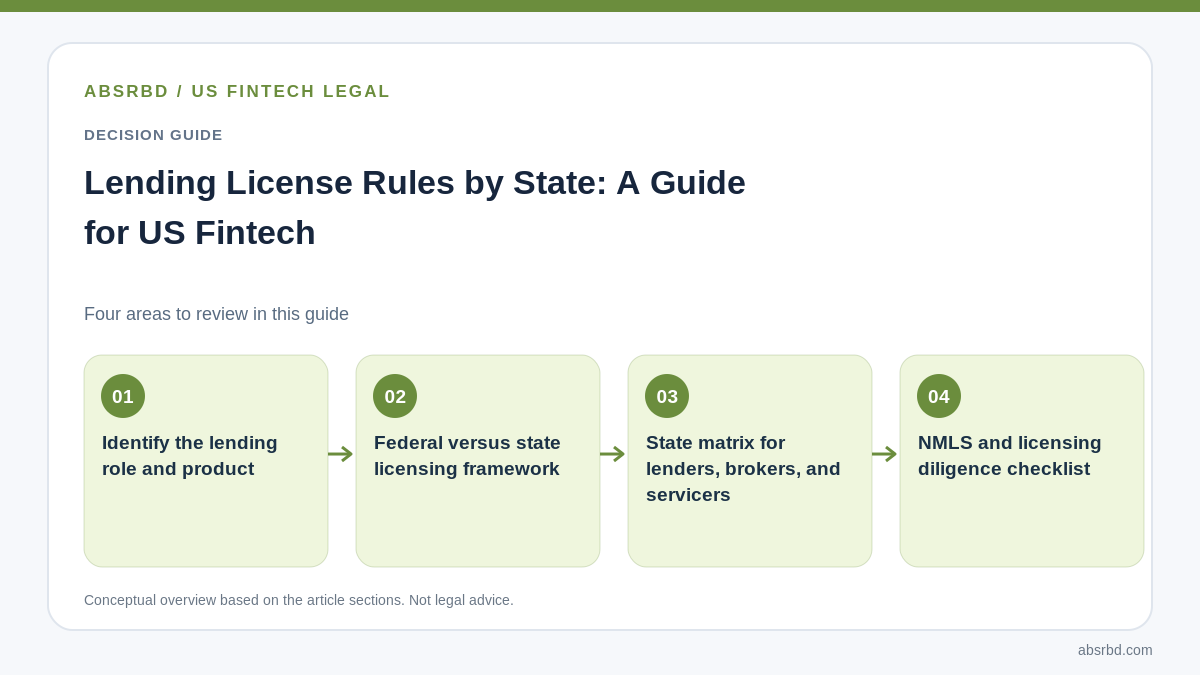
Most nonbank fintech lenders do not have access to a single nationwide lending license. Licensing is generally determined state by state based on three factors:
- What the company does: lends, brokers, services, collects, or performs several roles.
- What product it offers: consumer installment loans, small-dollar credit, mortgage loans, student loans, sales finance, commercial financing, or another product.
- Where the regulated activity occurs: often the borrower’s state, but operational locations and solicitation activity may also matter.
The Nationwide Multistate Licensing System & Registry, commonly called NMLS, can centralize many state applications. However, an NMLS account or identification number is not itself permission to lend. Each relevant state regulator must grant the required authority.
Practical rule: Build the licensing analysis around actual activities and borrower locations—not around labels such as “fintech,” “platform,” or “marketplace.”
This guide provides a planning framework for comparing lender, broker, and servicer requirements. It is not a substitute for state-specific legal advice.
Identify the Lending Role and Product First
A state cannot be evaluated accurately until the fintech’s role, product, and transaction flow are documented. Two companies offering similar online customer experiences may have very different licensing obligations.
Direct lender
A direct lender generally enters into the loan agreement as the creditor or originates credit using its own lending authority. Relevant questions include:
- Which entity appears as the lender in the agreement?
- Who makes the final credit decision?
- Who funds the loan at closing?
- Who initially owns the receivable?
- Does another institution originate the loan before selling it?
- Is the product secured or unsecured?
- What are the loan amount, duration, and pricing parameters?
State licensing categories may distinguish among consumer lenders, small-loan companies, sales finance companies, mortgage lenders, and other specialized creditors.
Loan broker or marketplace
A company may fall within a state’s loan broker licensing rules even if it never funds a loan. Potentially regulated activities can include:
- Soliciting loan applications
- Matching applicants with lenders
- Negotiating or offering loan terms
- Transmitting applications to funding sources
- Receiving compensation for arranging credit
- Advertising that implies the company can obtain financing
- Charging borrowers for assistance in securing a loan
The underlying license may not be named “loan broker license.” Depending on the state and product, the relevant framework may use terms such as credit services organization, finance broker, mortgage broker, small-loan broker, or loan arranger.
Pure lead generation should not automatically be assumed exempt. The analysis depends on the company’s advertising, compensation, customer communications, and involvement in the application process.
Loan servicer
A servicer typically administers loans after origination. Activities may include:
- Sending account statements
- Processing payments
- Maintaining account records
- Handling customer inquiries
- Managing modifications or payment plans
- Conducting delinquency outreach
- Remitting funds to loan owners
A state may regulate consumer loan servicing directly or address particular activities under another licensing category. If servicing includes collecting delinquent accounts, a separate collection-related analysis may also be necessary.
Multiple-role businesses
Many fintechs perform more than one regulated role. For example, a platform may market loans, collect applications, facilitate origination, acquire receivables, and service the resulting accounts.
Licensing should therefore be mapped by activity rather than assigned a single company-wide label.
| Business activity | Possible role | State review needed |
|---|---|---|
| Company funds and originates loans | Lender | Consumer or product-specific lending authority |
| Company submits applications to third-party lenders | Broker or arranger | Loan broker, credit services, or product-specific authority |
| Company purchases loans after origination | Loan owner or assignee | Whether ownership, acquisition, or enforcement triggers licensing |
| Company processes payments and manages accounts | Servicer | Consumer loan servicing or product-specific servicing authority |
| Company pursues delinquent balances | Servicer or collector | Servicing and collection-related licensing |
| Company only supplies advertising leads | Lead generator or possible broker | Solicitation, compensation, and involvement in credit placement |
Define the Product Before Comparing States
A licensing conclusion for one product should not be reused automatically for another. Create a written product profile containing:
- Consumer or business purpose
- Secured or unsecured status
- Closed-end or open-end structure
- Loan amount range
- Repayment term
- Interest and fee structure
- Borrower locations
- Origination channel
- Funding source
- Loan ownership after origination
- Servicing model
- Use of branches, remote employees, or third-party vendors
Product classification matters because states may maintain separate licensing regimes for mortgage credit, consumer installment loans, small-dollar loans, vehicle-related financing, student lending, or sales finance.
If the business model is still being selected, market data can help determine whether the cost of a multistate licensing program is commercially justified. Relevant planning resources include peer-to-peer lending statistics and revenue-based finance statistics.
Federal Versus State Lending Licensing
For most nonbank lenders, state licensing is the central issue. Federal regulation does not generally provide a universal nonbank license that authorizes consumer lending in every state.
Federal and state framework compared
| Dimension | Federal framework | State framework |
|---|---|---|
| Primary licensing function | Charters and supervises certain banks, credit unions, and other regulated institutions | Licenses many nonbank lenders, brokers, servicers, and specialized finance companies |
| Nationwide nonbank lending license | Generally unavailable | Authorization is commonly obtained jurisdiction by jurisdiction |
| Main relevance to fintechs | Depends on charter, institutional partners, registrations, and federal oversight | Depends on product, activity, borrower location, exemptions, and state-specific definitions |
| Application system | Varies by institution and regulator | Many applications are submitted through NMLS; some filings remain outside NMLS |
| Result of approval | Authority depends on the specific charter or approval | Authority is limited to the license type, licensed entity, activities, and jurisdiction |
| Ongoing obligations | Examinations, reports, records, and institutional requirements may apply | Renewals, reports, bonds, examinations, notices, and change approvals may apply |
Bank and credit union models
Banks and credit unions operate under federal or state charters and institution-specific supervisory frameworks. A fintech working with a bank should not assume the bank’s authority automatically covers every activity performed by the fintech.
The parties should identify separately:
- Which entity is the creditor at origination
- Which entity markets and receives applications
- Who controls underwriting decisions
- Who funds each transaction
- When and how loan ownership changes
- Who services the account
- Whether the fintech performs an independently licensed activity
A bank partnership can change the licensing analysis, but it does not eliminate the need to evaluate the fintech’s own conduct in every target state.
Nonbank models
A nonbank fintech commonly considers one of four licensing pathways:
| Pathway | Potential advantage | Principal licensing consideration |
|---|---|---|
| Obtain the company’s own state licenses | Direct control over origination and operations | Substantial application, renewal, reporting, and examination workload |
| Work with a chartered financial institution | May support broader product distribution | Fintech activities still require independent state analysis |
| Act only as a broker or marketplace | Avoids funding loans directly | Loan broker licensing may apply, and the operating model must match the approved role |
| Acquire a licensed business | May accelerate entry into some markets | Licenses may require regulator approval for ownership or control changes and may not transfer automatically |
Commercial planning should compare both the initial authorization process and the continuing cost of maintaining the chosen structure.
State Licensing Matrix for Lenders, Brokers, and Servicers
There is no reliable universal “licensed or exempt” answer for a state without knowing the role and product. The following matrix should be completed for every jurisdiction in which borrowers will be located or regulated activity will occur.
| State-level question | Direct lender | Broker or marketplace | Servicer |
|---|---|---|---|
| Does the activity fall within a regulated license category? | Required review | Required review | Required review |
| Is the product covered by a specialized licensing law? | Check product type, amount, term, and security | Check the product being arranged | Check the product being serviced |
| Does the state regulate activity conducted with its residents? | Check borrower-location nexus | Check solicitation and application nexus | Check account and borrower nexus |
| Is an exemption available for the entity or transaction? | Verify scope and conditions | Verify whether the exemption extends to arranging | Verify whether it extends to servicing |
| Is the filing available through NMLS? | Confirm in the state licensing checklist | Confirm the specific broker category | Confirm the specific servicing category |
| Is a separate non-NMLS filing required? | Check state regulator instructions | Check state regulator instructions | Check state regulator instructions |
| Is a surety bond required? | Often license-specific | Often license-specific | Often license-specific |
| Are branch or location licenses required? | Review offices and remote operations | Review offices and solicitation locations | Review servicing locations |
| Are individuals separately licensed? | Product-dependent | Product-dependent | Less common, but must be checked |
| Are ownership changes subject to approval or notice? | Usually requires review | Usually requires review | Usually requires review |
| Are periodic reports or assessments required? | Check state schedule | Check state schedule | Check state schedule |
| Are renewals managed through NMLS? | Confirm annually | Confirm annually | Confirm annually |
Build a 50-state tracker
The licensing team should create one row for every target jurisdiction, including the District of Columbia when applicable.
Recommended columns are:
| Tracker field | What to record |
|---|---|
| Jurisdiction | State or district being reviewed |
| Borrowers permitted | Whether customers in the jurisdiction may apply or receive loans |
| Product | Exact product covered by the conclusion |
| Company role | Lender, broker, servicer, collector, purchaser, or combination |
| License name | Official name used by the state regulator |
| Regulator | Agency responsible for the license |
| NMLS filing | Yes, no, or partially handled through NMLS |
| Exemption relied upon | Exact exemption and supporting conditions |
| Surety bond | Amount or calculation method, if applicable |
| Financial requirement | Audited statements, net worth, liquidity, or other evidence |
| Key individuals | Owners, control persons, qualified individuals, or branch managers |
| Branch treatment | Whether additional locations require approval |
| Application status | Research, preparation, submitted, deficient, approved, or denied |
| Renewal date | Annual renewal or expiration deadline |
| Reporting | Periodic reports, assessments, or call reports |
| Restrictions | Product or operational limits attached to the authority |
| Evidence | Regulator checklist, approval order, license record, and legal analysis |
| Last verified | Date the information was checked |
Do not use “NMLS available” as the final conclusion. The tracker should record the actual state license or registration and its current status.
State review should follow the business footprint
A fintech’s first-pass jurisdiction list should include:
- Every state where prospective borrowers reside
- States where employees solicit or arrange loans
- States containing physical offices or branches
- States where servicing operations occur
- States in which third-party agents act for the company
- The company’s formation and principal-business jurisdictions
- Any state connected to collateral or a specialized product
The relevant nexus can vary by state and activity. Borrower location is often central, but it should not be the only factor reviewed.
How NMLS Applies to Lending Licenses
NMLS is an electronic system used by participating state agencies to manage many financial-services licenses and registrations. It is operated by the State Regulatory Registry, a subsidiary of the Conference of State Bank Supervisors.
NMLS can support:
- Company applications
- Branch filings
- Individual filings
- Ownership and control disclosures
- Document uploads
- Attestations
- Amendments
- Renewals
- Regulatory reporting
- License-status research
Official starting points include the Conference of State Bank Supervisors and the Nationwide Multistate Licensing System.
What NMLS does not do
NMLS does not:
- Create one national nonbank lending license
- Decide that every state uses the same requirements
- Replace state regulator review
- Guarantee approval after an application is submitted
- Convert an NMLS identification number into lending authority
- Eliminate separate state forms, bonds, fees, or supporting documents
- Resolve whether a company qualifies for an exemption
Licensing teams should use the state-specific NMLS checklist for the exact license type, then compare it with the regulator’s current instructions.
NMLS Consumer Access
NMLS Consumer Access provides public information about many licensed companies, branches, and individuals. It is useful for confirming public license records and researching how comparable businesses are categorized.
However, public search results are not a substitute for reviewing the company’s approval documents, license conditions, and authorized activities.
State Licensing Application Requirements
Although requirements differ, state nonbank applications commonly request several categories of information.
Corporate records
Prepare:
- Formation documents
- Bylaws or operating agreement
- Certificates of good standing
- Foreign qualification records
- Registered-agent details
- Organizational charts
- Trade names and assumed-name registrations
Ownership and management information
Regulators may request information about:
- Direct and indirect owners
- Control persons
- Executive officers
- Directors or managers
- Qualified individuals
- Branch managers
- Affiliates and parent companies
Background checks, fingerprints, personal history disclosures, credit reports, or financial disclosures may apply to specified individuals.
Financial evidence
Depending on the license, the application may require:
- Financial statements
- Audited financial statements
- Bank account information
- Minimum net worth evidence
- Surety bonds
- Irrevocable letters of credit
- Forecasts or opening balance sheets
- Explanations of funding sources
Requirements can differ materially by license type and state.
Operating documents
A regulator may request:
- Business plan
- Product description
- Geographic rollout plan
- Funding model
- Sample loan or broker agreements
- Servicing procedures
- Customer complaint process
- Vendor-management materials
- Record-retention procedures
- Information-security documentation
- Disaster-recovery or business-continuity materials
The documents should describe the operating model consistently. Conflicting statements about who lends, approves, funds, owns, or services loans can delay review.
Lending Licensing Checklist
Use this checklist before accepting applications from a new state.
Business-model validation
- [ ] Identify the legal entity performing each activity.
- [ ] Document the lender, broker, owner, and servicer for every product.
- [ ] Map the complete flow of funds and customer data.
- [ ] Confirm who makes credit decisions.
- [ ] Identify all compensation paid for referrals or loan placement.
- [ ] Document when ownership of each loan changes.
- [ ] List all borrower, employee, office, vendor, and servicing locations.
State research
- [ ] Create a row for every target jurisdiction.
- [ ] Identify the official regulator and license category.
- [ ] Review the regulator’s current state-specific instructions.
- [ ] Check the applicable NMLS licensing checklist.
- [ ] Determine whether additional non-NMLS filings are required.
- [ ] Analyze entity and transaction exemptions separately.
- [ ] Check branch and individual licensing requirements.
- [ ] Record bonds, financial standards, and application fees.
- [ ] Record reporting, renewal, and assessment obligations.
- [ ] Save dated evidence supporting each conclusion.
Application preparation
- [ ] Confirm formation and foreign qualification status.
- [ ] Collect ownership and control-person information.
- [ ] Obtain required background checks or fingerprints.
- [ ] Prepare financial statements and funding evidence.
- [ ] Arrange required surety bonds.
- [ ] Reconcile the business plan with the actual product flow.
- [ ] Review sample contracts and customer-facing descriptions.
- [ ] Prepare policies requested by the regulator.
- [ ] Assign responsibility for regulator questions and deficiencies.
Launch controls
- [ ] Block applications from unapproved jurisdictions.
- [ ] Confirm each license is active before launch.
- [ ] Verify that approved legal names and trade names are used.
- [ ] Configure products to remain within authorized categories.
- [ ] Restrict branches, employees, and vendors to approved activities.
- [ ] Retain approval orders and license conditions.
- [ ] Schedule renewals, reports, bond updates, and periodic verification.
- [ ] Establish change-management review for new products, states, owners, and locations.
Common Licensing Mistakes
Treating an NMLS number as a license
An NMLS ID identifies a record in the system. It does not prove that the entity has an active license for a particular activity in a particular state.
Researching only the direct-lender role
Fintechs frequently analyze origination authority while overlooking brokering, servicing, loan purchasing, or collection activity.
Relying on the product’s marketing name
Regulators evaluate the legal structure and actual conduct. Calling a service a platform, marketplace, technology provider, or referral program does not determine its licensing category.
Assuming an exemption applies to every affiliate
Exemptions may be entity-specific, transaction-specific, or conditioned on how the business operates. An exemption available to a funding institution may not extend to a fintech affiliate or service provider.
Launching while an application is pending
Submission generally does not equal approval. The company should confirm that authority is active and that any prelaunch conditions have been satisfied.
Failing to update the analysis
Licensing conclusions can change when the company adds a product, enters a new state, changes funding partners, acquires loans, modifies compensation, opens a location, or changes ownership.
Choosing a Scalable Licensing Strategy
A practical licensing strategy should answer three questions:
- Which states are commercially important enough to justify entry?
- Which regulated roles must the fintech perform itself?
- Can the operating model remain consistent with those approved roles?
A staged rollout can reduce complexity by prioritizing states according to customer demand, application burden, operating cost, and strategic value. The company should still maintain controls preventing activity in jurisdictions that have not been approved.
The final deliverable should not be a static legal memo. It should be a maintained licensing inventory connecting each state, product, legal entity, role, license, regulator, approval status, and renewal obligation. Because state requirements and regulatory instructions change, high-frequency verification is essential before launch and throughout the life of the business.