A payment processor provides the technology and operational connections used to authorize, clear, and settle card transactions. A payment facilitator, or PayFac, operates a sponsored merchant-aggregation model: it enrolls businesses as submerchants under its relationship with an acquiring bank.
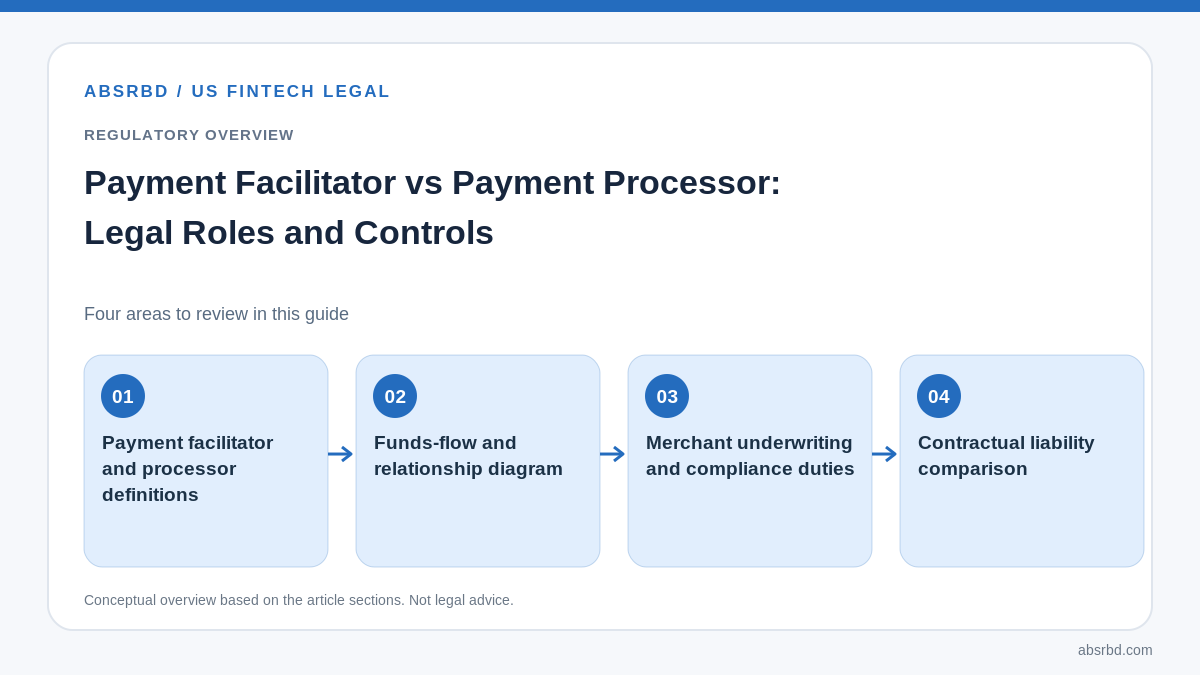
The practical distinction is responsibility. A processor primarily handles transaction data and related payment operations, while a payment facilitator usually assumes a broader role in merchant onboarding, underwriting, monitoring, settlement administration, and contractual risk.
| Comparison point | Payment facilitator | Payment processor |
|---|---|---|
| Primary function | Enrolls and manages submerchants within a sponsored program | Transmits and processes transaction information |
| Merchant status | Businesses generally operate as submerchants under the PayFac program | Businesses generally maintain direct merchant relationships with an acquirer |
| Bank relationship | Sponsored by an acquiring bank, often called a sponsor bank | Provides services to an acquirer, PayFac, merchant, or another payments provider |
| Underwriting role | Conducts or administers submerchant due diligence under sponsor-approved rules | May provide underwriting tools or operational support, but does not necessarily own merchant approval |
| Contract with the seller | Usually contracts directly with each submerchant | May have a service contract, but the merchant-acquiring agreement is often separate |
| Settlement role | May control settlement instructions or administer distributions to submerchants | Commonly processes settlement data without becoming the merchant aggregator |
| Commercial exposure | Typically carries direct submerchant, chargeback, fraud, and program obligations under its contracts | Exposure is generally limited by its processing agreement, subject to errors, outages, security duties, and other agreed risks |
The label alone is not conclusive. A company may provide processing technology, PayFac services, or both. Its actual role depends on its contracts, sponsor-bank arrangement, control over onboarding, and handling of settlement funds.
Payment Facilitator and Payment Processor Definitions
What is a payment facilitator?
A payment facilitator is a company sponsored by an acquiring bank to onboard other businesses as submerchants. Instead of requiring every seller to establish an entirely separate acquiring relationship, the PayFac creates a streamlined enrollment process within its sponsored program.
The payment facilitator commonly performs or coordinates:
- Submerchant applications and identity verification
- Business-model and risk assessment
- Approval under sponsor-bank criteria
- Transaction monitoring
- Chargeback and fraud management
- Reserve or funding-hold administration where contractually permitted
- Settlement reporting and submerchant funding
- Ongoing compliance monitoring
- Submerchant suspension or termination
The acquiring bank remains central to the arrangement. It sponsors the payment facilitator within the card-payment ecosystem, establishes program requirements, and oversees the PayFac’s activities.
A payment facilitator is sometimes described as a merchant aggregator because it brings multiple sellers into one sponsored payment program. However, “merchant aggregator” is a broad commercial description. Contracts and applicable payment-network classifications determine the company’s formal role.
What is a payment processor?
A payment processor supplies the infrastructure and operational services needed to move transaction messages among merchants, acquiring banks, payment networks, and card issuers.
Its functions may include:
- Routing authorization requests and responses
- Capturing completed transactions
- Preparing clearing records
- Calculating or transmitting settlement information
- Supporting refunds and reversals
- Delivering transaction reports
- Connecting fraud-management tools
- Maintaining payment interfaces and integrations
A processor does not automatically become the merchant’s acquirer, payment facilitator, or financial institution. It may process the transaction data while another party approves the merchant, holds the primary merchant contract, and bears the associated acquiring risk.
Why the terms are often confused
The distinction becomes less visible when one provider offers several layers of service. For example, a payment company may:
- Operate processing technology.
- Offer managed onboarding and risk tools.
- Support a sponsored PayFac program.
- Act as a payment facilitator for some customers but only as a processor for others.
Therefore, comparing a PayFac with a processor requires examining the specific payment program—not merely the provider’s marketing description.
Funds Flow and Relationship Diagram
Payment transactions involve two related but different flows:
- Transaction-data flow: Authorization, clearing, refunds, and other payment messages
- Funds flow: Settlement money moving among the issuer, payment network, acquirer, PayFac, and merchant
Confusing these flows can lead a business to assume that a processor possesses or controls funds simply because it transmits settlement instructions.
Direct merchant model using a processor
RELATIONSHIPS

Merchant ───────── Merchant agreement ───────── Acquiring bank
   │                                                   │
   └──────── Processing services ─────── Processor ────┘


AUTHORIZATION DATA

Cardholder → Merchant → Processor → Card network → Issuing bank
Cardholder ← Merchant ← Processor ← Card network ← Issuing bank


SETTLEMENT

Issuing bank → Card network → Acquiring bank → Merchant bank account
In this model, the merchant generally has its own approved merchant relationship. The processor carries transaction data and may support operations, but the acquiring bank retains the merchant-acquiring role.
The actual setup can vary. A processor, independent sales organization, gateway provider, or other service provider may participate in onboarding or customer support without becoming a payment facilitator.
Payment facilitator model
RELATIONSHIPS

                         Card network
                              │
                    Acquiring/sponsor bank
                              │
                    Payment facilitator
                     /        |
              Submerchant A   B   Submerchant C


AUTHORIZATION DATA

Cardholder → Submerchant → PayFac/processor → Network → Issuing bank
Cardholder ← Submerchant ← PayFac/processor ← Network ← Issuing bank


SETTLEMENT

Issuing bank → Network → Acquiring/sponsor bank
                                      │
                              PayFac program
                                      │
                    ┌─────────────────┼─────────────────┐
                    ↓                 ↓                 ↓
              Submerchant A     Submerchant B     Submerchant C
The PayFac may use its own processing platform or contract with a separate processor. This is why “PayFac vs processor” is not always an either-or choice: the payment facilitator is the merchant-program operator, while the processor can be the technical provider supporting that program.
Questions that reveal the real funds flow
A business evaluating a payments arrangement should ask:
- Who receives settlement from the acquiring bank?
- Is money sent directly to each merchant or distributed through a PayFac-controlled process?
- Which entity can delay, redirect, or suspend merchant funding?
- Who calculates fees, reserves, refunds, and chargeback deductions?
- Are settlement accounts owned by the merchant, the PayFac, or another regulated financial institution?
- Does the processor only transmit settlement files, or does it have authority over disbursement?
- What happens to pending merchant funds if a provider becomes insolvent or the agreement ends?
The answers affect operational control, reconciliation, contractual exposure, and potentially the legal analysis applied to the arrangement.
Sponsor-Bank Relationships
A sponsor bank—typically the acquiring bank in this context—provides the payment facilitator’s connection to the card-acquiring system. The relationship is more extensive than an ordinary technology-vendor arrangement.
The sponsor bank commonly:
- Reviews and approves the PayFac program
- Sets underwriting and risk parameters
- Oversees submerchant activity
- Receives program reporting
- Establishes prohibited or restricted business categories
- Monitors chargeback, fraud, and funding risk
- Requires remediation when program controls are inadequate
- Retains contractual rights to suspend or terminate activity
The payment facilitator executes many day-to-day functions, but delegation does not eliminate sponsor-bank oversight. If the PayFac’s submerchant controls fail, the consequences can extend beyond an individual seller to the entire sponsored program.
A processor’s bank relationship is usually different. It may connect to or serve an acquiring bank under a processing agreement, but it does not become a payment facilitator merely because it processes transactions for many merchants.
Merchant Underwriting and Compliance Duties
Underwriting in a direct merchant-processing model
In a conventional direct merchant arrangement, the acquirer generally approves the merchant. A processor or another service provider may collect information, run screening tools, or provide risk recommendations, but the contract should identify who has final approval authority.
Merchant underwriting commonly considers:
- Legal identity and business ownership
- Products or services sold
- Sales channels and expected transaction volume
- Average and maximum transaction amounts
- Refund and delivery practices
- Geographic exposure
- Chargeback and fraud risk
- Financial condition where relevant
- Restricted or prohibited activities
The processor’s obligations depend on its service agreement. A technology processor might only provide data and workflow tools, while a managed provider may perform substantial operational work on behalf of the acquirer.
Underwriting in a payment facilitator model
A PayFac typically builds a repeatable onboarding system for submerchants. Faster enrollment does not remove the need for risk-based review; it changes how that review is organized.
A sound PayFac underwriting process generally includes:
-
Identify the submerchant.
Collect the legal business name, address, tax information, ownership details, and relevant operating information. -
Understand the business activity.
Determine what the submerchant sells, where it sells, how customers are charged, and when products or services are delivered. -
Apply sponsor-approved risk rules.
Check the business against prohibited categories, volume limits, geography restrictions, and other program criteria. -
Assign appropriate controls.
Controls may include transaction limits, delayed funding, reserves, additional review, or enhanced monitoring where allowed by the agreement. -
Monitor activity after approval.
Compare actual transactions with the expected business profile and investigate significant changes or anomalies. -
Escalate or terminate when necessary.
The PayFac should have documented routes for further review, funding restrictions, suspension, and sponsor-bank notification.
The sponsor bank usually establishes the framework within which the PayFac can approve submerchants. Higher-risk businesses or exceptions may require sponsor review.
Compliance responsibility does not follow the product name
“Payment platform,” “processor,” and “embedded payments provider” are commercial labels, not complete legal conclusions. Responsibility should be mapped function by function.
| Function | Typical PayFac responsibility | Typical processor responsibility |
|---|---|---|
| Submerchant identity collection | Directly performs or manages it | May supply forms, APIs, or verification integrations |
| Approval decision | Often approves within sponsor-defined authority | Usually supports rather than owns the decision |
| Ongoing merchant monitoring | Monitors submerchants and escalates issues | Processes data and may provide monitoring tools |
| Chargeback management | Coordinates submerchant response and bears contractual program exposure | Supplies transaction records and workflow capabilities |
| Funding controls | May administer holds, reserves, and disbursement rules | Executes instructions according to the processing agreement |
| Program reporting | Reports portfolio activity to the sponsor bank | Produces processing and reconciliation data |
| Merchant termination | Can suspend or terminate submerchants under its agreement | Can suspend processing when contractually authorized |
| Sponsor oversight | Subject to direct program oversight | Subject to vendor and service-provider oversight |
This allocation is typical, not universal. The controlling documents are the sponsor agreement, merchant or submerchant terms, processing agreement, bank-account arrangements, and applicable payment-network rules.
FinCEN and money-services-business analysis
PayFac status does not automatically resolve whether a company is a money services business under federal law. The analysis depends on the company’s actual activities, including whether and how it accepts and transmits funds and whether an exclusion or exemption applies.
Businesses should not assume that describing themselves as a processor settles the issue. They should document:
- Who legally receives funds
- Whose instructions control transmission
- Whether the company acts only as an agent or service provider
- How funds are held and titled
- Whether the activity falls within a relevant exclusion or exemption
- Whether separate state-law analysis is required
The U.S. Financial Crimes Enforcement Network provides official information on money services business registration. Because classification is fact-specific, companies should obtain qualified legal advice before launching or materially changing a funds-flow model.
Contractual Liability Comparison
The legal consequences of each model largely follow the contract structure and allocation of control.
Who contracts with the merchant?
In a direct merchant model, the seller commonly enters into an agreement with the acquiring bank, sometimes through a combined or multi-party merchant application. The processor may have a separate technology or services contract.
In a PayFac model, the seller generally accepts a submerchant agreement with the payment facilitator. The agreement may incorporate sponsor-bank terms and payment-network requirements by reference.
This difference matters because the entity contracting with the seller commonly controls:
- Eligibility for payment services
- Funding schedules
- Fees and deductions
- Reserve requirements
- Chargeback allocation
- Refund procedures
- Suspension and termination
- Data access and reporting
- Post-termination obligations
Typical liability allocation
| Liability area | Payment facilitator model | Processor model |
|---|---|---|
| Submerchant misconduct | PayFac commonly has direct contractual remedies and program exposure | Processor exposure usually depends on whether it failed its agreed services |
| Chargebacks | PayFac often allocates liability to the submerchant but remains exposed within the sponsored program | Processor usually administers records and workflows rather than assuming merchant chargebacks |
| Fraud losses | PayFac may bear losses that cannot be recovered from a submerchant | Processor may be liable when losses result from a breach of its contractual duties |
| Underwriting failures | PayFac may face sponsor remedies for deficient onboarding or monitoring | Processor is generally responsible only for underwriting services it agreed to perform |
| Settlement errors | PayFac may be responsible for incorrect submerchant distributions | Processor may be responsible for inaccurate or delayed processing under service terms |
| Funding holds and reserves | PayFac often has contractual authority, subject to the agreement and applicable law | Processor normally applies controls only when instructed or contractually authorized |
| Program termination | Sponsor action can affect the PayFac’s entire submerchant portfolio | Termination usually affects the processor’s services and connected merchants according to transition terms |
| Merchant claims | Often directed first to the PayFac as the seller’s contractual counterparty | Depend on whether the merchant contracted directly with the processor |
Clauses that require careful review
A PayFac, processor, platform, or merchant should examine the following provisions before signing:
- Role definitions: Each party should be identified by function, not only by brand or product name.
- Underwriting authority: The contract should state who can approve, reject, suspend, or terminate merchants.
- Settlement instructions: It should identify who controls funding files, bank accounts, deductions, and payment timing.
- Chargeback allocation: Responsibility for disputes, fees, evidence, and unrecoverable balances should be explicit.
- Reserves and setoff: The agreement should define when funds may be withheld and which obligations can be offset.
- Indemnification: Indemnities should correspond to the risks each party controls.
- Liability limits: Exclusions and caps should be assessed alongside likely fraud, funding, and operational losses.
- Data rights: Parties need clear authority to access transaction and merchant data during and after the relationship.
- Audit and reporting: Sponsor-bank and program reporting duties should be operationally achievable.
- Termination assistance: The contract should address data export, merchant communications, pending settlements, reserves, and migration.
- Program changes: The parties should understand who can impose new risk rules or modify prohibited-business categories.
A contract that calls a provider a “processor” will not prevent broader liability if the provider actually controls merchant approval, settlement, and submerchant relationships.
How to Choose Between the Two Models
The relevant decision is usually not whether processing is needed—it is—but who should operate the merchant program and carry its responsibilities.
Choose a direct processor-led structure when:
- Each business can maintain a direct merchant relationship
- The platform does not want to underwrite a submerchant portfolio
- Merchant onboarding speed is less important than separating acquiring responsibility
- The platform wants limited control over merchant funding
- The business prefers the acquirer to retain primary merchant approval authority
Consider a payment facilitator structure when:
- A platform needs integrated merchant onboarding
- Submerchants should join through a unified user experience
- The platform is prepared to operate underwriting and monitoring controls
- Centralized settlement reporting is important
- The business can support sponsor-bank oversight and portfolio-level risk
- The platform accepts greater contractual and operational responsibility
Payments model comparison checklist
Before selecting a model, document the answer to each question:
- [ ] Who is the merchant or submerchant of record?
- [ ] Who signs the agreement with each seller?
- [ ] Who makes the final underwriting decision?
- [ ] Which acquiring bank sponsors the program?
- [ ] Who routes authorization and clearing data?
- [ ] Who receives settlement before the seller is paid?
- [ ] Who can hold, reserve, or redirect funds?
- [ ] Who bears unrecovered chargebacks and negative balances?
- [ ] Who monitors changes in merchant activity?
- [ ] Who communicates suspensions and terminations?
- [ ] What happens to pending funds when a relationship ends?
- [ ] Could the funds flow create separate federal or state regulatory obligations?
For broader context on the instruments that can be supported within a payment program, see this guide to payment methods. Businesses evaluating international reach can also review cross-border payment statistics when assessing geography, settlement, and portfolio complexity.
Key Takeaway
A payment processor moves transaction information and supports payment operations. A payment facilitator operates a sponsored submerchant program and usually takes on merchant onboarding, underwriting, monitoring, settlement administration, and direct contractual obligations.
The most reliable way to distinguish the models is to trace four things:
- Who contracts with the seller
- Who approves and monitors the seller
- Who controls settlement
- Who bears losses when the seller cannot pay
Those answers—not the product label—define the practical legal and compliance role of each participant.